How Ripple’s $1B deal could reshape $120T treasury market

ambcryptoPublished on 2025-10-16Last updated on 2025-10-17

Key Takeaways

How is Ripple positioning XRP in the DAT landscape?

By acquiring GTreasury, Ripple is providing corporates with a real-time liquidity engine and a utility-driven alternative to legacy treasury systems.

Why does this move stand out amid market turbulence?

Even as other DATs struggle, Ripple’s strategic acquisitions demonstrate its push into the $120 trillion corporate treasury market.


With major developments underway, it’s clear that Ripple [XRP] is stepping into the growing Digital Asset Treasury (DAT) landscape. However, rather than relying on external catalysts, Ripple is taking a proactive stance. 

A recent report revealed that Ripple Labs Inc. is planning to raise $1 billion through a Special Purpose Acquisition Company (SPAC), with the funds set to be used for accumulating XRP and housing it within a DAT framework.

However, the timing is key. DATs haven’t been immune to market turbulence, with MicroStrategy [MSTR] posting two consecutive down quarters. In this context, what strategic approach is Ripple leaning on?

Ripple targets $120 trillion corporate treasury market

Ripple’s latest move has significantly scaled its institutional network.

In an official announcement, the L1 blockchain confirmed its $1 billion acquisition of GTreasury, a SaaS platform that provides corporate treasuries with tools to streamline financial operations like cash management.

By integrating GTreasury into its ecosystem, Ripple gains direct access to a vast network of businesses, tapping into what CEO Brad Garlinghouse estimates as a $120 trillion corporate treasury payments market.

“Today, Ripple is breaking into the $120T corporate treasury payments market by acquiring GTreasury for $1B. GTreasury has worked with major brands for decades. Together, Ripple and GTreasury will help CFOs manage all their assets, including stablecoins and tokenized deposits at scale around the world.”

In short, Ripple is moving into the DAT landscape via a strategic play. It’s leveraging its on-chain infrastructure to deliver seamless payment solutions across the enterprise network managed by GTreasury.

Meanwhile, the partnership reinforces XRP’s role as a real-time liquidity engine. By providing corporations with an alternative to legacy payment methods, XRP’s move into the DAT space becomes a utility-driven play.

XRP’s strategic play stands out amid crypto turbulence

Ripple’s planned DAT hits as markets stay jittery after last week’s selloff.

The market dip, fueled by rising US-China trade tensions, was compounded by structural factors that shook trader sentiment and cast doubt on allocating capital to riskier altcoins, leaving investors cautious.

Even Bitcoin [BTC] wasn’t immune to the volatility. Yet, throughout 2025, DATs continued to emerge. Today, more than 349 entities hold Bitcoin alone. However, even the top BTC DATs haven’t fully turned profitable.

RippleRipple

Source: TradingView (MTPLF/USD)

MetaPlanet Inc. (MTPLF), for example, is approaching a full 100% drawdown since July. Against this backdrop, Ripple’s $1 billion SPAC raise and $1 billion GTreasury acquisition stand out as a strategic master stroke.

By building scalable, utility-focused digital-asset infrastructure, Ripple is hedging against market turbulence while positioning XRP as a liquidity layer for corporate treasuries and real-time cross-border settlements.

In this context, XRP, despite lagging behind Bitcoin in attracting Digital Asset Treasury (DAT) investor interest, may be nearing a strategic inflection point. 

This shift could mark the beginning of its long-anticipated institutional adoption within corporate treasury operations.


Share

Trending Cryptos

Related Reads

MSX US Stock Daily Observation: Alibaba FY2027 Q1 Earnings: AI Cloud Revenue Growth Hits Record High, AI Cloud Achieves Profitable Closed Loop

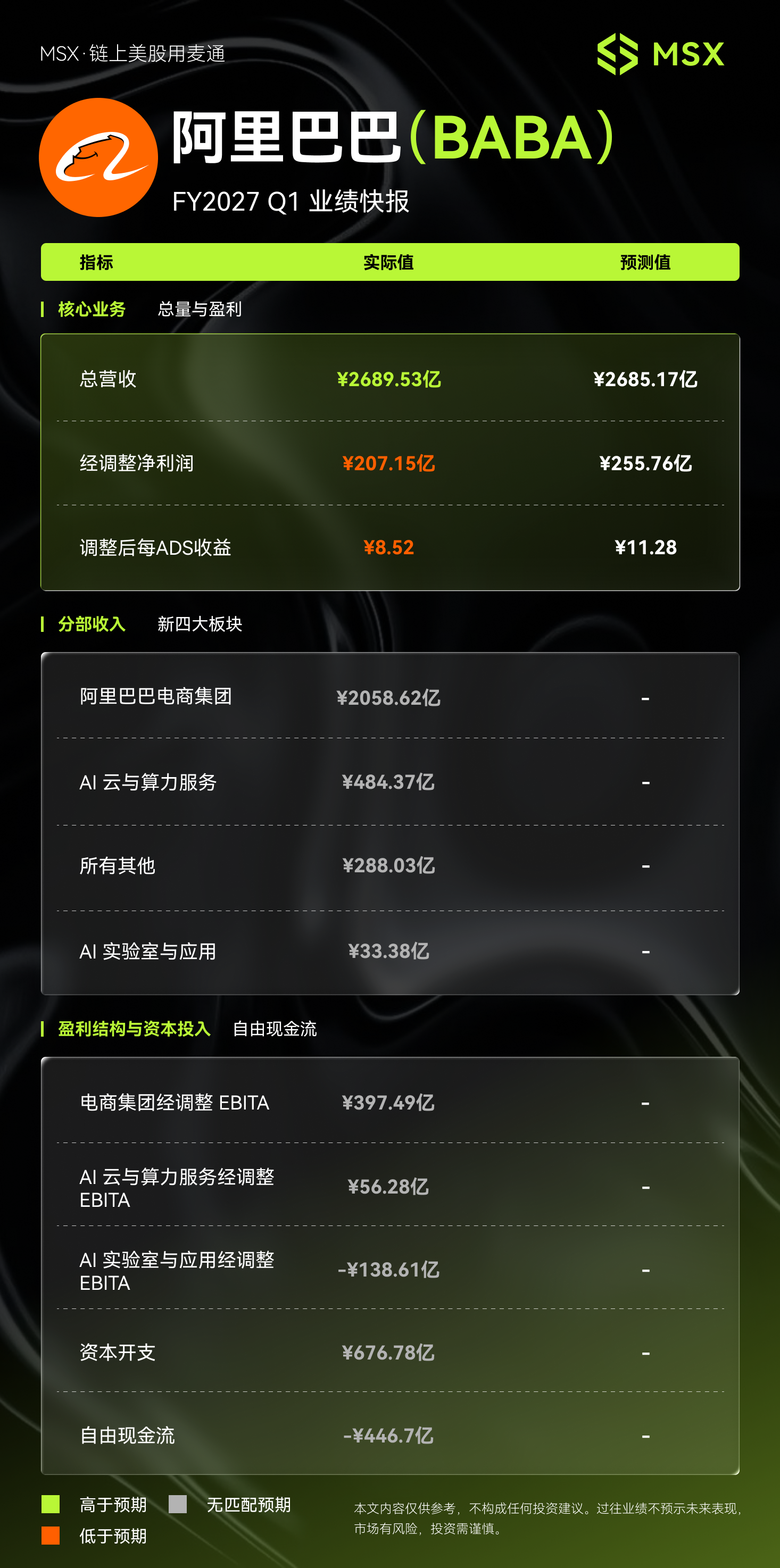
**MSX Daily US Stock Watch: Alibaba FY2027 Q1 Earnings – AI Cloud Revenue Hits Record Growth, Achieves Profitability Milestone** Alibaba's Q1 FY2027 revenue slightly exceeded expectations at 268.9B yuan (+9% YoY). However, adjusted net profit of 20.7B yuan (-38% YoY) and adjusted EPS missed consensus significantly. This shortfall was primarily driven by increased AI investments and two one-time items: a 5.5B euro provision for an EU Digital Services Act fine and 4.46B yuan in goodwill impairment. The restructured business segments showed clear divergence. The standout performer was the AI Cloud & Computing Services unit, with revenue surging 45% YoY to 48.44B yuan. Crucially, its adjusted EBITA jumped 133% YoY to 5.63B yuan, with margins expanding to 12%, signaling a profitable commercial loop for AI infrastructure. Within the Commerce Group, revenue growth was mixed: China Local Services (instant retail) grew 45% to 53.3B yuan, largely offsetting an 8% decline in Traditional China Commerce (110.9B yuan). International commerce revenue fell 1%. Despite this, the Commerce Group's adjusted EBITA dipped only 1% YoY to 39.75B yuan. A key area to watch is cash flow. Capital expenditures soared 75% YoY to 67.68B yuan, turning free cash flow to a net outflow of 44.67B yuan. However, operating cash flow remained positive and grew 11% YoY to 22.95B yuan, indicating the cash burn is a strategic choice for AI capacity build-out rather than operational weakness. In summary, while headline profits were pressured by heavy AI spending and one-off charges, the core takeaway is the emerging profitability of the AI Cloud business. The success of Alibaba's current investment cycle hinges on whether the profit improvement in AI Cloud can outpace the depreciation costs of its massive computing infrastructure expansion.

Odaily星球日报24m ago

MSX US Stock Daily Observation: Alibaba FY2027 Q1 Earnings: AI Cloud Revenue Growth Hits Record High, AI Cloud Achieves Profitable Closed Loop

Odaily星球日报24m ago

Trading

Spot

Hot Articles

What is XRP 2.0

XRP 2.0: A New Frontier in the Cryptocurrency Landscape Introduction to XRP 2.0 In the ever-evolving realm of cryptocurrency, new projects continuously emerge, vying for attention and adoption. One such promising initiative is XRP 2.0, a novel cryptocurrency project designed to leverage advanced blockchain technology and robust encryption methodologies. While the name draws parallels with Ripple’s XRP, it’s crucial to note that XRP 2.0 operates independently, focusing on enhancing transaction security, privacy, and scalability. As the digital financial landscape increasingly embraces decentralized solutions, XRP 2.0 aims to contribute meaningfully to web3 and the overall expansion of crypto projects. What is XRP 2.0? At its core, XRP 2.0 is a cryptocurrency project that aims to create a secure and decentralized digital currency ecosystem. Its foundational technology integrates sophisticated blockchain principles with cutting-edge encryption techniques. The overarching goal of XRP 2.0 is to establish itself as a reliable and efficient platform enabling swift transaction execution while prioritizing enhanced privacy protections for its users. The project is promoted as a solution to many limitations faced by existing cryptocurrencies, proposing a system that can handle a higher volume of transactions with improved speed and privacy. This versatility positions XRP 2.0 as a significant contender in a marketplace riddled with various digital currencies. Who is the Creator of XRP 2.0? The identity of the creator behind XRP 2.0 has been flagged as ‘Wilbur.’ However, comprehensive details regarding Wilbur or their associated entity remain elusive. The anonymity of many cryptocurrency creators is not an uncommon phenomenon in the industry, often designed to maintain a degree of privacy and security. Who are the Investors of XRP 2.0? As of now, specific information related to the investment foundations or organizations supporting XRP 2.0 is not publicly available. In the cryptocurrency sector, the backing by reputed investors can significantly influence a project's credibility and success, yet the transparency regarding the financial supporters of XRP 2.0 has not been established. How Does XRP 2.0 Work? XRP 2.0 stands out by employing a combination of blockchain technology and advanced encryption algorithms that ensures secure and decentralized transactions. Its innovative structure includes unique features designed to foster user engagement and broaden functionalities beyond conventional cryptocurrency transactions. Among these features, XRP 2.0 incorporates AI-powered capabilities, such as text-to-image and text-to-speech functionalities. These additions are designed to enhance the interactive experience for users, promoting broader applicability across various sectors. By bridging technological advancements with user-centered design, XRP 2.0 aims to capture the attention of a diverse range of individuals and enterprises looking to integrate cryptocurrency solutions into their operational frameworks. Timeline of XRP 2.0 Understanding XRP 2.0 requires examining the milestones that have defined its journey thus far: July 23, 2023: XRP 2.0 is introduced as a novel cryptocurrency project, aiming to revolutionize secure and decentralized transaction capabilities in the blockchain domain. September 8, 2023: The launching of another project, XRP20, occurs, marking the emergence of an ERC-20 token on the Ethereum blockchain that remains unrelated to XRP 2.0. November 13, 2023: The XRP Ledger undergoes a significant update with the release of rippled server software version 2.0.0. It is essential to note that this development is disconnected from the XRP 2.0 cryptocurrency project. Key Points About XRP 2.0 To distill the essence of XRP 2.0, several critical factors emerge: Unique Features: The inclusion of features like AI-powered text-to-image and text-to-speech further diversifies the potential applications of XRP 2.0. Blockchain Technology: The framework utilizes advanced blockchain mechanisms and encryption protocols, ensuring a secure and decentralized environment for transactions. Scalability and Privacy: XRP 2.0 prioritizes enhanced privacy protections in transaction processes and the scalability necessary to accommodate a growing user base. No Affiliation with Ripple: Importantly, despite its name, XRP 2.0 does not have any allegiance or collaboration with Ripple’s XRP, distinguishing its operational framework and objectives within the cryptocurrency ecosystem. Conclusion XRP 2.0 represents an ambitious venture into the cryptocurrency sphere, aiming to offer a combination of security, privacy, and efficiency in digital transactions. By integrating sophisticated technologies and user-friendly features, the project sets out to broaden the horizons of what cryptocurrency can achieve in today's digital economy. While the anonymity of its creator and lack of disclosed investors might raise questions for some, XRP 2.0's focus on advanced functionalities and decentralisation enhances its appeal amidst an increasingly crowded crypto market. As the cryptocurrency landscape continues to evolve, XRP 2.0 may yet emerge as a pivotal player in the expansion of secure and scalable blockchain solutions.

1.6k Total ViewsPublished 2024.04.01Updated 2024.12.03

What is XRP 2.0

Discussions

Welcome to the HTX Community. Here, you can stay informed about the latest platform developments and gain access to professional market insights. Users' opinions on the price of XRP (XRP) are presented below.

活动图片