分析师:SOLANA 为全球金融市场“量身定制”,目标价 1314 美元

marsbitPublished on 2025-09-12Last updated on 2025-09-12

要点速览:

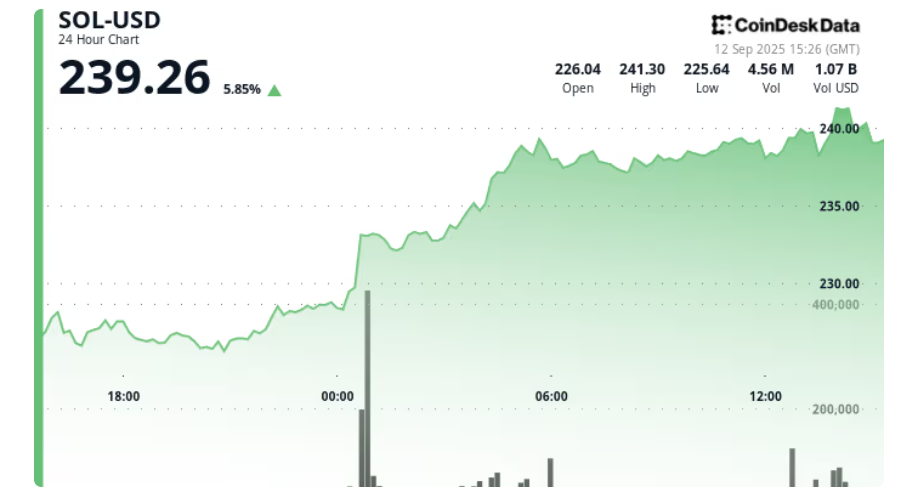
  • SOL 24小时内上涨近6%,突破240美元,跑赢整体加密市场(同期仅上涨1.2%)。
  • 分析师 Ali Martinez 认为 SOL 形态突破“杯柄形态”,目标价直指1,314美元。
  • Mike Novogratz 称 Solana 每日可处理140亿笔交易,已具备进军全球市场的实力。
分析师:SOLANA 为全球金融市场“量身定制”,目标价 1314 美元

Solana 的代币 SOL 周五突破239美元,延续了9月以来的强劲涨势。Galaxy Digital 首席执行官 Mike Novogratz 称该区块链是为全球金融市场“量身打造”的,而分析师 Ali Martinez 则描绘了其潜在上涨路径,目标价高达1,314美元。

知名加密分析师 Martinez 指出,Solana 已从技术图表中的“杯柄形态”中突破,这一形态通常被视为长期上涨行情的信号。

在其图表中,Martinez 将 1,314.41 美元标记为主要技术目标,并借助斐波那契回撤水平来预测 Solana 的上涨空间。该形态反映出一个跨越多年的筑底结构:Solana 在 2022 年和 2023 年的深度回调构成了“杯身”,而 2024 年至 2025 年初的横盘整理则形成了“杯柄”。

Martinez 表示,SOL 突破约 220 美元的阻力位,验证了这一技术结构,如果动能持续,将为更高的价格水平打开空间。

Novogratz 周四在 CNBC《Squawk Box》节目中,提出了一个覆盖更广泛加密市场的看涨逻辑,并特别强调了 Solana 的潜力。他首先提到,与 ETH 和 SOL 相关的资金管理公司正在筹集数十亿美元资金,为数字资产生态系统注入“大量活力和资本”。

随后,他将话题转向比特币,预测全球最大的加密货币将在年底前迎来一波上涨。

不过,他的重点落在 Solana 及不断变化的监管环境上。Novogratz 指出,美国证券交易委员会(SEC)主席 Paul Atkins 已明确表示,希望所有市场都能上链。他援引本周早些时候 Atkins 的演讲称:“链上资本市场和智能化金融正在到来,全世界都在关注。”

在这一背景下,Novogratz 特别提到纳斯达克已向 SEC 提交提案,允许在纳斯达克交易所直接交易代币化证券。结合美国新的稳定币监管框架,他认为加密行业终于同时具备了技术与监管的清晰性,能够成为金融市场的核心基础设施。

在技术层面,Novogratz 强调了 Solana 的处理能力,称该区块链每天可处理 140 亿笔交易——足以“覆盖股票、固定收益、大宗商品及外汇市场的所有交易”。他进一步评价 Solana 是一条“为金融市场量身打造”的区块链。

综合来看——可扩展的基础设施、支持区块链的监管立场,以及数十亿美元的新机构资金流入——Novogratz 总结道:“这是 Sol 的时刻。”在资本市场加速上链的当下,Solana 站在了引领位置。

技术分析要点(2025年9月11日15:00 – 9月12日14:00 UTC)

  • 根据 CoinDesk Research 的技术分析模型,SOL 在 24 小时内上涨约 6%,从 227.14 美元升至 240.02 美元,交易量达 366 万张合约。
  • 代币突破了长达八个月的 220 美元阻力位,并首次自 1 月以来触及 240 美元,机构买盘显著增加。
  • 最强劲的上涨出现在 9 月 12 日 13:14–14:13 UTC 的最后一个交易小时,SOL 从 239.92 美元再涨 1%,至 241.17 美元。
  • 最剧烈的突破发生在 9 月 12 日 UTC 午夜刚过,交易量飙升至 366 万张合约,几乎是 24 小时平均 146 万张的三倍。
  • 在早期横盘整理阶段,225.50 美元成为支撑位;而在 240.08 美元,价格多次受阻,形成初步阻力。
  • 在 228.78 美元,交易量高达 366 万张合约,确认该价位为关键支撑区间。
  • 最活跃的交易时段出现在 14:09–14:11 UTC,两分钟内成交 214,368 张合约,几乎是正常小时均值的六倍。
  • 一个新的支撑位已在 241.17 美元附近形成,显示买盘愿意在突破后继续守护更高价格水平。

Related Reads

Huawei's "Tao Law": A Comprehensive Overview of Core Companies

Huawei's "Tau Law": Core Companies Overview On May 25, 2026, Huawei's Director and President of the Semiconductor Business Division, He Tingbo, formally introduced the "Tau (τ) Law" at ISCAS 2026, marking a significant principle guiding industry development in the global semiconductor field from China. The Tau Law shifts focus from traditional Moore's Law, which pursues geometric transistor scaling, to "time scaling"—continuously compressing signal propagation delay (time constant τ) without solely relying on extreme feature size reduction. The core implementation path is "logic folding." This technique transforms circuit layouts from two-dimensional planes to multi-layer 3D stacks, using short vertical interconnects to replace long horizontal wiring, thereby drastically reducing τ. Huawei has already designed and mass-produced 381 chips following this principle over the past six years, with plans to launch a Kirin chip utilizing logic folding in Fall 2026. By 2031, high-end chips based on the Tau Law are expected to achieve performance levels equivalent to a 1.4nm process node. This development impacts several key industry segments, with related Chinese companies poised to benefit: 1. **EDA Design Software**: Essential for circuit-level optimization. Key players include: * **Empyrean Technology** (Huada Jiutian): China's largest full-flow EDA provider. * **Primarius Technologies** (Gailun Dianzi): Specializes in device modeling and verification. * **Semitronix** (Guangliwei): Focuses on yield enhancement and test chip EDA. 2. **Chiplet & Advanced Packaging**: Logic folding's 3D stacking necessitates advanced packaging (e.g., TSV, hybrid bonding). Core participants are: * **Tongfu Microelectronics**: A leader in advanced packaging and a key partner for AMD's Chiplet products. * **JCET Group** (Changdian Keji) & **Tianshui Huatian Technology**: Major OSATs with advanced packaging capabilities. * **VeriSilicon** (Xinyuan Gufen): Provides Chiplet-based design platforms and IP. 3. **Foundry Manufacturing**: Optimization must be implemented in transistor structures and process parameters. Potential foundries for Huawei's future chips include: * **SMIC**: China's leading foundry with advanced FinFET capabilities, the most likely candidate for next-gen Kirin chips. * **Hua Hong Semiconductor** (Huahong Gongsi): A leader in specialty processes (power, embedded memory). * **Nexchip Semiconductor** (Jinghe Jicheng): Major foundry for display driver ICs and MCUs. The Tau Law represents a strategic move towards architectural innovation and design-process co-optimization, driving demand across the domestic semiconductor supply chain.

marsbit1h ago

Huawei's "Tao Law": A Comprehensive Overview of Core Companies

marsbit1h ago

Trading

Spot
Futures

Hot Articles

Discussions

Welcome to the HTX Community. Here, you can stay informed about the latest platform developments and gain access to professional market insights. Users' opinions on the price of SOL (SOL) are presented below.

活动图片