SEC推迟狗狗币ETF至11月,发生了啥?周四上市的是"无用资产ETF"!DOGE暴涨破局!

金色财经Published on 2025-09-10Last updated on 2025-09-10

狗狗币ETF

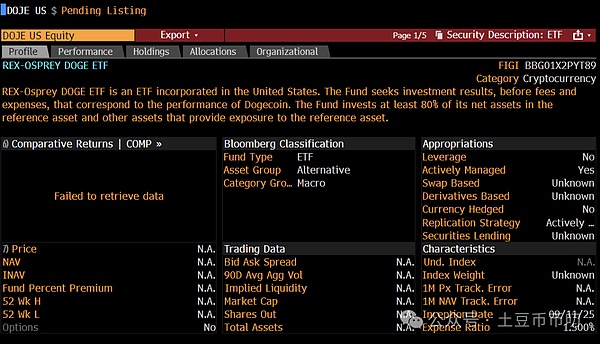
美国证券交易委员会(SEC)宣布将Bitwise狗狗币ETF和灰度Hedera ETF的决定推迟至11月12日,但市场迎来更大爆点:彭博分析师确认Rex-Osprey狗狗币ETF(DOJE)将于本周四正式推出,这将是全美首支故意配置“无用资产”的ETF,彻底刷新金融产品认知!

狗狗币应声上涨,机构资金已在路上?

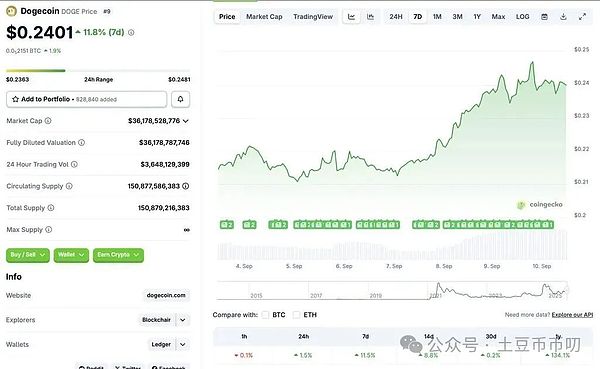
尽管Bitwise提案被推迟,DOGE依旧强势上涨。数据显示,其日涨幅1.5%、周涨11.5%,连续14天保持上行。市场猜测,这既源于ETF预期升温,也受本月美联储降息25基点的乐观情绪推动。

狗狗币价格走势图

比特币和以太坊在现货ETF通过后均创历史新高。同样,若狗狗币ETF获批,可能引发机构资金大规模涌入,推动DOGE突破前高,甚至开启meme币的机构化时代。

 “无用资产”ETF周四上市!前所未见,或将改变游戏规则

彭博ETF分析师Balchunas强调,DOJE将是“有史以来第一只故意持有无用资产的美国ETF”。尽管用语戏谑,却也暗示这类产品可能打开全新投资场景,进一步模糊主流金融与加密文化的边界。

图片

降息+ETF:双利好共振,狗狗币的“九月风暴”才刚刚开始?

美联储降息在即,流动性宽松预期升温,叠加ETF题材持续发酵,DOGE可能迎来年内最强上涨窗口。是短暂炒作还是真正转折?11月Bitwise最终决议仍是关键一战。

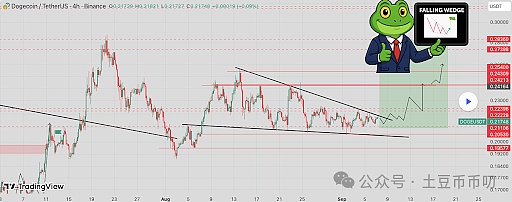
此前有分析师指出,狗狗币4小时图形成下降楔形,看涨反转信号预示可能突破上行。

价格在0.205-0.207美元关键支撑位盘整,中期吸筹阶段稳健。下周可能上涨至少15%,目标价0.26美元,進一步看0.277-0.28美元,支撑位0.21-0.19美元。

图片

DOGE需确认两个短期目标

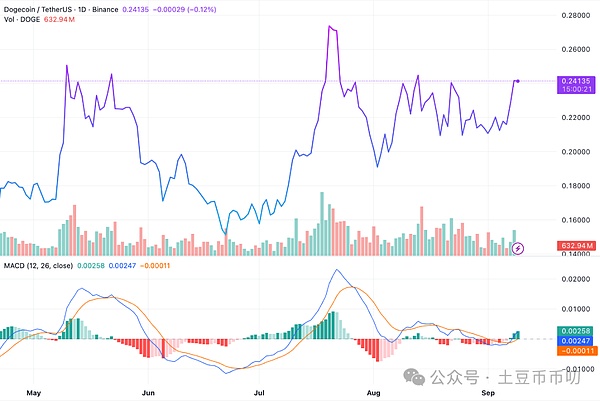
狗狗币在0.207美元附近的强劲支撑位,该位在过去一个月中多次成为价格反弹的跳板。狗狗币每次测试该水平,都会以强劲的看涨势头反弹,增强了市场对该区域作为价格上涨基础的信心。

在势头恢复之前,狗狗币可能会小幅回调至 0.213至0.216区间。随后目标看涨至0.23和0.24。图表中小型看涨延续形态支持这一乐观预测。

图片

宝子们快来

Trending Cryptos

Related Reads

The Philadelphia Semiconductor Index Tumbles Nearly 5% in a Single Night, Optical and Memory Sectors 'Collapse' Together: Surging U.S. Bond Yields Shake AI Belief

On the evening of August 18th, the US stock market saw a sharp sell-off concentrated in the AI hardware sector, with the Philadelphia Semiconductor Index plummeting nearly 5%. Leading AI infrastructure and components companies in fields like optical communication and memory chips experienced some of the steepest declines, such as Fabrinet (-19.38%) and Kioxia ADR (-13%). The sell-off was not broad-based but rather targeted the long-duration, high-momentum stocks previously driven by AI narrative optimism. This market shift is primarily attributed to a significant surge in long-term US Treasury yields, with the 30-year yield hitting its highest level since 2007. Rising yields increase discount rates, disproportionately impacting the valuations of growth stocks whose profits are projected far into the future—a category that includes most AI hardware plays. Additional pressure came from climbing oil prices due to Middle East tensions, which fueled inflation concerns. The article identifies three structural reasons for the severity of the drop in these specific subsectors: excessive prior gains and crowded positioning, high sensitivity to the sustainability of AI capital expenditure narratives, and inherent high volatility within the supply chain. Importantly, the sell-off appears to be a valuation and positioning reset rather than a fundamental repudiation of AI, evidenced by the relatively modest decline in a bellwether like Nvidia (-2.34%). Looking ahead, the direction hinges on three key indicators: whether the 30-year Treasury yield stabilizes, the trajectory of oil prices and geopolitical risks, and the market's pricing of new AI-related corporate debt. For related Asian and A-share markets, short-term negative sentiment spillover is expected, but medium-term drivers like domestic cloud capex may provide divergence. The episode signifies a market transition from pricing AI's "story" to rigorously evaluating its returns against a backdrop of higher financing costs.

marsbit6m ago

The Philadelphia Semiconductor Index Tumbles Nearly 5% in a Single Night, Optical and Memory Sectors 'Collapse' Together: Surging U.S. Bond Yields Shake AI Belief

marsbit6m ago

Ten Years, Wang Xingxing's Comeback: Unitree Valued at 400 Billion

Over a decade ago, Wang Xingxing, a 29-year-old with a passion for robotics but little funding, demonstrated his struggling robot dog to investors in Hangzhou. In 2019, with his company Unitree nearly out of cash, he captured the attention of Sequoia Capital China's managing director Li Yannan. Despite initial skepticism about the niche market for robot dogs, Wang's vision and deep technical conviction led Sequoia to make an initial seed investment. This marked a turning point. Following Sequoia's lead, a wave of prominent investors including Meituan, Tencent, Alibaba, and various venture capital and state-backed funds joined subsequent funding rounds. Wang's relentless focus and Unitree's technological advancements propelled the company to become a global leader in humanoid robotics. On August 19th, 2027, Unitree Robotics debuted on Shanghai's STAR Market as the first listed humanoid robotics company in China. Its shares skyrocketed over 500% at opening, reaching a market valuation of approximately 400 billion yuan. Wang Xingxing became one of the wealthiest individuals of his generation on the exchange, while Sequoia China, having invested across multiple rounds, remained a major shareholder. The story is celebrated as a classic outlier's triumph—a founder without elite credentials achieving success through pure belief and perseverance. Unitree's IPO is seen as a major milestone for China's embodied AI industry, providing a valuation benchmark and accelerating the sector's maturation. As Wang once stated, he aims to be "a small boat riding the mighty torrent of technology." His journey symbolizes the beginning of a new narrative for Chinese robotics on the global stage.

marsbit6m ago

Ten Years, Wang Xingxing's Comeback: Unitree Valued at 400 Billion

marsbit6m ago

Manufacturing's Share Drops Below 25%: Is Hangzhou Unconcerned?

Hangzhou is entering a critical phase of industrial restructuring. While its manufacturing-to-GDP ratio has fallen below 25%, the city is not alarmed. Instead, it is strategically navigating a dual focus: advancing advanced manufacturing and expanding its service sector, particularly producer services. Recently, the city celebrated the IPO of a humanoid robotics company, seen as a milestone in moving beyond its e-commerce era. Simultaneously, it set an ambitious target for its service sector: to exceed 2 trillion yuan in value by 2030, with producer services making up over 60%. Data shows a clear trend: the service sector's share of GDP has risen to 75.3%, while manufacturing's share has declined to around 20.1%. This shift revives the debate on whether a strong service sector weakens a city's manufacturing "foundation." Hangzhou's approach challenges the notion of a fixed manufacturing "red line" near 25%. The city argues that the quality and integration of industries matter more than simple ratios. Its strategy is "using software to drive hardware," leveraging its core strengths in digital economy and producer services—like R&D, software, and supply chain management—to empower and add value to manufacturing. This is embodied by its emerging "AI era" companies, whose innovation in Hangzhou feeds into national industrial chains. The city believes that for a hub like Hangzhou, the key is not merely boosting visible manufacturing output, but strengthening the "invisible" competitive edge provided by high-end producer services, which ultimately determine manufacturing profitability. National policy is also shifting from insisting on a "stable" manufacturing share to acknowledging a "reasonable" range, allowing for quality-focused development. Hangzhou's future industrial blueprint aims for a manufacturing share above 22% of GDP by 2027, coupled with a dominant, high-value service sector. The goal is not to choose between manufacturing and services, but to deeply integrate them, using advanced services as the accelerator for next-generation manufacturing.

marsbit31m ago

Manufacturing's Share Drops Below 25%: Is Hangzhou Unconcerned?

marsbit31m ago

SEC Suddenly Proposes "Regulation Crypto": U.S. Token Fundraising May Become Legal Again

On August 18, the U.S. Securities and Exchange Commission (SEC) proposed a landmark set of permanent rules, "Regulation Crypto Assets," specifically designed for crypto asset investment contracts. The 402-page proposal introduces two registration exemption paths and a groundbreaking safe harbor mechanism, representing the SEC's first dedicated crypto-specific regulatory framework. Two exemption tiers are proposed: a "Startup Exemption" allowing a one-time raise of up to $5 million within four years with basic disclosure requirements, and a "Financing Exemption" permitting raises of up to $75 million every 12 months with stricter obligations, including financial statements and ongoing reporting. Both paths require "principles-based narrative disclosure," a flexible approach distinct from traditional IPO forms. The most transformative element is the investment contract safe harbor. It provides a legal path for tokens to "graduate" from being classified as securities. If an issuer completes or permanently ceases its "essential managerial efforts" as promised in the investment contract and meets specific conditions, it can file with the SEC to have the token exit the securities framework. This creates a novel legal lifecycle where a token can begin as a regulated security for fundraising and later become a non-security asset as the network decentralizes. This move is seen as the SEC pragmatically filling a legislative vacuum, as the stalled CLARITY Act in Congress faces significant delays. The proposal aims to offer a compliant pathway for token offerings within the U.S., countering the trend of projects moving overseas. While currently a proposal open for a 60-day public comment period, it signals a major potential shift from an enforcement-heavy approach toward establishing clearer rules for the crypto industry.

marsbit35m ago

SEC Suddenly Proposes "Regulation Crypto": U.S. Token Fundraising May Become Legal Again

marsbit35m ago

Late Qing County Magistrates' 'Official Debt' and the Crypto World's 'Exchange Listings': The Cross-Temporal Truth of Financializing Power

This article draws parallels between financialization of power in late Qing Dynasty China and the modern cryptocurrency industry. It opens with a staggering contemporary corruption case involving billions, illustrating how official positions control massive cash flows, akin to toll booths. The core analysis focuses on Du Fengzhi, a late Qing county magistrate. His 22-year journey from passing the provincial exam to finally obtaining a post highlights how bureaucratic "qualification" (like a VC investment) doesn't guarantee immediate benefit. Crucially, upon receiving his appointment, Du had to borrow heavily—"official debt"—to cover travel and networking costs to actually assume his position. Lenders, seeing his future post as a revenue-generating asset, offered loans with exorbitant effective interest rates (e.g., borrowing 4000 taels but receiving only 2000), effectively discounting and financializing his future power. Once in office, Du faced immense pressure from both public tax quotas and his crippling private debt. His diaries reveal aggressive, sometimes extreme, tax collection methods (sealing ancestral temples, pressuring local gentry) to meet these demands. The article argues this created a system where public duty and private financial survival became indistinguishable, with corruption evolving from operational necessity to normalized practice. The piece consistently analogizes this to crypto: VC funding as mere "qualification," the costly "listing" process on exchanges, the role of market makers and KOLs as intermediaries akin to local gentry, and the relentless pressure on funded projects to deliver returns—often leading to perpetual pivots, artificial metrics, and ultimately, the extraction of value from retail liquidity. Both systems, it concludes, are driven by the financialization of future potential, trapping individuals in cycles of debt and obligation with limited alternatives for upward mobility.

marsbit42m ago

Late Qing County Magistrates' 'Official Debt' and the Crypto World's 'Exchange Listings': The Cross-Temporal Truth of Financializing Power

marsbit42m ago

Trading

Spot

Hot Articles

What is DOGE M

Doge Matrix ($doge m): The New Breed of Community-Driven Cryptocurrency Introduction In the ever-evolving landscape of cryptocurrency, new projects constantly emerge, each aiming to capture the interest of investors and enthusiasts alike. One of the latest entrants to this domain is Doge Matrix, represented by the ticker symbol $doge m. This project has attracted attention thanks to its roots in the popular meme culture surrounding Dogecoin, establishing its place within the web3 space. This article aims to provide a comprehensive analysis of Doge Matrix, covering its overview, creator, investors, functionality, timeline, and notable aspects. What is Doge Matrix ($doge m)? Doge Matrix is a community-driven cryptocurrency project that seemingly builds upon the widespread appeal of Dogecoin, a digital currency known for its Shiba Inu mascot and its meme origins. While the overarching objectives of Doge Matrix are not extensively defined, it is characterized by a commitment to harnessing community involvement and support. Unlike traditional cryptocurrencies that often emphasize utility or intrinsic value through underlying technologies, Doge Matrix positions itself within a space that embraces the cultural phenomenon of cryptocurrencies, particularly appealing to those who resonate with the ethos of meme-based assets. Drawing on the strengths of the Dogecoin community, Doge Matrix operates as part of a broader ecosystem, inviting participation and engagement from users who share an interest in cryptocurrency and the digital landscape. Who is the Creator of Doge Matrix ($doge m)? The identity of the creator of Doge Matrix remains unknown. This lack of transparency is not an uncommon occurrence in the cryptocurrency space, where some projects are launched without revealing the identities of their founders. The absence of information regarding the founding team can raise questions among potential investors about the project’s accountability and direction. Who are the Investors of Doge Matrix ($doge m)? As it stands, there is no publicly available information detailing the investors or investment foundations that back Doge Matrix. The project appears to rely primarily on community support rather than institutional investment. This model aligns with the community-driven nature of the initiative, fostering an environment where the direction of the project is shaped by its participants rather than being dictated by a select few financial backers. How Does Doge Matrix ($doge m) Work? The specifics regarding the operational mechanisms of Doge Matrix are somewhat vague, reflecting a broader trend of projects in the meme coin space where innovative functionalities are not always clearly articulated. Nonetheless, Doge Matrix seems designed to tap into the existing cryptocurrency ecosystem by encouraging user participation while tapping into the familiar cultural references associated with Dogecoin. Its potentially unique characteristics derive from community interactions rather than technological advancements, emphasizing shared experiences and collaboration among token holders. While the exact innovations have not been explicitly outlined, the project appears to create a space where community members can engage, share ideas, and propel the project's potential forward. Timeline of Doge Matrix ($doge m) Reflecting on the project’s timeline reveals notable events that have defined its journey thus far: November 25, 2024: Doge Matrix reached its all-time high value, marking a significant milestone in its early history. January 1, 2025: Conversely, Doge Matrix hit its all-time low value, illustrating the volatility often associated with cryptocurrencies, especially in the early stages of a project's lifecycle. Ongoing: The project continues to be actively traded and supported by its community, although specific future milestones or objectives have yet to be disclosed. Key Points About Doge Matrix ($doge m) Community Focus At the heart of Doge Matrix is a commitment to community engagement. The project thrives on the premise of collaboration and shared objectives among its members, emphasizing the importance of collective effort. Unlike centralized projects that often have a defined leadership structure, Doge Matrix at present showcases a more fluid approach to governance, where every community member's voice matters. Volatility The cryptocurrency market is notorious for its volatility, and Doge Matrix is no exception. Its price history reflects significant fluctuations between high and low values, which is typical of many new cryptocurrencies but underscores the risks associated with investment in emerging tokens. Lack of Detailed Information One of the most striking features about Doge Matrix is the scarcity of detailed information regarding its technological underpinnings and operational mechanisms. This ambiguity necessitates that potential investors conduct thorough due diligence before engaging with the project. Conclusion In summary, Doge Matrix ($doge m) illustrates a new wave of cryptocurrency projects that lean heavily on community engagement and cultural relevance. While lacking in certain specifics—such as clear leadership, defined objectives, and detailed functionality—the project has managed to generate interest within the crypto community, leveraging the established appeal of meme culture. As with any investment in the cryptocurrency space, understanding the inherent risks and conducting comprehensive research is essential for potential participants. Doge Matrix stands as a reminder of the dynamic, sometimes unpredictable nature of the crypto industry, marked by constant evolution and enthusiasm for community-driven initiatives.

4.4k Total ViewsPublished 2025.02.03Updated 2025.02.03

What is DOGE M

Discussions

Welcome to the HTX Community. Here, you can stay informed about the latest platform developments and gain access to professional market insights. Users' opinions on the price of DOGE (DOGE) are presented below.

活动图片