SHIB ETF proposal sparks breakout hopes – Will it ignite a massive rally?

AmbcryptoPublished on 2025-03-26Last updated on 2025-03-26

Abstract

SHIB’s selling pressure and network activity declined to quarterly lows.

One of Shiba Inu’s [SHIB] ecosystem executives, Lucie, is in the news today after she made an ETF pitch for the memecoin. Needless to say, this has sparked buzz around a potential price breakout. According to her, SHIB is accessible across several exchanges and isn’t ‘just a meme.’

“Is SHIB good for an ETF? Yes. Will boomers invest in a “doggy coin”? Also yes. Because SHIB isn’t just a meme—it’s decentralized, community-driven, and built to last.”

Will SHIB follow DOGE?

Here, it’s worth noting that apart from Dogecoin [DOGE], no issuer has filed for a spot memecoin ETF with the SEC, at the time of writing. Even so, the markets have high hopes, with there being a 72% chance of approval by the end of 2025 on Polymarket.

As the top pioneers in the memecoin space, it remains to be seen whether a SHIB ETF will follow DOGE ETF.

That being said, SHIB may be well primed for a breakout, given low selling pressure and a months-long accumulation spree. The only thing needed is the right catalyst. Notably, sell-offs on exchanges dipped to record lows, as illustrated by the supply on exchanges (yellow line).

Similarly, over 50 trillion SHIB have been moved from exchanges (accumulation) between December and March. Per supply outside exchanges (blue), the figure increased from 855 trillion SHIB to 901 trillion SHIB. Simply put, holders bought the Q1 dip and may be expecting a future rally.
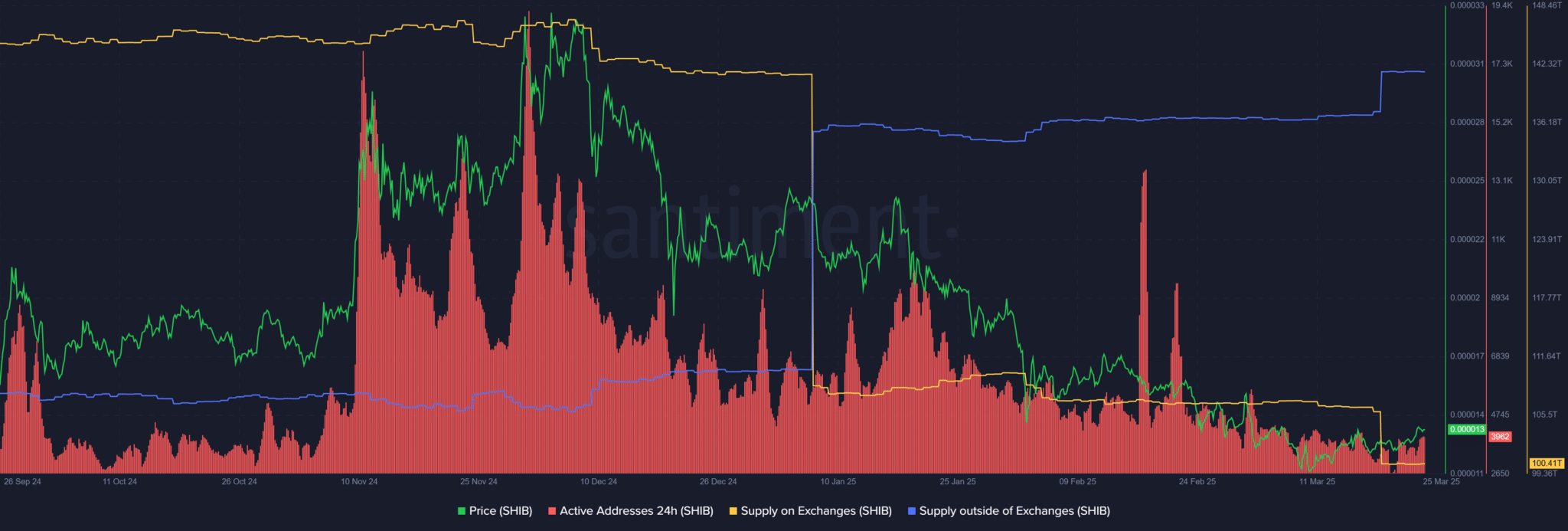
However, network activity declined to quarterly lows of around 4000, compared to nearly 20k seen in December. That hinted at 5x decline in user interest.

A strong recovery could be at risk if user interest remains low in the short term.
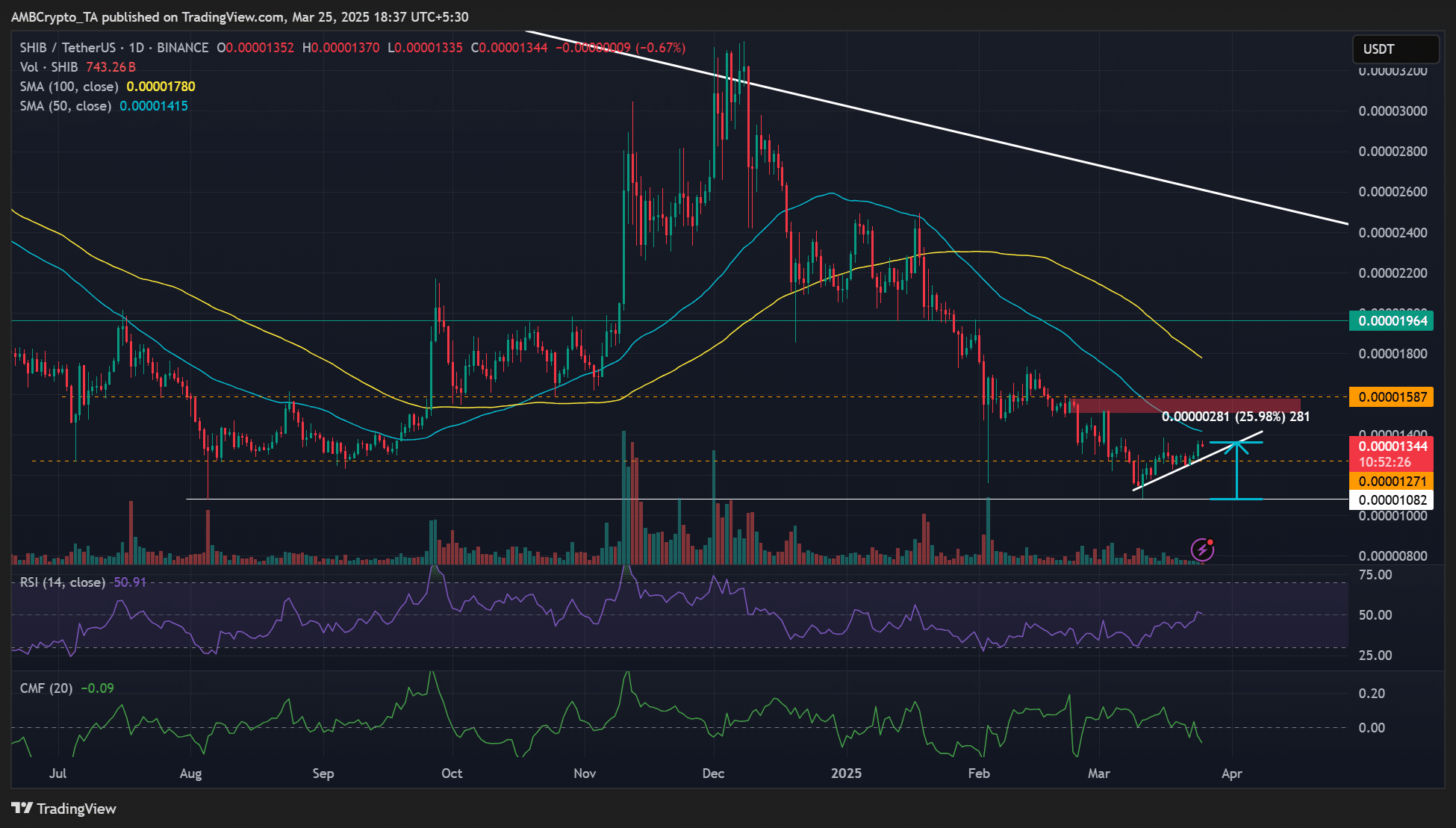
On the price chart, however, SHIB was up 25% from its March 2025 lows at press time. This also coincided with its August 2024 lows.

Right now, SHIB is stuck in a Q3 price range of $0.000012 and $0.000020. Gains of 47% could be feasible if recovery were extended to $0.000020. However, the hurdle of $0.000016 (red zone) has to be cleared first.

Related Reads

Why Sam Altman's 'Water and Electricity Theory' Sparks Copyright Controversy

OpenAI CEO Sam Altman's recent statement that "intelligence will become a utility like electricity or water" has sparked significant controversy, primarily around copyright issues and the nature of AI development. While positioning AI as a utility serves as a compelling narrative for infrastructure investors, critics argue the analogy is flawed in three key areas. First, there's a fundamental "property gap." Traditional utilities like water and power create new, physical infrastructure from scratch. In contrast, major AI models are trained by reorganizing vast amounts of existing human-created content—books, articles, code, etc.—often scraped from the web without explicit permission or compensation to creators. This "free acquisition, paid resale" model is seen by many as ethically problematic. Second, there's a "pricing gap." True public utilities are typically regulated to ensure universal service with non-discriminatory, cost-plus pricing. AI's token-based pricing, however, involves significant price discrimination (e.g., output tokens costing much more than input tokens) and is designed for revenue maximization, not equitable access. Third, a "governance gap" exists. Utilities operate under public oversight, while AI pricing and development are currently controlled by a few private companies. Furthermore, the industry's own shift toward buying licensed training data (e.g., deals with Reddit or news publishers) undermines its previous legal reliance on "fair use" for freely scraped data. In conclusion, while AI is indeed becoming a foundational technology, calling it a public utility remains contentious. The title requires not just scale and a pay-per-use model, but also credible solutions for data provenance, equitable pricing, and public governance.

marsbit15m ago

Why Sam Altman's 'Water and Electricity Theory' Sparks Copyright Controversy

marsbit15m ago

From ZEC's Surge to Vitalik's Support: Will the Privacy Narrative Resurface?

From ZEC's surge to Vitalik's endorsement, is privacy making a comeback? The recent rally in ZEC has refocused attention on the crypto privacy sector. This resurgence stems from a growing market realization: while blockchain transparency builds trust, full exposure of user balances, trading strategies, and risk positions can become a vulnerability, especially for large traders and institutions on platforms like Hyperliquid. The privacy landscape has evolved beyond classic anonymity coins like ZEC, XMR, and DASH. It now encompasses privacy infrastructure projects such as Railgun (bringing privacy to DeFi) and Aztec (a privacy-focused L2), as well as newer entrants like Genius Terminal, SilentSwap, and 0xBow that emphasize transaction privacy while attempting to balance compliance. Industry trends confirm privacy is becoming integrated, not a niche feature. Perp DEX Aster has introduced a "Shield Mode," and Vitalik has discussed the need for native privacy at the Ethereum protocol level, including proposals like EIP-8182 for standardized private transfers. In conclusion, this revival is more than a simple sector rotation. It reflects a critical reassessment of transparency's limits. As on-chain finance matures, the challenge is finding a sustainable balance between necessary transparency for trust and essential privacy for protecting assets and strategies, making privacy a potential cornerstone of next-generation infrastructure.

marsbit25m ago

From ZEC's Surge to Vitalik's Support: Will the Privacy Narrative Resurface?

marsbit25m ago

Trump, the "Stock Market Manipulator" in U.S. Stocks, Lifts Up the Entire Quantum Computing Sector

"Trump, the 'U.S. Stock Market Mastermind,' Boosts the Entire Quantum Computing Sector" This article details how former U.S. President Donald Trump's policies and public statements have significantly influenced the stock market, particularly in the quantum computing sector. A key example is the U.S. government's direct investment in Intel stock in August 2025, which yielded over $45 billion in gains within seven months. Trump publicly credited himself for this profit. Recently, the Trump administration announced a new $2 billion initiative. Through the Department of Commerce, funding from the CHIPS and Science Act will be provided to nine quantum computing companies in exchange for minority, non-controlling equity stakes. The recipients include IBM ($1B for its subsidiary Anderon), GlobalFoundries ($375M), and listed companies like D-Wave, Infleqtion, and Rigetti ($100M each). Private firms such as Atom Computing and PsiQuantum also received $100M. This "investment-for-equity" strategy marks a shift from pure subsidies to an "active investor" model under the CHIPS Act. The announcement immediately boosted quantum computing stocks. The article frames this as part of Trump's "America First" industrial policy, aimed at securing U.S. technological leadership, similar to past investments in semiconductors, rare earths, and lithium. The author suggests this pattern of government-backed market intervention, alongside Trump's personal stock endorsements, is a hallmark of his approach to driving market gains and may continue in sectors like defense and advanced energy.

marsbit1h ago

Trump, the "Stock Market Manipulator" in U.S. Stocks, Lifts Up the Entire Quantum Computing Sector

marsbit1h ago

Trading

Spot
Futures

Hot Articles

How to Buy SHIB

Welcome to HTX.com! We've made purchasing SHIBA INU (SHIB) simple and convenient. Follow our step-by-step guide to embark on your crypto journey.Step 1: Create Your HTX AccountUse your email or phone number to sign up for a free account on HTX. Experience a hassle-free registration journey and unlock all features.Get My AccountStep 2: Go to Buy Crypto and Choose Your Payment MethodCredit/Debit Card: Use your Visa or Mastercard to buy SHIBA INU (SHIB) instantly.Balance: Use funds from your HTX account balance to trade seamlessly.Third Parties: We've added popular payment methods such as Google Pay and Apple Pay to enhance convenience.P2P: Trade directly with other users on HTX.Over-the-Counter (OTC): We offer tailor-made services and competitive exchange rates for traders.Step 3: Store Your SHIBA INU (SHIB)After purchasing your SHIBA INU (SHIB), store it in your HTX account. Alternatively, you can send it elsewhere via blockchain transfer or use it to trade other cryptocurrencies.Step 4: Trade SHIBA INU (SHIB)Easily trade SHIBA INU (SHIB) on HTX's spot market. Simply access your account, select your trading pair, execute your trades, and monitor in real-time. We offer a user-friendly experience for both beginners and seasoned traders.

10.8k Total ViewsPublished 2024.03.29Updated 2025.06.04

How to Buy SHIB

Discussions

Welcome to the HTX Community. Here, you can stay informed about the latest platform developments and gain access to professional market insights. Users' opinions on the price of SHIB (SHIB) are presented below.

活动图片