Ethereum OG Sitting On 630,000% Gain Wakes Up After 10 Years

bitcoinistPublished on 2026-05-27Last updated on 2026-05-27

Abstract

On-chain data reveals a long-dormant Ethereum wallet from 2015, containing 2,000 ETH, has been reactivated after 10.8 years. Classified as a "pre-mine address," it belonged to an early participant from Ethereum's 2014 presale. The wallet's initial $620 investment, untouched for over a decade, is now worth over $4.2 million—a gain of nearly 630,000%. The activity began with a small test transfer of 1 ETH, followed by a near-complete movement of the remaining 1,997.9 ETH. While the funds have not been sent to a centralized exchange, the sudden activity suggests the owner may have recently regained access to lost or forgotten keys.

On-chain data shows an ancient Ethereum wallet containing 2,000 ETH that had been inactive for nearly 11 years has suddenly come back to life.

Ethereum OG Wallet Has Turned $620 Into $4.2 Million

According to data from cryptocurrency transaction tracker service Whale Alert, an old Ethereum wallet has just broken a 10.8-year phase of dormancy. The address in question held a total of 2,000 ETH, worth $620 back in 2015.

The wallet is so old that Whale Alert classifies it as a pre-mine address. In the context of ETH, a “pre-mine address” refers to one that received its tokens before mining began on the network with its public launch in 2015. Such wallets were allocated these coins because they belonged to early contributors and participants of the presale in 2014.

Interestingly, despite getting in early on the cryptocurrency, this particular investor just never participated in activity, with their only transaction in over 10 years being the deposit that they received at the blockchain’s genesis.

Now, the pre-mine address has suddenly been reactivated. Below are the details related to the transaction that broke the long spell of dormancy for the wallet.
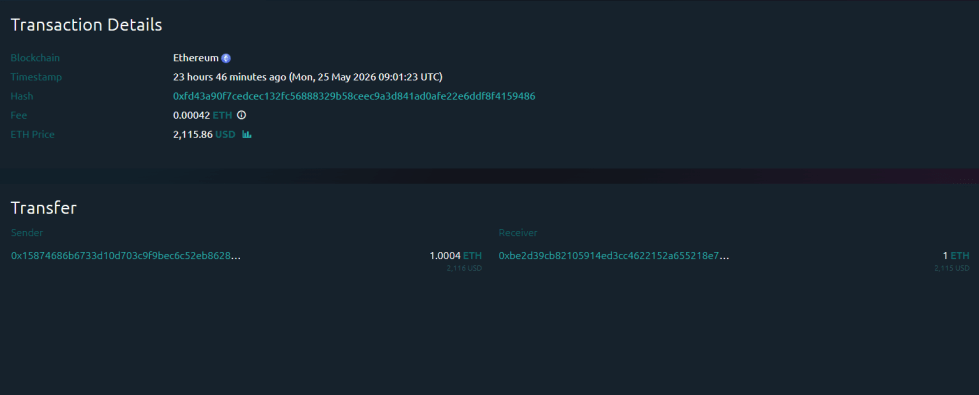
Looks like the investor moved a small amount with this transfer | Source: Whale Alert

As is visible, the move involved a sum of just 1 ETH, suggesting that it was likely a test transaction. After this transfer, the wallet followed up with a few more transactions, including a 1,997.9 ETH shift that nearly completely emptied out its balance. So far, these coins haven’t made their way to a centralized exchange, so it’s hard to say whether the investor is looking to sell them.

As mentioned before, the Ethereum stack held by the address was worth just $620 back in 2015. Today, the same amount converts to more than $4.2 million, representing a gain of nearly 630,000%.

What could be the reason behind the OG making a sudden return? Well, the answer to that would lie in what happened to the wallet after it fell silent. Often, addresses that are this old get to their age not via resolute HODLing, but by being lost or forgotten. As such, it’s possible that this address was simply inaccessible during its dormancy and just recently had its keys rediscovered.

A less probable, but not impossible, scenario is that the Ethereum balance indeed reached its age by long-term holding. If so, the investor would be among the most stalwart of diamonds in the digital asset sector.

ETH Price

Ethereum declined toward the $2,000 level a few days ago, but the cryptocurrency has managed to claw its way back up as its price is now trading around $2,130.

The price of the coin seems to have overall been following a sideways trajectory in recent days | Source: ETHUSDT on TradingView


Trending Cryptos

Related Questions

QWhat is the total value of the Ethereum holdings in the rediscovered pre-mine wallet today, and what was its approximate value in 2015?

AThe wallet held 2,000 ETH, which was worth about $620 in 2015. As of the article's writing, the same amount is valued at over $4.2 million.

QAfter how many years of dormancy did the old Ethereum wallet become active again?

AThe wallet became active again after a dormancy period of 10.8 years.

QWhat is a likely reason, suggested in the article, for the wallet's sudden reactivation after such a long time?

AA likely reason suggested is that the wallet's private keys were lost or forgotten and have only recently been rediscovered, making the funds accessible again.

QWhat initial transaction did the wallet make upon reactivating, and what does this suggest about the owner's intent?

AThe initial transaction was a transfer of just 1 ETH. This suggests it was likely a test transaction to ensure the wallet was functioning correctly before moving larger sums.

QAccording to the article, has the investor sold their Ethereum by sending it to a centralized exchange?

ANo, the article states that the coins haven't made their way to a centralized exchange yet, so it's hard to say if the investor is looking to sell them.

Related Reads

Claude Accused of Becoming Dumber by the Entire Internet, Anthropic Steps In to Reveal: It’s Not the Model That’s Tricking You

When users complained that Claude was "getting dumber," the root cause wasn't the AI model itself. In an official blog post, Anthropic clarified the critical difference between two key settings in Claude Code: Model and Effort. Model refers to the core "brain"—the fixed, trained weights of a specific AI (like Sonnet, Opus, or Fable). Changing the Model addresses *capability* ("can it do this?"), but its knowledge is static post-training. Effort, however, controls the AI's *approach and thoroughness* for a specific task. A higher Effort level instructs Claude to read more files, run tests, perform verification, and complete multi-step reasoning before responding, significantly increasing its "work output" for that job. Conversely, low Effort leads to quicker, less thorough replies. This distinction explains the March 2024 uproar where users experienced a sudden drop in Claude's performance. The cause was not a model change but Anthropic quietly lowering the *default* Effort setting from "high" to "medium" to reduce latency, which was later reverted. The key insight is that a smaller, capable model (like Sonnet) on high Effort can often outperform a larger, more powerful model (like Opus) on low Effort for many tasks. The article provides a practical troubleshooting framework: if Claude makes an error, first check the context and instructions. If it seems to skip necessary steps or validations, increase Effort. If it diligently attempts the task but fails conceptually or makes consistent factual errors despite good context, then consider switching to a more capable Model. The takeaway is a shift in focus: effective AI programming is less about always choosing the "strongest" model and more about intelligently *orchestrating* models and effort levels—acting like a project manager to assign the right "brain" with the right level of diligence for each job, optimizing both results and cost.

marsbit14m ago

Claude Accused of Becoming Dumber by the Entire Internet, Anthropic Steps In to Reveal: It’s Not the Model That’s Tricking You

marsbit14m ago

Will the Ethereum Foundation Evolve into a 'Mascot'? Diversified Organizations Are Fragmenting Its Functions

The Ethereum Foundation (EF) is undergoing significant internal turmoil and functional erosion. Following its largest-ever layoff of 54 staff (20% of its workforce) and a major organizational restructuring announced in June, its Protocol Support Team has been officially dissolved. This comes alongside the high-profile resignation of key figures like co-executive director Xiaowei Wang, bringing senior departures this year to at least eight. Criticism of EF's rigid structure, opaque decision-making, and perceived lack of a clear value narrative for ETH has intensified within the community. The layoffs have catalyzed the emergence of independent, non-profit organizations like Ethlabs and Ethereum Institutional, founded by former EF researchers and members. These entities are now taking on core functions such as protocol research/development and institutional adoption, effectively fragmenting the EF's traditional leadership role. Concurrently, EF's security team is adapting to technological change, deploying specialized AI agents to audit Ethereum's codebase, which successfully discovered a critical vulnerability (CVE-2026-34219). While EF states AI complements rather than replaces researchers, it signals a potential future shift in its operational model. Faced with these challenges—internal restructuring, talent drain, the rise of competing organizations, and AI integration—the Ethereum Foundation appears to be stepping back from a central commanding role. Analysts and community observers speculate it may increasingly transition towards a symbolic "ecosystem mascot" function, while decentralized initiatives drive Ethereum's future growth and institutional adoption.

marsbit40m ago

Will the Ethereum Foundation Evolve into a 'Mascot'? Diversified Organizations Are Fragmenting Its Functions

marsbit40m ago

Nearly a Hundred Players Rush into Embodied Data: With 4.47 Billion Yuan in Financing in One Year, Who Can Really Make Money by 'Selling Data'?

The domestic embodied AI data industry has attracted nearly 100 players, with 70 focused on data collection and 27 on data infrastructure. In the past year, 15 independent embodied data service providers raised approximately 4.47 billion yuan. Despite this growth, the sector remains early-stage, fragmented, and faces significant challenges. Data collection methods are diverse, categorized into four main routes: teleoperation of real robots, human demonstration without a robot (using motion capture, exoskeletons, etc.), simulation synthesis, and distillation from internet videos. Most companies (43%) adopt hybrid approaches, combining multiple routes, as no single method can meet all training needs. Teleoperation alone is pursued by 31% of players, often by state-owned platforms and robot companies, while newer firms favor asset-light, no-hardware human demonstration. Independent data service providers now form the largest player group (40%), indicating the emergence of a distinct industry segment rather than just a subsidiary function for robot makers. Two-thirds of all players are "embodied-native" startups, while one-third are companies that pivoted from fields like AI data annotation, which are more prevalent in the data infrastructure layer. Current annual industry capacity is estimated at 1.6-1.8 million hours plus 70-80 million data points, with a short-term goal to increase this 15-20 fold within 1-3 years. Data collection factories are spread across 20 provinces in China, concentrated in the Yangtze River Delta, Beijing-Tianjin-Hebei, and Pearl River Delta regions. Financially, the 4.47 billion yuan raised in the past year pales compared to the 43.8 billion yuan raised by the broader embodied intelligence sector in just the first half of 2026, highlighting that data remains a less "sexy" bet for investors. The 15 funded independent providers show clear stratification: a top tier led by a unicorn (Lightwheel Intelligence, 3.1 billion yuan), a middle tier of 11 firms raising tens to hundreds of millions, and an early-stage tier of 3 companies. Sixty-nine investment institutions have participated, but none have made concentrated bets, reflecting uncertainty about viable business models. Over half of these funded companies are less than a year old, most are at pre-A or A rounds, and profitability remains largely unproven. In summary, the embodied data industry has become an independent track creating jobs and local economic activity. However, it is still nascent, with unformed consensus, unsolved problems, and unproven business models. The coming 1-2 years will be a critical validation window to see if companies can build sustainable, profitable businesses purely by "selling data."

marsbit3h ago

Nearly a Hundred Players Rush into Embodied Data: With 4.47 Billion Yuan in Financing in One Year, Who Can Really Make Money by 'Selling Data'?

marsbit3h ago

Trading

Spot

Hot Articles

How to Buy GAIN

Welcome to HTX.com! We've made purchasing GriffinAI (GAIN) simple and convenient. Follow our step-by-step guide to embark on your crypto journey.Step 1: Create Your HTX AccountUse your email or phone number to sign up for a free account on HTX. Experience a hassle-free registration journey and unlock all features.Get My AccountStep 2: Go to Buy Crypto and Choose Your Payment MethodCredit/Debit Card: Use your Visa or Mastercard to buy GriffinAI (GAIN) instantly.Balance: Use funds from your HTX account balance to trade seamlessly.Third Parties: We've added popular payment methods such as Google Pay and Apple Pay to enhance convenience.P2P: Trade directly with other users on HTX.Over-the-Counter (OTC): We offer tailor-made services and competitive exchange rates for traders.Step 3: Store Your GriffinAI (GAIN)After purchasing your GriffinAI (GAIN), store it in your HTX account. Alternatively, you can send it elsewhere via blockchain transfer or use it to trade other cryptocurrencies.Step 4: Trade GriffinAI (GAIN)Easily trade GriffinAI (GAIN) on HTX's spot market. Simply access your account, select your trading pair, execute your trades, and monitor in real-time. We offer a user-friendly experience for both beginners and seasoned traders.

3.8k Total ViewsPublished 2025.09.24Updated 2026.06.02

How to Buy GAIN

Discussions

Welcome to the HTX Community. Here, you can stay informed about the latest platform developments and gain access to professional market insights. Users' opinions on the price of GAIN (GAIN) are presented below.

活动图片