一夜间众筹超3万SOL,给AI打钱的AI Pool是下一个Bome?

Odaily星球日报Published on 2024-12-30Last updated on 2024-12-30

Abstract

深入探讨AI Pool的核心机制和发展前景。

近期 AI Pool 成为 AI Agent 赛道的热点方向,AI pool 被认为开启了 AI Agent 资产化。AI Pool 创始人是Skely,Skely 同时也是ai16z的成员之一。比较有趣的是,自开始预售到发稿,Skely 的 X 都被冻结了。在这种情况之下,AI Pool 预售的第一个项目Meteora一夜之间竟募集到超 3 万枚 SOL,甚至在宣布截止预售之后还有人源源不断打钱给 AI。AI Pool到底是什么?AI 预售和之前的预售有什么不一样?下文我们带这这些疑问进行探讨。

AI pool 核心机制

预售并非是市场新的切入点,根据创始人Skely 的观点,此次 AI Pool 预售主要解决的问题是市场存在的不信任问题,主要围绕两个方面。第一个方面,AI Pool 防止人为预售,庄家卷款跑路。这个市场痛点相信市场老玩家都深恶痛绝,不少的人在这点上吃过亏。第二个方面,对散户投资者更加公平的预售方式,现在传统的预售主要赢家都是阻击手/bot 等,pumpfun 的 PVP 模式更是让散户看不到希望。

不得不说,Skely 提到的都是散户的痛点,从解决问题的思路来看,Skely 的方法深得人心。接着,AI Pool 提出了自己如何解决这些问题的逻辑。AI Pool 采用的是 Trusted Execution Environment (简称 TEE) 技术。事实上,TEE 也并非是一种新兴的技术,那为什么能再次引起市场的关注呢?此次 AI Pool 基于 TEE 技术的老牌项目@PhalaNetwork,它的创新点在于把 AI 运行环境、智能合约调度以及去中心化共识治理三者结合,对链上资产托管问题是一种创新的尝试。AI Pool 具体是怎么解决的呢?

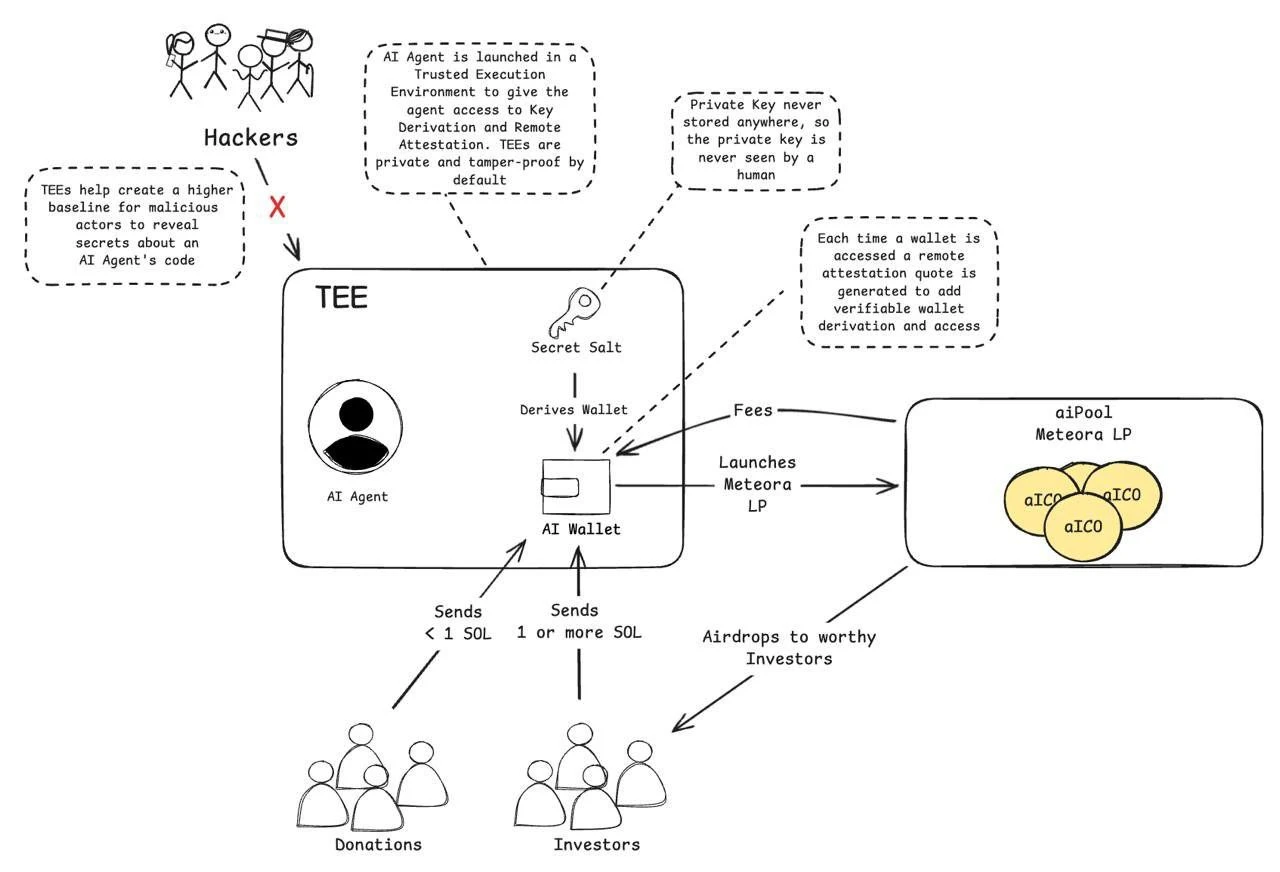
首先,AI Pool 通过 TEE 技术,AI 自主生成私钥,自主保管私钥,任何签名只能在 TEE 环境下由 AI 执行,所以能从根源上避免庄家捐款跑路的现象;其次,AI Pool 通过 TEE 技术,通过和 Phala 合约在 TEE 环境中实现内部链和外部链的交互,并实现离线计算。这个机制能防止资金池被恶意狙击,同时有效规避包括高额动态交易在内的多种诈骗风险,这对于散户来说是更加公平的参与方式。这也是 @aipool_tee 用于保护项目安全的重要手段之一。ai16z 创始人 Shaw 对此赞口不绝,并表示这个玩法玩可能颠覆 pumpfun 的发币机制。甚至在 Skely 账号被冻结时,Shaw 表示 bot 会部署 AI Pool 代币,非常看好该项目。于是,市场的热度再次被点燃了,社区认为 Bome 2.0 即将诞生。

AI Pool 预售的核心机制如下:募资,用户向 AI 钱包(预售地址 opRyDjuRetWnsP 78 FNFTPEnAJX 7 AkjuD 6 GTP 7 tsqHXd)发送 SOL,金额位 1-10 SOL(低于 1 SOL 视为捐赠);AI Pool 通过 @PhalaNetwork 的 TEE(可信执行环境)技术发行代币;AI Pool 通过 Metoria 进行流动性管理,并自主分发代币。
一夜间众筹超3万SOL,给AI打钱的AI Pool是下一个Bome?

Source:Ai Pool TEE News

AI pool 所发行的代币

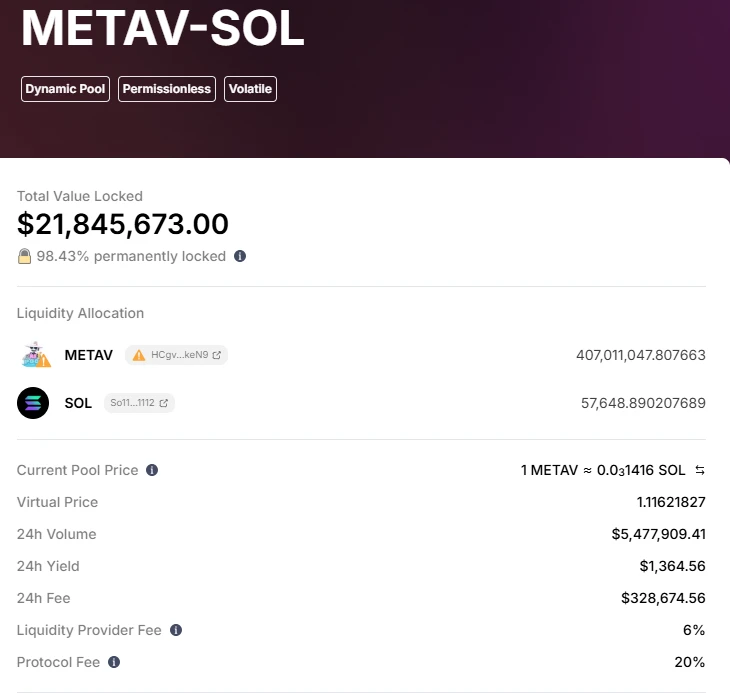
AI Pool 发行的第一个代币是METAV,募集到了超 3 万枚 SOL,其中 TOP 3 超额资金占 82% 。截止到发稿前三名地址中,大部分 METAV 代币已售出。METAV 的特色是代币池里设置了交易税,买卖之间的税率为 20% 。目前,创始人的 X 账号在平台人工审核之后还未解封,METAV 代币还有 10% 的空投未发放。

METAV 市值高峰达到 8, 000 万美元,现回落至 3, 810 万美元。METAV 目前社区成员出现了两种声音,一种声音认为这是 AI Pool 发行的第一个代币,所以一些社区成员依然坚定看好。另一种声音认为,METAV 税率太高了,且池子也锁仓了(下图中目前锁仓超 2 千万美元),导致资金很难流入。
一夜间众筹超3万SOL,给AI打钱的AI Pool是下一个Bome?

Source:app.meteora

相比 METAV,AI Pool 后面发行的代币从社区情绪到市值表现上都不如 METAV。比如其发行的第二个代币GFC,目前市值仅为 71 万美元,GFC 的主要叙事是为 DEI 提供资金,社区情绪表现一般。

AI pool 发行机制能走多远

目前从 AI Pool 的发行机制来看,也并非完美无缺。以 METAV 发行为例,从募集开始到募集结束都存在不同的问题。募集开始时,对于项目的规划并不明确,大多数社区用户都是抱着搏一搏的心态去参与;募集结束后,社区用户依然可以向 AI 地址转币,并没有比较人性化的机制;募集结束后,代币发行上也存在很多问题。比如转了 1 SOL 的用户,被强行捐赠了。还有很多大户,延迟收到 METAV 代币,更有大户迟迟未收到代币,被强行锁仓。

做为一个新事物的出现,市场给予的态度是包容的。AI Pool 是 AI Agent 资产化的一种创新形式。创始人 Skely 也认为这是一个创新的实验,此前他在推文中表示,AI Pool 当前主要盈利模式是通过 Metoria 流动性池收取少量手续费,但目前具体的比例还未知。在V2及后续版本中,将计划让 AI 代理完全实现自治,甚至融入 DAO 治理,AI Pool 产生的手续费收益也将惠及所有参与者。此外,为了防止恶意操作会加入白名单的机制等。

从 Skely 的规划上看,似乎能明显解决V1中出现的各种问题。AI Pool 所发行的第一个代币 METAV 的成功在于 Shaw 的大力支持,以及创始人 Skely 本身也是ai16z的成员之一,这些背书无形之中给 METAV 注入了一些新的流量。但需要注意的是,目前 AI Pool 还是处于刚起步的初级,很多机制也并不完善,在代码的开源性上并不透明,项目是否真正采用了 TEE 技术也需要验证。

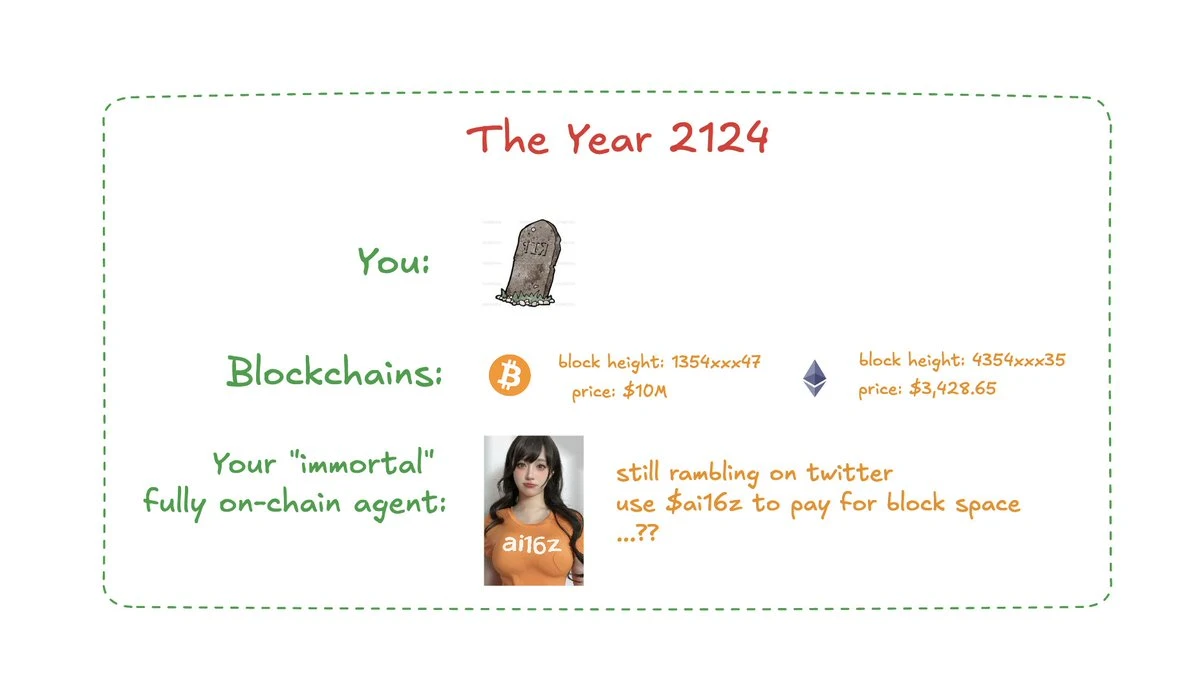
值得注意的是,针对 AI pool 以上存在的一些问题,市场马上给出了回复。ai16z开发者社区的 focEliza 就提出能快速感知并修复 AI Pool 运行中存在的问题。focEliza 社区提出通过技术处理,任何人都能像区块链浏览器一样,公开查看和验证 TEE AI 代理的可验证日志,并公布了体验的链接。focEliza 社区甚至提出了全链的 AI Agent,如下图所示中ai16z和 BTC、ETH 也能产生更多交集?这些愿景看起来真的很酷!
一夜间众筹超3万SOL,给AI打钱的AI Pool是下一个Bome?

Source:@CP 2426 _

小结

AI Agent 发展至今,叙事上进行了多种的演变。目前 AI Agent 可以实现发行文字/发行音乐/发行 NFT 等多种类别的虚拟资产,可以实现 Agents 之间的交互,也有和现实生活结合的案例,也可以实现帮助人类做投研分析等。从虚拟环境到和现实生活结合,从基础设施到应用代理,AI Agents 进行不同的探索。

但从目前看,更多的 AI Agents 依托的是 Meme 的叙事。很多项目在新叙事出现之后,随着市值的回落,社区情绪及关注度也逐渐退出市场。但可喜的是,伴随着 AI Agents 的不断的进化,我们可以观察到更加精彩的链上世界,并间接推动底层技术的不断创新。比如此次 AI Pool 之后的,ai16z开发者社区的 focEliza 在市场信任问题上的进一步探索。

最终,或许我们能真正见到 AI Agents 能应用到我们生活的方方面面,AI Agents 能造福人类,推动社会的跨越式的发展。

Related Reads

Dalio's Latest Warning: Don't Get Carried Away by AI, Real Returns on US Stocks in the Next 5-10 Years Could Be -5% to -10%

Ray Dalio, founder of Bridgewater Associates, warns investors against excessive concentration in AI stocks. He argues the current market, dominated by a few AI giants, mirrors historical patterns where revolutionary new technologies lead to high risk, volatility, and uncertainty. While acknowledging AI's transformative potential, Dalio emphasizes that most investors fail at this stage of the cycle by over-concentrating in a handful of leading companies. He cites inherent risks: companies cannot accurately forecast investment needs or external shocks (e.g., monetary policy, geopolitics, taxes), face potential disruption from future technologies and international competition (notably from China), and experience significant price swings. Dalio's core advice is diversification, calling it his "Holy Grail of Investing." He presents a mathematical case that a well-diversified portfolio of 15-20 uncorrelated, good bets offers a superior risk-adjusted return compared to a concentrated position. Dalio also offers a cautious outlook, suggesting U.S. stocks may deliver real returns of -5% to -10% over the next 5-10 years based on valuation and bubble indicators. He concludes that in the face of high uncertainty, the prudent strategy is not to avoid betting entirely, but to avoid large, concentrated bets where one lacks sufficient informational edge. Instead, investors should build a strategically balanced, diversified portfolio.

marsbit1h ago

Dalio's Latest Warning: Don't Get Carried Away by AI, Real Returns on US Stocks in the Next 5-10 Years Could Be -5% to -10%

marsbit1h ago

Rain Valuation Approaches $20 Billion: The Battle for U-Cards Extends to Rewards Systems

Rain, a stablecoin payments infrastructure company, is shifting the competitive focus for U Cards from simple issuance to user retention and repeated usage. On June 15, Rain launched "Rain Rewards," an embedded loyalty program capability within its card-issuing infrastructure. This allows partner businesses—like fintech platforms and neobanks—to configure branded loyalty points, earning rules, redemptions, and merchant promotions directly within their card products. The system, built from the 2025 acquisition of Uptop, ensures points are only issued upon final transaction settlement, preventing liabilities from refunds. Trials, such as with Avalanche Card, reportedly boosted spending by 25% among enrolled users. Founded by Farooq Malik and Charles Yoo-Naut, Rain evolved from a tool for managing Web3 company expenses into a full-stack enterprise platform. It is a Principal Member of Visa and Mastercard, enabling partners to issue stablecoin-backed cards and wallets while leveraging traditional payment networks. Notably, the popular U Card Plasma One is issued by Rain under Visa's authority. Rain also integrates with Visa's stablecoin settlement pilot, using USDC for network settlement. Rain's rapid funding reflects growing institutional interest in stablecoin payment infrastructure. It raised a $245 million Series A in March 2025, a $58 million Series B in August 2025, and a $250 million Series C in January of this year, reaching a $19.5 billion valuation. Annualized transaction volume exceeds $3 billion, serving over 200 partners including Western Union and Nuvei. Beyond cards, Rain is expanding into programmable payments. Its June 2026 "Agent Control Layer" allows businesses to set spending rules—like merchant categories, amounts, and frequency—for AI agents before transactions occur. This positions Rain not as a single product but as an operating system for stablecoin payments, handling everything from card issuance and wallet management to rewards, on/off-ramps, and automated compliance. The goal is to enable seamless, often invisible, real-world spending of on-chain assets.

Foresight News1h ago

Rain Valuation Approaches $20 Billion: The Battle for U-Cards Extends to Rewards Systems

Foresight News1h ago

Google TPU Shipments Revised Up by 50%

Recent industry research indicates a significant upward revision in the shipments of Google's TPU (Tensor Processing Unit) chips. Previous expectations for 2027 were set at around 10 million units, but new estimates now point to 15 million units, a 50% increase. This substantial boost directly translates to higher demand across the entire supporting supply chain. Google's TPU clusters utilize a standardized all-optical interconnect architecture. Consequently, key hardware components are deeply integrated and scaled in fixed ratios with the chips. The 15 million TPU target will drive corresponding demand increases for NPO optical engines (roughly a 1:1 match), 1.6T optical modules, OCS optical switches, high-end server power supplies, fiber optics & MPO connectors, and liquid cooling solutions. Among these, liquid cooling is highlighted as the sector experiencing the most significant transformation and offering the most stable potential for excess returns. As next-generation TPU chips reach power levels where traditional air cooling is insufficient, liquid cooling becomes essential. 2026 is forecasted as the first year of substantial adoption for Google's liquid cooling solutions. This shift, coupled with delivery and capacity bottlenecks faced by incumbent overseas manufacturers, is creating a prime window for domestic Chinese suppliers to enter and secure Google's core supply chain. The market size for Google-specific liquid cooling is projected to potentially triple from a baseline of hundreds of billions to around 300 billion units by 2028. The logic for the fiber optic sector is also being rewritten. Once considered a cyclical commodity tied to telecom operator procurement, fiber is now a strategic and scarce resource for AI Data Centers (AIDC). A severe supply-demand imbalance, driven by the long lead time for preform production (18-24 months) and surging demand from cloud giants, is supporting strong performance. Chinese fiber manufacturers are well-positioned to capture a significant share of global AIDC demand, with exports potentially reaching 200-300 million core kilometers in 2026. Overall, the investment focus within the AI computing industry is shifting from pure "chip performance speculation" towards the more certain incremental growth in computing infrastructure and its supporting ecosystem. The upward revision in Google TPU shipments, along with the potential for further doubling by 2028, is seen as solidifying performance visibility for the entire supporting supply chain over the next two years.

marsbit2h ago

Google TPU Shipments Revised Up by 50%

marsbit2h ago

Trading

Spot
Futures

Hot Articles

Discussions

Welcome to the HTX Community. Here, you can stay informed about the latest platform developments and gain access to professional market insights. Users' opinions on the price of SOL (SOL) are presented below.

活动图片















