Merlin Chain Launches MERL: A Major Leap Forward in Bitcoin Layer 2 Solutions

cryptoslatePublished on 2024-04-22Last updated on 2024-04-22

Abstract

Merlin Chain's native token, $MERL, empowers users with governance, security enhancements, and robust ecosystem interaction, following its successful $3.6 billion TVL growth.

Press ReleaseMerlin Chain Launches MERL: A Major Leap Forward in Bitcoin Layer 2 Solutions
Merlin Chain's native token, $MERL, empowers users with governance, security enhancements, and robust ecosystem interaction, following its successful $3.6 billion TVL growth.
News Desk · Apr. 19, 2024 at 11:00 am UTC · 3 min read
Merlin Chain Launches MERL: A Major Leap Forward in Bitcoin Layer 2 Solutions

April 19th, 2024 — Merlin Chain, the largest Bitcoin Layer 2 protocol by total value locked (TVL), is thrilled to announce the launch of its native token, $MERL. As a significant enhancement to the Bitcoin network, Merlin Chain facilitates the rapid growth of decentralized applications (DApps) across various sectors, including decentralized finance (DeFi), gaming and social platforms.

Since its mainnet debut in February 2024, Merlin Chain has seen explosive growth, accumulating over $3.6 billion in TVL and fostering a vibrant ecosystem with more than 200 native DApps. The introduction of $MERL marks a pivotal moment in the evolution of Merlin Chain, offering enhanced governance, security and ecosystem development opportunities for its users.

$MERL Token Utilities and Features

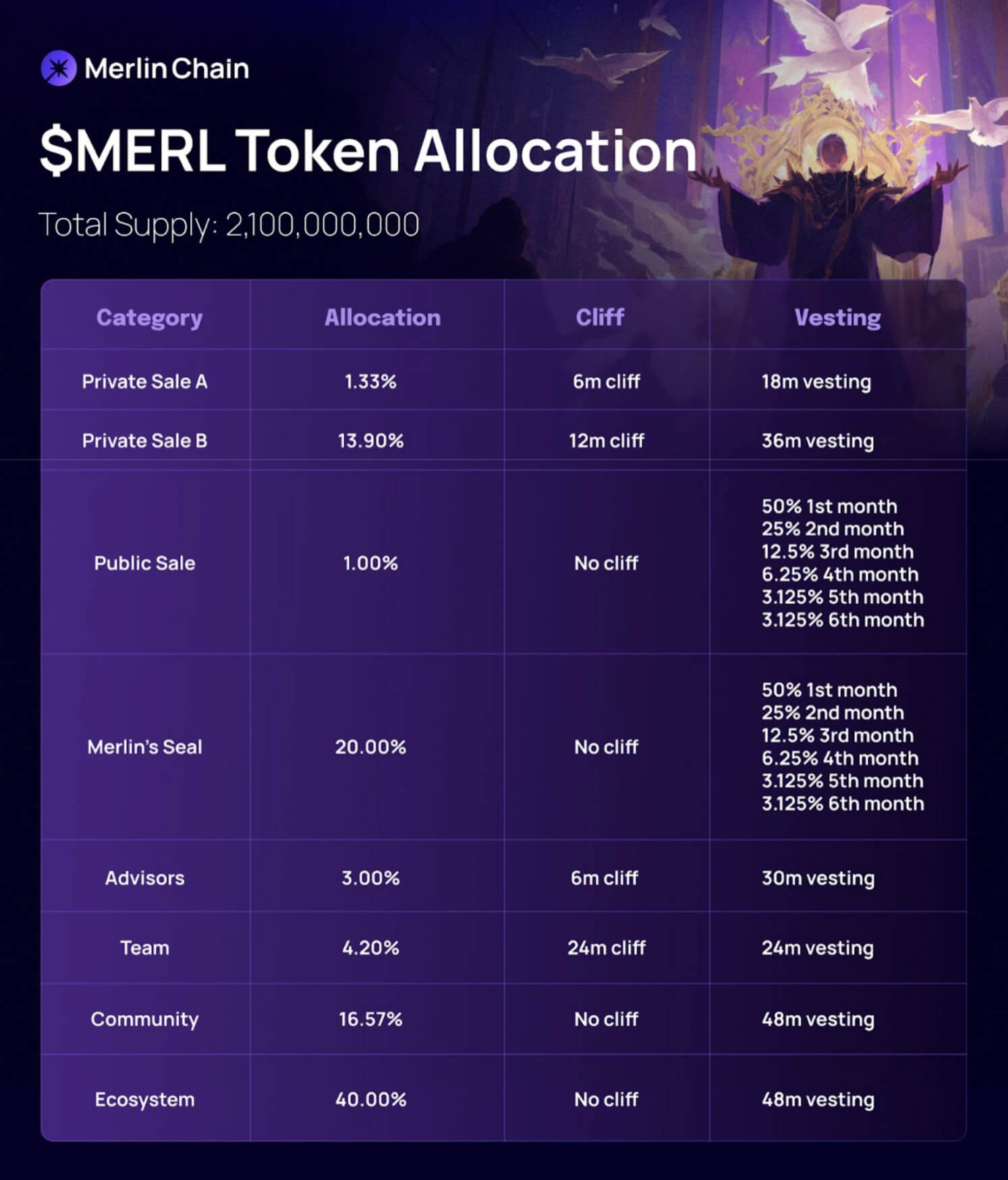
$MERL, operating under the Bitcoin-compatible blockchain standard BRC-20, has a total supply of 2.1 billion tokens and is meticulously designed to empower the community through various utilities.

Token holders can shape the future of Merlin Chain by voting on critical proposals, thus actively participating in governance. Additionally, users can stake $MERL to enhance the security of the network, ensuring its reliable performance. $MERL also facilitates the payment of transaction fees within the Layer 3 enhancements. Community members may support network operations through collator delegation or operate their collators by utilizing $MERL tokens. Furthermore, $MERL serves as native liquidity and collateral, enabling seamless transactions and robust lending mechanisms within the ecosystem.

$MERL Token Allocation

$MERL’s 2.1 billion tokens will follow the specified rules for allocation:
Merlin’s Seal

20% of the total supply of $MERL tokens will be airdropped to participants of the Merlin’s Seal event. This event showcased an impressive TVL of $3.6 billion, with 91% of these funds coming from the Bitcoin community, including $1.75 billion in BTC and $980 million in BRC-20 assets. This substantial support from the Bitcoin community has been vital to the rapid growth and expansion of Merlin Chain in recent months.

Public and Private Sales

1% of the total supply of $MERL tokens is designated for public sale through the People’s Launchpad, providing a broad range of investors with an opportunity to participate. Additionally, 15.23% of the total supply is allocated to private investors, who have access to tokens through two distinct release schedules.

Advisors and Team

3% of the total supply of $MERL tokens is reserved for strategic advisors whose expertise and guidance are instrumental to the project’s success, with a vesting schedule aligned with the platform’s growth. Additionally, 4.20% is allocated to the dedicated core team in recognition of their continuous contributions, ensuring their commitment to the project’s long-term development through a structured vesting plan.

Community and Ecosystem

16.57% of $MERL’s total supply is allocated for community rewards designed to foster participation and engagement within the ecosystem. 40% of the tokens are distributed through grants and incentives aimed at stimulating development and innovation on Merlin Chain.
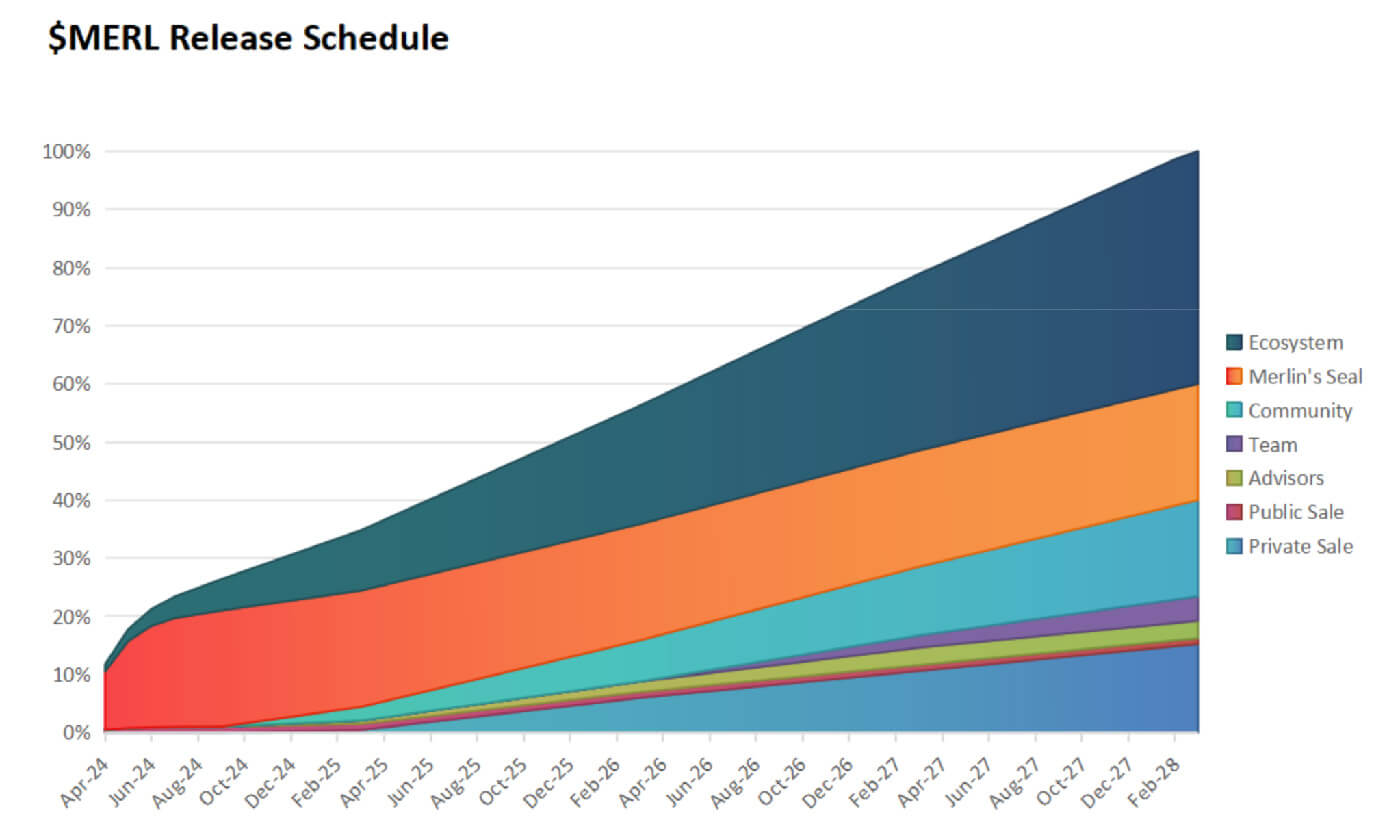
$MERL will be distributed over a four-year timeline.

Together, all token allocations enhance the vibrancy and growth of Merlin’s platform by rewarding active community involvement and supporting innovative projects that contribute to the ecosystem’s expansion.

$MERL Token’s Listing Schedule

Merlin Chain is set to mark a significant milestone with the upcoming listings of its native token, $MERL, on multiple crypto exchanges.

As a BRC-20 token, $MERL will be the third of its kind to be featured on OKX. Deposits will be available starting April 17, 2024, at 10:00 UTC; trading will begin on April 19, and withdrawals will be on April 20.

Additionally, $MERL will debut as the first new coin on Hashkey Global, following the same trading schedule as OKX.

Noteworthy listings also include Bitget, where deposits are already open, and trading set for April 19. Other platforms like Gate.io, Kucoin, WOO X, ByBit and BingX are aligning with similar deposit and trading schedules.

This expansion into various major exchanges underscores Merlin Chain’s robust growth and the community’s strong support, which has been instrumental in its development. The leadership of Merlin Chain expressed gratitude for the community’s role in this progress, emphasizing that these developments are just the beginning of their mission to “Make Bitcoin Fun Again” and unlock the full potential of Bitcoin through innovative Layer 2 solutions.

Trending Cryptos

Related Reads

Deep Insight: Decentralized Inference is Not Hype, but a Key Track for AI to Break Through Centralized Monopoly

Decentralized Reasoning: Beyond the Hype, a Key to Breaking AI's Centralized Monopoly A future scenario where a powerful AI model is banned by a major government illustrates the core value proposition of decentralized AI: resistance to censorship. The core bet of decentralized inference networks is mitigating this risk, with other benefits like cost being secondary. The path is extremely difficult, involving four key challenges: 1. **Running Massive Models:** Distributing a single model across a decentralized GPU swarm requires sophisticated techniques like pipeline and speculative decoding to overcome crippling network latency, aiming for usable speeds (e.g., 30-40 tokens/second). 2. **Proving Model Integrity:** Verifying that a node runs the correct model is critical. Solutions range from cryptographically secure but slow ZKML to faster, economically-secure methods like statistical fingerprints, deterministic re-execution, or live-weight proofs, each involving trade-offs between integrity, latency, and cost. 3. **Ensuring Prompt Privacy:** Simply sharding a model does not protect user inputs from nodes. Robust solutions currently require trusted hardware (TEEs) or advanced cryptography (FHE), which are not yet widely deployed in consumer swarms. 4. **Building a Real Market:** Identifying the ideal customer is tough. Beyond speculative AI agents, the viable market currently consists of startups embedding AI and projects needing batch processing (e.g., synthetic data generation), where decentralized aggregation can be an advantage over low-latency needs. The article analyzes several projects tackling these problems, such as Dolphin Network (live-weight proofs), Inference.net (statistical verification), Morpheus (TEE-based), and Darkbloom (Apple Secure Enclave). It provides a framework: decentralization is a "tax" for latency-sensitive applications (e.g., chat) but a potential supply-side advantage for throughput-oriented tasks (e.g., batch processing). The long-term vision is a closed data loop where decentralized inference generates valuable data (traces, preferences) to feed decentralized training networks, which in turn produce better open-weight models for the inference networks. A due diligence checklist advises focusing on projects that: are truly decentralized at specific layers; have a credible integrity method; offer real cost benefits; ensure genuine privacy; handle node reliability; have paying users; and are built by teams with deep AI expertise. The ultimate goal should be products that appeal beyond the crypto-native audience, using crypto mechanisms invisibly to deliver better cost, performance, or privacy.

Foresight News13m ago

Deep Insight: Decentralized Inference is Not Hype, but a Key Track for AI to Break Through Centralized Monopoly

Foresight News13m ago

The Final Piece of Franklin Templeton's Crypto Ambition

Franklin Templeton Completes Crypto Ambition with Acquisition of 250 Digital On June 22, Franklin Templeton announced the acquisition of 250 Digital and established Franklin Crypto, a new division focused on actively managed cryptocurrency strategies for institutional investors. The unit is led by Christopher Perkins and Seth Ginns. This acquisition marks a key piece in Franklin Templeton's multi-year crypto strategy, which began in 2018 with a digital assets team. The firm's crypto product suite now spans three layers: tokenized funds like the blockchain-based money market fund BENJI (~$831M AUM); a series of passive ETFs including Bitcoin (EZBC, ~$368M), Ethereum (EZET), XRP (XRPZ, ~$252M), Solana (SOEZ), and a multi-crypto index fund (EZPZ); and the newly added active management strategies from Franklin Crypto. The company has also expanded its crypto ecosystem through investments in projects like Ethena and Crossmint, and collaborations with blockchains such as Aptos and Sui. With approximately $18B in digital asset AUM and a total firm AUM of ~$1.78T, Franklin Templeton is positioning itself as a comprehensive crypto asset manager for pensions and sovereign wealth funds. In contrast, competitor Fidelity Investments has taken a different path, focusing early on building its own custody and trading infrastructure. Fidelity's Bitcoin ETF (FBTC) holds over $11B, significantly larger than Franklin Templeton's equivalent offering. Both giants' moves underscore the deepening trend of traditional finance entering the crypto space.

Foresight News37m ago

The Final Piece of Franklin Templeton's Crypto Ambition

Foresight News37m ago

Trading

Spot
Futures

Hot Articles

How to Buy MERL

Welcome to HTX.com! We've made purchasing Merlin chain (MERL) simple and convenient. Follow our step-by-step guide to embark on your crypto journey.Step 1: Create Your HTX AccountUse your email or phone number to sign up for a free account on HTX. Experience a hassle-free registration journey and unlock all features.Get My AccountStep 2: Go to Buy Crypto and Choose Your Payment MethodCredit/Debit Card: Use your Visa or Mastercard to buy Merlin chain (MERL) instantly.Balance: Use funds from your HTX account balance to trade seamlessly.Third Parties: We've added popular payment methods such as Google Pay and Apple Pay to enhance convenience.P2P: Trade directly with other users on HTX.Over-the-Counter (OTC): We offer tailor-made services and competitive exchange rates for traders.Step 3: Store Your Merlin chain (MERL)After purchasing your Merlin chain (MERL), store it in your HTX account. Alternatively, you can send it elsewhere via blockchain transfer or use it to trade other cryptocurrencies.Step 4: Trade Merlin chain (MERL)Easily trade Merlin chain (MERL) on HTX's spot market. Simply access your account, select your trading pair, execute your trades, and monitor in real-time. We offer a user-friendly experience for both beginners and seasoned traders.

5.1k Total ViewsPublished 2024.04.19Updated 2026.06.02

How to Buy MERL

Discussions

Welcome to the HTX Community. Here, you can stay informed about the latest platform developments and gain access to professional market insights. Users' opinions on the price of MERL (MERL) are presented below.

活动图片