Authors: Anton Astafiev, Chief Technology Officer, Near One;
Mally Anderson, NEAR Columnist
Compiled by: Saoirse, Foresight News
The NEAR core development team Near One recently announced two major upgrades to the NEAR protocol, both set to go live later this month: one is dynamic resharding, used to enhance network scalability; the other is the launch of the first quantum signature scheme, providing post-quantum security for all NEAR accounts. This article details the next core plan in NEAR's technical roadmap—SPICE, which stands for "Separation of Protocol Into Consensus and Execution." SPICE is currently still in the research and development phase and is the most important upgrade before the implementation of Nightshade 3.0, the next iteration of NEAR's sharding technology.
(To understand the sharding technology evolution from 2019 to the present, you can read the previously published dynamic resharding feature article; for a complete understanding of NEAR protocol's overall evolution, please refer to Bowen Wang's keynote speech on Nightshade 3.0 at the 2026 NEARCON conference.)
After SPICE officially launches, NEAR's block production speed will increase to three times its original rate, achieving a 200-millisecond block time. As of May 2025, NEAR's current performance is 600ms block time and 1.2-second transaction finality. The core logic behind this performance leap is decoupling the consensus process from transaction execution: the consensus layer can run at full speed without waiting for transaction execution to complete before producing a block. It's worth mentioning that constrained by the speed of light and the basic time required for consensus nodes to send and receive messages, 200 milliseconds is the theoretical fastest block time achievable at the physical layer.
The layered operation of consensus and execution will bring three core improvements: faster block times, lower transaction latency, and support for longer-running, more complex logic transactions.
How SPICE Achieves Protocol Speedup
The separation of consensus and execution is a fundamental and far-reaching upgrade to the NEAR protocol. It is also the most extensive technical transformation since the introduction of the stateless validation mechanism in 2024, representing a massive engineering effort for the Near One team. The concept of SPICE was first proposed at the NEAR industry summit in late 2024; now that prerequisite upgrades like Gas Keys (already live in version 2.12), sharded smart contracts, and dynamic resharding have all been implemented, SPICE's development process has also accelerated.
Although implementing this layered architecture is extremely difficult, its underlying logic is clear and easy to understand: the core value of a blockchain is to provide an immutable, irrevocable guarantee of transaction ordering. Traditional schemes rely on Byzantine Fault Tolerant (BFT) consensus mechanisms, where each block synchronously packs ordered transactions and updates account balances, which directly slows down block production efficiency. SPICE, however, splits transaction ordering and state execution into two independent processes: all validator nodes only need to reach consensus on the transaction list and block hash, ensuring the transaction order cannot be tampered with. This process requires no complex computation while preserving blockchain determinism. Nodes can produce blocks by only verifying transaction signatures. Account state calculations can proceed asynchronously while block consensus is confirmed. The execution flow is no longer tied to block ordering and does not need to synchronously update the state root in every consensus block round.
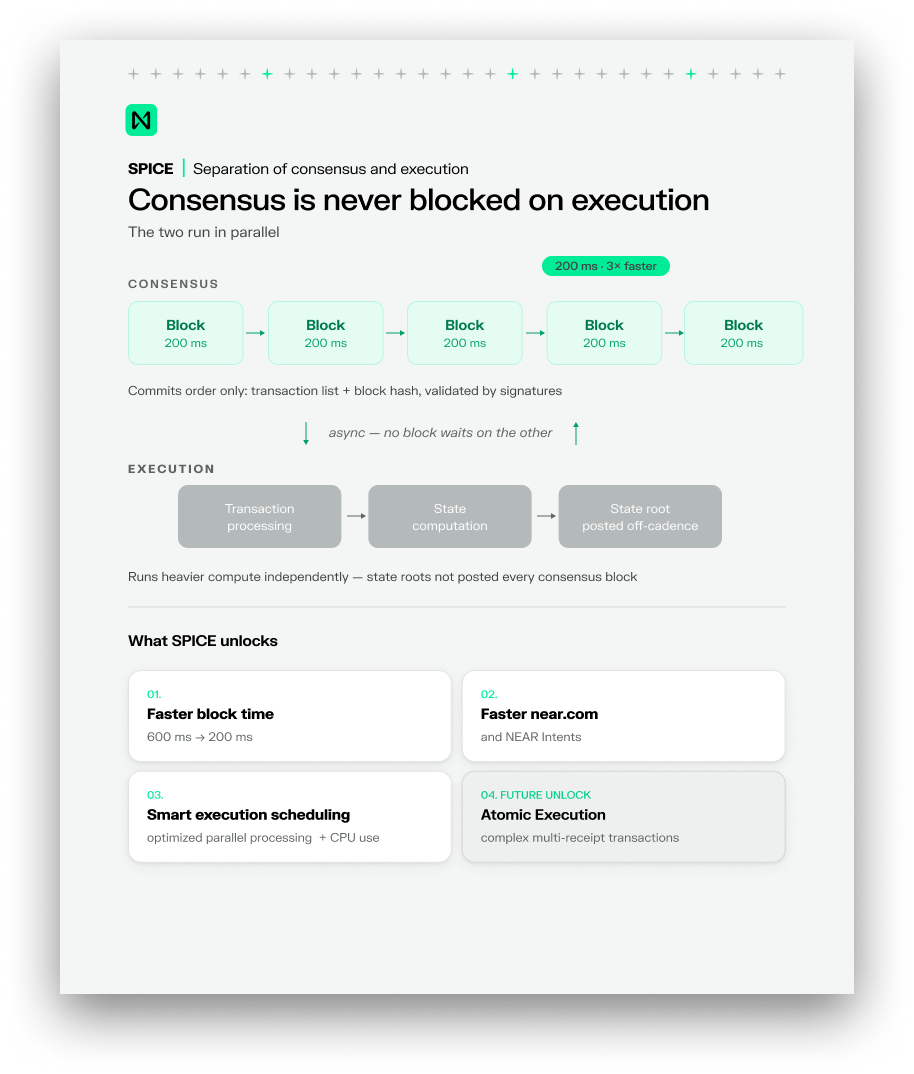
Diagram of the SPICE layered architecture
SPICE does not just compress block time from 600ms to 200ms, tripling the speed; it can also handle more interaction operations within the same timeframe, significantly accelerating complex transaction processing, and even support long-process transactions executed in steps across multiple blocks. NEAR itself already uses an optimistic block mechanism, and SPICE will greatly reduce the maximum wait time for users. Under the current mechanism, if a transaction requires supplementary external data, users must wait for a full block to be produced before initiating the next operation; with SPICE, users can complete three consecutive interaction operations within the waiting period of what was previously one block.
SPICE will also significantly optimize the user experience for near.com and NEAR Intents. Alex Shevchenko, CEO of Defuse Labs, commented on this: "The increased block speed on NEAR means faster transaction finality, making the user experience incredibly smooth, truly achieving 'instantaneous completion.' Whether it's ultra-fast sub-second transactions, transfers, or private payments, all can be realized. The transaction confirmation standard for traditional payment giant Visa is 3 seconds, while NEAR only needs 0.4 seconds, faster than you can input a payment password or tap your phone against a payment terminal."
This extreme speed is also a necessity for the agent economy: the interaction rate of automated agents far exceeds that of human users and traditional financial systems. Relying on this block production mechanism approaching the physical limit, NEAR can unleash the full operational potential of agents, enabling seamless flow between fiat and crypto assets; while also supporting multiple agents initiating complex, longer-duration transactions in parallel.
The Technical Path to Nightshade 3.0
The separation of consensus and execution is the first crucial step towards implementing Nightshade 3.0. Among all sharded public blockchains, NEAR is the first project to implement this architecture; while Monad has also achieved consensus-execution separation, it is based on a non-sharded EVM public chain. Besides speed improvement, SPICE further enhances network scalability through deep parallelization. Currently, NEAR executes transactions by shard according to account ID. Once a shard experiences a surge in load, all user transactions within that shard will experience delays. SPICE lays the groundwork for subsequent cross-shard synchronous transactions. Simultaneously, it utilizes "bubble filling" mechanisms to make full use of bandwidth resources: the execution queue doesn't need to wait for network communication, and block generation doesn't need to wait for transaction execution to complete. The two processes run in parallel without gaps, greatly improving network resource utilization.
Faster blocks paired with the already-launched sharded smart contracts can also simultaneously enhance network security. NEAR's sharded smart contracts are essentially lightweight independent accounts, partitioned individually by user and business scenario; combined with shorter, more concise blocks, the entire network's business load can be evenly distributed across various shards, enabling dynamic adaptive scaling for the network. This not only optimizes scaling performance but also yields significant security benefits. With AI tools significantly lowering the barrier for hacker attacks and vulnerability exploitation, structurally simple blocks and lightweight contracts are easier to secure; as NEAR gradually implements formal verification of contracts and zero-knowledge proofs, short blocks can significantly reduce verification computational power consumption and cost.
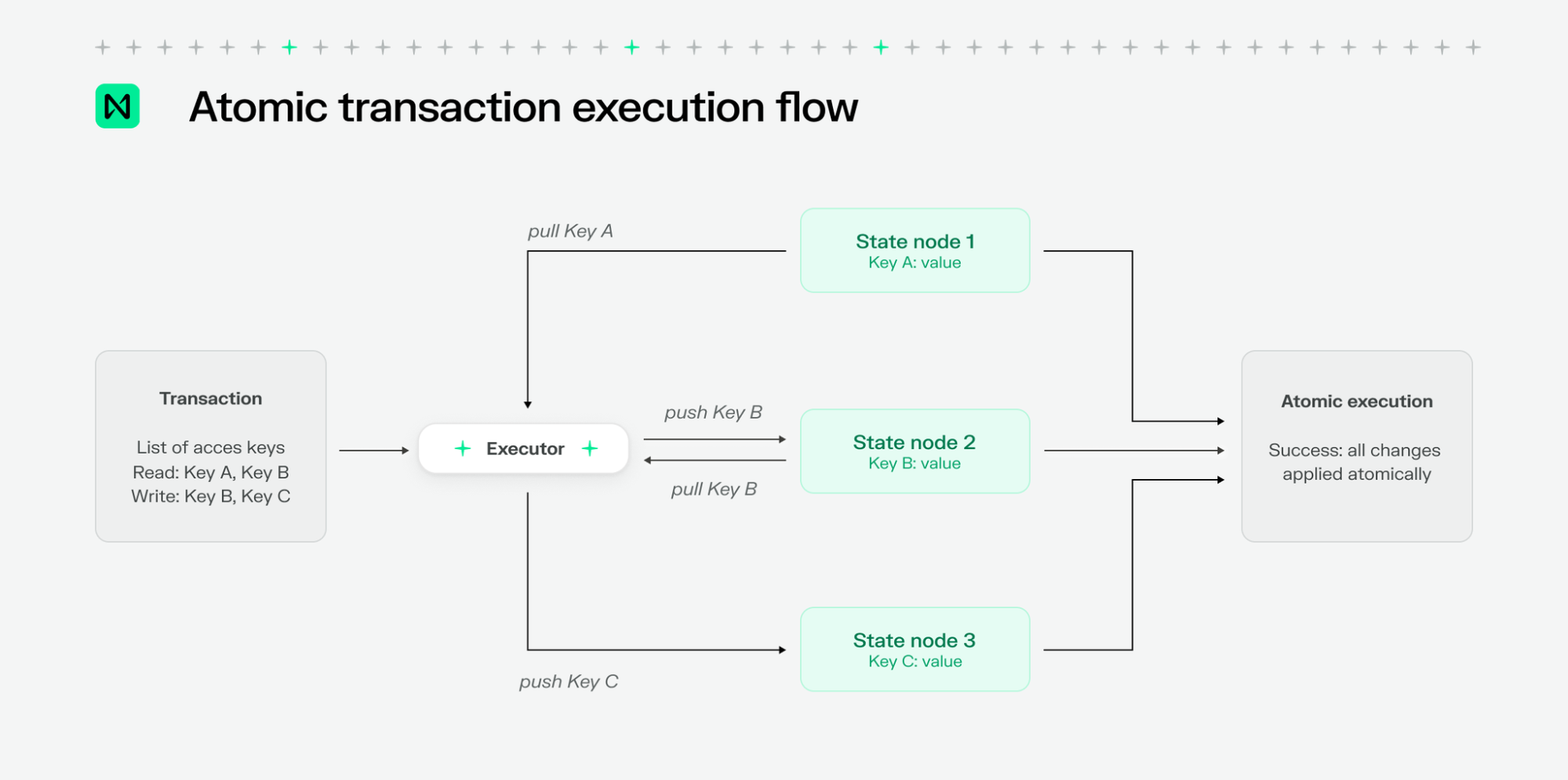
Cross-shard atomic transaction execution flow
SPICE also paves the way for subsequent major upgrades in Nightshade 3.0. In the future, building on SPICE with another iteration of updates will enable cross-shard atomic transactions—indivisible, irreversible complete execution across shards. This has long been a core goal in the field of sharding technology and a key demand for developers (especially NEAR Intents ecosystem developers). Atomic execution can simplify complex transaction logic, avoiding development difficulties brought by existing asynchronous cross-shard mechanisms. This type of asynchronous logic has long been a primary cause of smart contract vulnerabilities and functional delays, and the SPICE architecture can mitigate this issue from the ground up. The core implementation idea is: by leveraging the decoupling of consensus and execution, migrate transaction calculations to dedicated execution nodes that can read the state of all shards involved in the transaction. Combined with NEAR's mature stateless validation system, only a single execution node needs to generate an execution proof for all other nodes in the network to complete verification. This design does not raise the hardware requirements for ordinary validator nodes while continuously unleashing the performance ceiling of the execution layer.
The Near One team is fully advancing SPICE development, planning to implement and launch it within the coming months. (Everyone can continue to follow nearone.org for detailed technical updates, or check the latest protocol developments on the NEAR X official account.)