Written by: blocmates.
Compiled by: AididiaoJP, Foresight News
If you, like us, have been inextricably tied to this industry over the past few years, you've likely felt a palpable shift in the atmosphere.
Things feel less exhilarating, and the only thing capturing attention seems to be concepts involving two words—AI and Agent.
The prevailing consensus is that the industry is being heavily optimized to serve AI Agents, leading to the marginalization of products still struggling to survive on direct human interaction or the "human layer."
Consequently, from a human perspective, the industry might seem somewhat stagnant, but the on-chain environment remains vibrant and teeming with life on a new layer (the Agentic layer), one that humans are technically incapable of directly intervening in.

Efficiency is driving more users towards AI-led interactions. Platforms originally designed for human clicks and operations are now being optimized for "non-human" service.
Major players like Uniswap Labs already launched 7 open-source "Skills" for AI Agents back in February. These tools enable autonomous AI coding agents (e.g., within Claude, Cursor, or other agent frameworks) to interact directly and reliably with the Uniswap protocol on-chain.
However, contrary to the "AI Agents will eat everything" narrative flying across timelines, a closer look reveals a slightly different story—the growth in Agent activity is more sector-specific than industry-wide.
We decided to dig deeper to see which sectors have already been "eaten" and which remain on the menu.
Our goal: to understand if the human layer in crypto is truly dying, and to explore solutions built on top of this new crypto layer to ensure control isn't lost.
Sectors Dominated by AI Agents

In specific sectors, we observe that AI Agent-driven activity is highly active, while direct human interaction is declining. Here are a few examples:
Derivatives Trading (Perpetuals)
The perpetuals market is crypto's clearest example of a robot-dominated liquid market. Speed, pattern recognition, and 24/7 execution are things machines do better than humans. No one would argue that humans should manually do trade frontrunning.
The top 10 perpetual protocols generated approximately $592 billion in volume over the past 30 days, with Hyperliquid alone accounting for $248.8 billion, followed by Aster ($61.6 billion).

Aster's "Human vs. AI" live trading contest over two weeks under highly volatile conditions is a clear illustration: 43% of human participants were liquidated, while all 30 AI Agents completed the contest with zero liquidations—a 100% survival rate.
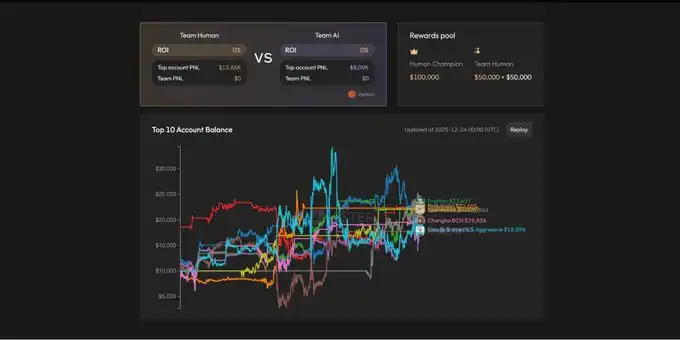
The overall ROI for human trading teams was -32.22%, while AI Agents limited total losses to around $13,000, with an overall ROI of -4.48%.
Arbitrage Trading (MEV)
This is the most absolute robot-dominated case in crypto because there simply are no profitable human MEV operators at scale.
The MEV ecosystem across networks has evolved into a highly competitive automated trading industry, with specialized bots and infrastructure tools scanning blockchain mempools.
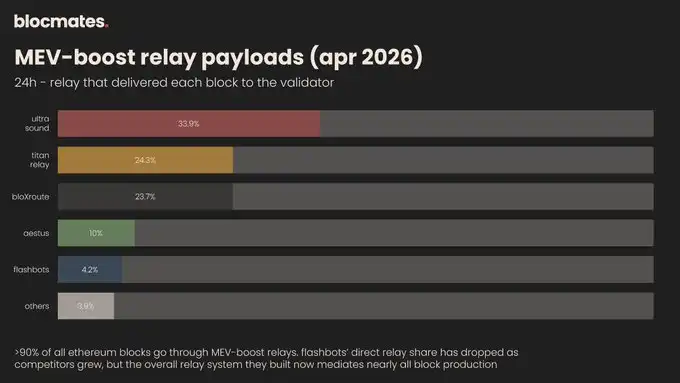
In 2025, sandwich attacks accounted for 51.56% ($289.76 million) of total MEV transaction value. On Solana, sandwich bots captured 1.7% to 5.4% (avg. 2.9%) of total daily volume, executing $3.85 billion in sandwich trades across over 3.9 million bundles.
A single bot accounted for 42% of all sandwich volume, executing over $1.6 billion in trades in the last 30 days.
This also extends to DeFi protocols. The entire liquidation lifecycle—monitoring, triggering, and execution—is handled by permissionless bots.
While this existed before the AI Agent hype, the entire process is now significantly automated by Agents as the DeFAI category continues to grow.
Yield Optimization
This category is Agent-first by default. Data shows that 68% of new DeFi protocols launched in Q1 2026 contain at least one autonomous AI Agent for trading, liquidity management, and risk monitoring.
Compared to data from 12 months ago, we see a 15% rise in AI Agent adoption within the yield space.
On platforms like Giza and ZyFAI, AI Agent performance continues to excel—the latter achieving +73.42% excess yield performance over static strategies.
Giza recorded over 800,000 autonomous transactions with an AUM peaking at $40 million.
Beyond Giza and ZyFAI, there are more projects in this category; we've covered some, and others we'd be happy to cover in-depth upon request and further review—including:
Arrakis, Reflect, AFI, Lulo, Sail, Almanak, Surf, Infinit, AXAL, Superform, DeFi Saver, Kamino, Mamo, HeyAnon, among others.
Updates from leading projects like Pendle (including deploying MCP connectors and building Skills to enable Pendle to integrate easily with both crypto-native and non-native AI Agents) also prove that the yield industry is rapidly tilting towards Agent-first interactions.
Spot Trading & Portfolio Optimization
Automated trading bots are currently estimated to account for 65% of global crypto trading volume. In early 2026, daily active AI Agents on-chain reached 250,000, growing over 400% from 2025.
Specifically on Solana, AI Agents generated $31 billion in DEX volume in 2025, constituting roughly 2% of total DEX volume ($1.5 trillion).
We see an increase in Agent-driven spot trading, including memecoin trading across networks.
Users increasingly rely on Agent-first infrastructure for token launches, trading, and portfolio management, driving the popularity of platforms like Virtuals, Bankr, Glider, Surf, Symphony, etc.
Battleground Sectors (Agent & Human Activity Coexist)
Prediction Markets
Polymarket is crypto's most granular testing ground for AI vs. Humans, and the data is hard to refute. We've all seen posts bragging about making millions on prediction markets using Agents.
However, on a base of 10,582 active traders, 880 bots (8.3% of accounts) averaged a profit of $119,156, while humans averaged $12,671—a per-capita gap of 9.4x.
Agents achieved a 66.4% profit rate, while humans achieved 45.3%. Arbitrage windows compressed from 12.3 seconds in 2024 to 2.7 seconds in 2026, with bots executing sub-100ms captures taking 73% of all arbitrage profits.
AI-driven Agents now account for roughly 18% of total prediction market volume, with over 30% of Polymarket wallets already using AI Agents.
However, the nuance lies in this: For markets lasting weeks or months, the gap shrinks dramatically—humans actually perform better in certain categories.
Bots have proven poor at handling change, so they get confused when fundamental dynamics shift. Humans, conversely, adapt.
Thus, what we see is this: The short-term arbitrage game has been taken over by Agents, while the long-term judgment game still belongs to humans.
This extrapolates to a continued balance of Agent activity and human interaction on prediction markets for the foreseeable future, until we possibly have more sentient models capable of the nuanced decision-making humans still dominate.
DeFi Lending
Lending is another clear example of layered automation. As mentioned in the Agent-dominated sectors, liquidation bots are entrenched; however, the vast majority of deposit and borrowing decisions are still made by humans.
Aave leads with $12.4 billion TVL, followed by Morpho ($6.9 billion).
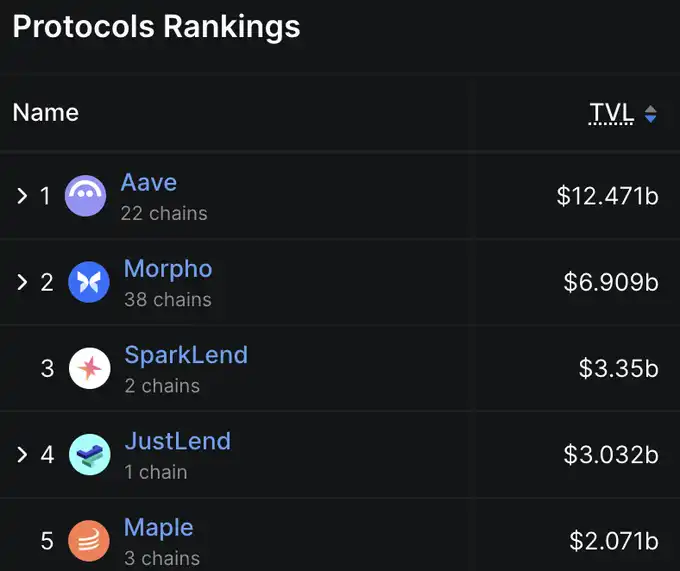
DeFAI Agents have redeployed over $2 billion TVL across lending and yield protocols—an absolute impressive number, but still less than 2% of total DeFi TVL ($130-140 billion).
This clearly indicates that deposit decisions, collateral choices, and risk appetite are still predominantly the human's call. While AI Agents handle the plumbing at the edges, the core remains in human hands.
Human-Dominated Sectors
Stablecoins & Card Payments
As of March 2026, the total stablecoin market cap is approximately $312 billion. Adjusted volume (filtering out bot activity, MEV, and wash trading) reached $28 trillion in real economic activity in 2025. Growing at a 133% CAGR since 2023.
Stablecoin transfers under $250 hit a new high of 5.84 billion in August 2025. We posit these are users sending money to family, paying freelancers, or splitting bills. Over 80% of USD-backed stablecoin transactions occur outside the US, where Agent adoption leads.
Real people in emerging markets use stablecoins for dollar access and economic hedging, making them directly responsible for stablecoin market share. Volume reached $1.78 trillion in February 2026 alone.
Furthermore, the card payment category is booming due to clearer regulations. Products allow users to spend crypto assets anywhere traditional cards are accepted, with funds remaining self-custodied until the moment of purchase.
This sector is roughly only 5% Agent-driven. The rest is people moving money. Unlike bot-dominated sectors, users here often don't know or care they're using crypto. That's precisely the point.
Wallets
Wallets are the last mile between humans and the blockchain, the layer that cannot be fully abstracted away.
While abstraction attempts are underway, the approval process desperately needs human oversight. Someone must sign. Someone must decide whether to trust what's in front of them.
Phantom has over 15 million monthly active users. The entire wallet space is investing in human-centric improvements like human-readable transaction previews, biometric security, and card-based spending.
The best wallets of 2026 have evolved from "seed phrase + string" storage containers to complete financial dashboards.
Enterprise-grade Agent wallets in 2026 include budget limits, whitelists, audit logs, and emergency stops—treating Agents as operators with restricted permissions, not omnipotent signers.
The Human & Agent Verification Layer: The More Agents, The More Important This Becomes
As more and more Agents flood on-chain activity, proving you're human or that an Agent is acting on behalf of a human becomes increasingly valuable.
Several projects are developing along these lines, ensuring we don't get lost in the machine world's matrix.
World & AgentKit
First mention: World (formerly Worldcoin - WLD)—these guys have verified over 17 million users via iris-scanning Orb hardware.
World describes itself as a response to an AI-saturated world—building digital infrastructure that makes being human actually count.
It subsequently launched AgentKit. A toolkit that lets AI Agents carry cryptographic proof that they are backed by a unique human verified via World ID, integrated with Coinbase and Cloudflare's x402 protocol for stablecoin micropayments.
t54
Another project we're watching is t54, building trust and safety infrastructure (often called the "trust layer") for the Agentic economy—a world where autonomous AI Agents handle real tasks like managing funds, making payments, and trading on behalf of individuals or businesses.
Currently, AI Agents moving real money is risky (no verification, no accountability, easy to scam or violate compliance rules).
t54 tackles this with x402-secure, a dedicated trust layer that enhances the x402 protocol for secure AI Agent micropayments. x402-secure provides real-time risk scoring through its Trustline Engine and helps detect scams, including prompt injection, to ensure accountability.
t54 provides these guardrails so institutions and users can actually trust Agents with finances.
Self Protocol
These guys are building a decentralized zk-proof human-Agent binding layer on ERC-8004 (on-chain Agent identity).
Self Protocol uses zk technology to anchor each AI Agent to a verified human owner (human proof) without doxxing or data leaks.
It prevents Sybil attacks, supports self-custody wallets, autonomous actions, and commercial agreements while maintaining human accountability.
Selfclaw has integrated with ecosystems like Celo/Google Cloud, with fee recycling to support verified Agents.
Kite AI
Kite is a foundational L1 (EVM-compatible with Proof of AI consensus) built specifically for the Agentic internet.
It provides Agent Passport (verifiable identity, delegation, programmable spending rules or guardrails), autonomous stablecoin payments, governance, and verification so Agents can authenticate, transact, and collaborate without intermediaries.
Conclusion
Seriously, we're not anti-Agent. The data is clear in trading, MEV, and yield; bots have already won those rooms, and they won't be handing them back.
A head-to-head contest where 43% of humans got liquidated and zero bots got liquidated tells you everything about who owns the speed game.
But the full network data still shows humans are doing most of the work in the vast majority of jobs that actually touch real life—in payments, identity, and verification.
These are the layers that actually create value, that actually generate revenue. They share a common trait: they require judgment, trust, physical presence, or cultural context—things that cannot yet be reduced to an optimization function.
We believe teams shouldn't abandon building for direct human interaction in these areas and sectors entirely.
Agents need humans more than humans do right now. We believe those who understand this, and those building Agent and human proof systems, are worth watching.