Which Crypto Sectors Have Been 'Eaten' by AI Agents?

marsbitPublished on 2026-06-22Last updated on 2026-06-22

Abstract

The article examines the transformative impact of AI Agents on the cryptocurrency landscape, highlighting how specific sectors are becoming increasingly dominated by automated systems. Key "agent-eaten" sectors include derivatives trading (perpetuals), where AI agents demonstrate significantly higher survival and performance rates than human traders; MEV and arbitrage trading, which are almost entirely automated; yield optimization, with over two-thirds of new DeFi protocols incorporating AI agents; and spot trading/portfolio management, where agents drive a growing share of DEX volume. "Battleground" sectors like prediction markets and DeFi lending show a mix, with agents excelling in short-term/arbitrage activities but humans retaining an edge in longer-term, nuanced decisions. Sectors still primarily "human-led" include stablecoin payments/remittances (driven by real-world economic activity) and wallets, where human oversight for approvals and security remains critical. As AI agent activity grows, the article emphasizes the rising importance of human-agent verification layers (e.g., World/AgentKit, t54, Self Protocol) to ensure trust, accountability, and control in an increasingly agentic economy. The conclusion is that while AI agents dominate in speed and optimization-focused areas, human judgment, trust, and real-world context remain essential in value-creating layers like payments and identity.

Written by: blocmates.

Compiled by: AididiaoJP, Foresight News

If you, like us, have been inextricably tied to this industry over the past few years, you've likely felt a palpable shift in the atmosphere.

Things feel less exhilarating, and the only thing capturing attention seems to be concepts involving two words—AI and Agent.

The prevailing consensus is that the industry is being heavily optimized to serve AI Agents, leading to the marginalization of products still struggling to survive on direct human interaction or the "human layer."

Consequently, from a human perspective, the industry might seem somewhat stagnant, but the on-chain environment remains vibrant and teeming with life on a new layer (the Agentic layer), one that humans are technically incapable of directly intervening in.

Efficiency is driving more users towards AI-led interactions. Platforms originally designed for human clicks and operations are now being optimized for "non-human" service.

Major players like Uniswap Labs already launched 7 open-source "Skills" for AI Agents back in February. These tools enable autonomous AI coding agents (e.g., within Claude, Cursor, or other agent frameworks) to interact directly and reliably with the Uniswap protocol on-chain.

However, contrary to the "AI Agents will eat everything" narrative flying across timelines, a closer look reveals a slightly different story—the growth in Agent activity is more sector-specific than industry-wide.

We decided to dig deeper to see which sectors have already been "eaten" and which remain on the menu.

Our goal: to understand if the human layer in crypto is truly dying, and to explore solutions built on top of this new crypto layer to ensure control isn't lost.

Sectors Dominated by AI Agents

In specific sectors, we observe that AI Agent-driven activity is highly active, while direct human interaction is declining. Here are a few examples:

Derivatives Trading (Perpetuals)

The perpetuals market is crypto's clearest example of a robot-dominated liquid market. Speed, pattern recognition, and 24/7 execution are things machines do better than humans. No one would argue that humans should manually do trade frontrunning.

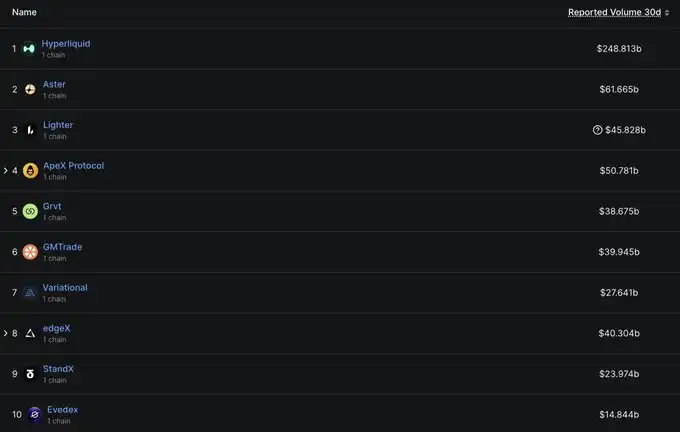
The top 10 perpetual protocols generated approximately $592 billion in volume over the past 30 days, with Hyperliquid alone accounting for $248.8 billion, followed by Aster ($61.6 billion).
Aster's "Human vs. AI" live trading contest over two weeks under highly volatile conditions is a clear illustration: 43% of human participants were liquidated, while all 30 AI Agents completed the contest with zero liquidations—a 100% survival rate.
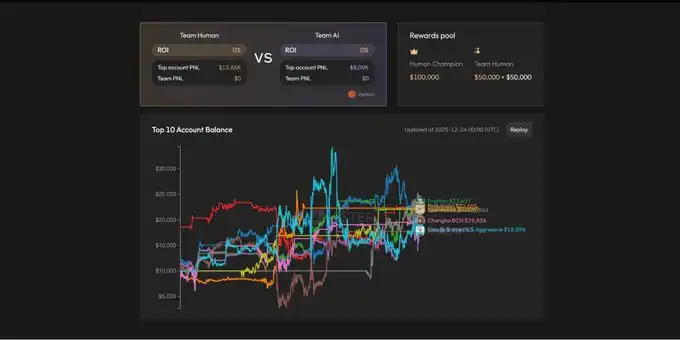
The overall ROI for human trading teams was -32.22%, while AI Agents limited total losses to around $13,000, with an overall ROI of -4.48%.

Arbitrage Trading (MEV)

This is the most absolute robot-dominated case in crypto because there simply are no profitable human MEV operators at scale.

The MEV ecosystem across networks has evolved into a highly competitive automated trading industry, with specialized bots and infrastructure tools scanning blockchain mempools.
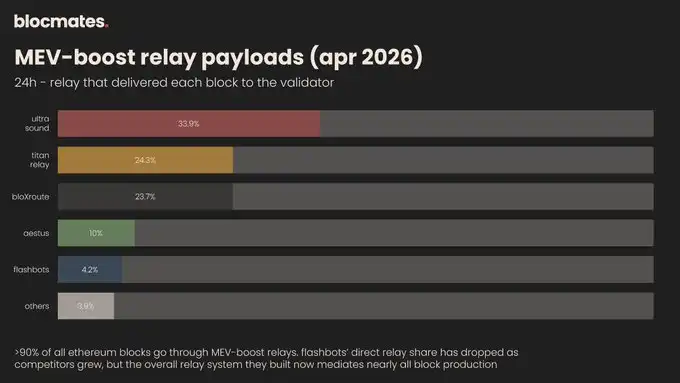
In 2025, sandwich attacks accounted for 51.56% ($289.76 million) of total MEV transaction value. On Solana, sandwich bots captured 1.7% to 5.4% (avg. 2.9%) of total daily volume, executing $3.85 billion in sandwich trades across over 3.9 million bundles.

A single bot accounted for 42% of all sandwich volume, executing over $1.6 billion in trades in the last 30 days.

This also extends to DeFi protocols. The entire liquidation lifecycle—monitoring, triggering, and execution—is handled by permissionless bots.

While this existed before the AI Agent hype, the entire process is now significantly automated by Agents as the DeFAI category continues to grow.

Yield Optimization

This category is Agent-first by default. Data shows that 68% of new DeFi protocols launched in Q1 2026 contain at least one autonomous AI Agent for trading, liquidity management, and risk monitoring.

Compared to data from 12 months ago, we see a 15% rise in AI Agent adoption within the yield space.

On platforms like Giza and ZyFAI, AI Agent performance continues to excel—the latter achieving +73.42% excess yield performance over static strategies.

Giza recorded over 800,000 autonomous transactions with an AUM peaking at $40 million.

Beyond Giza and ZyFAI, there are more projects in this category; we've covered some, and others we'd be happy to cover in-depth upon request and further review—including:

Arrakis, Reflect, AFI, Lulo, Sail, Almanak, Surf, Infinit, AXAL, Superform, DeFi Saver, Kamino, Mamo, HeyAnon, among others.

Updates from leading projects like Pendle (including deploying MCP connectors and building Skills to enable Pendle to integrate easily with both crypto-native and non-native AI Agents) also prove that the yield industry is rapidly tilting towards Agent-first interactions.

Spot Trading & Portfolio Optimization

Automated trading bots are currently estimated to account for 65% of global crypto trading volume. In early 2026, daily active AI Agents on-chain reached 250,000, growing over 400% from 2025.

Specifically on Solana, AI Agents generated $31 billion in DEX volume in 2025, constituting roughly 2% of total DEX volume ($1.5 trillion).

We see an increase in Agent-driven spot trading, including memecoin trading across networks.

Users increasingly rely on Agent-first infrastructure for token launches, trading, and portfolio management, driving the popularity of platforms like Virtuals, Bankr, Glider, Surf, Symphony, etc.

Battleground Sectors (Agent & Human Activity Coexist)

Prediction Markets

Polymarket is crypto's most granular testing ground for AI vs. Humans, and the data is hard to refute. We've all seen posts bragging about making millions on prediction markets using Agents.

However, on a base of 10,582 active traders, 880 bots (8.3% of accounts) averaged a profit of $119,156, while humans averaged $12,671—a per-capita gap of 9.4x.

Agents achieved a 66.4% profit rate, while humans achieved 45.3%. Arbitrage windows compressed from 12.3 seconds in 2024 to 2.7 seconds in 2026, with bots executing sub-100ms captures taking 73% of all arbitrage profits.

AI-driven Agents now account for roughly 18% of total prediction market volume, with over 30% of Polymarket wallets already using AI Agents.

However, the nuance lies in this: For markets lasting weeks or months, the gap shrinks dramatically—humans actually perform better in certain categories.

Bots have proven poor at handling change, so they get confused when fundamental dynamics shift. Humans, conversely, adapt.

Thus, what we see is this: The short-term arbitrage game has been taken over by Agents, while the long-term judgment game still belongs to humans.

This extrapolates to a continued balance of Agent activity and human interaction on prediction markets for the foreseeable future, until we possibly have more sentient models capable of the nuanced decision-making humans still dominate.

DeFi Lending

Lending is another clear example of layered automation. As mentioned in the Agent-dominated sectors, liquidation bots are entrenched; however, the vast majority of deposit and borrowing decisions are still made by humans.

Aave leads with $12.4 billion TVL, followed by Morpho ($6.9 billion).
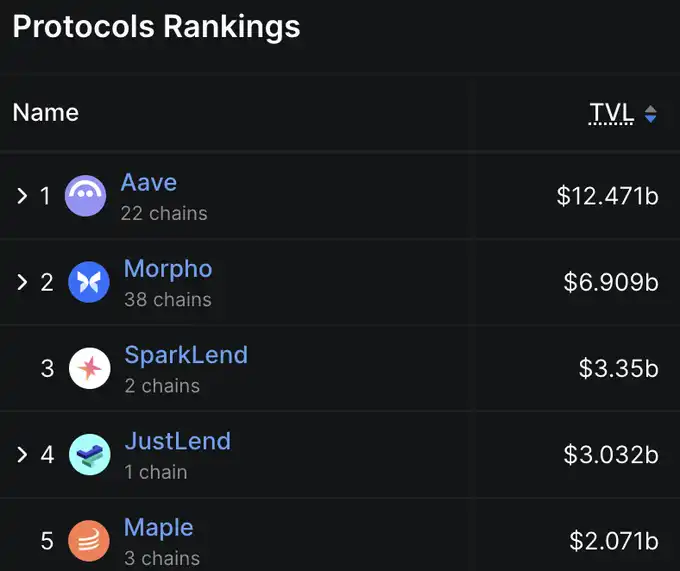
DeFAI Agents have redeployed over $2 billion TVL across lending and yield protocols—an absolute impressive number, but still less than 2% of total DeFi TVL ($130-140 billion).

This clearly indicates that deposit decisions, collateral choices, and risk appetite are still predominantly the human's call. While AI Agents handle the plumbing at the edges, the core remains in human hands.

Human-Dominated Sectors

Stablecoins & Card Payments

As of March 2026, the total stablecoin market cap is approximately $312 billion. Adjusted volume (filtering out bot activity, MEV, and wash trading) reached $28 trillion in real economic activity in 2025. Growing at a 133% CAGR since 2023.

Stablecoin transfers under $250 hit a new high of 5.84 billion in August 2025. We posit these are users sending money to family, paying freelancers, or splitting bills. Over 80% of USD-backed stablecoin transactions occur outside the US, where Agent adoption leads.

Real people in emerging markets use stablecoins for dollar access and economic hedging, making them directly responsible for stablecoin market share. Volume reached $1.78 trillion in February 2026 alone.

Furthermore, the card payment category is booming due to clearer regulations. Products allow users to spend crypto assets anywhere traditional cards are accepted, with funds remaining self-custodied until the moment of purchase.

This sector is roughly only 5% Agent-driven. The rest is people moving money. Unlike bot-dominated sectors, users here often don't know or care they're using crypto. That's precisely the point.

Wallets

Wallets are the last mile between humans and the blockchain, the layer that cannot be fully abstracted away.

While abstraction attempts are underway, the approval process desperately needs human oversight. Someone must sign. Someone must decide whether to trust what's in front of them.

Phantom has over 15 million monthly active users. The entire wallet space is investing in human-centric improvements like human-readable transaction previews, biometric security, and card-based spending.

The best wallets of 2026 have evolved from "seed phrase + string" storage containers to complete financial dashboards.

Enterprise-grade Agent wallets in 2026 include budget limits, whitelists, audit logs, and emergency stops—treating Agents as operators with restricted permissions, not omnipotent signers.

The Human & Agent Verification Layer: The More Agents, The More Important This Becomes

As more and more Agents flood on-chain activity, proving you're human or that an Agent is acting on behalf of a human becomes increasingly valuable.

Several projects are developing along these lines, ensuring we don't get lost in the machine world's matrix.

World & AgentKit

First mention: World (formerly Worldcoin - WLD)—these guys have verified over 17 million users via iris-scanning Orb hardware.

World describes itself as a response to an AI-saturated world—building digital infrastructure that makes being human actually count.

It subsequently launched AgentKit. A toolkit that lets AI Agents carry cryptographic proof that they are backed by a unique human verified via World ID, integrated with Coinbase and Cloudflare's x402 protocol for stablecoin micropayments.

t54

Another project we're watching is t54, building trust and safety infrastructure (often called the "trust layer") for the Agentic economy—a world where autonomous AI Agents handle real tasks like managing funds, making payments, and trading on behalf of individuals or businesses.

Currently, AI Agents moving real money is risky (no verification, no accountability, easy to scam or violate compliance rules).

t54 tackles this with x402-secure, a dedicated trust layer that enhances the x402 protocol for secure AI Agent micropayments. x402-secure provides real-time risk scoring through its Trustline Engine and helps detect scams, including prompt injection, to ensure accountability.

t54 provides these guardrails so institutions and users can actually trust Agents with finances.

Self Protocol

These guys are building a decentralized zk-proof human-Agent binding layer on ERC-8004 (on-chain Agent identity).

Self Protocol uses zk technology to anchor each AI Agent to a verified human owner (human proof) without doxxing or data leaks.

It prevents Sybil attacks, supports self-custody wallets, autonomous actions, and commercial agreements while maintaining human accountability.

Selfclaw has integrated with ecosystems like Celo/Google Cloud, with fee recycling to support verified Agents.

Kite AI

Kite is a foundational L1 (EVM-compatible with Proof of AI consensus) built specifically for the Agentic internet.

It provides Agent Passport (verifiable identity, delegation, programmable spending rules or guardrails), autonomous stablecoin payments, governance, and verification so Agents can authenticate, transact, and collaborate without intermediaries.

Conclusion

Seriously, we're not anti-Agent. The data is clear in trading, MEV, and yield; bots have already won those rooms, and they won't be handing them back.

A head-to-head contest where 43% of humans got liquidated and zero bots got liquidated tells you everything about who owns the speed game.

But the full network data still shows humans are doing most of the work in the vast majority of jobs that actually touch real life—in payments, identity, and verification.

These are the layers that actually create value, that actually generate revenue. They share a common trait: they require judgment, trust, physical presence, or cultural context—things that cannot yet be reduced to an optimization function.

We believe teams shouldn't abandon building for direct human interaction in these areas and sectors entirely.

Agents need humans more than humans do right now. We believe those who understand this, and those building Agent and human proof systems, are worth watching.


Trending Cryptos

Related Questions

QWhich sectors in crypto are already dominated by AI Agents according to the article?

AAccording to the article, the sectors already dominated by AI Agents include derivatives trading (perpetuals), arbitrage trading (MEV), yield optimization, and spot trading with portfolio optimization.

QIn the context of prediction markets, what is the nuanced difference between AI Agent and human performance?

AIn prediction markets, AI Agents dominate short-term arbitrage games due to speed, achieving a 66.4% win rate versus 45.3% for humans and capturing most profits from sub-100ms executions. However, for markets lasting weeks or months, the gap narrows significantly, and humans often perform better by adapting to shifting fundamental dynamics, a task at which current robots struggle.

QWhat are some examples of sectors where human activity remains dominant, and why?

AHuman activity remains dominant in stablecoin & card payments and wallet management. This is because these sectors involve real-world economic activities like remittances, payments, and spending that require trust, judgment, and physical/cultural context. For wallets, the approval and signing process inherently requires human oversight for security and trust decisions.

QWhat is the purpose of human-Agent verification layers mentioned in the article, and name two projects building them?

AThe purpose of human-Agent verification layers is to provide trust, safety, and accountability in an increasingly agentic economy. They ensure that AI Agents represent verified human interests, prevent Sybil attacks, and enable secure financial actions. Two projects building such layers are t54 (building a trust & safety infrastructure with x402-secure) and Self Protocol (building a decentralized zk-proof human-Agent binding layer on ERC-8004).

QWhat key conclusion does the article draw about the relationship between AI Agents and human activity in crypto?

AThe article concludes that while AI Agents clearly dominate in speed and optimization-driven sectors like trading and MEV, human activity remains crucial in areas requiring judgment, trust, and real-world context, such as payments and identity. It argues that teams should not abandon building for direct human interaction in these areas, as 'Agents currently need humans more than humans need Agents,' and projects that build verification systems for both are key to watch.

Related Reads

Critical Game Week: BTC Retracement Confirmation vs. HYPE Support Battle | Guest Analysis

This weekly analysis outlines a critical juncture for BTC and HYPE markets, focusing on key price level confirmations. **BTC Analysis:** BTC is at a pivotal point after a five-wave rally from the June 5th low of $59,100. The price has broken below a short-term rising channel's lower boundary, with the current move seen as a pullback to test this breakdown. Failure to reclaim this level could lead to a retest of the $59,000-$60,000 support zone. The core scenario hinges on this channel retest outcome. * **Key Levels:** Resistance at $64,500-$65,000 (channel boundary) and $69,500-$70,500. Support at $59,000-$60,000 and $55,000. * **Strategy:** A core bearish stance is maintained (20% short from last week), with short-term plans for tactical trades. Three detailed contingency plans (A/B/C) are provided for short positions on resistance tests or breakdowns, emphasizing strict stop-loss discipline. **HYPE Analysis:** HYPE shows strong momentum but is currently in a corrective phase after hitting a new high of $76.94. The price is retesting the crucial $64-$66 support area. * **Key Levels:** Resistance near $77 and $80-$82. Support at $64-$66 and $52-$54. * **Strategy:** The short-term approach is "buy on dips, avoid chasing rallies." A long position is considered only if clear stabilization signals appear at the $64-$66 or deeper $52-$54 support zones, with tight risk controls. **General Risk Management:** A standardized trailing stop-loss protocol is emphasized: set initial stop, breakeven at +1% profit, then trail stops upward to lock in gains. *Disclaimer: All analysis is presented as a personal trading framework, not investment advice. Market conditions are complex and require dynamic adjustment.*

marsbit6m ago

Critical Game Week: BTC Retracement Confirmation vs. HYPE Support Battle | Guest Analysis

marsbit6m ago

Research Report Interpretation: Citi Attends AWS Summit, Bullish on Cloud Business Acceleration but Data Governance Remains Key Variable

Citi analyst Tyler Radke's team attended the AWS New York Summit (June 17-18), engaging with over 10 clients and partners. In a June 19 report, they highlighted the summit's focus on scaling agent AI for enterprise deployment. Citi maintains a "Buy" rating on Amazon, forecasting AWS revenue growth to accelerate to 37% in FY27 from 30% in FY26, noting this estimate may be conservative. Key takeaways: 1. **AWS Strategy Shift:** AWS is moving from proof-of-concepts to scalable deployment. New offerings like AWS Context (building enterprise knowledge graphs), Amazon Quick (cross-application AI assistant), and security tool Continuum address core enterprise pain points for AI adoption. 2. **Data Infrastructure Beneficiaries:** Data infrastructure companies like Snowflake, Elastic, Oracle, and ClickHouse are seen as direct beneficiaries of scaling AI workloads, as evidenced by strong growth and use cases presented. 3. **Critical Role of Data Governance:** As AI agents scale from hundreds to thousands, effective data governance becomes the key variable for deploying AI in core business processes. AWS Context represents AWS's strategic extension from providing compute/models to offering a data governance infrastructure layer. The report emphasizes that without solving data governance, AI will remain confined to pilot projects. The investment thesis focuses on AWS revenue acceleration and data infrastructure vendors' growth, while monitoring signals like AWS's quarterly revenue growth, Bedrock AgentCore task volume, and pricing impacts on companies like Elastic.

marsbit12m ago

Research Report Interpretation: Citi Attends AWS Summit, Bullish on Cloud Business Acceleration but Data Governance Remains Key Variable

marsbit12m ago

Crucial Week of Contention: BTC Tests Support and HYPE's Key Level Battle | Special Analysis

**Market Enters Critical Week: Bitcoin Pullback Test and HYPE Support Battle** The market enters a crucial phase of contention this week. The marginal shifts in Federal Reserve policy expectations continue to dictate the pricing rhythm for risk assets. Meanwhile, in the crypto market, following a period of sideways consolidation, the divergence between bulls and bears is becoming concentrated at key price levels. **Bitcoin (BTC) Analysis & Strategy** * **Technical View:** The 4-hour chart suggests BTC is in a five-wave structure since the June 5th low near $59,100. Price action shows a short-term rising channel. The recent drop below this channel's lower boundary is now being followed by a pullback attempt (wave 40-41). The outcome of this retest is critical. * **This Week's Outlook:** The core focus is whether BTC can reclaim and hold above the channel's lower boundary. * **Bullish Scenario:** A successful hold could lead to a continued rebound, potentially challenging the $69,500 - $70,500 resistance zone. * **Bearish Scenario:** Failure to hold may trigger a renewed test of the $59,000 - $60,000 core support area, with $55,000 as a deeper support level. * **Operational Strategy:** The author maintains a 20% mid-term short position initiated last week near $64,500, based on a model signaling a shift to a bearish structure. Short-term tactics involve using 30% capital for potential "spread" trades, with three contingency plans (A, B, C) outlined for reacting to resistance tests, breakouts, or support breakdowns. **HYPE Analysis & Strategy** * **Technical View:** On the 4-hour chart, HYPE shows strong momentum, having recently broken to a new high since January. The current pullback presents a clear three-wave correction structure, bringing the price back to the critical $64 - $66 support zone. * **This Week's Outlook:** The focus is on the battle for the $64 - $66 support area. * **Bullish Scenario:** Holding this support could signal a continuation of the uptrend from the June 10th low, leading to new highs. * **Bearish Scenario:** A breakdown could extend the correction, potentially testing the deeper $52 - $54 support band. * **Operational Strategy:** The recommended short-term approach is "buy on dips, avoid chasing rallies." A light long position (under 30% capital) could be considered if HYPE shows stabilization signals at the $64-$66 or $52-$54 support zones, confirmed by model signals. Strict stop-loss discipline is emphasized. **General Risk Management:** A strict trailing stop-loss protocol is advised: set an initial stop; move to breakeven at +1% profit; lock in profits progressively thereafter. *Disclaimer: All analysis is presented as the author's personal technical perspective and trading log, not as investment advice. Markets are complex and dynamic; risk control is paramount.*

Odaily星球日报12m ago

Crucial Week of Contention: BTC Tests Support and HYPE's Key Level Battle | Special Analysis

Odaily星球日报12m ago

AI Agents Also Need 'Credit Checks': ERC-8126 is Filling the Gap in On-chain Trust

The article discusses ERC-8126, a proposed standard designed to address the lack of trust and verification for AI Agents operating on-chain. While ERC-8004 provides AI Agents with a basic on-chain identity (answering "Who are you?"), it does not guarantee trustworthiness. ERC-8126 aims to fill this gap by establishing a verification layer (answering "Are you reliable?"). It standardizes how independent verification providers can assess an agent's associated risks across five key areas: Token/Contract Verification (ETV), Media Content Verification (MCV), Solidity Code Verification (SCV), Web Application Verification (WAV), and Wallet Verification (WV). These providers generate a standardized risk score (0-100) and proofs based on their checks, without acting as a single authoritative certifier. This allows wallets, marketplaces, dApps, and other agents to consume these risk signals—for example, to display warnings, filter listings, or make interaction decisions. The standard also incorporates concepts like Private Data Verification (PDV) and Zero-Knowledge Proofs (ZKP) to allow verification without exposing sensitive underlying data. Positioned alongside ERC-8004 (Identity) and ERC-8183 (Commerce for agents), ERC-8126 represents a step toward building a verifiable and accountable infrastructure for the emerging on-chain AI Agent economy, shifting trust assessment from purely user-based judgment to standardized, consumable signals.

marsbit30m ago

AI Agents Also Need 'Credit Checks': ERC-8126 is Filling the Gap in On-chain Trust

marsbit30m ago

Rented Conviction: How Much Real Money Is Behind the Bitcoin ETF Flows

Borrowed Belief: How much of Bitcoin ETF flows are real money? Weekly Bitcoin ETF flows, often interpreted as a measure of institutional conviction, are heavily influenced by a hidden arbitrage trade rather than genuine directional buying. A cash-and-carry arbitrage, where traders buy the ETF while simultaneously shorting Bitcoin futures on the CME to lock in a basis spread (the price difference between futures and spot), drives roughly half of the week-to-week flow volatility. This delta-neutral activity appears as ETF inflows but is unrelated to price views. Data shows a strong correlation (0.70) between weekly ETF inflows and increases in hedge fund short positions on CME futures, while Bitcoin’s weekly price returns have almost no explanatory power. However, this arbitrage activity dominates short-term *fluctuations*, not the cumulative *stock* of investments. Of the total ~$55 billion in net ETF inflows since launch, only about $1 billion currently represents net arbitrage exposure. The vast majority consists of steady, directional buying averaging around $400 million per week. The arbitrage trade has been unwinding for two years, with hedge fund short positions peaking near $14 billion in late 2024 and declining to ~$4.5 billion. Recent ETF outflows partly reflect this ongoing unwind as the basis compresses, not a loss of faith in Bitcoin. Thus, ETF flows overstate the *volatility* of belief, not its *level*. The headline number is more a gauge of arbitrage desk activity than conviction. For accurate interpretation, monitor the CME basis relative to Treasury yields and hedge fund net shorts—these reveal how much of the reported “demand” is truly directional.

marsbit33m ago

Rented Conviction: How Much Real Money Is Behind the Bitcoin ETF Flows

marsbit33m ago

Trading

Spot
Futures

Hot Articles

Discussions

Welcome to the HTX Community. Here, you can stay informed about the latest platform developments and gain access to professional market insights. Users' opinions on the price of AI (AI) are presented below.

活动图片