# Neobanks的所有文章

在 HTX 新聞中心流覽與「Neobanks」相關的最新資訊與深度分析。潘蓋市場趨勢、專案動態、技術進展及監管政策,提供權威的加密行業洞察。

The Truth Behind Digital Banking: The Fragile Ecosystem Supporting 1.46 Billion Users

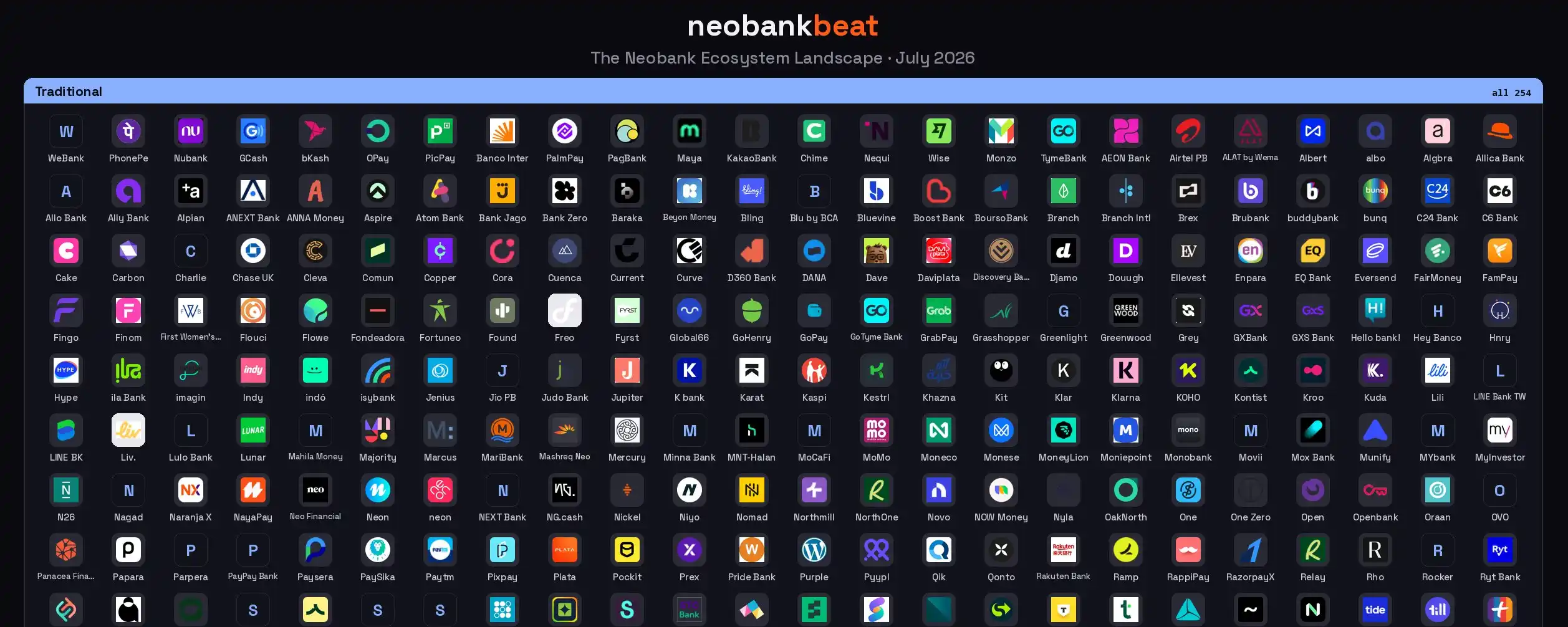
The article "The Truth About Digital Banks: The Fragile Ecosystem Behind 1.46 Billion Users" provides a data-driven analysis of the digital banking sector based on a verified list of 368 active neobanks as of July 2026. While these platforms collectively serve 1.46 billion users, with Asia (817 million users) and institutions like WeBank and Nubank dominating the landscape, the sector faces significant structural vulnerabilities. A key finding is that only 127 of the 368 neobanks hold full banking licenses. The majority operate atop third-party infrastructure providers like Banking-as-a-Service (BaaS) platforms, creating systemic risk where the failure of a single provider, as seen in past cases like Wirecard and Synapse, can jeopardize multiple consumer brands. Furthermore, the industry experiences a steady, quiet stream of failures, mergers, and shutdowns that often go unreported. The analysis also examines the adoption of artificial intelligence (AI), finding only 67 platforms (18%) have deployed AI at scale, with many innovators based in emerging markets like Nigeria and the Philippines. The infrastructure layer is highly concentrated, with 106 providers supporting the entire ecosystem of 368 consumer-facing brands. The article concludes with three predictions: the unlicensed gap will close through acquisitions or exits; an AI credit model is likely to fail in the next economic downturn; and a nascent but significant trend is the emergence of financial services designed for AI agents rather than humans.

marsbit昨天 11:06

The Truth Behind Digital Banking: The Fragile Ecosystem Supporting 1.46 Billion Users

marsbit昨天 11:06

The Fate of Digital Banks: A Fancy App Can't Match a Banking License

**Title:** The Fate of Digital Banks: A Fancy App is No Match for a Banking License **Summary:** The article argues that digital-only "neobanks" have struggled to achieve profitability, with 76% still operating at a loss. Their core mistake was focusing on offering low-fee checking accounts, which generate minimal revenue from interchange fees. The fundamental profit engine of banking is **credit**—lending money and earning interest—a business largely restricted to licensed entities. Successful neobanks like **Nubank** and **Revolut** only became profitable by pivoting to become full-scale lenders, using their sleek apps as mere customer acquisition tools. Others, like **Chime**, suffered for years relying solely on transaction fees before embracing lending. The piece highlights the systemic risks of depending on third-party infrastructure, exemplified by the **Synapse** bankruptcy which froze millions in user funds. The only reliable safeguard is a **banking license**, which provides direct regulatory oversight and control over assets. This realization is now dawning in the cryptocurrency sector. Major firms like Paxos, Circle, and Crypto.com are actively seeking **national trust charters** from the OCC to legitimize their operations and escape dependency on traditional banking partners. Companies like **SoFi** have completed the evolution from fintech to licensed bank to stablecoin issuer. While DeFi has grown in secured lending, **unsecured lending** remains minuscule due to the lack of real-world identity and legal recourse for defaults on blockchain. Truly scaling credit likely requires a banking license. The conclusion is stark: despite promises of disruption, surviving digital banks have simply replicated the age-old banking model—profiting from interest on loans. A user-friendly interface changes the experience, but not the essential economics. In the end, a banking license is not an option but a necessity for sustainable operation.

marsbit06/18 01:53

The Fate of Digital Banks: A Fancy App Can't Match a Banking License

marsbit06/18 01:53

The Fate of Digital Banks: No Fancy App Can Outshine a Banking License

The Fate of Digital Banks: A Flashy App is No Match for a Banking License The article argues that despite attracting billions of users with fee-free checking accounts and sleek apps, most "neobanks" struggle to be profitable because their core business—transaction fees—is inherently low-margin. The real profit engine of banking is lending (credit), which generates interest income. However, many early neobanks operated without their own banking licenses, which restricted their ability to lend at scale. Examples like Nubank, Revolut, and Chime illustrate the point. While they gained users with free accounts, their eventual profitability came from rolling out credit products. The piece highlights systemic risks for neobanks that rely on third-party infrastructure, citing the Synapse bankruptcy, which froze user funds and revealed the fragility of such models. The solution, according to the author, is obtaining a formal banking license, like the U.S. OCC's national trust charter. This provides regulatory backing, allows direct custody of funds, and eliminates dependency on intermediary partners. The trend is now evident in the crypto sector, where companies like Kraken, SoFi, and others are actively pursuing such licenses. The article concludes that while technology changes, the fundamental business logic of banking—profiting from lending—remains constant. Successful digital banks ultimately conform to this old model, just with better interfaces and fairer terms.

Foresight News06/17 10:03

The Fate of Digital Banks: No Fancy App Can Outshine a Banking License

Foresight News06/17 10:03

Crypto's New Frontier: Building the Next Generation of Permissionless Neobanks

Crypto Neobanks: Building the Next Generation of Permissionless Banking A new paradigm is emerging in crypto's second decade: permissionless neobanks. Unlike fintech neobanks that improved banking's front-end but kept traditional back-ends, crypto neobanks aim to rebuild the entire financial backend using stablecoins and public blockchains. They provide a unified, self-custodial interface for four core financial functions: Store, Spend, Grow, and Borrow. The landscape includes self-custody wallets (Ledger, MetaMask), payment solutions (EtherFi card, Bitget QR), growth platforms (Hyperliquid for trading), and lending protocols (Aave, Morpho). Centralized exchanges like Coinbase and Binance are also evolving into full-service neobanks. Key insights: - Success requires capturing high-velocity money flows, starting with Grow (trading fees) and Borrow (interest), then expanding to Spend and Store. - Wallet-first approaches face monetization challenges unless they drive active transactions. - Payment-focused apps must move beyond card commoditization to build unique user loyalty. - Enterprise "stablecoin chains" (Stable, Tempo) prioritize institutional efficiency and privacy. - Non-custodial lending remains crypto's "holy grail," limited by the lack of robust identity systems. Future opportunities lie in solving privacy-compliance parity, achieving real-world composability, leveraging permissionlessness for global-local strategies, and unlocking undercollateralized consumer credit. Crypto neobanks aren't just new apps—they are rebuilding the underlying rails of money itself.

marsbit02/24 04:00

Crypto's New Frontier: Building the Next Generation of Permissionless Neobanks

marsbit02/24 04:00

2026 Crypto Narratives to Watch: Who Will Be the Next Star?

Crypto Narratives to Watch in 2026: Key Trends and Opportunities The crypto industry continues to evolve through narratives and trends. Identifying these early is crucial for success. Key narratives expected to shape 2026 include: - **GambleFi**: Prediction and information markets like Polymarket and Kalshi are becoming essential tools for real-world decision-making, offering economically-backed insights. - **Launchpads**: Community-led fundraising and ICOs are making a strong comeback, with over $341M raised recently. Platforms like Legion, MetaDao, and Coinlist are leading this shift toward investor-friendly and protocol-economy focused sales. - **Privacy**: With institutional capital demanding confidentiality, privacy is no longer optional. Over $500M has been invested in privacy-focused dApps and chains in 2025. Selective disclosure—proving legitimacy without exposing data—will be critical. - **Crypto Neo-Banks**: Wallets are evolving into full financial interfaces integrating custody, payments, yield, reporting, and compliance. Projects like Revolut and Avici are pioneering this shift. - **DePIN**: After a 2025 slump, decentralized physical infrastructure networks like Helium, Hivemapper, and Render are gaining real traction with measurable usage and revenue, attracting continued VC interest. - **Perp DEXs**: Platforms like Hyperliquid and dYdX are proving that decentralized perpetual exchanges can compete with CEXs in volume and fees. The winners will offer capital efficiency, low slippage, and innovative risk management. - **AI**: AI is moving beyond trading bots to become core infrastructure—writing smart contracts, managing risk, and optimizing liquidity. Key skills include vibecoding, prompt engineering, and AI-augmented research. Additional narratives to monitor include x402 (onchain simplification), bot tokenization, stablecoins, and real-world assets (RWA). 2026 promises to be a dynamic year for crypto innovation and value creation.

marsbit12/30 04:56

2026 Crypto Narratives to Watch: Who Will Be the Next Star?

marsbit12/30 04:56

活动图片