STRC Must Re-Anchor for a BTC Bull Market to Happen

marsbit發佈於 2026-06-26更新於 2026-06-26

文章摘要

Title: STRC's Depegging Threatens MicroStrategy's Bitcoin-Buying Machine, and Thus the BTC Bull Run Summary: The sustained depegging of MicroStrategy's priority share STRC (trading ~25% below its $100 target) is severely disrupting the company's core business model and poses a major risk to Bitcoin (BTC) price support. STRC was MicroStrategy's most efficient and low-cost funding tool, designed to allow continuous capital raises near its $100 par value to fuel relentless BTC accumulation. Its depegging has effectively blocked this primary funding channel. The situation creates a severe cash flow crisis. STRC and other priority shares now obligate MicroStrategy to pay approximately $1.7 billion in annual cash dividends, while the company's cash reserves are only about $1.4 billion — insufficient to cover one year of payments. To raise cash, MicroStrategy is increasingly resorting to issuing common stock (MSTR) through ATM offerings. However, recent raises show most proceeds (around 90% in one week) are now used to bolster cash reserves rather than buy Bitcoin. This dilutes the key metric of Bitcoin per MSTR share, eroding the fundamental value proposition for equity investors. The company faces grim alternatives: issuing high-cost debt or selling its massive Bitcoin holdings. The latter, though hinted at, would likely trigger significant negative market reactions. Conclusion: As BTC's largest corporate holder and a major marginal buyer, MicroStrategy's funding woes mean ...

Author|Azuma(@azuma_eth)

The "de-anchoring" of Strategy's preferred stock STRC continues to intensify.

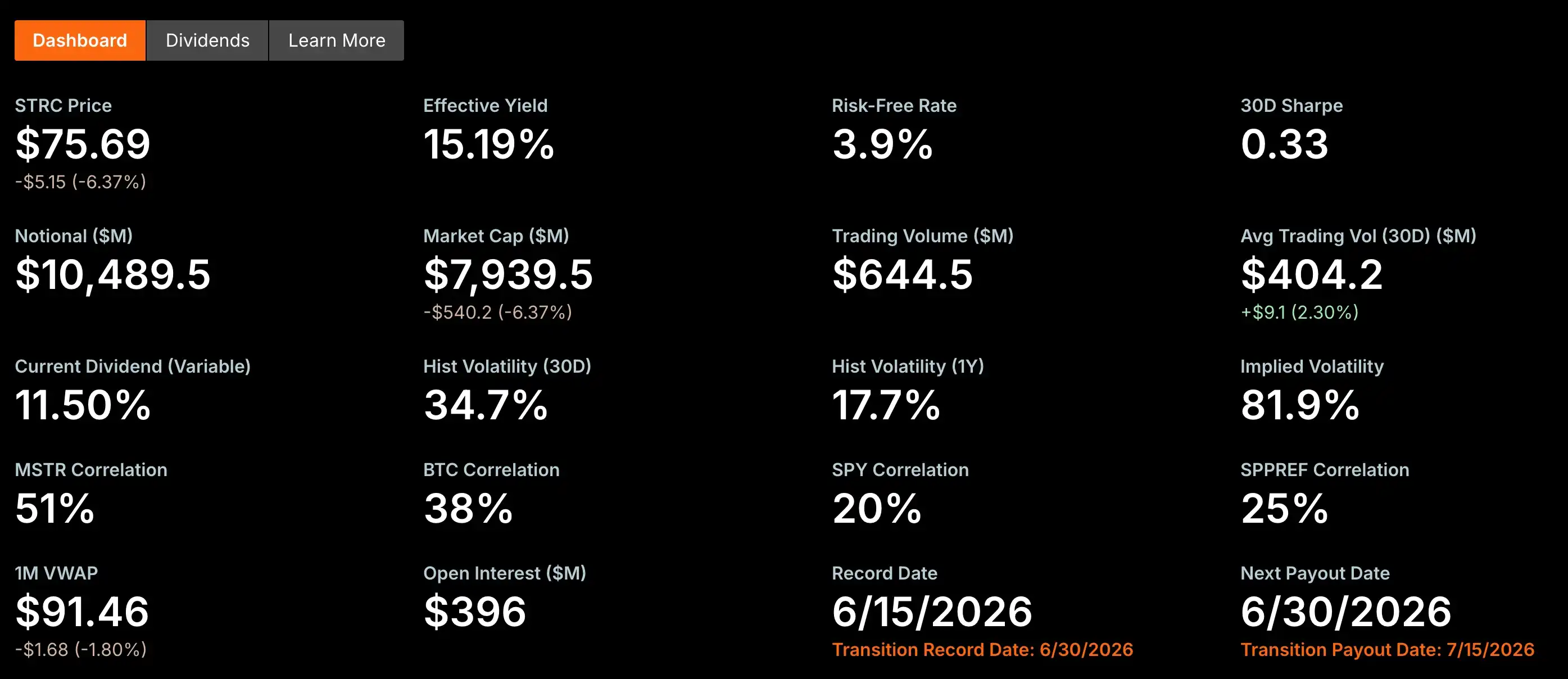
During yesterday's U.S. stock market session, STRC fell below the 80 mark for the first time, touching a low of $73.62 at one point. Although it rebounded slightly by the close, the price remained at only $75.69, nearly 25% "de-anchored" from its target face value of $100.

Last week, we wrote an article titled "STRC De-anchored by 11%, Can Strategy's Perpetual Motion Machine Keep Running?" focusing on the reasons for STRC's de-anchoring and briefly outlining its potential future impacts.

However, judging from community discussions, it seems many readers still do not fully grasp just how dire the consequences of STRC's persistent de-anchoring are, so we decided to write another article to break down this issue.

Strategy's Most Important Fundraising Channel Has Failed

What exactly is STRC? In a nutshell, it is Strategy's cheapest and most efficient fundraising channel.

The essence of Strategy's business model is to continuously raise funds from the market to acquire more BTC, then raise more funds and acquire even more BTC. This is a cycle that must keep turning. Strategy's high valuation is largely based on the market's belief in its ability to persistently raise funds and buy BTC. As long as its fundraising capability remains, it can keep expanding its BTC holdings; and the ever-growing BTC holdings, in turn, further support the market's expectations for its future fundraising ability.

Over the past few years, Strategy has tried almost every fundraising method—issuing common stock, convertible bonds, and various types of preferred stock—and continuously invested the raised funds into BTC. Among all its fundraising tools, STRC was once considered by the market as the one closest to "perfect," and is Michael Saylor's proudest creation. Saylor once boasted, "STRC is a product designed by AI, humans couldn't have designed this."

As a preferred stock, STRC's advantages are very clear. Issuing common stock could dilute existing shareholders' equity; issuing convertible bonds means the company bears future debt repayment pressure; but STRC, as a perpetual preferred stock, has no maturity date, does not dilute common shareholders, and only requires fixed dividend payments. For Strategy and Saylor, this was almost the lowest-cost, highest-efficiency fundraising method.

From its inception, STRC was designed as a product anchored to $100. Strategy envisioned that by dynamically adjusting its dividend yield, STRC would trade long-term around $100 (sound familiar, like algorithmic stablecoins?). As long as the secondary market could maintain this price, the company could continuously issue new STRC at prices close to face value, raise new funds, and continue buying Bitcoin.

In other words, STRC's core value lies in its endless fundraising ability, but this ability is predicated on its price remaining near the target face value. As STRC continues to de-anchor, this fundraising channel is effectively blocked. Because for any investor, if buying the same STRC in the secondary market only costs $75, there is no incentive to participate in the company's new preferred stock issuance at a price close to $100.

For Strategy, the options are either to keep raising the dividend yield to attract funds (which has proven to have limited appeal) or to accept the reduced fundraising efficiency from discounted issuance (which actively breaks the original target face value). Either way, it means this fundraising machine is developing increasingly significant friction.

The Fundraising Tool Has Become a Cash Flow Burden

If it were just a temporary failure of fundraising ability, it might be manageable. The bigger problem is that STRC requires Strategy to make continuous, substantial cash dividend payments.

According to Strategy's latest official disclosure, the current issuance size of STRC is approximately $10.49 billion, with a current dividend yield of 11.5%. This means that for STRC alone, Strategy has an annual cash dividend payment obligation exceeding $1.2 billion. Adding other preferred stocks like STRD, STRK, STRF issued by Strategy, this figure climbs to about $1.7 billion.
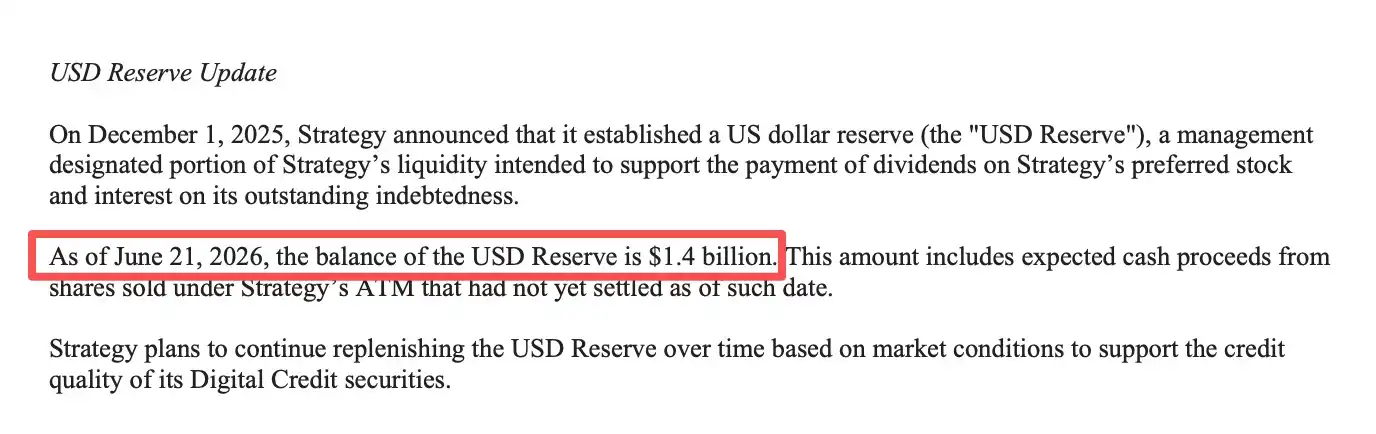
In the common stock issuance filing on June 21st (note: common stock, details below), Strategy disclosed that its cash reserves are approximately $1.4 billion. At this cash reserve level, Strategy's on-book cash can cover less than one year of preferred stock dividend payments.
Resolving the Situation Requires Money, But Where Will It Come From?

Whether to sustain its own business model or to escape its current severe cash flow situation and avoid dividend payment default (the more urgent issue), Strategy needs more money. Theoretically, Strategy now has only three viable paths to "get money."

First, issuing common stock.

This is currently the most direct and mature financing method. Through its ATM (At-the-Market Offering) program, Strategy can continuously sell MSTR common shares to the market to raise funds.

But common stock financing is not without cost. Continuous issuance means the number of outstanding shares keeps increasing. If the growth rate of BTC purchased with newly raised funds cannot outpace the share expansion rate, the BTC per share growth will slow down, and common shareholders will face continuous dilution—note this point, it's important for what follows.

Second, issuing more debt.

Over the past few years, Strategy has repeatedly raised funds through debt instruments like convertible bonds, which were a crucial source of funds for its early large-scale BTC acquisitions.

However, as the scale of preferred stock has continued to expand and fixed cash outflows have persisted, the market has started paying closer attention to Strategy's liquidity and debt repayment capacity. In the current financing environment, if the company issues bonds again, investors are likely to demand higher risk premiums, meaning financing costs will be significantly higher than in the past.

More importantly, bonds differ from preferred or common stock; their interest payments and principal repayments are rigid obligations. Against a backdrop of declining cash reserves and increasing dividend payments, further expanding debt would undoubtedly加重 the company's financial burden and compress its future financing space.

Third, selling BTC.

From a financial perspective, this is the fastest way to replenish cash reserves. Strategy has certainly considered this path. The company stated on its official X account regarding dividend payment pressure: "When considering its massive Bitcoin reserves, they are sufficient to cover 32 years of dividend payments."

But for Strategy, this is also an extremely dangerous choice. Earlier this month, Strategy sold some of its Bitcoin holdings for the first time. Although the sale was only for 32 BTC, and the official presentation framed it as "active market desensitization testing" and mentioned "will buy back more later," it still caused a short-term market dip.

As the largest single holder of Bitcoin in the market, Strategy's actions can easily trigger market chain reactions. If it increases sales volume in the future, it will undoubtedly place huge pressure on the already fragile BTC price. If BTC declines further, Strategy's so-called "reserves" would also quickly shrink.

In summary, in the current situation, every viable fundraising channel for Strategy comes at a higher cost than in the past.

Has Strategy Made Its Choice?

Based on Strategy's latest moves, aside from hinting at possibly selling BTC, the company seems to have already chosen its path.

Since June, Strategy has relied on its common stock ATM (At-the-Market Offering) program for fundraising for three consecutive weeks, with the latest round (June 22nd) being particularly typical.
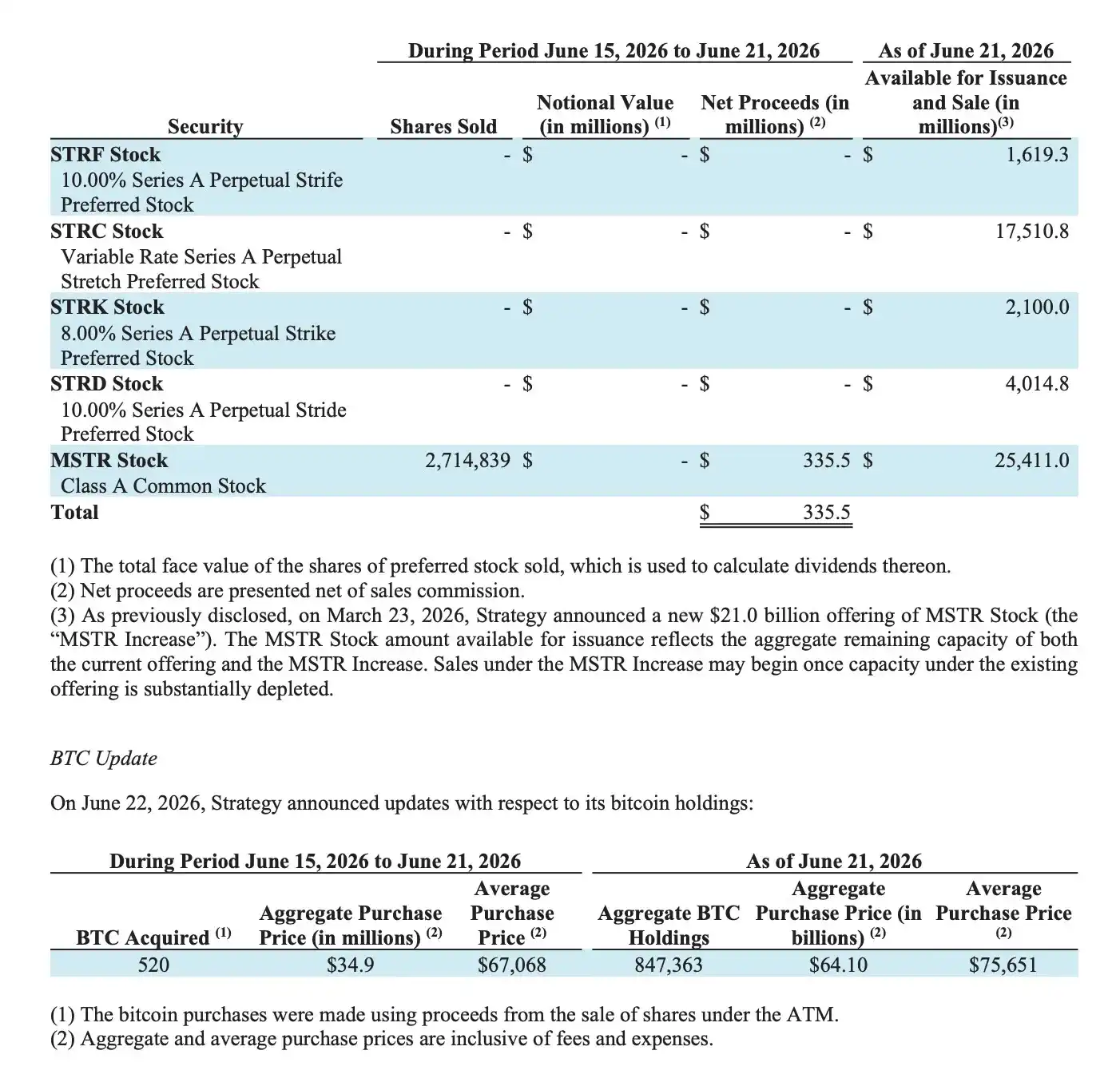
According to Strategy's latest 8-K filing, the company sold a total of 2,714,839 MSTR common shares in one week, raising $335.5 million. However, that same week, Strategy only purchased 520 BTC, spending a total of $34.9 million, with an average purchase price of around $67,068. In other words, of the $335.5 million raised, only about 10% was actually used to continue acquiring BTC. The remaining funds were primarily used to replenish the company's cash flow reserves, increasing cash from about $1.1 billion previously to the current ~$1.4 billion.

This might seem quite effective? But there's another trap here.

For MSTR common shareholders, the most critical information is: for each new common share issued, how much BTC can the raised funds ultimately buy back? Is it enough to cover the BTC equity corresponding to this new share? If the new financing can buy back more BTC than the share originally corresponded to, then common shareholders' equity is actually enhanced. Conversely, if the raised funds buy back insufficient BTC to cover the new share's corresponding BTC equity, then common shareholders suffer dilution.

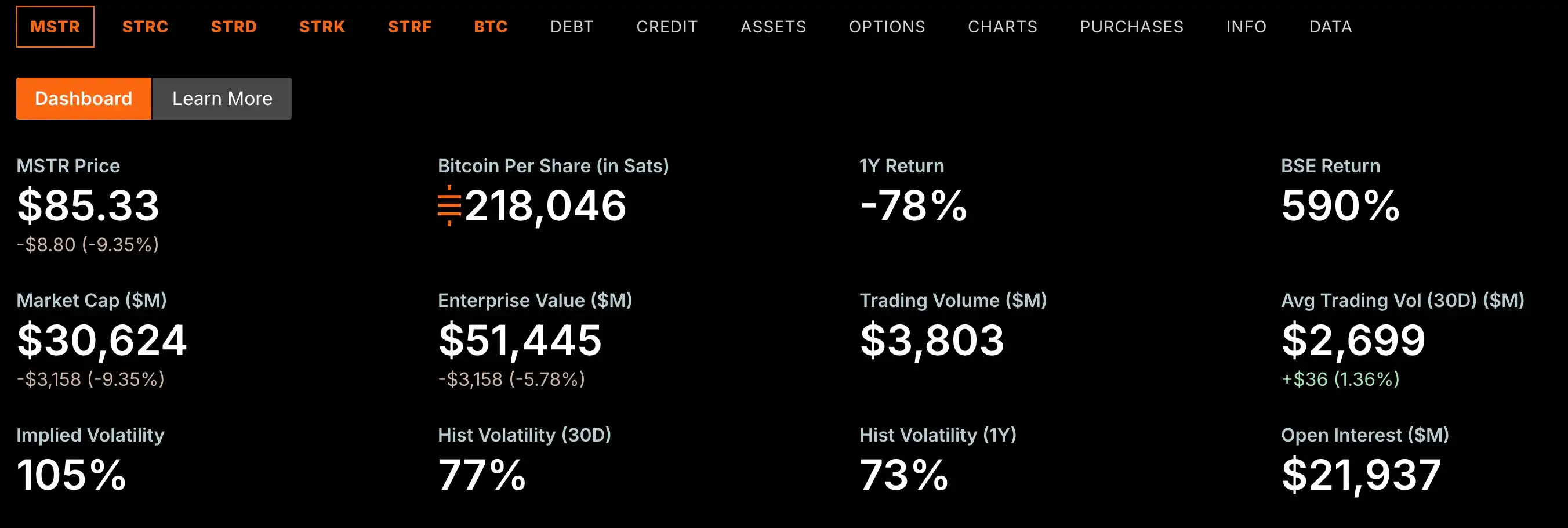
Clearly, Strategy's recent common stock issuance has come at the cost of diluting common shareholder equity. Strategy's official data also shows that MSTR's BTC per share has decreased from a peak of 220,900 Sats to 218,046 Sats.
This is the biggest limitation of common stock financing. For the vast majority of public companies, issuing common stock is just one of many financing methods; but for Strategy, common stock itself is part of its business model.

Over the past few years, Strategy's growth has essentially relied on the continuous operation of the "fundraise ➡️ buy coins ➡️ solidify market expectations ➡️ fundraise again ➡️ buy coins again..." flywheel. The market's core expectation for Strategy lies in its ability to continuously create more BTC equity for common shareholders, not dilute it.

However, when Strategy is forced to rely increasingly on common stock financing to replenish cash reserves rather than continue acquiring BTC, the operating logic of this flywheel changes. While common stock financing can indeed alleviate Strategy's cash pressure in the short term, it is difficult to become a long-term substitute for STRC.

Once common stock financing persistently erodes BTC per share, the foundation upon which MSTR's high premium relies may also be challenged, and this is precisely the core competitive advantage of Strategy's entire business model.

What About BTC?

Over the past few years, Strategy has become the most important marginal buyer in the BTC market (arguably without "one of"). To date, Strategy has accumulated holdings of 847,363 BTC, accounting for about 4% of BTC's current circulating supply, valued at over $50.7 billion. The market has long grown accustomed to Saylor's massive, unwavering weekly purchases.

But now, this situation is changing. Strategy can still raise funds through common stock, but most of the funds are no longer flowing into BTC; they are prioritized for replenishing cash reserves. This means that under the same fundraising scale, the actual new buying power entering the BTC market is diminishing.

More detrimentally, this situation may persist. If STRC fails to re-anchor long-term, and preferred stock financing remains blocked, Strategy will be forced to rely on common stock financing long-term to maintain cash flow, potentially further reducing the proportion of funds used for BTC accumulation. For the BTC market, this means the most stable and certain institutional buying power of the past few years will no longer grow as consistently as before.

But even more concerning is that if excessive common stock issuance overly dilutes MSTR shareholder equity, Strategy may have to consider another financing channel—selling coins.

From weakened new buying power to the emergence of potential selling pressure, today's Strategy is no longer BTC's largest marginal buyer, but a giant sword hanging over BTC.


熱門幣種推薦

相關問答

QWhat is the core function of STRC within Strategy's business model, and why is its 'de-pegging' a critical issue?

ASTRC serves as Strategy's most efficient and low-cost financing channel. Its design aims to trade around a $100 par value, enabling Strategy to continuously issue new shares near that price to raise funds for buying more Bitcoin. The ongoing de-pegging, with the price dropping significantly below $100, has effectively blocked this crucial financing channel. Investors are unwilling to pay near par value for new issues when they can buy cheaper on the secondary market, undermining Strategy's core mechanism for growth.

QAccording to the article, what major financial burden does the STRC de-pegging create for Strategy beyond just hampering fundraising?

ABeyond hindering new fundraising, the de-pegged STRC imposes a massive ongoing cash dividend obligation on Strategy. With approximately $10.49 billion of STRC issued and an 11.5% dividend rate, Strategy must pay over $1.2 billion in cash dividends annually for STRC alone. Combined with other preferred shares, the total annual dividend burden rises to around $1.7 billion, which threatens to deplete its reported $1.4 billion cash reserve in less than a year.

QWhat are the three main paths for Strategy to raise more capital as outlined in the article, and what are the downsides of each?

AThe three main paths are: 1) Issuing common stock (MSTR): This dilutes existing shareholders if the new capital doesn't buy enough Bitcoin to cover the increased share count, eroding the key metric of BTC per share. 2) Issuing more debt (e.g., convertible notes): This increases rigid financial obligations (interest and principal) in an environment where investors would demand higher risk premiums, worsening Strategy's liquidity and debt burden. 3) Selling Bitcoin (BTC): While quickly boosting cash, this risks triggering a market downturn due to Strategy's status as a major holder, which could conversely devalue its own massive BTC reserves.

QHow has Strategy's recent use of common stock (MSTR) ATM offerings changed, and what concerning trend does this reveal?

AStrategy's recent common stock ATM offerings reveal a shift in fund allocation. For example, a late June offering raised $335.5 million, but only about $34.9 million (roughly 10%) was used to buy more Bitcoin. The majority was used to bolster the company's cash reserves. This indicates that new equity financing is increasingly being used not for growth (buying BTC) but for survival (covering cash needs like dividend payments), leading to a dilution of BTC per share for common stockholders.

QWhy does the article argue that 'If STRC doesn't re-peg, BTC has no bull market,' and what is the new risk Strategy poses to Bitcoin?

AThe article argues this because Strategy has been the most significant marginal buyer in the Bitcoin market, with its constant, large-scale purchases driven by efficient financing (like STRC). If STRC remains de-pegged, Strategy loses its primary funding tool and must rely on less efficient methods (common stock sales) that funnel less new money into BTC. This weakens a major source of buy-side pressure. Furthermore, if cash pressures mount, Strategy might be forced to sell Bitcoin, transforming it from the market's biggest steady buyer into a potential large-scale seller—a 'giant blade' hanging over the Bitcoin market.

你可能也喜歡

韩国机构的加密竞赛:稳定币与 RWA 双线爆发

韩国加密货币市场正经历结构性变革,金融与互联网巨头依托庞大的散户基础,积极布局机构级区块链基础设施,其中稳定币和现实资产(RWA)代币化是两大核心驱动力。 在稳定币领域,各方正围绕合规韩元稳定币的发行主体展开博弈。银行(如KB金融、韩亚金融)、支付商(如新韩信用卡、BC Card、Danal)及互联网平台(如KakaoPay、NAVER Pay)均已开展试点,旨在防御因美元稳定币流行导致的资金外流,并将数字金融活动锚定在本土体系内。加密原生项目若能在此期间主动提供底层技术解决方案,有望在监管放开后成为关键基建一环。 RWA代币化方面,韩国机构进展迅速,且聚焦本土特色产业,如船舶融资、军工供应链、K-pop知识产权等。相关法律框架(《资本市场法》修订)将于2027年初生效,新韩投资证券等机构已牵头搭建交易平台。加密项目的机遇在于弥补韩国券商的技术短板,提供全球分发渠道、跨链流动性方案及资产赋能工具,而非试图颠覆现有机构。 用户入口方面,互联网平台掌握关键流量。NAVER拟收购Upbit母公司Dunamu,Kakao正打造统一数字钱包,Toss则拥有全金融牌照和广泛线下网络。它们将区块链视为底层基建,是加密项目触达海量普通用户的重要渠道。 当前韩国监管框架逐步明晰,市场已具备散户基础、机构试点和民众认知。在监管完全落地前,与本土机构建立深度合作、落地实用场景的加密企业,将更有可能定义韩国数字资产行业的未来格局。美国《CLARITY法案》等外部监管进展也可能影响韩国市场的推进节奏。

Foresight News40 分鐘前

韩国机构的加密竞赛:稳定币与 RWA 双线爆发

Foresight News40 分鐘前

如何判断AI视频真假?综述动态、可溯源、可解释的检测体系

随着AI生成视频技术(如Sora、Veo等模型)的飞速发展,生成内容的逼真度已大幅提升,对虚假视频的检测变得日益困难且紧迫。传统仅输出“真假”二分类的检测方法已无法满足需求,检测目标应重新定义为“事实保真度验证”,即核查视频内容在感知和认知层面是否与真实世界一致。 本文综述了AI生成视频检测领域的最新进展。首先,将AI生成视频分为三类范式:局部操控视频、跨模态音视频编辑和端到端生成式视频合成。针对检测,提出了一个从低层到高层的四层方法框架: 1. 底层视觉线索分析:检测像素异常、生理信号等底层伪迹。 2. 时空一致性分析:核查视频在时间和空间上的连续性与合理性。 3. 跨模态一致性分析:验证视频内画面、声音、文字等多模态信息是否对齐。 4. 语言引导的世界级推理:引入外部知识,判断视频内容是否符合常识、物理规律和事实。 检测方法的演进趋势是从依赖视觉线索(第1、2层)逐步转向结合语言和多模态推理(第3、4层)。评测体系也需相应发展,不仅评估分类准确率,更要关注模型判断的可解释性、证据的可靠性以及在真实复杂环境下的鲁棒性。 未来的可信检测系统需要协同视觉与语言双视角,建立“识别-定位-解释”的清晰推理路径,并将内容分析与来源追溯相结合。这需要计算机视觉、自然语言处理、多模态理解等领域的共同努力,构建动态、可溯源、可解释的检测体系,以应对日益严峻的AI生成视频挑战。

marsbit1 小時前

如何判断AI视频真假?综述动态、可溯源、可解释的检测体系

marsbit1 小時前

万万没想到,AI x Crypto 最先落地的是安全审计

AI正深刻改变加密领域安全审计的格局。数据显示,2026年上半年DeFi领域安全事件频发,累计损失约9.42亿美元,其中第二季度尤为严重。传统观点认为安全审计需求稳定,但以Claude Mythos为代表的新一代AI工具大幅降低了发现智能合约漏洞的门槛,攻击者可快速扫描并利用漏洞,使得传统审计报告的有效期急剧缩短。 攻击不再局限于小型协议,即使经过多家知名机构审计的头部协议也频繁遭殃。攻击手段扩展到社会工程学、基础设施配置缺陷等领域,显示代码审计的覆盖范围存在局限。例如,Drift Protocol和KelpDAO均因非代码层面的漏洞导致重大损失。同时,AI也在辅助攻击者挖掘多年前部署的旧合约漏洞,使历史审计的保护价值归零。OpenZeppelin联合创始人甚至公开表示“所有DeFi都不安全”,引发行业广泛讨论。 面对挑战,项目方开始基于新标准进行防御性的重复审计,但这更多是应对风险的被动支出。审计机构则加速转型,一方面研发AI辅助审计系统提升效率,如OpenZeppelin推出Skills系统将安全防线前移;另一方面,商业模式正从一次性报告交付转向提供持续监控、形式化验证等嵌入式服务。例如,AI原生审计工具Firepan在已被多重人工审计的Curve合约中发现了新的组合型漏洞,展现了AI在防守端的潜力。 总之,AI加剧了攻防两端的竞赛。对于项目方,安全已成为需要持续投入的基础设施;对于审计机构,唯有加快技术和服务模式的重构,才能适应新时代的竞争。安全审计赛道正从红利模式转向激烈的竞争模式。

链捕手1 小時前

万万没想到,AI x Crypto 最先落地的是安全审计

链捕手1 小時前

交易

現貨

熱門文章

什麼是 $S$

理解 SPERO:全面概述 SPERO 簡介 隨著創新領域的不斷演變,web3 技術和加密貨幣項目的出現在塑造數字未來中扮演著關鍵角色。在這個動態領域中,SPERO(標記為 SPERO,$$s$)是一個引起關注的項目。本文旨在收集並呈現有關 SPERO 的詳細信息,以幫助愛好者和投資者理解其基礎、目標和在 web3 和加密領域內的創新。 SPERO,$$s$ 是什麼? SPERO,$$s$ 是加密空間中的一個獨特項目,旨在利用去中心化和區塊鏈技術的原則,創建一個促進參與、實用性和金融包容性的生態系統。該項目旨在以新的方式促進點對點互動,為用戶提供創新的金融解決方案和服務。 SPERO,$$s$ 的核心目標是通過提供增強用戶體驗的工具和平台來賦能個人。這包括使交易方式更加靈活、促進社區驅動的倡議,以及通過去中心化應用程序(dApps)創造金融機會的途徑。SPERO,$$s$ 的基本願景圍繞包容性展開,旨在彌合傳統金融中的差距,同時利用區塊鏈技術的優勢。 誰是 SPERO,$$s$ 的創建者? SPERO,$$s$ 的創建者身份仍然有些模糊,因為公開可用的資源對其創始人提供的詳細背景信息有限。這種缺乏透明度可能源於該項目對去中心化的承諾——這是一種許多 web3 項目所共享的精神,優先考慮集體貢獻而非個人認可。 通過將討論重心放在社區及其共同目標上,SPERO,$$s$ 體現了賦能的本質,而不特別突出某些個體。因此,理解 SPERO 的精神和使命比識別單一創建者更為重要。 誰是 SPERO,$$s$ 的投資者? SPERO,$$s$ 得到了來自風險投資家到天使投資者的多樣化投資者的支持,他們致力於促進加密領域的創新。這些投資者的關注點通常與 SPERO 的使命一致——優先考慮那些承諾社會技術進步、金融包容性和去中心化治理的項目。 這些投資者通常對不僅提供創新產品,還對區塊鏈社區及其生態系統做出積極貢獻的項目感興趣。這些投資者的支持強化了 SPERO,$$s$ 作為快速發展的加密項目領域中的一個重要競爭者。 SPERO,$$s$ 如何運作? SPERO,$$s$ 採用多面向的框架,使其與傳統的加密貨幣項目區別開來。以下是一些突顯其獨特性和創新的關鍵特徵: 去中心化治理:SPERO,$$s$ 整合了去中心化治理模型,賦予用戶積極參與決策過程的權力,關於項目的未來。這種方法促進了社區成員之間的擁有感和責任感。 代幣實用性:SPERO,$$s$ 使用其自己的加密貨幣代幣,旨在在生態系統內部提供多種功能。這些代幣使交易、獎勵和平台上提供的服務得以促進,增強了整體參與度和實用性。 分層架構:SPERO,$$s$ 的技術架構支持模塊化和可擴展性,允許在項目發展過程中無縫整合額外的功能和應用。這種適應性對於在不斷變化的加密環境中保持相關性至關重要。 社區參與:該項目強調社區驅動的倡議,採用激勵合作和反饋的機制。通過培養強大的社區,SPERO,$$s$ 能夠更好地滿足用戶需求並適應市場趨勢。 專注於包容性:通過提供低交易費用和用戶友好的界面,SPERO,$$s$ 旨在吸引多樣化的用戶群體,包括那些以前可能未曾參與加密領域的個體。這種對包容性的承諾與其通過可及性賦能的總體使命相一致。 SPERO,$$s$ 的時間線 理解一個項目的歷史提供了對其發展軌跡和里程碑的關鍵見解。以下是建議的時間線,映射 SPERO,$$s$ 演變中的重要事件: 概念化和構思階段:形成 SPERO,$$s$ 基礎的初步想法被提出,與區塊鏈行業內的去中心化和社區聚焦原則密切相關。 項目白皮書的發布:在概念階段之後,發布了一份全面的白皮書,詳細說明了 SPERO,$$s$ 的願景、目標和技術基礎設施,以吸引社區的興趣和反饋。 社區建設和早期參與:積極進行外展工作,建立早期採用者和潛在投資者的社區,促進圍繞項目目標的討論並獲得支持。 代幣生成事件:SPERO,$$s$ 進行了一次代幣生成事件(TGE),向早期支持者分發其原生代幣,並在生態系統內建立初步流動性。 首次 dApp 上線:與 SPERO,$$s$ 相關的第一個去中心化應用程序(dApp)上線,允許用戶參與平台的核心功能。 持續發展和夥伴關係:對項目產品的持續更新和增強,包括與區塊鏈領域其他參與者的戰略夥伴關係,使 SPERO,$$s$ 成為加密市場中一個具有競爭力和不斷演變的參與者。 結論 SPERO,$$s$ 是 web3 和加密貨幣潛力的見證,能夠徹底改變金融系統並賦能個人。憑藉對去中心化治理、社區參與和創新設計功能的承諾,它為更具包容性的金融環境鋪平了道路。 與任何在快速發展的加密領域中的投資一樣,潛在的投資者和用戶都被鼓勵進行徹底研究,並對 SPERO,$$s$ 的持續發展進行深思熟慮的參與。該項目展示了加密行業的創新精神,邀請人們進一步探索其無數可能性。儘管 SPERO,$$s$ 的旅程仍在展開,但其基礎原則確實可能影響我們在互聯網數字生態系統中如何與技術、金融和彼此互動的未來。

108 人學過發佈於 2024.12.17更新於 2024.12.17

什麼是 $S$

什麼是 AGENT S

Agent S:Web3中自主互動的未來 介紹 在不斷演變的Web3和加密貨幣領域,創新不斷重新定義個人如何與數字平台互動。Agent S是一個開創性的項目,承諾通過其開放的代理框架徹底改變人機互動。Agent S旨在簡化複雜任務,為人工智能(AI)提供變革性的應用,鋪平自主互動的道路。本詳細探索將深入研究該項目的複雜性、其獨特特徵以及對加密貨幣領域的影響。 什麼是Agent S? Agent S是一個突破性的開放代理框架,專門設計用來解決計算機任務自動化中的三個基本挑戰: 獲取特定領域知識:該框架智能地從各種外部知識來源和內部經驗中學習。這種雙重方法使其能夠建立豐富的特定領域知識庫,提升其在任務執行中的表現。 長期任務規劃:Agent S採用經驗增強的分層規劃,這是一種戰略方法,可以有效地分解和執行複雜任務。此特徵顯著提升了其高效和有效地管理多個子任務的能力。 處理動態、不均勻的界面:該項目引入了代理-計算機界面(ACI),這是一種創新的解決方案,增強了代理和用戶之間的互動。利用多模態大型語言模型(MLLMs),Agent S能夠無縫導航和操作各種圖形用戶界面。 通過這些開創性特徵,Agent S提供了一個強大的框架,解決了自動化人機互動中涉及的複雜性,為AI及其他領域的無數應用奠定了基礎。 誰是Agent S的創建者? 儘管Agent S的概念根本上是創新的,但有關其創建者的具體信息仍然難以捉摸。創建者目前尚不清楚,這突顯了該項目的初期階段或戰略選擇將創始成員保密。無論是否匿名,重點仍然在於框架的能力和潛力。 誰是Agent S的投資者? 由於Agent S在加密生態系統中相對較新,關於其投資者和財務支持者的詳細信息並未明確記錄。缺乏對支持該項目的投資基礎或組織的公開見解,引發了對其資金結構和發展路線圖的質疑。了解其支持背景對於評估該項目的可持續性和潛在市場影響至關重要。 Agent S如何運作? Agent S的核心是尖端技術,使其能夠在多種環境中有效運作。其運營模型圍繞幾個關鍵特徵構建: 類人計算機互動:該框架提供先進的AI規劃,力求使與計算機的互動更加直觀。通過模仿人類在任務執行中的行為,承諾提升用戶體驗。 敘事記憶:用於利用高級經驗,Agent S利用敘事記憶來跟蹤任務歷史,從而增強其決策過程。 情節記憶:此特徵為用戶提供逐步指導,使框架能夠在任務展開時提供上下文支持。 支持OpenACI:Agent S能夠在本地運行,使用戶能夠控制其互動和工作流程,與Web3的去中心化理念相一致。 與外部API的輕鬆集成:其多功能性和與各種AI平台的兼容性確保了Agent S能夠無縫融入現有技術生態系統,成為開發者和組織的理想選擇。 這些功能共同促成了Agent S在加密領域的獨特地位,因為它以最小的人類干預自動化複雜的多步任務。隨著項目的發展,其在Web3中的潛在應用可能重新定義數字互動的展開方式。 Agent S的時間線 Agent S的發展和里程碑可以用一個時間線來概括,突顯其重要事件: 2024年9月27日:Agent S的概念在一篇名為《一個像人類一樣使用計算機的開放代理框架》的綜合研究論文中推出,展示了該項目的基礎工作。 2024年10月10日:該研究論文在arXiv上公開,提供了對框架及其基於OSWorld基準的性能評估的深入探索。 2024年10月12日:發布了一個視頻演示,提供了對Agent S能力和特徵的視覺洞察,進一步吸引潛在用戶和投資者。 這些時間線上的標記不僅展示了Agent S的進展,還表明了其對透明度和社區參與的承諾。 有關Agent S的要點 隨著Agent S框架的持續演變,幾個關鍵特徵脫穎而出,強調其創新性和潛力: 創新框架:旨在提供類似人類互動的直觀計算機使用,Agent S為任務自動化帶來了新穎的方法。 自主互動:通過GUI自主與計算機互動的能力標誌著向更智能和高效的計算解決方案邁進了一步。 複雜任務自動化:憑藉其強大的方法論,能夠自動化複雜的多步任務,使過程更快且更少出錯。 持續改進:學習機制使Agent S能夠從過去的經驗中改進,不斷提升其性能和效率。 多功能性:其在OSWorld和WindowsAgentArena等不同操作環境中的適應性確保了它能夠服務於廣泛的應用。 隨著Agent S在Web3和加密領域中的定位,其增強互動能力和自動化過程的潛力標誌著AI技術的一次重大進步。通過其創新框架,Agent S展現了數字互動的未來,為各行各業的用戶承諾提供更無縫和高效的體驗。 結論 Agent S代表了AI與Web3結合的一次大膽飛躍,具有重新定義我們與技術互動方式的能力。儘管仍處於早期階段,但其應用的可能性廣泛且引人入勝。通過其全面的框架解決關鍵挑戰,Agent S旨在將自主互動帶到數字體驗的最前沿。隨著我們深入加密貨幣和去中心化的領域,像Agent S這樣的項目無疑將在塑造技術和人機協作的未來中發揮關鍵作用。

887 人學過發佈於 2025.01.14更新於 2025.01.14

什麼是 AGENT S

如何購買S

歡迎來到HTX.com!在這裡,購買Sonic (S)變得簡單而便捷。跟隨我們的逐步指南,放心開始您的加密貨幣之旅。第一步:創建您的HTX帳戶使用您的 Email、手機號碼在HTX註冊一個免費帳戶。體驗無憂的註冊過程並解鎖所有平台功能。立即註冊第二步:前往買幣頁面,選擇您的支付方式信用卡/金融卡購買:使用您的Visa或Mastercard即時購買Sonic (S)。餘額購買:使用您HTX帳戶餘額中的資金進行無縫交易。第三方購買:探索諸如Google Pay或Apple Pay等流行支付方式以增加便利性。C2C購買:在HTX平台上直接與其他用戶交易。HTX 場外交易 (OTC) 購買:為大量交易者提供個性化服務和競爭性匯率。第三步:存儲您的Sonic (S)購買Sonic (S)後,將其存儲在您的HTX帳戶中。您也可以透過區塊鏈轉帳將其發送到其他地址或者用於交易其他加密貨幣。第四步:交易Sonic (S)在HTX的現貨市場輕鬆交易Sonic (S)。前往您的帳戶,選擇交易對,執行交易,並即時監控。HTX為初學者和經驗豐富的交易者提供了友好的用戶體驗。

1.9k 人學過發佈於 2025.01.15更新於 2026.06.02

如何購買S

相關討論

歡迎來到 HTX 社群。在這裡,您可以了解最新的平台發展動態並獲得專業的市場意見。 以下是用戶對 S (S)幣價的意見。

活动图片