Original | Odaily Planet Daily (@OdailyChina)
Author | Azuma (@azuma_eth)

In conventional understanding, time is linear, but the crypto world has its "exceptions".
Yesterday, Eastern Time (ET) completed the switch from standard time to daylight saving time as per convention (generally on the second Sunday of March at 2:00 AM), moving the clock forward by one hour, jumping directly from 2:00 AM on March 8 to 3:00 AM. The time didn't vanish into thin air; it's just that the Eastern Time zone switches between Eastern Standard Time (EST) and Eastern Daylight Time (EDT) based on custom, aiming to artificially adjust the time scale to make fuller use of daylight hours (and save electricity in the process).
For daily life, this switch doesn't cause much impact, but on the prediction market Polymarket, yesterday's time zone switch directly sparked an unexpected controversy.
Polymarket Runs Into Timing Controversy
The controversy occurred around the "Crypto Up or Down" prediction events on Polymarket.
Polymarket offers cryptocurrency price movement prediction events with timeframes of year, month, week, day, 4 hours, 1 hour, 15 minutes, and 5 minutes, supporting major tokens like BTC, ETH, SOL, and XRP. These events are automatically created and settled based on Eastern Time and have become a significant source of trading volume on Polymarket.
At 1:00 AM on March 8 (still Eastern Standard Time at that moment), Polymarket launched new 1-hour up/down prediction events for BTC, ETH, SOL, and XRP. Links to the relevant events are below.
- BTC (Final Result: Up): https://polymarket.com/event/bitcoin-up-or-down-march-8-1am-et
- ETH (Final Result: Down): https://polymarket.com/event/ethereum-up-or-down-march-8-1am-et
- SOL (Final Result: Down): https://polymarket.com/event/solana-up-or-down-march-8-1am-et
- XRP (Final Result: Down): https://polymarket.com/event/xrp-up-or-down-march-8-1am-et
According to the event settlement rules — comparing the opening and closing prices of the 1-hour candle on Binance's USDT trading pairs starting from the event's beginning — the above four events have all been settled.
However, because the end time of this batch of events coincided with the daylight saving time switch, the moment Eastern Time reached 2:00 AM, it immediately jumped to 3:00 AM (meaning the period from 2:00 AM to 3:00 AM was skipped), causing some timing confusion for this batch of events on the Polymarket platform itself.




As shown on Polymarket's frontend interface, perhaps because 2:00 AM did not exist in yesterday's Eastern Time reckoning, the time period currently displayed for this batch of events is "March 8, 1-1 AM ET" (i.e., March 8, 1:00 AM - 1:00 AM). Under normal timing conditions, such events should display a 1-hour time period (for example, the previous day's similar event was "March 7, 1-2 AM ET", i.e., 1:00 AM - 2:00 AM). If accounting for the daylight saving time switch, a more reasonable time period for this batch would be "March 8, 1-3 AM ET" (i.e., 1:00 AM - 3:00 AM, still effectively 1 hour).
So no matter how you look at it, the currently displayed "March 8, 1-1 AM ET" is very strange.
Chinese user "Xiao Z" (@richrichardoz) posted on X regarding this, stating that besides the frontend, Polymarket's API also returned the "1-1 AM ET" time period, causing automated programs relying on the API data to "all crash", estimating losses exceeding $100,000 as a result.

"Xiao Z" further explained that the start time and end time being exactly the same is a market state that is logically impossible. Many automated trading systems rely on the end time to determine the trading window; this error directly caused their program to lose a large sum of money. Therefore, they suggested Polymarket change the time standard for relevant events to UTC time and compensate users affected by the data issue.
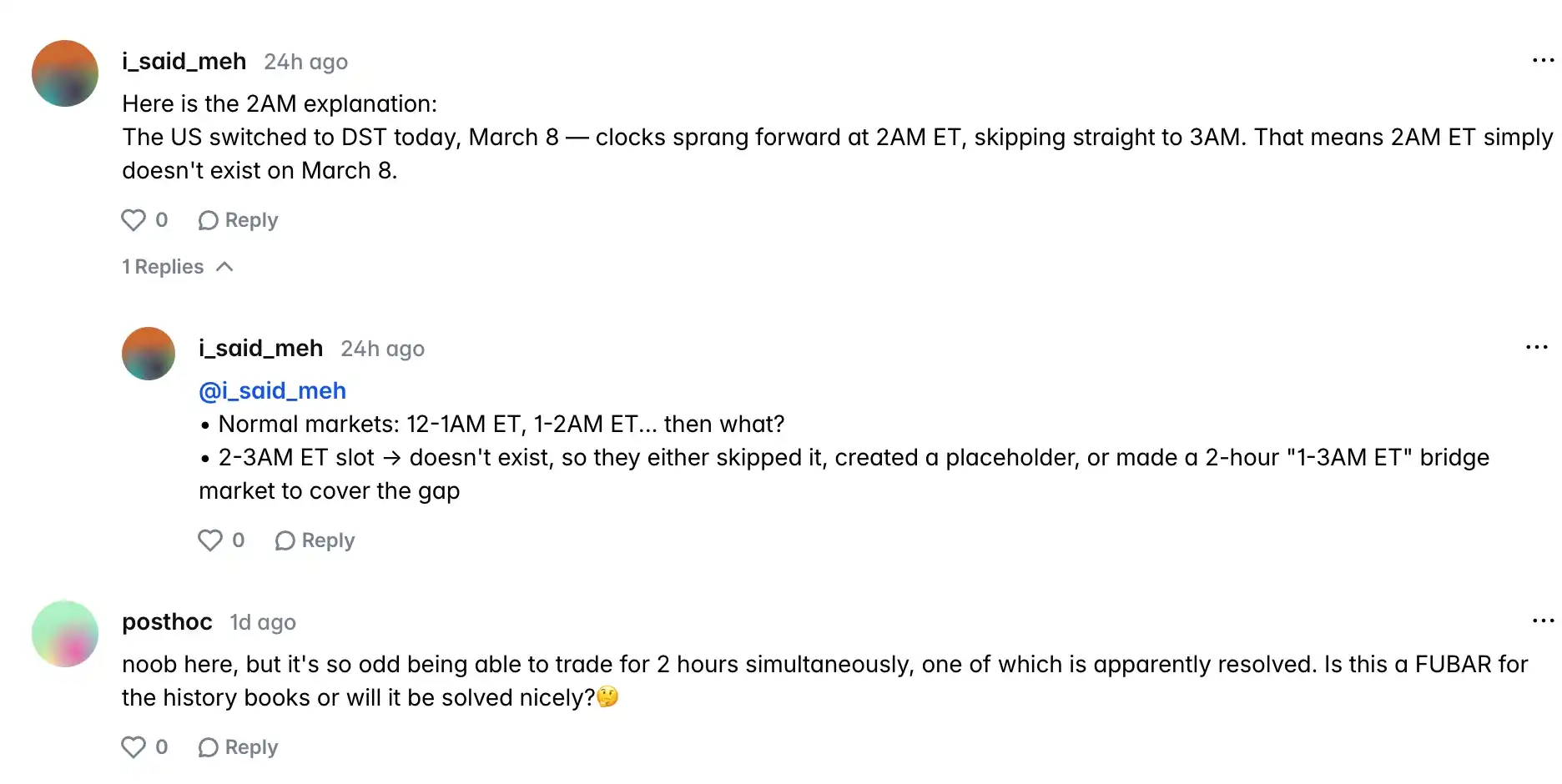
Besides this user, many other users have also commented under the relevant events expressing confusion, but as of writing, Polymarket has not responded through official channels.
Time Standards in Traditional Financial Markets
Looking back at this controversy, while the scale of impact isn't huge, it exposed a fundamental design flaw in Polymarket's "Crypto Up or Down" market events.
Influenced by historical customs, economic status, and industry practices, Eastern Time is still widely used across various industries. However, this is not particularly friendly to financial systems because Eastern Time switches between daylight saving time and standard time every year — artificially moving the clock forward or backward by one hour at specific times, creating "jumps" and "overlaps" in time respectively.
In modern financial systems, UTC time has long become the de facto universal standard. In the vast majority of financial infrastructure, internal systems typically use UTC timestamps as the sole standard time. Local times like Eastern Time are still used, but in system logic, they often only exist in the presentation layer面向用户. This design is precisely to avoid the uncertainty of time systems, ensuring that time remains monotonic, unique, and globally consistent in financial transactions, settlement, and automated systems.
The key矛盾 (contradiction) in this Polymarket controversy lies in the fact that the relevant events used Eastern Time as the timing standard but failed to fully consider the potential variable of the daylight saving time switch, ultimately causing confusion in the frontend and API data. Among the current user base of prediction markets, more and more participants are trading via APIs and automated programs. Some issues that originally only affected frontend display can easily be amplified into real financial losses in automated systems.
Judging by the outcome, this controversy might not be considered a serious incident, and theoretically it can only happen at most twice a year, but what it reveals is a more serious design problem — as prediction markets gradually move towards becoming financial infrastructure, they must also adhere to the engineering standards used by financial infrastructure.







