Organized & Compiled: Deep Tide TechFlow
Guest: Darren Mowry, Vice President, Google Cloud
Host: Rebecca Bellan
Podcast Source: TechCrunch
Original Title: Is your startup's check engine light on? Google Cloud's VP explains what to do | Equity Podcast
Broadcast Date: February 19, 2026
Key Summary
Startup founders are facing unprecedented pressure: with funding becoming tighter and infrastructure costs rising, they not only need to accelerate innovation but also prove their product's market appeal at an early stage. While the availability of cloud credits (free trial credits provided by cloud service providers), GPUs, and foundation models (pre-trained models supporting generative AI) has made starting a business easier, these early infrastructure choices can bring unexpected challenges when the free credits run out and actual cloud service fees become due.
In this episode of TechCrunch's Equity podcast, Rebecca Bellan delves into the trade-offs and challenges faced by startups during rapid scaling with Google Cloud's Global Vice President for Startups, Darren Mowry. As a key figure in the global startup ecosystem, Mowry shares his observations on industry trends, how Google Cloud attracts AI startups amidst competition, and the key issues startup founders need to pay attention to when scaling.
Highlights
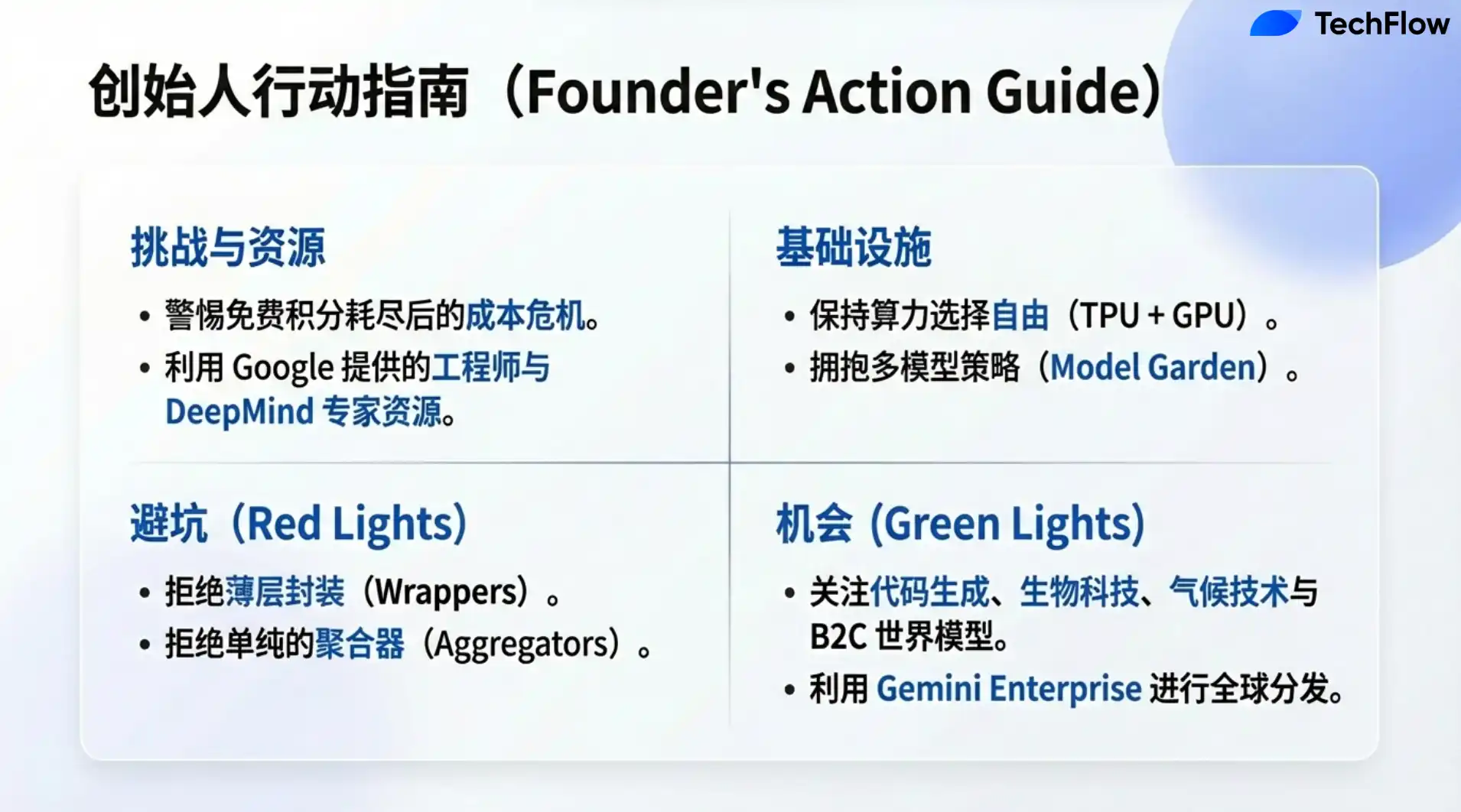
- While cloud credits are a standard practice in the industry, there's nothing particularly special about them. We all know credits are indeed important for startups, but what founders truly need is deeper engineering resources and technical support.
- Whether based on TPUs or GPUs, our goal is to help founders find the solution that best suits them, not to force them down a fixed path. We find this freedom of choice is very important for founders and is a major advantage for us.
- Startups are now shifting their focus from chips (like GPUs and TPUs) to focusing more on data models and agents. Currently, about 10% to 15% of discussions still revolve around chips, but the vast majority, about 80% to 85%, are focused on model and agent development.
- Agents can solve complex, customized problems, and their application scenarios are very broad. In the future, thousands of agents might be developed.
- We are now seeing the emergence of more and more first-time founders, coming from top universities, Y Combinator, and renowned AI research institutions like OpenAI, Anthropic, and DeepMind. These new founders bring more innovative energy.
- Speaking of AWS and Microsoft... their market positioning leans more towards a technology distributor role, rather than directly providing advanced technology solutions like Google. Google not only develops world-class AI technology but can also support third-party capabilities as a first-party provider, which makes us unique in the competition.
- Startups, in the rapid development of cloud computing and AI, are changing the traditional economic logic of enterprise IT. In the past, we typically thought companies with more employees were the biggest customers... but now some small startups, like Cursor, Lovable, and Open Evidence, despite their small size, consume far more technical resources than their scale would suggest. These companies are engineering-driven at their core, pushing our platform to new technical limits.
- The first is the 'Large Language Model (LLM) Wrapper' phenomenon. Wrapping refers to adding a layer of functionality or intellectual property around a model like Gemini or GPT-5 to form an application layer. However, we are seeing a rapid decline in industry demand for this simple wrapping. If a startup relies solely on the backend model to do all the work and is essentially just white-labeling the model, this approach is already struggling to gain traction.
- Another noteworthy trend is the challenge of the 'Aggregator' model. Aggregators refer to systems trying to build a layer on top of multiple models or platforms to help users choose models.... We find that this aggregator model is not showing significant growth because users want to see more intelligent functionality, not just a simple selection layer.
- Biotechnology, climate technology, and consumer experience are the areas we focus on. These industries are developing rapidly, and we see significant growth, strong retention rates, and increasing interest in the ecosystem.
How Startups Can Join the Google Cloud Ecosystem
Rebecca:How do startups become part of your ecosystem? How do they get involved? What support do you provide them?
Darren:
It's a two-way interactive process; we attract startups to our ecosystem through both push and pull factors. When I first joined Google Cloud five years ago, the cloud computing market was dominated by AWS. AWS had a frictionless, credit-card-like model that allowed founders to easily use compute, storage, and databases to build products, while Google Cloud's market position was more of a 'third choice' at the time, in a relatively traditional competitive environment.
But in the last 18 to 20 months, with the rapid development of AI, the situation has changed dramatically. AI is no longer a hype concept but has become a practical technological solution. Google has invested heavily in AI technology, for example, our advanced large language model Gemini, which has powerful natural language processing capabilities, provides technical support for many startups. It is these technological advantages that have led more and more founders to actively choose to build their products on Google Cloud from the start, creating a strong pull factor.
To help these startups, we launched the Google Cloud for Startups program. Founders can find the program through a simple online search and learn more details. We provide tailored cloud credits based on the startup's stage of development. These credits are free trial credits provided by Google Cloud, aimed at supporting startups in the early stages to launch projects quickly. Whether they have just completed their first round of funding or are in a more mature stage, we provide corresponding technical resources and services based on their needs and supporter situation to help them achieve rapid growth.
Beyond Cloud Credits: Engineering Resources and Technical Support
Darren: I want to emphasize that while cloud credits are a standard practice, there's nothing particularly special about them. We all know credits are important for startups, but founders truly need deeper engineering resources and technical support. For example, they want direct guidance from DeepMind experts, or they want experienced customer engineers involved in product definition. To this end, we have strengthened the technical support model, directing resources to the core needs of startups. From the early stage to the later stages, we provide support from technical experts for startups. This is a unique advantage of Google Cloud and a major highlight of our program.
Furthermore, we provide additional support for startups, including promotional activities, free use of Workspace (Google's office suite, including Gmail, Google Drive, and Google Docs), and solutions to help startups bring their Minimum Viable Product (MVP) or first-generation product to market. All of this is included in the Google Cloud for Startups program. So I'm glad you mentioned this, because many people mistakenly think this program is just about providing credits, but it actually goes far beyond that.
Rebecca:So how many startups are currently participating in this program? How do you provide engineer and researcher resources to these startups?
Darren:
There are thousands of startups currently participating in the program. This year we have seen significant growth, largely due to the technological appeal of Google, including the leading capabilities of Gemini and DeepMind. More importantly, we view startups from a lifecycle perspective. We know that when they exhaust their credits or can no longer use them, they face a critical transition moment. To help them transition smoothly, we provide commercial and economic level support to allow them to remain in our ecosystem.
While I can't share specific retention rates, we strictly measure the number of startups that remain on the Google Cloud platform after their credits end. From an industry perspective, our retention rate is very high, something I haven't seen in my career. And this number is growing every quarter, indicating that even after the credits are used up, startups still choose to stay on our platform.
TPUs vs. GPUs: Building Freedom of Choice
Rebecca:A notable advantage of Google Cloud is that you have your own TPUs (Tensor Processing Units), right? How much of a differentiating advantage are TPUs in attracting startups? Also, could this potentially create issues, such as startups getting accustomed to building on TPUs and then facing difficulties when switching to GPUs (Graphics Processing Units)?
Darren:
That's a good question. The core issue you mentioned actually reflects an important philosophy of ours: providing startups with freedom of choice. We believe this flexibility is a major competitive advantage for us right now.
From a chip level, TPUs are one of Google's core technologies. We are already on the seventh generation and will soon launch the eighth generation. Unlike some competitors who are just entering the chip field, Google has been深耕 (deeply cultivating) this area for many years. Our TPUs have excellent performance and a strong commercial and economic model, so many startups are willing to choose to build their products based on TPUs from the start.
At the same time, I also want to emphasize that we not only provide TPUs but also have a close partnership with NVIDIA. Just in my office behind me, I had an in-depth exchange with the leadership of NVIDIA's startup team. Many startups have great confidence in NVIDIA's technology, and we hope to provide more choices for startups through our cooperation with NVIDIA. Whether based on TPUs or GPUs, our goal is to help founders find the solution that best suits them, not to force them down a fixed path. We find this freedom of choice is very important for founders and is a major advantage for us.
What to Do When Cloud Credits Run Out and Costs Surge
Rebecca: You mentioned that many startups still stay on your platform after using up Google's cloud credits, and the retention rate seems very high. But I've also heard some founders complain that they knew the credits would run out, but didn't expect it to happen so quickly, and the subsequent cost surge caught them off guard. Generally, switching cloud services can take months, and startups often don't have that time. Rising infrastructure costs, coupled with increased bargaining power for cloud providers, could lead to startups facing the risk of failure before revenue covers costs. Do they express concerns about feeling trapped? If so, does Google have a responsibility to help startups through this, or provide more free resources to ease their pressure?
Darren:
This is a very important question, especially in the last six to eight months, we have indeed observed some new usage patterns, particularly in AI applications. We noticed that cost surges can occur after cloud credits are used up, and for this we have taken some measures to help startups better manage costs.
For example, we deployed technical tools and programmatic mechanisms in the program, allowing founders to monitor resource usage and costs through the console to avoid budget overruns. The console is a management interface for cloud services where startups can view resource consumption and costs in real-time. Our goal is to help them self-manage, because there are thousands of startups in the program, and I can't communicate with every founder individually. Therefore, we must provide solutions that require no manual intervention to help them manage resources more efficiently.
At the same time, we also invest heavily in the early stages of startups, helping them make development decisions, platform choices, and architectural design. This early intervention has significantly reduced cost-related surprises, mainly for two reasons. First, our engineers not only focus on technical issues but also consider the cloud credits allocated to the startup, the burn rate (the speed at which a startup consumes funds over a period of time) and the overall funding situation. Second, we are very clear that letting startup costs spiral out of control is not good for either party. We want to build long-term relationships with startups, not have them exit because they run out of money. Therefore, our engineers not only provide technical support but also help founders optimize resource usage from an economic and commercial perspective, ensuring they can smoothly navigate the post-credit phase.
The Shift from Chips to Models and Agents
Darren: Recently I noticed a very interesting phenomenon: the focus of startup discussions is shifting rapidly. Now startups are moving from focusing on chips (like GPUs and TPUs) to focusing more on data models and agents (Agentic). Currently, about 10% to 15% of discussions still revolve around chips, but the vast majority, about 80% to 85%, are focused on model and agent development.
This shift has significantly changed the economic model for startups. For example, the cost of using Google's Gemini model for task processing is significantly different compared to traditional cloud computing costs. Gemini is an advanced large language model developed by Google, focused on generative AI applications. It can help startups complete more tasks at lower cost and faster speed.
Therefore, we need to help startups shift away from an excessive focus on chips and start discussing data model and agent development more.
Trends in AI Adoption Among Startups
Rebecca:What trends have you observed recently? What changes are there in AI adoption among early-stage companies? How do you define success?
Darren:
The way AI technology is adopted is changing rapidly.
First, compared to the past, startups are showing new characteristics in terms of funding sources and founder backgrounds. In the cloud computing era, we mainly focused on startups that received large investments, usually backed by well-known venture capital firms like A16Z, Sequoia, Gradient, and GV. These firms are known for discovering excellent founders and projects. However, now we are seeing the emergence of more and more first-time founders, coming from top universities, Y Combinator, and renowned AI research institutions like OpenAI, Anthropic, and DeepMind. These new founders bring more innovative energy, while also requiring us to prepare for more complex and larger support needs.
Second, in the past 18 to 20 months, the focus of startups has changed significantly. From initially focusing on chip technology (like GPUs and TPUs) to now focusing more on data model and agent development. An Agent is an AI system capable of autonomous learning and performing complex tasks, often used in conjunction with large language models (LLMs). We find that the demand for models from startups is growing rapidly, for example, Google's Gemini model. Gemini is an advanced large language model focused on generative AI applications, capable of helping startups complete complex tasks at lower cost and faster speed.
Furthermore, we also notice that other companies are developing excellent models, such as Anthropic's Claude and Meta's Sonnet. To meet the increasingly diverse needs of startups, we launched a flexible platform, integrating these models through Marketplace and Model Garden. Model Garden is a model integration platform provided by Google where startups can choose and integrate various AI models. This flexibility allows startups to use multi-model solutions while fully leveraging the Google Cloud platform for integration and development.
Finally, although chips and models are still the focus of discussion, we believe the key to the future lies in the development of data, applications, and agents. Agents can solve complex, customized problems, and their application scenarios are very broad. In the future, thousands of agents might be developed. In comparison, the number of competitors in the chip field is smaller, while the potential of agents is huge. Google and Alphabet have deep technical积累 (accumulation) in data, developer support, and the application field, which gives us a unique advantage in promoting the development of agent technology. I believe this trend will continue to drive startup adoption of AI technology and enable more efficient innovation.
Are Agents Already Generating Actual Revenue?
Rebecca:Are agents already translating into actual revenue? Have you seen this phenomenon?
Darren:
We are indeed seeing this trend. Agents are gradually moving from scientific experiments to practical applications, although this transition is still in its early stages, it shows great potential.
Take Google's agent platform Gemini Enterprise as an example. We are helping large global enterprises, such as Walmart, Wells Fargo, and Verizon, acquire agent solutions. These agents can be developed by Google, other companies, or the enterprise's internal IT teams to solve practical problems. For these enterprises, agents are already creating real value in optimizing processes and improving efficiency.
For startups, the significance of Gemini Enterprise is even more unique. It not only supports startups in building agents using Google's technology but also provides a global distribution channel. For example, if you are a startup founder who has developed an automated podcast agent platform and wants to promote it to more users, then Gemini Enterprise can help you distribute the solution to thousands of enterprises worldwide. These enterprises can use agents to solve practical problems, thereby generating revenue and user growth for the startup. Although this model is still in its early stages, we believe this market and distribution opportunity has unparalleled value in the enterprise领域 (field) and is an important opportunity for startups.
Rebecca:
So this is indeed a complete ecosystem, from concept to market promotion. Obviously, your compute architecture is very centralized, but I've noticed some startups are experimenting with decentralized computing to reduce costs and avoid lock-in. Do you think this approach can become a real alternative to centralized cloud infrastructure, or is it more of a complement?
Darren:
At present, we don't believe decentralized computing is a complete replacement for centralized cloud infrastructure. Depending on the specific use case and the founder's needs, we find that centralized and distributed computing can be used in combination. Distributed computing can indeed reduce costs and reduce dependence on a single service provider in certain situations, but it currently acts more as a complement to centralized cloud infrastructure rather than a mainstream solution. We will continue to monitor progress in this area, but for now it remains an additional option.
Competition with AWS and Microsoft
Rebecca:Looking at the current competitive landscape of the cloud market, besides alternative solutions like decentralized computing, there are other major players, like the hyperscale cloud providers, for example AWS and Microsoft. In the startup space, they offer services similar to yours. Besides the unique aspects of Google you've already mentioned, what other factors make you stand out in the competition?
Darren:
That's a good question. I think the current competitive landscape of the cloud market is changing rapidly, one could even say this change has already undergone a significant shift.
First, speaking of AWS and Microsoft, we have great respect for them. These companies have deep technical积累 (accumulation), excellent talent, and strong financial backing, and are always competitors to watch. However, their market positioning leans more towards a technology distributor role, rather than directly providing advanced technology solutions like Google. Google not only develops world-class AI technology but can also support third-party capabilities as a first-party provider, which makes us unique in the competition.
Recently, at a startup event we held in Mountain View, a founder focused on climate technology shared his experience. He had worked with AWS but found that AWS's services were more inclined to distribute other technologies, while Google could directly provide advanced AI technical support. This difference gives us a unique advantage in competing with other hyperscale cloud providers.
Second, the focus of startups is also changing. In the past, our discussions with founders mainly focused on chip supply, like GPUs and TPUs. But now, more attention is turning to AI model and agent development. For example, Google's Gemini model, which is a large language model (LLM) focused on generative AI applications, can help startups complete complex tasks at lower cost. At the same time, other companies are also developing excellent models, such as OpenAI's GPT-5 and Anthropic's Claude. Claude is an agent model focused on automating complex tasks. We find many startups are integrating the use of Gemini and Claude models to optimize solutions, which is a very unique approach.
Furthermore, in the past our discussions with founders focused more on the chip level, like the supply of GPUs and TPUs, but now the focus of discussion has shifted to AI models. Gemini is an advanced large language model (LLM) developed by Google, and Claude is Anthropic's agent model. We find many startups are using both Gemini and Claude simultaneously, and this integration method is very unique.
Finally, I also want to mention our special relationship with Anthropic. Anthropic is both our partner and our competitor. This cooperative yet competitive relationship is very common in the current market, but it also makes the competitive landscape more complex. We closely monitor these dynamic changes every day because the market is evolving so quickly.
Startup Usage vs. Sustained Paid Demand
Rebecca:The conversion path from startup to cloud customer is part of Google's cloud customer acquisition, right? So when Google mentions strong growth in cloud usage, how do you distinguish between usage funded by startup credits and actual sustained paid demand?
Darren:
Startups, in the rapid development of cloud computing and AI, are changing the traditional economic logic of enterprise IT. In the past, we typically thought companies with more employees were the biggest customers because they would buy more products. But now some small startups, like Cursor, Lovable, and Open Evidence, although small in size, consume far more technical resources than their scale would suggest. These companies are engineering-driven at their core, pushing our platform to new technical limits. For example, they suggest model optimizations to DeepMind and provide feedback on cloud功能 (function) improvements to Google Cloud. This approach completely颠覆 (overturns) the traditional enterprise IT model.
Returning to your question, we measure startups and enterprise customers differently. For startups, we focus on their actual usage. We measure how many startups are building products on our platform, how much they use the Gemini model, and how many third-party models they integrate. We have shifted from focusing on procurement to focusing on actual usage volume. Now, I can discuss the usage of advanced services by startups with our CRO (Chief Revenue Officer) and COO (Chief Operating Officer), not just raw data. These growth metrics are my daily focus.
Additionally, we pay special attention to those startups that graduate from the cloud credits program, ensuring they can smoothly transition to the sustained paid phase and achieve long-term development. We support startups from early-stage technology building to later-stage market promotion, helping them create transaction opportunities and achieve revenue growth. Our goal is to help these companies succeed both technically and economically in a balanced way.
Potential Problems: LLM Wrapping and Aggregators
Rebecca:You mentioned many startups are using cloud credits. How confident are you that today's AI workloads will translate into long-term cloud revenue for Google, rather than just more credits and more usage?
Darren:
This is a very important question and one of the most exciting parts of my job. Waking up every day, I have the opportunity to interact with founders who are全力 (going all out) building products they deeply believe in. This interaction fills me with confidence and anticipation for the future.
Recently, there are two phenomena I particularly want to提醒 (alert) entrepreneurs to. The first is the 'Large Language Model (LLM) Wrapper' phenomenon. Wrapping refers to adding a layer of functionality or intellectual property around a model like Gemini or GPT-5 to form an application layer. However, we find that industry demand for this simple wrapping is declining rapidly. If a startup relies solely on the backend model to do all the work and is essentially just white-labeling the model, this approach is already struggling to gain traction. Today, startups need to build deep moats through innovation, whether through horizontal differentiation or focusing on specific vertical markets to develop unique solutions. Those startups that merely do simple wrapping often struggle to achieve long-term growth.
Another noteworthy trend is the challenge of the 'Aggregator' model. Aggregators refer to systems trying to build a layer on top of multiple models or platforms to help users choose models. This model has appeared before in cloud computing, for example, some companies tried to build a service selection layer on top of multiple cloud platforms, or hardcoded to a certain model. However, we find that this aggregator model is not showing significant growth because users want to see more intelligent functionality, not just a simple selection layer. Users want the system to truly understand their needs and recommend the most suitable model through intelligent features, not just provide a thin layer of options.
Focus Areas: Biotechnology, Climate Technology, and World Models
Darren:
In some areas, we are seeing some very exciting trends, such as code generation and developer platforms. 2025 was a year of wonders; my experiences working with Replete, Lovable, and Cursor have been incredibly exciting. These companies are彻底重塑 (completely reshaping) the code generation and development tools领域 (field).
Beyond that, biotechnology is also a field full of potential. We believe the combination of technology and biology is key to solving major health problems, like cancer treatment. Biology alone cannot accomplish such tasks, and the addition of technology is changing this situation. I also have some personal emotional connection to this field. My daughter is pursuing a PhD in biomedical engineering at a nearby university, and she uses the AlphaFold model in her lab, an AI tool developed by DeepMind for predicting protein structures. This tool allows her to complete research tasks that were previously impossible. The biotechnology and digital health fields are experiencing explosive growth, and we are seeing some amazing innovations.
Another promising field is climate technology. Although we have been anticipating breakthroughs in climate technology, we are finally seeing significant progress. Venture capital is pouring into this field, and startups are innovating using massive amounts of data. By integrating this data, these companies can solve climate problems in ways previously unimaginable. Climate technology is one of the fastest-growing areas we see.
Finally, there is innovation in consumer experience. Technology is redefining how we bring advanced tools directly to consumers. My other daughter is a film and television student, and she has created many works using VO and our latest models. These technologies allow her to realize creative projects that were previously difficult to complete. Now, we can enable more people to achieve their dreams, which excites me greatly.
Currently, biotechnology, climate technology, and consumer experience are our key focus areas. These industries are developing rapidly, and we see significant growth, strong retention rates, and increasing interest in the ecosystem. This is an era full of opportunities, and we are full of anticipation for the future.
Closing Remarks
Rebecca:You consider areas facing challenges and slower growth to be potential problems, like the aggregator model. Whereas areas capable of achieving long-term growth are emerging industries like biotechnology, world models, and film/TV creation. Can you give a few examples of startups that are rapidly growing into important customers for Google Cloud?
Darren:
Certainly. We have mentioned Harvey several times already; it's a startup focused on professional services and the legal field, rapidly growing into an important customer for us. Additionally, there's the climate technology startup Watershed, which has deep cooperation with us. As for the developer platform field, the companies I mentioned earlier, Replete, Lovable, and Cursor, are also developing rapidly. We will continue to showcase these startups through various channels, including podcasts like this one, and the upcoming Google Cloud Next event in April. This is an annual technology conference held by Google Cloud, focused on showcasing the latest cloud technologies and partnership cases. At the same time, we will also provide more exposure opportunities for these startups at our own events to help them grow and expand.