BlackRock Warns Bitcoin And Ethereum Investors About Quantum Computing

bitcoinist發佈於 2026-06-10更新於 2026-06-10

文章摘要

BlackRock's report warns that future advancements in quantum computing could threaten the cryptographic security of Bitcoin, Ethereum, and other digital assets. While no cryptographically relevant quantum computer (CRQC) exists today, the firm stresses the need for proactive industry migration to post-quantum cryptography before "Q-Day." The primary risk lies in the elliptic curve cryptography (ECC) used for digital signatures, which a powerful quantum computer running Shor's algorithm could break. Bitcoin's SHA-256 hash function is considered quantum-resistant, but roughly 35% of circulating BTC may be vulnerable due to exposed public keys. The report notes that Bitcoin's technical upgrade path is relatively narrow, focusing on signature algorithms, but faces significant challenges in decentralized coordination. Ethereum has a more defined migration roadmap but greater complexity due to its proof-of-stake architecture, smart contracts, and layered cryptographic systems. BlackRock concludes that quantum computing presents a manageable but serious long-term risk. Successfully coordinating and implementing post-quantum upgrades across decentralized networks is seen as a multi-year challenge, but one that is less daunting than building a functional CRQC.

BlackRock has entered the quantum-computing debate with a new report warning that future breakthroughs could eventually threaten the cryptography securing Bitcoin, Ethereum and much of the broader digital-asset market. The firm’s central message is not that blockchains face an immediate crisis, but that the industry needs to begin post-quantum migration before “Q-Day” becomes a live security event.

The report, titled “Quantum Computing and Blockchains,” was authored by Will Su, Head of Digital Assets Research at BlackRock, Inish Crisson, Senior Software Engineer at Aladdin Digital Assets Lab, and Robert Mitchnick, BlackRock’s Head of Digital Assets. It frames quantum computing as both a cybersecurity risk and a potential test of blockchain governance, particularly for networks that rely on elliptic curve cryptography for transaction signatures.

“Quantum computing has been the subject of growing attention in recent years, particularly due to its implications for blockchains and many other elements of modern cyber infrastructure,” the authors wrote. “In our view, quantum computing is likely to be a manageable risk for blockchains, subject to the industry’s ability to upgrade swiftly and proactively to post-quantum cryptography in the coming years.”

Bitcoin And Ethereum’s Core Risk

BlackRock stresses that no functional Cryptographically Relevant Quantum Computer, or CRQC, exists today. But it says timelines have shifted. The report notes that Google has moved its post-quantum migration deadline to 2029, while IBM is targeting large-scale fault-tolerant quantum computing between 2029 and 2033.

The main issue is not Bitcoin’s proof-of-work engine. BlackRock says Bitcoin’s SHA-256 hash function is “largely considered quantum-resistant,” with Grover’s algorithm offering only a quadratic speedup that could be absorbed by Bitcoin’s difficulty adjustment. The more relevant attack surface is ownership: the digital signatures that prove control over coins.

Bitcoin and Ethereum currently rely on elliptic curve cryptography for key ownership and transaction authorization. Classical computers would need millions to billions of years to break 256-bit ECC, according to the report. A sufficiently powerful quantum computer using Shor’s Algorithm could change that equation by turning private-key recovery into a more tractable mathematical problem.

“The foundations of modern-day cryptography become challenged in the quantum world,” BlackRock wrote. “This is not because quantum computers run faster. Rather, QCs are particularly efficient at teasing out hidden patterns in large datasets by leveraging unique properties of quantum physics and employing quantum algorithms to solve classically infeasible problems like ECDLPs in as little as days to minutes.”

Bitcoin’s Migration Is Simpler, But Coordination Is Hard

For Bitcoin, BlackRock argues that the technical scope of a post-quantum upgrade is narrower than for many other systems because the core task is replacing a digital-signature algorithm. The harder problem is social coordination across a decentralized network that deliberately avoids rapid or centralized change.

The report says nearly 7 million BTC, or roughly 35% of circulating supply, may be vulnerable to long-range quantum attacks because public keys have already been exposed. That figure includes 1.9 million BTC in address types that expose unhashed public keys and another 5 million BTC in reused addresses that have revealed public keys in previous transactions while still holding UTXOs.

BlackRock also highlights the unresolved debate around inactive or lost coins. It cites Chainalysis estimates that 2.3 million to 3.7 million BTC, or 11% to 19% of circulating supply, may be permanently lost. That includes roughly 1.1 million BTC in P2PK addresses widely believed to belong to Satoshi Nakamoto.

“In our view, PQ migration for cryptocurrencies is eminently addressable from a technical standpoint, and the key challenge is one of timely coordination and implementation,” the report said. “The end-to-end process to build consensus around PQC protocols and timing, implement upgrades on the blockchain, and perform orderly migrations across the ecosystem will likely be a multi-year endeavor.”

Ethereum Has A Roadmap, But More Moving Parts

Ethereum’s situation is different. BlackRock says the network has a more clearly defined migration path, guided by the Ethereum Foundation, but faces greater technical complexity due to its proof-of-stake architecture, smart-contract environment, data layer and application-layer zero-knowledge systems.

The report cites four Ethereum vulnerability areas identified by Vitalik Buterin in early 2026: BLS signatures in the consensus layer, KZG proofs in the data layer, externally owned account signatures, and zero-knowledge proofs in the application layer. In simpler terms, validator voting, data verification, user transactions and app-level proofs all touch quantum-vulnerable cryptographic assumptions.

BlackRock points to Ethereum’s “L1 Strawmap,” a draft sequence of seven network updates and hard forks between 2026 and 2029, five of which directly address quantum vulnerabilities. These include native account abstraction, post-quantum signature precompiles, post-quantum validator keys, hash-based consensus signatures and a longer-term shift from KZG commitments toward STARK-based verification.

A Wall Of Worry For Crypto

BlackRock’s conclusion is measured. The report does not present quantum computing as an imminent existential threat to Bitcoin or Ethereum. It argues instead that quantum risk is one of the few remaining “walls of worry” for digital assets, and that successful post-quantum migrations could strengthen the sector over time.

“Global cybersecurity infrastructure stands at an important inflection point as quantum computing advances,” the authors wrote. “Digital assets including Bitcoin and Ethereum are technically positioned for migration; a harder problem is coordinating timelines and rolling out upgrades across decentralized networks in an orderly manner. That said, it is a much less daunting task to upgrade current cryptographic systems, including Bitcoin, Ethereum, and others, to a quantum-secure standard than it is to build a CRQC from where quantum computing progress stands today.”

At press time, BTC traded at $62,629.
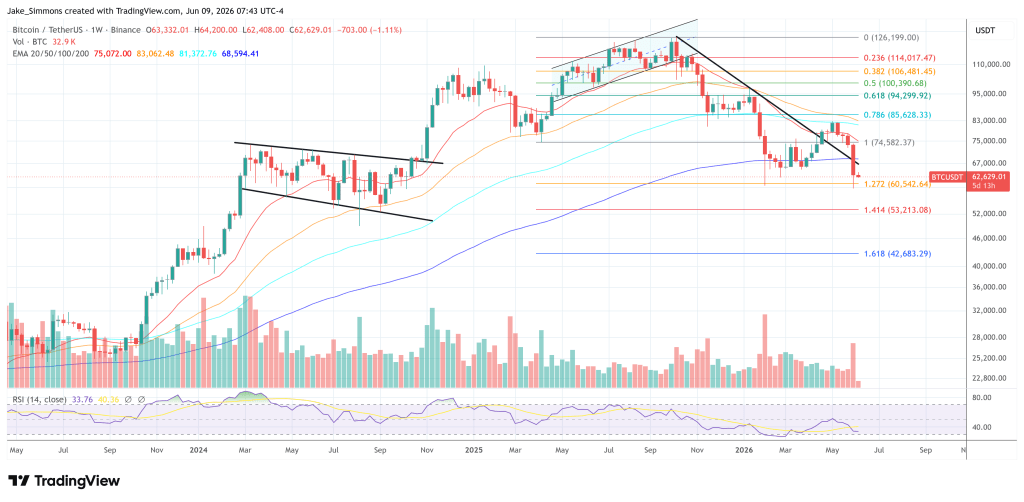
Bitcoin trades below the 200-week EMA, 1-week chart | Source: BTCUSDT on TradingView.com

相關問答

QWhat is the main message of BlackRock's report on quantum computing and blockchains?

AThe main message is not that blockchains face an immediate crisis, but that the industry needs to proactively begin migrating to post-quantum cryptography before 'Q-Day' becomes a live security event.

QAccording to the report, what is the primary quantum vulnerability for Bitcoin and Ethereum?

AThe primary vulnerability is the elliptic curve cryptography used for key ownership and transaction authorization, which could be broken by a sufficiently powerful quantum computer using Shor's Algorithm to recover private keys.

QWhy does BlackRock consider Bitcoin's migration path to be technically simpler but still challenging?

AIt is technically simpler because the core task is primarily replacing a digital-signature algorithm. The greater challenge is the social coordination required across a decentralized network that avoids rapid or centralized change.

QWhat key difference does the report highlight between Bitcoin and Ethereum regarding quantum risk mitigation?

AEthereum has a more clearly defined migration roadmap (like the L1 Strawmap) guided by the Ethereum Foundation, but faces greater technical complexity due to its proof-of-stake architecture, smart contracts, data layer, and application-layer zero-knowledge systems.

QWhat is BlackRock's overall conclusion about the quantum computing threat to cryptocurrencies?

ABlackRock concludes that quantum computing is not an imminent existential threat but a manageable risk and a 'wall of worry.' Successfully upgrading to post-quantum cryptography is seen as a much less daunting task than building a Cryptographically Relevant Quantum Computer (CRQC).

你可能也喜歡

特朗普加密帝国:一场23亿美元的财富转移实验

2026年6月,路透社调查揭示特朗普家族重返白宫后,通过四大加密业务(World Liberty Financial、$TRUMP迷因币、American Bitcoin及ALT5 Sigma/AI Financial)累计获利约23亿美元,而同期参与投资者总体浮亏也接近23亿美元。这些业务涉足不同领域,但核心逻辑均非技术创新,而是将特朗普的政治影响力与话题效应转化为金融资产进行变现。 特朗普过去曾公开批评加密货币,但随着加密行业政治影响力上升及市场情绪助推,其立场转变,并被塑造为“加密总统”。家族以此为核心资产,构建商业网络。 其中,World Liberty Financial(WLFI)是最重要的盈利来源,通过发行锁仓治理代币和高比例销售分成,为家族创造约16亿美元收益,投资者却因流动性受限和价格下跌承受损失。$TRUMP迷因币则直接金融化特朗普品牌,家族通过预留代币获利超6亿美元,而代币价格后期暴跌使高位接盘散户严重亏损。American Bitcoin作为矿业公司,因“特朗普概念”获得高估值,但基本面无法支撑,股价回落令投资者受损。ALT5 Sigma更名为AI Financial后,叠加AI、加密和特朗普概念,股价经历资本狂欢后因实际增长不足而回调。 这四个项目遵循共同模式:利用政治品牌建立信任与关注,通过媒体放大情绪,吸引资金进入后,家族通过股权、代币销售等方式实现收益变现,而市场投资者承担后端风险。 特朗普家族成功完成了一次大规模的品牌变现,但对于投资者而言,这再次警示:基于情绪、名人效应而非基本面的投资,往往风险巨大。这场23亿美元的财富转移实验,成为政治影响力、资本市场与投资心理相互作用的现实一课。

marsbit1 小時前

特朗普加密帝国:一场23亿美元的财富转移实验

marsbit1 小時前

交易

現貨
合約

熱門文章

什麼是 BITCOIN

理解 HarryPotterObamaSonic10Inu (ERC-20) 及其在加密空間中的地位 近年來,加密貨幣市場見證了迷因幣的流行激增,吸引了不僅是交易者的注意,還有尋求社區參與和娛樂價值的人士。在這些獨特的代幣中,有一個有趣的項目 HarryPotterObamaSonic10Inu (ERC-20),它將文化參考融入加密貨幣的織造中。本文深入探討 HarryPotterObamaSonic10Inu 的關鍵方面,探索其機制、以社區為驅動的精神,以及其與更廣泛的加密生態的互動。 HarryPotterObamaSonic10Inu (ERC-20) 是什麼? 正如其名所示,HarryPotterObamaSonic10Inu 是一種建立在以太坊區塊鏈上的迷因幣,按照 ERC-20 標準分類。與強調實用性或投資潛力的傳統加密貨幣不同,這項代幣依賴於娛樂價值和其社區的力量。該項目旨在促進一個讓互動用戶可以聚在一起、分享想法和參與受不同文化現象啟發的活動的環境。 HarryPotterObamaSonic10Inu 的一個顯著特點是其 交易零稅。這一引人注目的元素旨在鼓勵交易和社區參與,無需擔心可能會阻礙小型交易者的額外費用。該幣的總供應量定為十億個代幣,這一數字標示其意圖在社區內保持較大的流通量。 HarryPotterObamaSonic10Inu (ERC-20) 的創建者 HarryPotterObamaSonic10Inu 的起源有些神秘;對創建者的具體資訊尚不清楚。這個代幣的開發缺乏可識別的團隊或明確的藍圖,這在迷因幣領域並不罕見。相反,該項目是自然產生的,其進展主要依賴於社區的熱情和參與。 HarryPotterObamaSonic10Inu (ERC-20) 的投資者 關於外部投資和支持,HarryPotterObamaSonic10Inu 亦保持模稜兩可。該代幣並未列出任何已知的投資基金或顯著的組織支持。相反,該項目的生命力來自其草根社區,通過集體行動和參與在加密空間促進其增長和可持續性。 HarryPotterObamaSonic10Inu (ERC-20) 如何運作? 作為一種迷因幣,HarryPotterObamaSonic10Inu 主要在傳統的資產價值框架之外運作。以下是幾個定義該項目運作方式的獨特方面: 零稅交易:由於交易沒有稅費,使用者可以自由地買賣該代幣,而不必擔心隱藏成本。 社區參與:該項目依賴於社區互動,利用社交媒體平台創造話題並促進參與。討論、內容分享及互動是幫助擴展其影響力和加強支持者忠誠度的重要元素。 無實用性:需要指出的是,HarryPotterObamaSonic10Inu 在金融生態中並不提供具體的實用性。相反,它被定義為主要用於娛樂和社區活動的代幣。 文化參考:該代幣巧妙地融入了流行文化中的元素,以吸引興趣,與迷因愛好者和加密追隨者建立聯繫。 HarryPotterObamaSonic10Inu 範例展示了迷因幣如何與更傳統的加密貨幣項目運作不同,作為創新的社會構造進入市場,而非實用資產。 HarryPotterObamaSonic10Inu (ERC-20) 的時間線 HarryPotterObamaSonic10Inu 的歷史標誌著幾個值得注意的里程碑: 創建:這個代幣源於一個病毒式的迷因,捕捉了許多加密愛好者的想像力。具體的創建日期目前並不清楚,凸顯其自然興起。 上架交易所:HarryPotterObamaSonic10Inu 已經在多個交易所上架,使社區更容易存取和交易。 社區互動倡議:持續進行旨在增進社區互動的活動,包括比賽、社交媒體活動和來自粉絲和支持者的內容創作。 未來擴展計劃:該項目的路線圖包括推出 NFT 收藏品、周邊商品及相關電子商務網站,進一步與社區互動並嘗試為其生態系統增添更多維度。 關於 HarryPotterObamaSonic10Inu (ERC-20) 的關鍵點 以社區為驅動的特質:該項目優先考慮集體意見和創意,確保用戶參與在其發展過程中居於核心地位。 迷因幣分類:它代表了以娛樂為基礎的加密貨幣的典範,與傳統投資工具大相徑庭。 與比特幣無直接關聯:儘管在代碼名稱上有相似之處,HarryPotterObamaSonic10Inu 是獨特的,並不與比特幣或其他已建立的加密貨幣存在關係。 協作焦點:HarryPotterObamaSonic10Inu 旨在為持有者創造一個共享故事和協作的空間,提供創意和社區聯結的途徑。 未來前景:向超越其初步主題擴展至 NFT 和周邊商品的雄心,描繪了該項目潛在進入數字文化的更主流途徑。 隨著迷因幣繼續吸引加密貨幣社區的想像力,HarryPotterObamaSonic10Inu (ERC-20) 由於其文化聯繫和以社區為中心的方式而脫穎而出。儘管它可能不符合以實用性為導向的代幣的典型模式,其本質在於支持者間培育的快樂和友誼,突顯了在日益數字化的時代中,加密貨幣的演變特性。隨著該項目的持續發展,觀察社區動態如何影響其在不斷變化的區塊鏈技術格局中的軌跡將是重要的。

2.2k 人學過發佈於 2024.04.01更新於 2024.12.03

什麼是 BITCOIN

如何購買BTC

歡迎來到HTX.com!在這裡,購買Bitcoin (BTC)變得簡單而便捷。跟隨我們的逐步指南,放心開始您的加密貨幣之旅。第一步:創建您的HTX帳戶使用您的 Email、手機號碼在HTX註冊一個免費帳戶。體驗無憂的註冊過程並解鎖所有平台功能。立即註冊第二步:前往買幣頁面,選擇您的支付方式信用卡/金融卡購買:使用您的Visa或Mastercard即時購買Bitcoin (BTC)。餘額購買:使用您HTX帳戶餘額中的資金進行無縫交易。第三方購買:探索諸如Google Pay或Apple Pay等流行支付方式以增加便利性。C2C購買:在HTX平台上直接與其他用戶交易。HTX 場外交易 (OTC) 購買:為大量交易者提供個性化服務和競爭性匯率。第三步:存儲您的Bitcoin (BTC)購買Bitcoin (BTC)後,將其存儲在您的HTX帳戶中。您也可以透過區塊鏈轉帳將其發送到其他地址或者用於交易其他加密貨幣。第四步:交易Bitcoin (BTC)在HTX的現貨市場輕鬆交易Bitcoin (BTC)。前往您的帳戶,選擇交易對,執行交易,並即時監控。HTX為初學者和經驗豐富的交易者提供了友好的用戶體驗。

5.5k 人學過發佈於 2024.12.12更新於 2026.06.02

如何購買BTC

什麼是 $BITCOIN

數字黃金 ($BITCOIN):全面分析 數字黃金 ($BITCOIN) 介紹 數字黃金 ($BITCOIN) 是一個基於區塊鏈的項目,運行於 Solana 網絡,旨在將傳統貴金屬的特徵與去中心化技術的創新相結合。雖然它與比特幣同名,常被稱為「數字黃金」,因其被視為價值儲存工具,但數字黃金是一個獨立的代幣,旨在於 Web3 生態系統中創造一個獨特的生態系。其目標是將自己定位為一個可行的替代數字資產,儘管有關其應用和功能的具體細節仍在發展中。 什麼是數字黃金 ($BITCOIN)? 數字黃金 ($BITCOIN) 是一個專門為 Solana 區塊鏈設計的加密貨幣代幣。與比特幣提供廣泛認可的價值儲存角色不同,這個代幣似乎更專注於更廣泛的應用和特徵。值得注意的方面包括: 區塊鏈基礎設施:該代幣建立在 Solana 區塊鏈上,以其處理高速和低成本交易的能力而聞名。 供應動態:數字黃金的最大供應量上限為 100 萬兆代幣(100P $BITCOIN),儘管有關其流通供應的詳細信息目前尚未披露。 實用性:雖然具體功能尚未明確說明,但有跡象表明該代幣可能被用於各種應用,可能涉及去中心化應用(dApps)或資產代幣化策略。 誰是數字黃金 ($BITCOIN) 的創建者? 目前,數字黃金 ($BITCOIN) 的創建者和開發團隊的身份仍然是 未知 的。這種情況在許多創新項目中是典型的,特別是那些與去中心化金融和迷因幣現象相關的項目。雖然這種匿名性可能促進社區驅動的文化,但也加劇了對治理和問責制的擔憂。 誰是數字黃金 ($BITCOIN) 的投資者? 可用的信息顯示,數字黃金 ($BITCOIN) 沒有任何已知的機構支持者或知名的風險投資。該項目似乎運行在一個以社區支持和採用為重點的點對點模型上,而不是傳統的資金籌集途徑。其活動和流動性主要位於去中心化交易所(DEXs),如 PumpSwap,而不是已建立的集中交易平台,進一步突顯其草根方法。 數字黃金 ($BITCOIN) 如何運作 數字黃金 ($BITCOIN) 的運作機制可以根據其區塊鏈設計和網絡特徵進行詳細說明: 共識機制:通過利用 Solana 的獨特歷史證明(PoH)結合權益證明(PoS)模型,該項目確保高效的交易驗證,促進網絡的高性能。 代幣經濟學:雖然具體的通縮機制尚未詳細說明,但巨大的最大代幣供應量暗示它可能適合微交易或尚待定義的利基用例。 互操作性:存在與 Solana 更廣泛生態系統的整合潛力,包括各種去中心化金融(DeFi)平台。然而,關於具體整合的詳細信息仍未明確。 重要事件時間表 以下是關於數字黃金 ($BITCOIN) 的重要里程碑時間表: 2023:該代幣首次在 Solana 區塊鏈上部署,並以其合約地址為標誌。 2024:數字黃金獲得曝光,因其在去中心化交易所如 PumpSwap 上可供交易,允許用戶以 SOL 進行交易。 2025:該項目見證了零星的交易活動和社區主導參與的潛在興趣,儘管截至目前尚未記錄到任何顯著的合作夥伴關係或技術進展。 關鍵分析 優勢 可擴展性:基於 Solana 的基礎設施支持高交易量,這可能增強 $BITCOIN 在各種交易場景中的實用性。 可及性:每個代幣潛在的低交易價格可能吸引零售投資者,促進更廣泛的參與,因為存在分割所有權的機會。 風險 缺乏透明度:缺乏公眾已知的支持者、開發者或審計過程可能引發對該項目可持續性和可信度的懷疑。 市場波動性:交易活動在很大程度上依賴於投機行為,這可能導致價格波動和投資者的不確定性。 結論 數字黃金 ($BITCOIN) 在快速發展的 Solana 生態系統中,作為一個引人入勝但模糊的項目出現。雖然它試圖利用「數字黃金」的敘事,但其與比特幣作為價值儲存工具的既定角色的脫離,突顯了對其預期實用性和治理結構更清晰區分的需求。未來的接受度和採用率可能取決於解決當前的不透明性,並更明確地定義其運營和經濟策略。 注意:本報告涵蓋截至 2023 年 10 月的綜合信息,並且在研究期間可能發生了進展。

83 人學過發佈於 2025.05.13更新於 2025.05.13

什麼是 $BITCOIN

相關討論

歡迎來到 HTX 社群。在這裡,您可以了解最新的平台發展動態並獲得專業的市場意見。 以下是用戶對 BTC (BTC)幣價的意見。

活动图片