Original | Odaily Planet Daily (@OdailyChina)
Author | Azuma (@azuma_eth)

At 8:00 AM Beijing Time on August 5th, stablecoin issuer Circle (CRCL) will release its quarterly earnings report before the US stock market opens. However, on the eve of this report, Wall Street has already shown a clear divergence regarding Circle's future value.
On August 3rd, Morgan Stanley (hereafter referred to as "MS") downgraded Circle's rating from "Equal Weight" to "Underweight" and significantly lowered its price target from $106 to $38.
Simultaneously, TD Cowen initiated coverage of Circle for the first time, assigning a "Buy" rating with a price target of $82.
The two institutions have presented completely opposing rating judgments. The core divergence reflected behind this lies in how to define the current Circle — is it still a stablecoin issuer dependent on the growth of USDC's scale, or is it evolving into a technology company transitioning towards a digital financial infrastructure platform?
Institutional Divergence: MS Bearish on USDC Growth, TD Cowen Bets on Platform Transformation
The MS analyst issuing the "Underweight" rating is James Faucette. On TipRanks, Faucette holds a four-star rating (out of five). He is widely considered an above-average sell-side analyst. Although Faucette's average return rate over the past two years is only 3.1%, his success rate in judgment is as high as 60%.
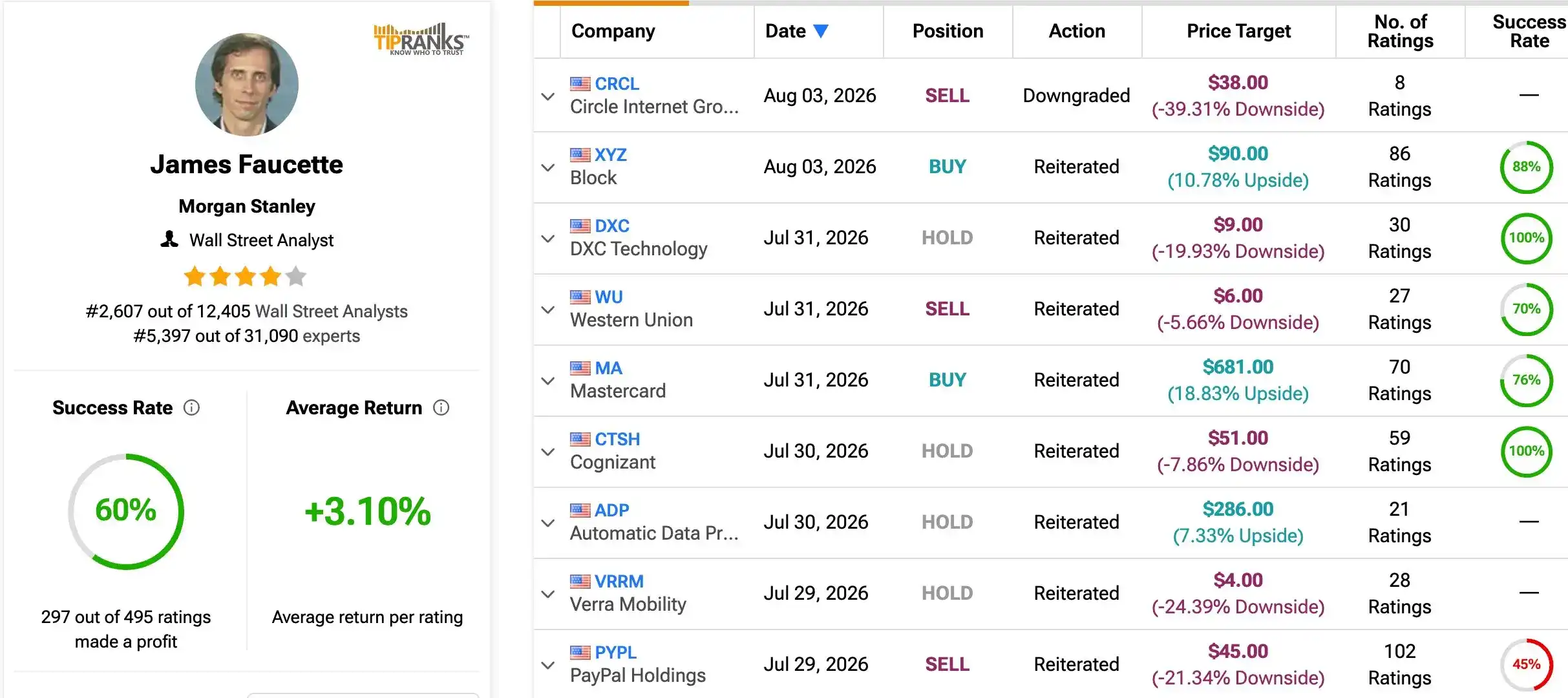
Faucette's bearish logic primarily revolves around Circle's current revenue model.
In his view, the market may have overestimated USDC's future growth potential, and the expansion speed of stablecoin use cases is also lower than previously expected — since Q3 2025, USDC's circulating supply has not actually grown. Currently, aside from remittances and stablecoin-linked card payments, no large-scale new use cases for USDC have emerged.
This suggests that Circle's most core revenue source, "Reserve Income," may face growth pressure. Currently, Circle's main revenue is highly dependent on investing USDC reserve assets in assets such as cash and short-term U.S. Treasury bills to earn interest income. Therefore, the growth of USDC's circulation is often seen as a key driver for the company's profit expansion.
Faucette believes that if USDC scale growth slows down, Circle's future revenue structure may gradually tilt towards transaction income, which has lower profit margins. Based on this judgment, he expects Circle's future earnings performance may fall short of market expectations and considers the current valuation to already reflect overly high growth expectations.
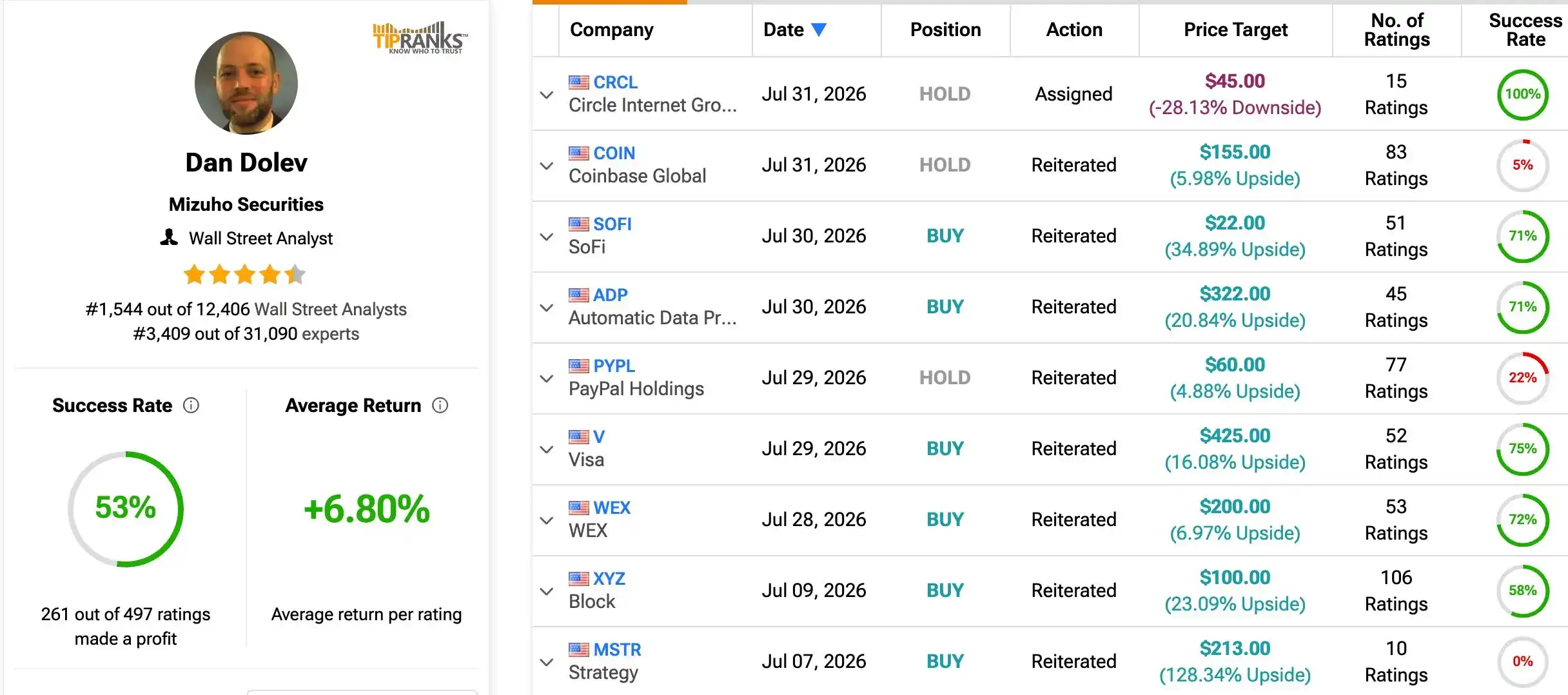
An analyst holding a similar bearish view to Faucette is Dan Dolev from Mizuho Securities. Dolev's rating on TipRanks is 4.5 stars, higher than Faucette's. This analyst assigned Circle a "Hold" rating last Friday but lowered his price target from $50 to $45.
As for TD Cowen, the analyst providing the "Buy" rating is Bryan C. Bergin. However, on TipRanks, Bergin's personal performance rating is only half a star, with a historical average return of -3.4% and a success rate of only 43%......
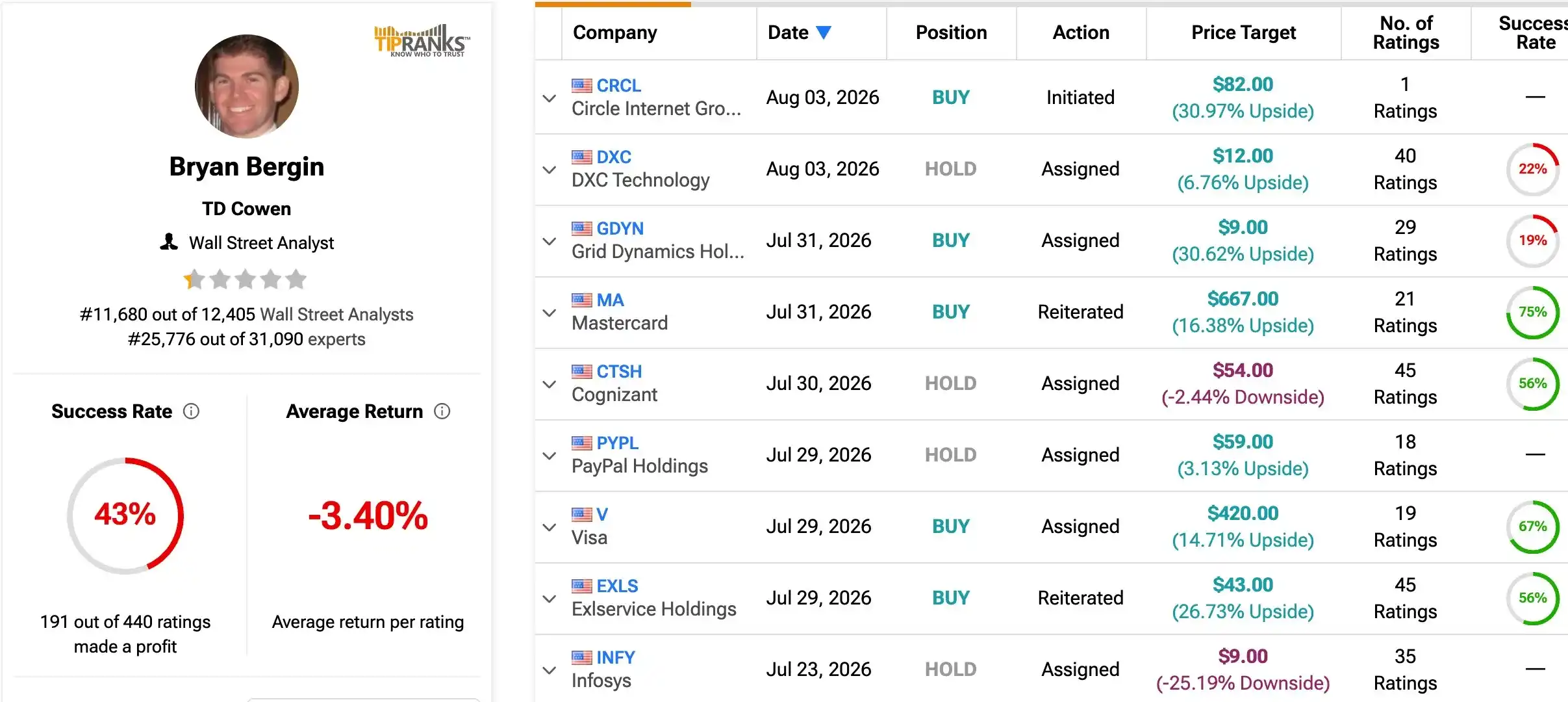
Bergin believes the market may currently be underestimating Circle's potential to transform from a stablecoin issuer into a broader financial infrastructure platform.
Within his analytical framework, Circle's future value does not solely depend on USDC's circulation scale, but rather on its ability to build a more comprehensive financial service ecosystem around stablecoins. This includes businesses such as payments, treasury management, real-world asset (RWA) tokenization, developer services, and blockchain infrastructure.
Bergin projects that by 2030, USDC's circulating supply could maintain a compound annual growth rate (CAGR) of approximately 31%. Simultaneously, fee-based revenue is expected to grow significantly faster than traditional reserve income. Furthermore, Circle's ongoing development of the Arc network is seen as a potential growth catalyst, which could further expand Circle's influence in the digital financial infrastructure space.
Another Recent Key Variable: CLARITY Act Progress
Apart from the company's own business model, regulatory progress is also a crucial factor currently influencing market expectations for Circle.
Previously, the market widely viewed the CLARITY Act as a key catalyst for further development in the stablecoin industry — if the bill is ultimately enacted, the issuance, trading, and related financial services of stablecoins would obtain a clearer regulatory framework, potentially reducing compliance uncertainty for institutional adoption of stablecoins.
However, as of now, the progress of the CLARITY Act has not been smooth. With only the final few working days left before the Senate's summer recess, market expectations for its short-term advancement have significantly declined.
- Odaily Note: Refer to "So Close, Yet So Far: What's Stalling the Clarity Act?" and "What if the CLARITY Act Ultimately Fails?".
If the advancement of this bill continues to be delayed, the market may reassess the commercialization speed of the stablecoin industry and the growth expectations for Circle. Therefore, ahead of the earnings report, the uncertainty surrounding the CLARITY Act has also become a factor suppressing market sentiment towards CRCL.
Earnings Report Approaching, Market Awaits Circle's Answers
Ultimately, Wall Street's divergence regarding Circle stems not from short-term performance but from different judgments about the company's future positioning. Bearish analysts focus on whether Circle's traditional reserve income model can still support its current valuation if USDC growth slows. Bullish analysts are betting on Circle's ability to evolve into a digital financial infrastructure platform by leveraging its stablecoin business.
Therefore, in this earnings report, besides focusing on revenue and profit performance, the market will also closely observe the progress of reserve income (especially distribution agreements with Coinbase and other partners) as well as businesses like payments and RWA.
Following the release of tomorrow night's earnings report, Odaily Planet Daily will also provide an earnings analysis for everyone as soon as possible.