Original | Odaily Planet Daily(@OdailyChina)
Author|jk
Recently, payment giant PayPal recently announced its Q2 earnings: revenue of $8.68 billion, exceeding market expectations, with total payment volume (TPV) reaching $486.4 billion, a year-on-year increase of 10%.
Furthermore, PayPal has positioned PYUSD (PayPal USD) as the "major enabler/key enabler" of the PayPal World platform, emphasizing its core role as a "commerce-first" stablecoin targeted at mainstream consumer and merchant scenarios.
In the fiercely competitive stablecoin market, PYUSD has remained lukewarm. What is its future development prospect? And can PayPal really withstand the cost?
Q2 Earnings: Where Does PYUSD Stand?
PayPal's revenue this quarter was $8.68 billion, an increase of approximately 5% year-on-year, exceeding analysts' expectations of $8.68 billion vs. $8.47 billion; adjusted earnings per share (EPS) were $1.38, also better than the market consensus of $1.28, while GAAP EPS was $1.26, slightly below expectations. Total Payment Volume reached $486.4 billion, a 10% year-on-year increase, or 9% on a currency-neutral basis. The full-year adjusted EPS guidance was raised to approximately $5.38.
Looking at these core indicators alone, this is a slightly better-than-expected earnings report.
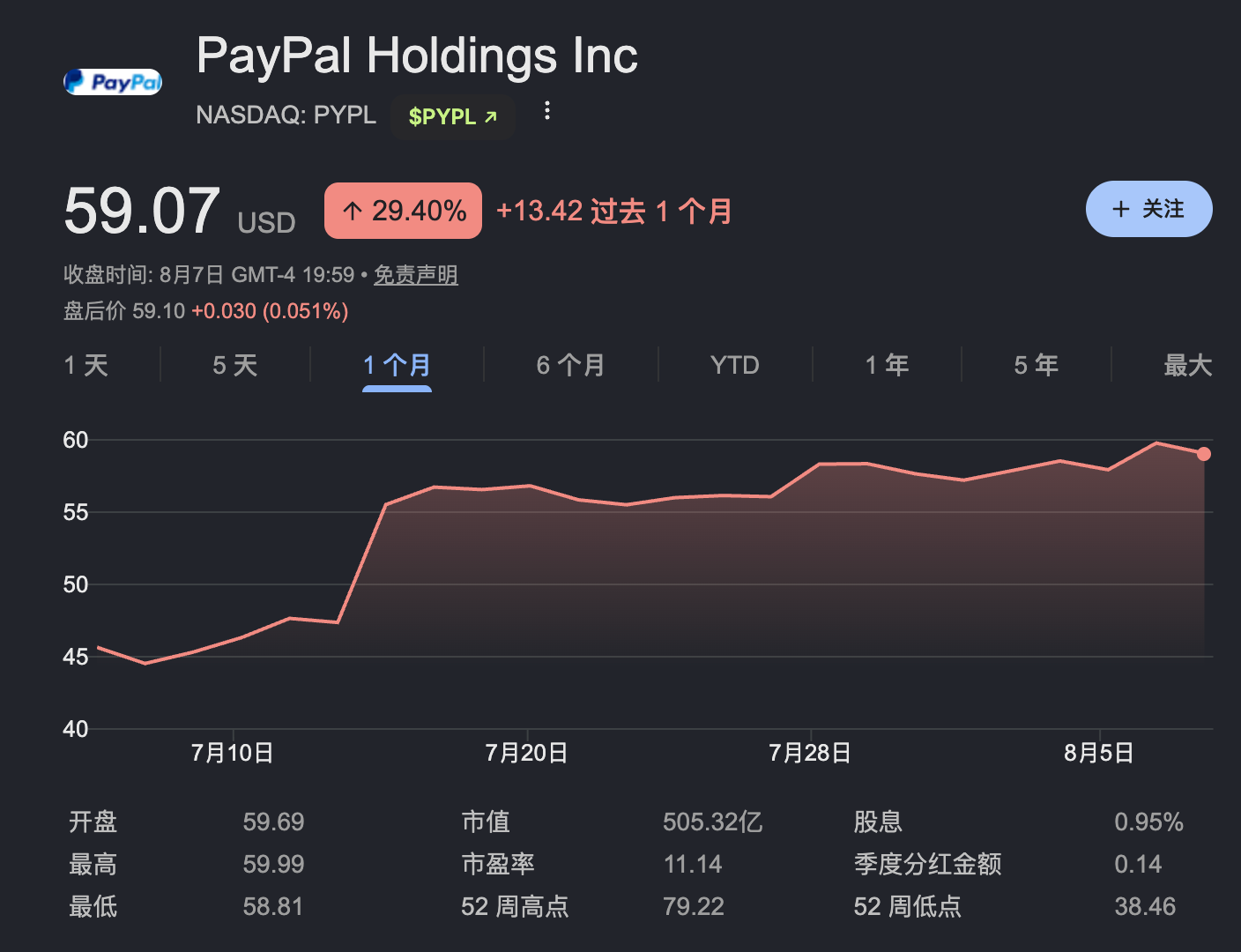
The stock price has been growing over the past month. Source: Google
But the story on the profit margin side is different. The GAAP operating margin decreased from 18.1% in the same period last year to 16.4%. The company attributed an $81 million net loss to strategic investments and crypto assets held for investment purposes, excluding it from non-GAAP results. In other words, crypto assets have already exerted some pressure on PayPal's reported profits. However, it's still difficult to conclude whether this loss is merely a temporary paper loss due to market declines or a cost the company is actively bearing to drive the expansion of related businesses.
At the same time, PayPal established a new "Payment Services & Crypto" department this quarter, placing PYUSD and merchant processing businesses under the same line. CEO Enrique Lores stated in the earnings call that the company plans to launch more merchant products powered by PYUSD and AI-driven agentic payments. PYUSD has been integrated into PayPal's core merchant payment system, no longer just a relatively independent innovation project. Compared to management's verbal emphasis on its "strategic value," this organizational restructuring better reflects PayPal's actual positioning of PYUSD.
However, the company has still not separately disclosed PYUSD's specific contributions to revenue, merchant retention, or transaction profit margins. Investors can only infer how much this stablecoin is truly driving performance from aggregate data and management's statements, making this the most critical information gap to track in the coming quarters.
The Strategic Significance of PYUSD for PayPal: Expanding Narrative and Contracting Supply
Since its issuance in August 2023, PYUSD has gone through a cycle of expansion and contraction along with the crypto market.
In March of this year, the company expanded its coverage to 70 markets, and its supply once surged to around $4.2 billion, with a year-on-year growth rate peaking at nearly 680%, making it the fastest-growing among mainstream stablecoins at the time. To date, PYUSD has been deployed on nine public chains including Ethereum, Solana, Arbitrum, Stellar, Avalanche, Aptos, Sei, Tron, and Abstract. PayPal also designated Solana as the default payment processing network in February this year.
On July 9th, PYUSD achieved a native launch via Polygon's Open Money Stack, integrating wallets, fiat on-ramps, compliance tools, and on-chain settlement capabilities, explicitly targeting enterprise-level cross-border payment scenarios. The PYUSDx framework, launched in collaboration with MoonPay, allows developers to issue application-specific stablecoins based on PYUSD reserves, attempting to position PYUSD as a foundational layer for others to build upon, rather than just an end-consumer product. Kraken also recently announced support for PYUSD deposits and withdrawals on the Stellar network, further expanding its presence on exchanges.
Putting these moves together sketches out the story PayPal wants to tell: PYUSD is evolving from a balance tool for PayPal users into a payment infrastructure layer that can be directly utilized by third-party wallets, exchanges, and developers.
In other words, in the future, when businesses plan to accept global payments, they could directly use or develop PYUSD-based payment collection tools to receive fees globally, without the lengthy customs declarations and foreign exchange processing required for fiat currencies, and without being limited to crypto-related users like other stablecoins. This is a scenario all import/export businesses dream of: All funds arrive in real-time, fees are lower than before, and the paying users hardly notice the process. The payer's fiat is converted to PYUSD in the backend and then converted again to another fiat currency for the recipient, with the entire process being rapid and convenient.
This is also why PYUSD is mentioned alongside AI in PayPal's earnings report. The company stated it is using machine learning to optimize fraud detection, reduce processing costs, and support automatic conversion between fiat and stablecoins based on exchange rates and user behavior.
However, on-chain data is less encouraging: After reaching a peak supply of around $4.2 billion in March, PYUSD's supply contracted by approximately 31% by the end of Q2, falling to around $2.7 billion. This is the first significant decline since issuance, mainly due to reduced reward incentives and capital rotation into other assets. As of early August, the circulating supply of PYUSD is about 2.7 billion tokens, with a market cap of approximately $2.72 billion, ranking around 32nd on CoinGecko's stablecoin rankings.
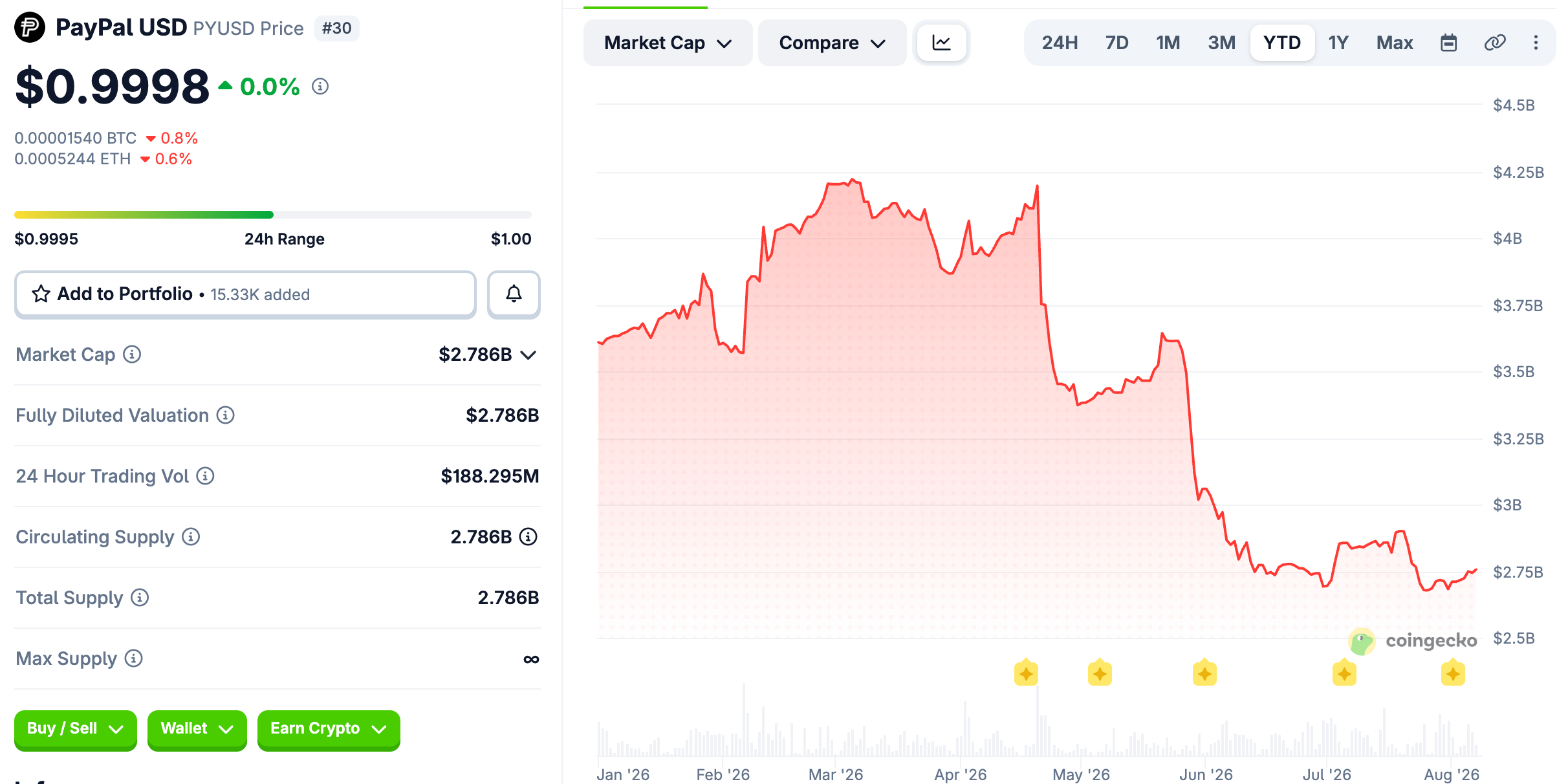
PYUSD's scale is declining. Source: Coingecko
This means that while the earnings narrative emphasizes the breadth of market coverage and chain integrations, the actual circulating supply contracted by nearly one-third during the same period. The coexistence of an expanding narrative and contracting supply reflects a harsh reality: unique market position and regulatory status (PYUSD is the first dollar stablecoin issued by a federally regulated entity, Paxos, a status further solidified when Paxos transitioned to OCC federal oversight by the end of 2025) do not necessarily translate into sustained demand for holding the token. When incentives were withdrawn, the initial volume did not transform into stable usage, and the competition with USDC still has a long way to go. If subsidies prove ineffective like early crypto industry tactics, PYUSD's current cake may not grow any larger.
PYUSD vs. Open USD: Why Did PYUSD Come Earlier But Have Less Influence?
If PYUSD represents the single-issuer model of stablecoins, then Open USD, which emerged on June 30th, represents a structurally different path, and its timing was just under a month before PayPal's Q2 earnings release.
Open USD is operated by a newly formed independent company, Open Standard, with its founding CEO being Zach Abrams, co-founder of Stripe's Bridge. It has over 140 signed partners, covering almost the entire roster of top names in payments and finance: payment networks like Visa and Mastercard; payment infrastructure like Stripe and Shopify; asset management and banking like BlackRock, BNY, and Standard Chartered; tech platforms like Google and IBM; and crypto-native players like Coinbase, Solana, and Aave. The project is expected to launch in the second half of 2026 and has not been officially issued yet.
The most fundamental difference between Open USD and PYUSD lies in their economic structure and governance model: Simply put, only PayPal profits from PYUSD, while everyone benefits from Open USD.
PYUSD follows the classic model used by USDT and USDC, with Paxos as the single issuer custodian holding reserve assets and earning floating income, and PayPal as the brand owner driving product roadmap and market strategy. Open USD, in contrast, makes minting and redemption completely free and without limits for partners. The income generated from reserve assets, after deducting minimal management fees, is returned to the partner institutions participating in distribution, rather than being monopolized by a single issuer. Governance power is also given to a board composed of partner institutions, not dictated by one company. As some industry commentary suggests, this is closer to the governance logic of interbank clearing networks like ACH or SWIFT, not that of today's USDC or USDT.
A detail easily overlooked but crucial for understanding PayPal's situation is that PayPal itself is one of the over 140 signatories of Open USD, even though PYUSD will continue to exist as an independently issued asset. This means PayPal has not fully tied itself to the PYUSD ship but has instead taken a position in both stablecoin models—continuing to bet on PYUSD as its proprietary branded asset while securing a seat in the potential future industry landscape through signing onto Open USD.
In contrast, Circle and Tether are absent from Open USD's partner list. Circle's stock price fell over 16% on the day of the announcement. Circle CEO Jeremy Allaire later publicly responded, emphasizing USDC's network effects and distribution depth, and cited Paxos's consortium-model stablecoin USDG as a precedent, pointing out that its supply only reached about $3 billion after more than two years since launch, far short of initial optimistic expectations.
Looking at these three together, the competitive landscape PayPal faces is becoming more complex. PYUSD, with its first-mover advantage, has built some brand recognition and multi-chain deployment foundation, but its absolute size is still only about one-twentieth of USDC, and recent signs show supply contraction. If Open USD successfully launches, its real threat is not in poaching PYUSD's existing holders but in its attempt to redefine the distribution economics of the entire industry. If distribution giants like Stripe, Visa, and Mastercard can share reserve income through a consortium model, the single-issuer stablecoin model could be entirely replaced.
By hedging its bets, PayPal, in a way, acknowledges this uncertainty. Rather than betting on one model winning out, it keeps a seat at both tables. For PYUSD, what truly needs to be proven in the coming quarters is not how many markets or chains it covers, but whether it can convert the established distribution network into sustained, subsidy-independent demand after incentives fade. If it ultimately fails to carve out this path, then the current $2.7 billion might be PYUSD's existing peak.