After passing through multiple security checks and having phone camera lenses covered with privacy film, Phoenix Network Technology entered this data center located in Ulanqab, Inner Mongolia. This facility supports the large-scale intelligent computing operations of cloud providers and AI companies, serving as a microcosm of China's AI industry's struggle for computing infrastructure.
Contrary to expectations of dusty scenes, a low, deep hum filled the air—the sound of chilled air roaring through the containerized modules. Orange-and-white massive box-like structures stood in orderly rows, awaiting the insertion of computing cards.
"It can be said that today, not a single card is idle. Delivery translates directly to productivity; faster delivery enables greater customer value," explained Wang Chaoyang, General Manager of Alibaba Cloud Global Data Centers, to us.
Since the beginning of this year, as AI newcomers like DeepSeek have announced plans to build or co-build their own data centers, the industry has been quietly shifting from the light-asset model of "renting space, buying computing power" towards gaining deeper control over the computing power foundation. The corporate logic has also evolved from simply purchasing cards to stockpiling strategic assets, with ten thousand or even a hundred thousand cards becoming the starting threshold.
Ulanqab has thus become a key battleground for AI giants vying for computing power dominance. From self-built data centers with self-developed equipment to modular "containerized" solutions achieving rapid 100-day delivery in leased facilities, a "new Foxconn" model for the AI era is emerging.
Visiting Ulanqab: What's Inside an Intelligent Computing Center?
Ulanqab, a grassland city in central Inner Mongolia with an annual average temperature of just 4.3 degrees Celsius, entered the AI industry's spotlight in mid-year following a recruitment notice from DeepSeek.
Historically known as the "Potato Capital of China," Ulanqab introduced Huawei in 2013 to build its first cloud data center as the mobile internet era dawned, officially kicking off the big data epoch. In the subsequent years, the rise and fall of the internet unfolded here silently in symbols unreadable by humans, with Huawei, Alibaba, Apple, Kuaishou, 21Vianet, and GDS successively establishing a presence.
According to local government data, by the end of 2025, Ulanqab had signed 84 data center projects, 81 of which are intelligent computing centers, with total investments exceeding 500 billion yuan.
In 2026, a new protagonist arrived. DeepSeek began large-scale recruitment for its intelligent computing center in Ulanqab, planning to build an ultra-large intelligent computing center with a total power capacity of 1 Gigawatt (GW) there, simultaneously hiring IDC design and planning engineers.
Following the industry's collective gaze, the veil was lifted on a massive intelligent computing center cluster originally hidden on the grasslands. Phoenix Network Technology also arrived in Ulanqab this August.
"One step west from Beijing, and you're in Ulanqab." Exiting the high-speed rail station, besides the refreshing cool air, eye-catching red promotional banners were visible.
Situated 350 km from Beijing, reachable by high-speed rail in under two hours, with network latency as low as 4 milliseconds, a cool climate year-round, strong winds, dry air, and located away from seismic zones... Most importantly, it's a "price trough" for electricity, with green power accounting for 90% of its supply and electricity prices at 0.32-0.35 yuan per kWh—hosting the same data center in Ulanqab could save 5 billion yuan in annual electricity costs compared to a neighboring city.
With these combined advantages, Ulanqab has become the nation's largest intelligent computing cluster, surpassing all Eastern Data to Western Computing nodes, transforming into a true "City of Tokens."
Alibaba Cloud's data center campus is also in Ulanqab. Here, there is not only a data center Alibaba built years ago but also a newly constructed 5.0 containerized data center delivered in just 100 days using modular design—the latter now handles 80% of Alibaba Cloud's intelligent computing business.
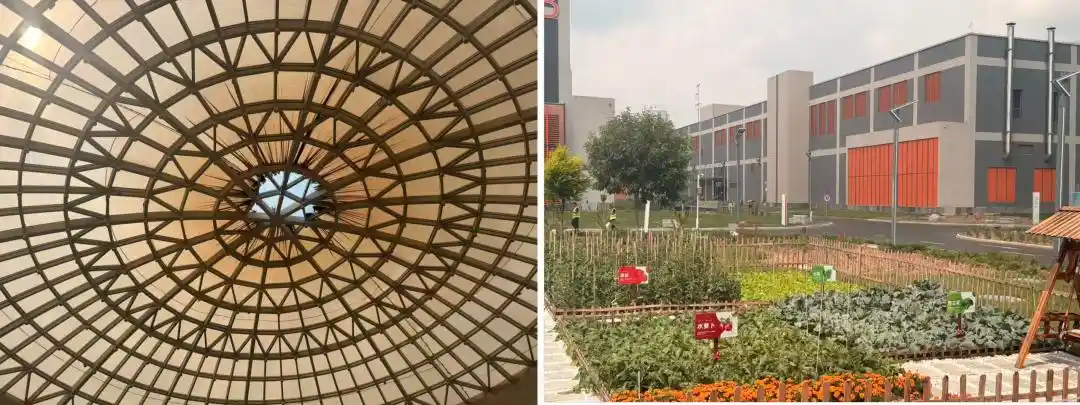
Left: The top of the Alibaba data center office building, featuring a 'Mongolian yurt'-style structure for insulation; Right: Exterior view of the data center.
Here, we discovered that data center construction isn't just about "building houses." Like DeepSeek hiring IDC design and planning engineers, it's full of intricacies. For instance, Alibaba's self-built 2.0 architecture data center in Ulanqab represents the pinnacle of the previous generation's technology. To save power, Alibaba trialed its self-developed Panama Power Supply here, drastically compressing the power transformation process. To conserve water, the data center employs a closed-loop system, even utilizing server-generated heat to warm equipment rooms in winter.
In the power distribution room, our guide explained, "In traditional data centers, the first floor is all infrastructure, with servers on the second. But in our new 5.0 architecture, everything has been 'flattened.'"
This "flattening" essentially means "transforming construction into manufacturing, replacing projects with products," Wang Chaoyang clarified. Everything from the 10kV medium-voltage power distribution and the self-developed Panama Power Supply to lithium battery backup and liquid-cooled IT cabinets is prefabricated inside the containers. On-site, it's merely about positioning the containers like Lego blocks and connecting the cables.
"In the past, building a data center required thousands of workers on site. Now, it's a team of cranes positioning the containers. Our record is from breaking ground on a new building to delivery in four and a half months." The guide revealed that while currently constrained by pulsed shortages of upstream raw materials and components—making the ideal 100-day timeline with "30 days of prefabrication" sometimes difficult to hit perfectly—the assembly phase has been optimized to the extreme.
DeepSeek Joins the Fray, Competing for Computing Infrastructure
In recent years, competition among large model companies has focused on algorithms, data, and model parameters.
But entering the era of ten-thousand or even hundred-thousand-card training, computing power has transformed from a "procured resource" into a strategic asset determining a company's survival.
DeepSeek's heavy investment is a microcosm of this trend. A harsh reality faces all AI race contenders: readily available computing power facilities on the market have long been snapped up. Traditional construction cycles of 12 months or more simply cannot keep pace with the exponential explosion in Token demand. In the context of an AI demand boom, whoever can more quickly secure a large-scale, high-density, low-cost, dedicated computing power foundation holds the ticket to the next round of competition.
Moreover, the rise of Agents has led to an explosive growth in inference demand as well. According to China's National Bureau of Statistics, the national daily Token call volume surpassed 140 trillion in March 2026. This necessitates an even larger scale of data center construction.
The massive Token demand has led to data centers springing up everywhere. Phoenix Network Technology witnessed numerous projects under construction in Ulanqab. In areas like Yiwutang, Bayin, and Chayou Qianqi, besides internet companies like Huawei, Kuaishou, and Alibaba, third-party data service providers like 21Vianet and Zhongjin Data occupy even larger plots.
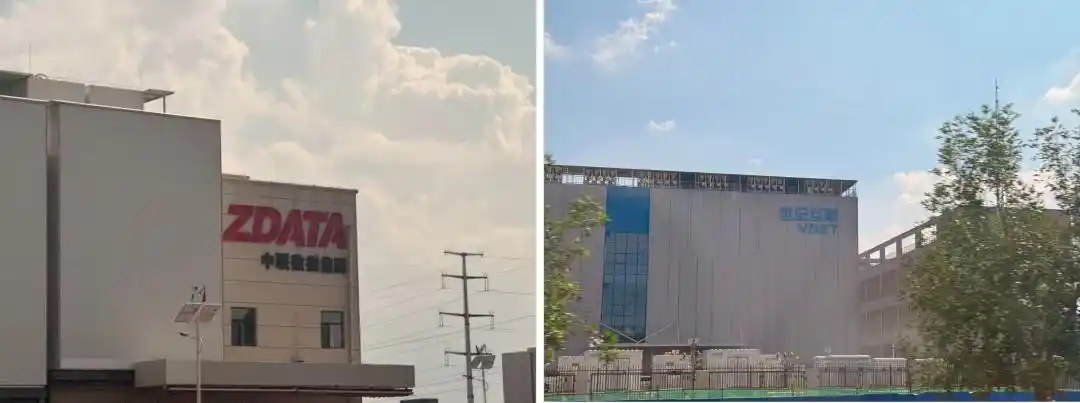
How to make Tokens operate more efficiently has become a new competitive focus in the AI era.
Wang Chaoyang recalled significant internal opposition when the modular solution was first proposed, deemed too costly. "But once a product iterates and optimizes, costs will inevitably come down." Resistance persisted when seeking partners. "One partner disagreed, saying the cost was too high. Upon review, we found they had overestimated the cost per kilowatt by more than one-third. They later regretted it deeply; they had miscalculated." Wang stated that many partners have now fully accepted the approach.
What made him more aware of the industry shift was the reaction from competitors. "One of our biggest competitors spent three months internally learning it. Hearing we were developing the next architecture made them very nervous. Other partners are also asking when our new standard will be released." Not just domestically; overseas operators are following suit. In his view, this solution has evolved from Alibaba's own exploration into a path the industry is collectively adopting.
Alibaba Cloud has even more ambitious plans for data center construction—"to become the Foxconn of this industry." Through an ODM model, they aim for the supply chain to engage in large-scale manufacturing according to Alibaba's self-developed standards.
Inside the containers, even a power supply module is highly standardized. The guide used the on-site air conditioning as an example: "The market predominantly offers AC air conditioning, but AC to DC conversion incurs losses. Alibaba specifically commissioned a smaller manufacturer to customize DC air conditioning for this architecture." Wang Chaoyang later added that within this modular solution, "each module has undergone optimal debugging," and China's supply chain can fully keep up. "Wherever we want to build in a major base, these manufacturers are willing to follow us and set up local factories."
Wang Chaoyang emphasized that modularization is useless if not achieving over 90%. "If only 30% or 20% is modularized, it only solves part of the product issue. First, it doesn't address overall cost problems; second, it certainly doesn't solve overall delivery timeline issues." He also acknowledged the practical challenge of modularization: "once internally finalized, it's hard to change. Fortunately, we can now continuously iterate. Behind modularization must be versioning and standardization."
This capability to turn data centers into "standard products" could also stir the landscape of the US-China AI race. Wang Chaoyang further mentioned that China's manufacturing capacity is "frightening"; finding a few enterprises in Zhejiang can produce these containerized data centers. In contrast, facing widespread shortages of skilled labor overseas and delivery cycles stretching to 30 months, leveraging modular products from China's supply chain would present a crushing advantage. "When performance catches up with competitors, our Token cost will undoubtedly be at a killer level."
The Ultimate Limit of AI is Electricity
The ultimate limit of computing power is electricity. All efforts toward extreme efficiency and cost control ultimately point to electricity.
"For the same data center, locating it in Ulanqab versus a neighboring city can result in a 50 billion yuan difference in annual electricity costs," said Wang Chaoyang. When data center scales are over ten times larger than before, with single cabinet power heading towards 1000 kilowatts (equivalent to the heat emitted by over ten thousand people), electricity price becomes the sole critical factor besides chips.
However, cheap electricity isn't simply waited for. As AI enters the era of inference explosion, computing power demand presents a "two-way flow"—training workloads head west in a "three-level depth" pursuit of low-cost green power, while inference workloads move east in a "three-level下沉" (sinking) to be closer to economic hubs.
This encounters the current biggest pain point: computing-power-electricity coordination. Wang Chaoyang observed that many current so-called source-grid-load-storage initiatives are essentially for new energy consumption, not genuine computing power coordination. "Electricity delivery takes three to five years, but our computing power delivery is compressed to 100 days. When Tokens are experiencing quasi-exponential explosion, planning coordination is crucial."
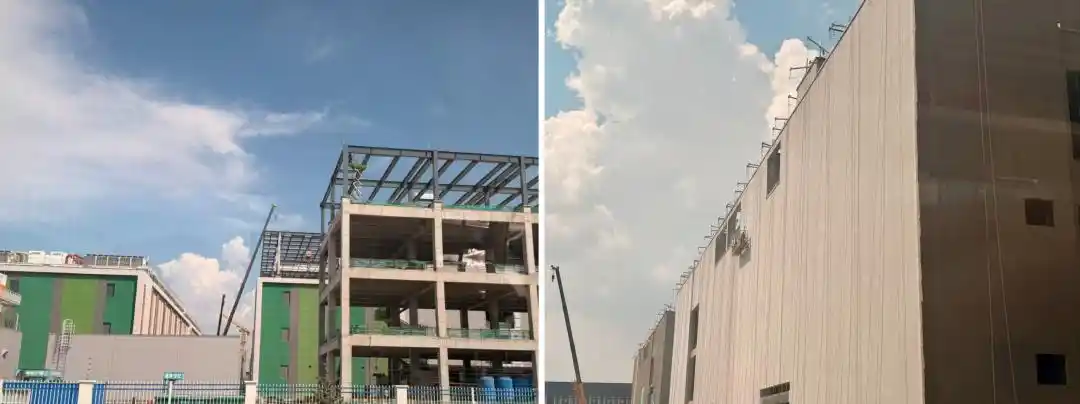
Caption: Construction sites are everywhere.
He judges that the gap between current planned scale and actual demand is so significant that it will force the industry to develop explosive solutions within two years. "Power companies are excited but unsure how to participate. Future data centers cannot be rigid loads; they must become flexible, self-regulating systems, allowing computing power to adapt to electricity supply, achieving dynamic balance."
To find balance in water-scarce Inner Mongolia, Alibaba is also relentlessly tackling water usage. In Ulanqab, data centers exclusively use reclaimed water, with benchmark projects achieving a Water Usage Effectiveness (WUE) as low as 0.088, almost negligible water consumption. Wang Chaoyang admitted: "Using more water can save electricity, and low water pricing leads manufacturers to prefer water cooling. But when building ultra-large clusters, social costs must be considered, finding that微妙 (subtle)临界点 (critical point) between optimal cost and greenness."
From the "Potato Capital" to "China's Computing Power Capital," Ulanqab is witnessing a frenzied advance in computing infrastructure. As Alibaba Cloud and others transform data centers from "civil engineering projects" into "products" mass-producible on factory assembly lines, and as new players like DeepSeek also begin building their own computing power foundations along this path, a new paradigm for AI infrastructure, supported by Chinese manufacturing, is emerging.
Inside those orange-and-white containers on the grasslands, Tokens are being produced 24/7. The next chapter of this computing power surge may well be the true arrival of AI普惠 (inclusiveness/accessibility) when these "Chinese solutions" flow globally along the supply chain.
This article is from the WeChat public account "Phoenix Network Technology," author: Phoenix Network Technology.