South Korean Stocks Plunge Again, Latest Response from the Blue House

marsbit發佈於 2026-08-06更新於 2026-08-06

文章摘要

Korean Stock Market Plummets Amid Global Sell-Off, Presidential Office Responds South Korea's stock market experienced a sharp decline on Thursday. The benchmark KOSPI index fell over 4%, with major components SK Hynix and Samsung Electronics dropping over 8% and 5%, respectively. The sell-off quickly spread to related Hong Kong ETFs. The trigger was weak forward guidance from U.S. memory chip giants SanDisk and Western Digital, whose revenue forecasts fell short of lofty market expectations despite strong prior-quarter results. Their subsequent stock plunge led to a sell-off in Asian semiconductor stocks, highlighting the region's dependence on U.S. market sentiment. Since hitting a record high in mid-June, the KOSPI has fallen over 21% in about a month. In response to market volatility, the South Korean government has implemented measures, including raising cash margin requirements for single-stock leveraged ETFs. This led to a significant drop in their trading volume. A senior presidential official stated the focus is on closely monitoring the situation and formulating appropriate countermeasures. Analyst views on the market outlook diverge: while Morgan Stanley sees the sell-off as a buying opportunity due to low valuations, others like China Securities warn of continued high volatility as leverage unwinds. Looking ahead, analysts expect the global memory chip sector to remain in a high-sensitivity phase. However, Goldman Sachs maintains a long-term bullish target of...

Thursday, South Korean stock markets fell sharply.

At the time of writing, the KOSPI index dropped over 4%, currently at 6322.55 points. Among individual stocks, SK Hynix fell over 8% and Samsung Electronics dropped over 5%.
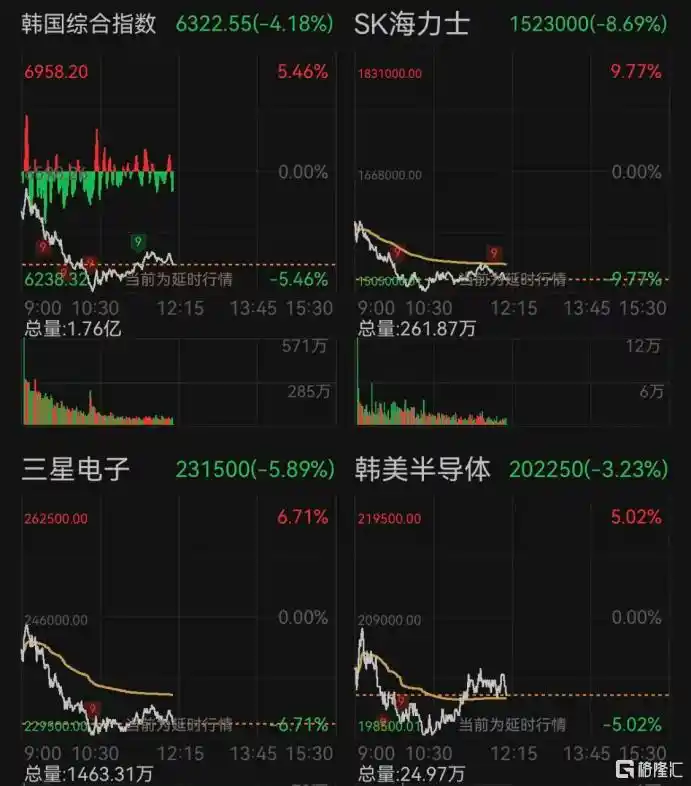
In the Hong Kong market, the Direxion Daily CSI 300 China A Share Bull 2X Shares ETF linked to Hynix fell over 15%, and the 2X leveraged ETF on Samsung dropped over 11%.

Guidance Shock from U.S. Memory Giants

The trigger for this round of selling points directly to the "guidance shock" from the U.S. memory chip sector overnight.

After the U.S. market closed on Wednesday Eastern Time, SanDisk and Western Digital both released their latest financial reports.

The reports showed that these two memory giants delivered unexpectedly strong results for the previous quarter, but their current-quarter guidance both failed to meet Wall Street's higher growth expectations.

Specifically, SanDisk expects next quarter revenue to be between $10.3 billion and $10.8 billion, below analysts' expectation of $11.16 billion. Western Digital expects next quarter revenue between $4.0 billion and $4.2 billion, slightly above the analyst consensus of $4.04 billion.

The "better-than-expected past" was not enough to fully offset the "slightly-below-expectations future."

Following the earnings release, both memory giants were heavily sold off, with SanDisk falling over 8% and Western Digital dropping over 11%.

The pessimistic guidance from the memory giants quickly transmitted through the supply chain to Asian markets.

On Thursday, after the South Korean stock market opened, SK Hynix and Samsung Electronics faced heavy selling pressure.

Data shows that up to the previous trading session, foreign investors had accumulated a net purchase of 1.4513 trillion won in Korean stocks, but on the 6th, they net sold over 500 billion won in the market.

Analysts pointed out that Asian markets ultimately still need to watch the U.S. market's movements and lack pricing power.

Mirae Asset Securities researcher Han Ji-young stated that despite improvements in geopolitics and the macro environment, influenced by the weakening Philadelphia Semiconductor Index and profit-taking after the recent rapid short-term stock price gains, the market is likely to enter a phase of consolidation and sector rotation.

"The exceptionally amplified volatility seen during the July crash has passed its peak."

Latest Response from the Blue House

It is noteworthy that since surging to an all-time high on June 19, the South Korean stock market has been fluctuating downwards. Over the past month, the KOSPI index has accumulated a loss of 21.17%.
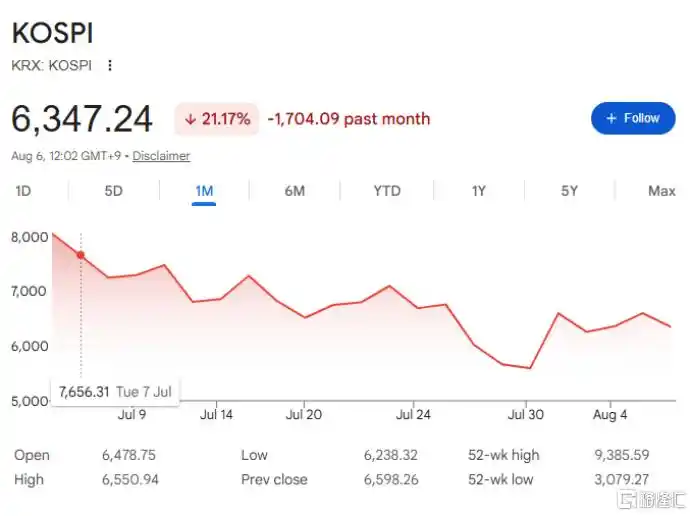
Facing the sharply volatile market, the South Korean government is urgently "rescuing the market."

Earlier, Kim Yong-beom, the head of the Office for Government Policy Coordination under the President's Office, faced criminal charges for "rushing the introduction of leveraged ETFs."

In response, Seong Gi-hong, Senior Presidential Secretary for Public Relations and Communication, stated in the latest response that the current priority is to closely monitor market conditions and formulate corresponding countermeasures.

"All relevant officials in the presidential office are carefully examining each situation and very prudently studying how to formulate related measures."

Last Friday, South Korea's financial regulator raised the minimum cash margin requirement for investing in single-stock leveraged ETFs.

After the regulator introduced these restrictive measures, trading volume in South Korean single-stock leveraged ETFs plummeted.

Latest data released by the Korea Exchange showed that the average daily trading volume of 16 single-stock leveraged ETFs fell to 919.8 billion won on Wednesday, dropping below 1 trillion won for the first time since their listing on May 27.

Morgan Stanley noted that the previous intense leverage unwinding is nearing its end, and KOSPI valuations have fallen to historically low levels, providing investors with a more attractive entry point.

However, China Securities (CITIC Securities) holds a different view on this matter.

The institution believes that while leverage among South Korean retail investors has been rapidly reduced, margin balances are still shrinking at the fastest pace this year, and the liquidation rate remains far above normal levels. It expects subsequent market volatility to remain relatively high.

Looking ahead, analysts stated that after a prolonged bull market, the global memory semiconductor sector has entered a phase of high sensitivity and high volatility, and short-term sentiment shocks need time to digest.

From a medium to long-term perspective, Goldman Sachs firmly maintains its target of 12,000 points for the KOSPI index, expecting the market still has about 80% to 90% upside potential.

The bank believes that current market pricing does not reflect the potential severe shortage of memory chips, which could persist until 2030. As AI computing demand accelerates, the semiconductor industry, which accounts for over 50% of the KOSPI's weight, will become a global profit engine.

J.P. Morgan similarly maintains its optimistic outlook on SK Hynix and the memory chip industry, viewing this pullback as an opportunity to increase positions.

This article is from the WeChat public account "Gelonghui APP" (ID: hkguruclub), author: Gelonghui Editor.


熱門幣種推薦

相關問答

QWhat triggered the sharp decline in the South Korean stock market?

AThe sell-off was primarily triggered by disappointing future revenue guidance from U.S. memory storage giants SanDisk and Western Digital, which led to a sharp drop in their stock prices and caused the negative sentiment to spread to Asian markets.

QHow did the South Korean government respond to the market volatility?

AThe South Korean government is implementing emergency measures to stabilize the market. This includes raising the minimum cash margin requirement for single-stock leveraged ETFs, which has led to a significant drop in their trading volume. The Blue House stated that officials are closely monitoring the situation and carefully formulating corresponding measures.

QWhat was the performance of key South Korean semiconductor stocks like Samsung and SK Hynix?

AKey South Korean semiconductor stocks experienced significant declines. SK Hynix fell over 8% and Samsung Electronics dropped over 5%, contributing to the KOSPI index's decline of over 4%.

QWhat are the differing views from major financial institutions on the future of the South Korean market?

AFinancial institutions hold differing views. Morgan Stanley believes the severe leverage unwinding is nearly over and valuations are attractive. Goldman Sachs maintains a long-term bullish target of 12,000 points for the KOSPI, citing potential chip shortages. However, CITIC Securities warns that while retail leverage has decreased, margin debt is still shrinking rapidly and market volatility will remain high.

QWhat is the main reason cited for the lack of pricing power in Asian markets according to the article?

AAccording to analysts in the article, Asian markets ultimately have to follow the lead of the U.S. stock market and lack independent pricing power. The negative guidance from U.S. tech giants quickly transmitted through the supply chain, impacting related stocks in Asia.

你可能也喜歡

达利欧警示美债供需失衡:黄金与比特币或成债务危机对冲资产

桥水基金创始人达利欧在最新文章中警示美国正面临严重的债务供需失衡,可能引发政府债务危机。他引用其著作《国家如何走向破产:大周期》中的框架,指出当前有三个迹象符合危机前兆:日本减持美债、美国长债收益率攀升且美元走弱、美财政部宣布购债但规模有限。 达利欧解释,政府债务运行如同一个可印钞和征税的实体。当债务过高、还本付息挤占其他支出,或债券供应远超市场需求时,利率将被迫上升或央行需印钞购债,这会导致货币贬值与通胀。他提出了三个关键观察指标:还本付息额占财政收入比、债券供应与市场需求比、以及央行为弥补需求缺口而印钞的规模。 目前,美国政府年收入约5.5万亿美元,支出约7.5万亿美元,赤字达2万亿美元。其债务规模约为年收入的6倍(约32万亿美元),每年利息支出约1万亿美元,加上到期本金,偿债总额高达11万亿美元,是财政收入的200%。若不改变,未来十年债务可能激增至55-60万亿美元。 达利欧提出了“3%三部分解决方案”:通过平衡地削减支出、增加税收和降低利率,将财政赤字降至GDP的3%,以避免危机。他警告,若不趁经济尚强劲时调整,危机可能在约三年后爆发。 在问答部分,达利欧指出类似债务周期在历史上反复发生,储备货币地位并非免死金牌。他以日本为例,说明高债务已导致其债券回报低迷和货币相对贬值。他建议投资者应充分分散资产,低配债券,并考虑超配黄金、配置少量比特币作为对冲,因为这类非政府创造的资产在货币贬值期间可能表现更好。

marsbit13 分鐘前

达利欧警示美债供需失衡:黄金与比特币或成债务危机对冲资产

marsbit13 分鐘前

交易

現貨

熱門文章

什麼是 $BLUE

藍色基底 ($BLUE):迷因經濟的新前沿 引言 在不斷演變的數位技術景觀中,Web3領域創新項目的出現吸引了許多人的注意。在這些項目中,藍色基底,以其代碼 $BLUE 表示,作為加密貨幣蓬勃發展中的獨特概念而脫穎而出。這個項目見證了迷因、藝術和數位進步的融合。透過其新穎的方式,它體現了騎在迷因經濟浪潮上的本質,同時對區塊鏈社群的更廣泛對話作出了重要貢獻。 什麼是藍色基底 ($BLUE)? 藍色基底的核心是被描述為首個基底元迷因,一個捕捉藍色主題迷因獨特精神的數位構建。該項目希望將這些迷因提升到所謂的「藍天」,象徵著數位領域中廣闊的可能性地平線。 藍色基底的創造者設想了一個元迷因,代表著日益興起的藍色迷因文化的集體聲音——提供從最深的鈷藍色調到最亮的天藍色調的光譜。這個項目旨在提供文化表達的通道,讓參與者能夠接觸到在各個數位平台上引起共鳴的廣泛迷因庫。 藍色基底的雄心在於理解迷因不僅僅是稍縱即逝的影像——它們體現了社會評論、藝術表達和文化身份。藉由發掘迷因文化的巨大潛力,該項目希望透過提供一個多面向的平台來吸引用戶,使其在娛樂和社群感之間取得平衡。 藍色基底 ($BLUE) 的創造者是誰? 有關藍色基底 ($BLUE) 的創造者的信息可惜相當稀少。截至目前,有關這個創新項目的個人或團隊的詳細資料仍不明朗。這種不透明性在加密領域是一個常見問題,令人質疑項目的問責制和身份,但它也強調了項目對社群的重視,而非單一的個人。 藍色基底 ($BLUE) 的投資者是誰? 雖然投資動態對任何加密貨幣項目的成功至關重要,但有關藍色基底 ($BLUE) 的財務支持者或投資基礎的明確細節並不容易獲得。這種缺乏明確投資者身份的情況提出了一個關鍵問題,這對於加密項目的透明度至關重要——這是保持潛在投資者和參與者了解項目可持續性的一個重要方面。 藍色基底 ($BLUE) 如何運作? 了解藍色基底的核心是其運作框架,圍繞著成為元迷因的概念。這種獨特的方式使得該項目能夠利用迷因的病毒性質,在Web3平台上與廣泛的觀眾互動。項目通過擁抱各種藍色主題的迷因構建,作為社群參與的工具和數位表達的框架。 藍色基底的核心使命是建立自己作為迷因經濟的關鍵參與者,邀請用戶貢獻、創作,並與以其藍色主題定義的內容互動。該項目促進了社群成員之間的互動,從而增強用戶體驗,同時推動藍色迷因敘事向前發展。 需要注意的是,儘管該項目依賴社群生成的內容,但有關其技術基礎設施的具體細節,例如智能合約動態或代幣經濟學,並未在目前的信息中詳細說明。隨著項目的進展,可能會出現更清晰的技術規格,提供對其功能的更全面理解。 藍色基底 ($BLUE) 的時間軸 儘管藍色基底的詳細時程里程碑有限,但該項目的概念化和定位突顯了其在Web3創新時間軸中的相關性。隨著圍繞加密貨幣和迷因文化的氛圍演變,藍色基底適應了數位進步的更廣泛背景。 藍色基底的時間軸可以通過加密項目典型的關鍵事件進行推斷,包括概念公告、初步社群參與和啟動階段。對於有興趣的各方而言,隨著項目點滴發展而持續關注更新將至關重要,這可能會產生重要的里程碑和增長階段。 有關藍色基底 ($BLUE) 的要點 概念:藍色基底 ($BLUE) 是一個數位項目,代表首個基底元迷因,反映了迷因、藝術和數位進步的交織。 目標:該項目旨在匯集各種藍色主題迷因的力量,代表新數位曙光的集體聲音。 創造者:目前不明,強調社群導向的精神。 投資者:有關特定投資者或支持基礎的信息仍然不明確。 運作:利用其元迷因概念促進Web3內的參與和創新,專注於用戶參與和文化意義。 附加信息 儘管藍色基底 ($BLUE) 在加密貨幣領域中擁有獨特的身份,但參與此類項目時務必謹慎行事。對於這些新興項目的潛在影響和創新,應以審慎的樂觀態度接近。 總之,藍色基底 ($BLUE) 作為不斷演變的數位和迷因經濟中一個引人入勝的面向而出現。通過將自己框定為元迷因,它旨在挑戰對迷因文化的傳統解讀,同時擁抱其社群的集體創造力。隨著Web3領域不斷擴展,藍色基底等項目為文化、技術和數位互動的未來交集提供了寶貴的見解。 隨著該項目的發展,將需要進一步的調查以洞察它在迷因經濟和更廣泛的加密貨幣空間中如何劃定自己的利基——最終塑造有關數位文化的對話。

221 人學過發佈於 2024.04.22更新於 2024.12.03

什麼是 $BLUE

什麼是 VRJAM(BLUE)

VRJAM(BLUE):徹底改變虛擬世界中的現場體驗 VRJAM(BLUE)介紹,$vrjam(blue) 在虛擬體驗日益普及的時代,VRJAM(BLUE),以代幣$vrjam(blue)為代表,成為加密貨幣領域的一個先驅項目。於2022年推出的VRJAM(BLUE)旨在利用區塊鏈技術和Hedera Hashgraph平台來轉變數字領域中的現場活動進行方式。作為沉浸式社交遊戲與互動虛擬活動的獨特融合,VRJAM(BLUE)努力創造一個全面且引人入勝的體驗,使全球用戶都能共鳴。 VRJAM(BLUE)是什麼,$vrjam(blue)? VRJAM(BLUE)的核心是一個現場體驗平台,運用區塊鏈促進虛擬活動中的沉浸式互動。它作為一個未來主義的解決方案,讓用戶能夠實時彼此互動,縮短物理世界與數字世界之間的距離。 該平台利用先進技術,包括AI驅動的虛擬人類,這些虛擬人類提供可自定義的數字代表。這些實體作為化身,增強虛擬聚會的社交動態。將這些虛擬生物與非同質化代幣(NFT)的使用相結合,增添了一層安全性與真實性,確保獨特的數字資產能在平台的生態系中被正確交易與估值。 此外,VRJAM(BLUE)整合了一種原生加密貨幣VRJAM Coin,作為其虛擬世界中的交易媒介。這種數字貨幣有助於支付服務、內容和資產的交易,並使用戶能夠無縫參與現場活動和互動體驗。 VRJAM(BLUE)的創建者,$vrjam(blue) VRJAM(BLUE)的創建者具體身份尚未公開,不過該項目由首席執行官Sam Speaight領導。他對該平台的願景旨在利用創新技術和戰略夥伴關係,擴大VRJAM(BLUE)在快速發展的web3生態系中的影響力。 VRJAM(BLUE)的投資者,$vrjam(blue) VRJAM(BLUE)受到各類投資者和資金輪次的 considerable interest,成功透過12次融資活動籌集了總計534萬美元的資金。這些不同的措施,包括首次DEX發行(IDO)和代幣發佈,為該項目提供了推進的必要資本。然而,對於支持VRJAM(BLUE)的個別投資者或組織的具體資訊尚未披露。 VRJAM(BLUE),$vrjam(blue) 是如何運作的? VRJAM(BLUE)的創新方法圍繞多種前沿技術,特別是人工智能、虛擬現實和區塊鏈。 AI驅動的虛擬人類 VRJAM(BLUE)的一個顯著特徵是其整合的AI驅動虛擬人類。這些可自定義的角色會根據用戶的互動進行動態反應,豐富虛擬活動的整體體驗。這種個性化使得用戶能夠創造獨特的身份,並促進社區內部更有意義的聯繫。 NFT技術 通過在其框架中納入NFT技術,VRJAM(BLUE)為用戶提供了增強的安全性和對數字資產的擁有權。用戶可以購買、出售或交易代表虛擬門票、紀念品或其他與現場活動相關的數字創作的NFT,確保擁有權可驗證且受到保護。 原生加密貨幣 VRJAM Coin作為平台的原生貨幣,允許用戶在虛擬環境中無縫進行交易。這種加密貨幣不僅支持傳統的用戶活動,還促進了一個更大的經濟生態系,旨在滿足VRJAM社區的需求。 去中心化金融解決方案 該項目還透過納入無信任的協議擁抱去中心化金融(DeFi)。這些解決方案旨在穩定代幣價格並增強流動性,讓用戶能在沒有中介限制的情況下進行金融交易。 VRJAM(BLUE)的時間表,$vrjam(blue) 要全面理解VRJAM(BLUE)的演變,有必要深入了解其時間表: 2022:VRJAM(BLUE)正式推出——該平台的首次亮相,開創了虛擬活動體驗的新時代。 2022年11月30日:代幣產生事件(TGE)的完成——這是一個重要的里程碑,平台的原生加密貨幣開始對投資者開放。 TGE之後:在TGE之後,代幣的分發開始,包括20%的即時釋放,隨後的80%則按照六個月的線性解鎖階段釋放。 主要特點和合作夥伴 VRJAM(BLUE)的成功也歸功於其戰略合作夥伴關係和創新特點。 合作夥伴 在將生命帶入元宇宙的追求中,VRJAM(BLUE)與行業內的知名實體建立了聯盟。其與Polygon的合作旨在提升現場活動的效率與覆蓋範圍。與Agora和Enjin等組織的額外合作進一步增強了內容分發和NFT技術的利用。這些合作不斷提升VRJAM(BLUE)的能力,擴大其在web3生態系中的影響力。 代幣流動性協議 在Hedera Hashgraph上運行的VRJAM(BLUE)採用代幣流動性協議,匯總了各個交易平台的流動性。這項舉措旨在統一代幣定價,從而增強用戶對VRJAM Coin的信心,並促進生態系的穩定性。 Web3經濟 VRJAM(BLUE)全力推動可持續的web3經濟,正在努力開發其DeFi產品套件。通過提供用於金融參與的工具,例如收益農業或質押,該項目為其虛擬經濟的更廣泛參與鋪平了道路。 結論 VRJAM(BLUE)及其代幣$vrjam(blue)站在虛擬體驗和數字空間中的現場互動革命的最前沿。通過結合人工智能、虛擬現實和區塊鏈等先進技術,該項目開發了一個不僅促進沉浸式體驗的平台,還建立了一個充滿活力的互動社區。隨著加密和web3行業的持續演變,VRJAM(BLUE)旨在在塑造虛擬活動和體驗的未來中發揮關鍵作用。憑藉對創新和社區參與的承諾,VRJAM(BLUE)將能在未來幾年為數字互動鋪設繁榮之路。

226 人學過發佈於 2024.12.03更新於 2024.12.03

什麼是 VRJAM(BLUE)

如何購買BLUE

歡迎來到HTX.com!在這裡,購買Bluefin (BLUE)變得簡單而便捷。跟隨我們的逐步指南,放心開始您的加密貨幣之旅。第一步:創建您的HTX帳戶使用您的 Email、手機號碼在HTX註冊一個免費帳戶。體驗無憂的註冊過程並解鎖所有平台功能。立即註冊第二步:前往買幣頁面,選擇您的支付方式信用卡/金融卡購買:使用您的Visa或Mastercard即時購買Bluefin (BLUE)。餘額購買:使用您HTX帳戶餘額中的資金進行無縫交易。第三方購買:探索諸如Google Pay或Apple Pay等流行支付方式以增加便利性。C2C購買:在HTX平台上直接與其他用戶交易。HTX 場外交易 (OTC) 購買:為大量交易者提供個性化服務和競爭性匯率。第三步:存儲您的Bluefin (BLUE)購買Bluefin (BLUE)後,將其存儲在您的HTX帳戶中。您也可以透過區塊鏈轉帳將其發送到其他地址或者用於交易其他加密貨幣。第四步:交易Bluefin (BLUE)在HTX的現貨市場輕鬆交易Bluefin (BLUE)。前往您的帳戶,選擇交易對,執行交易,並即時監控。HTX為初學者和經驗豐富的交易者提供了友好的用戶體驗。

815 人學過發佈於 2024.12.13更新於 2026.06.02

如何購買BLUE

相關討論

歡迎來到 HTX 社群。在這裡,您可以了解最新的平台發展動態並獲得專業的市場意見。 以下是用戶對 BLUE (BLUE)幣價的意見。

活动图片