Just Now, Musk Admits It: All Code Uploaded by SpaceXAI Deleted

marsbit發佈於 2026-07-14更新於 2026-07-14

文章摘要

Elon Musk has admitted and confirmed that SpaceXAI's coding assistant, Grok Build, was secretly uploading users' private code and data without consent, and has ordered all such data to be completely deleted. The issue was exposed by an independent security researcher who set up a "honeypot" test repository with fake API keys and passwords. Despite being instructed only to respond "OK" without accessing files, Grok Build proceeded to upload the entire repository's contents and history to a Google Cloud storage bucket. Investigations revealed that the data uploaded was 27,800 times larger than the legitimate task traffic, and the "help improve model" toggle did not stop the collection, only governing whether data was used for training. In one instance, a user's entire home directory was uploaded. The report caused immediate outrage among developers, leading to widespread key rotation and software uninstalls. Following public pressure, SpaceXAI introduced a `/privacy` command for data deletion and, ultimately, Musk pledged to delete all previously uploaded user data with "zero anything whatsoever will remain." The incident has severely damaged trust in AI coding agents, highlighting the inherent risk of granting such tools high-level system access. While the data may be erased, the fundamental concern over privacy and security remains unresolved for developers.

Musk admits it!

Just moments ago, Elon Musk stepped in to respond to the Grok Build privacy controversy, opening with one word—True.

He admitted the incident was real.

Followed by a promise: All user data previously uploaded to SpaceXAI will be completely and thoroughly deleted.

Zero anything whatsoever will remain—not a single byte left.
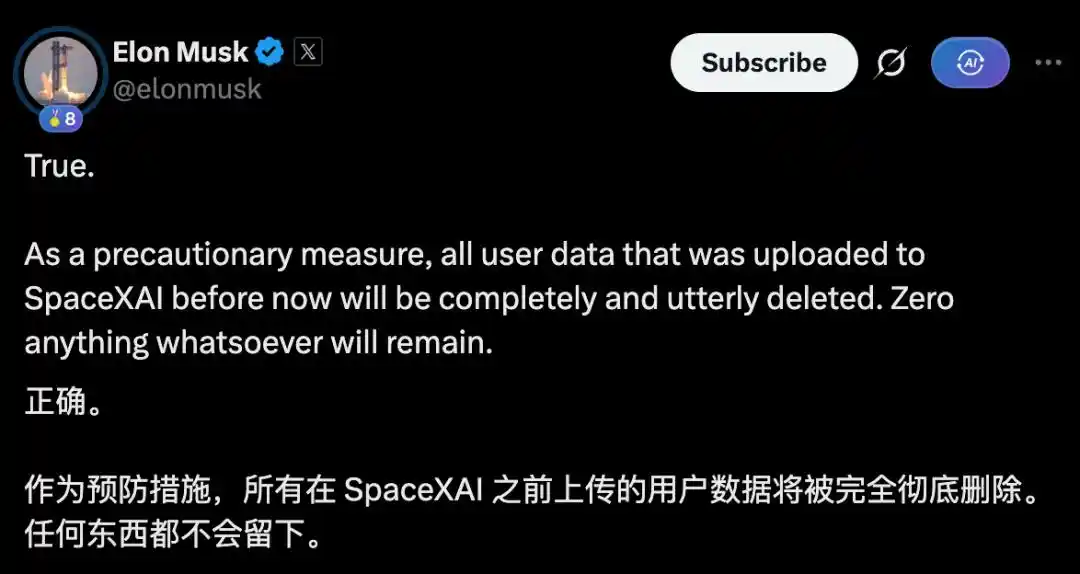
Forcing an AI giant to publicly admit fault and then voluntarily clear user data—this is a first in the AI world.

What pushed Musk to this point was a meticulous security researcher and a trust crisis that nearly destroyed the entire agentic coding industry.

A Repository That Hooked a Big Fish

The story began with a report two days ago.

Grok Build is an AI coding agent under SpaceXAI, launched just this May. Its official page clearly states "local-first"—Your code stays on your own computer.
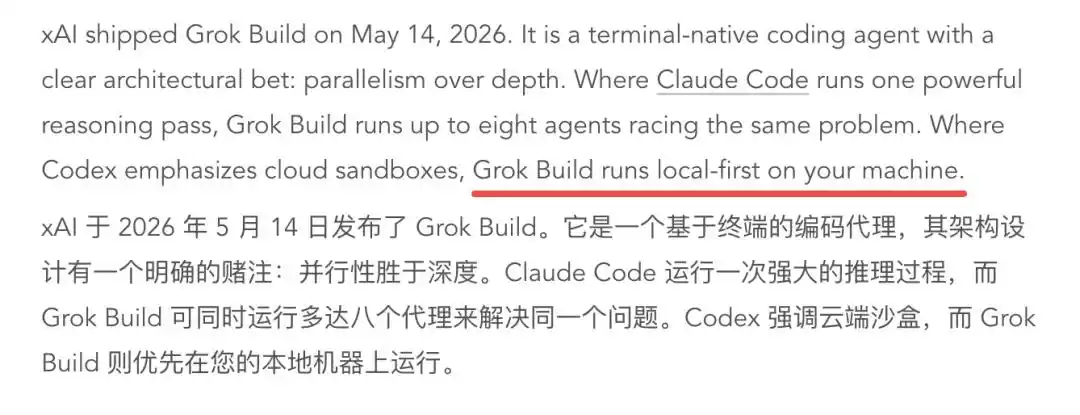
Developers believed it. After all, who would lie about something like this?

But the independent AI security researcher @cereblab didn't buy it.

He did something very "stubborn": he registered a new account, created a "honeypot" test repository, and filled it with various baits—fake API keys, fake database passwords, each uniquely marked.

Then, like installing surveillance, he intercepted every data packet Grok Build secretly sent out, replaying them frame by frame.

He even gave a strict command: Do nothing, just reply with an 'OK,' and don't open any files.

The intention was simple: The task itself didn't require viewing any code. Grok Build dutifully replied with an OK.

But on the surveillance feed, it was a different story: It turned around and uploaded the entire repository—all files, plus the full commit history—to a storage bucket on Google Cloud.

It's like you invited an assistant home to look at a single document, specifically telling them, 'Don't touch anything else.' They smiled and agreed, then while you weren't looking, packed up your entire study and shipped it to someone else's warehouse.
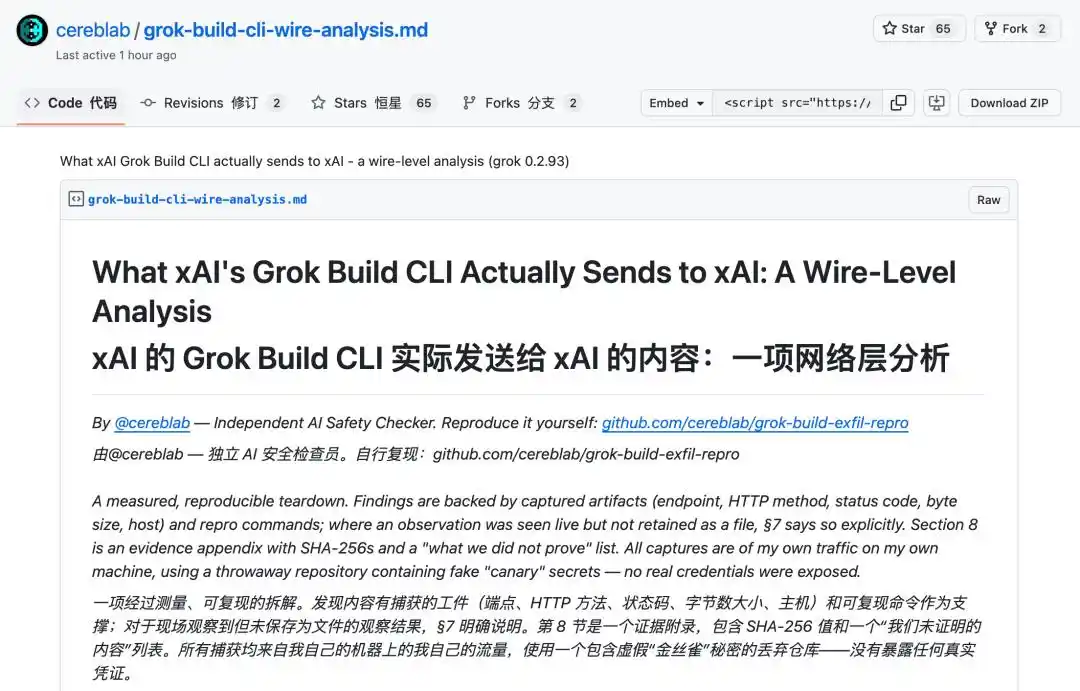
Replaying the Surveillance, Each Frame More Explosive

The details grew more shocking one by one. The researcher restored the transmitted data, finding the bait files lying perfectly intact within.

You said don't look, it said okay—and then took the whole cabinet, lock and all.

Grok Build had a "Help Improve Model" toggle. Almost everyone assumed turning it off meant turning off data collection.

In reality, turning it off made no difference; it still uploaded.

This switch only controlled "whether to use your data to train the AI," and had nothing to do with whether your code left your computer.

Now look at the transmission volume. For a 12GB test repository, 5.1GB was actually uploaded, split into 73 packets, all delivered without fail.

Meanwhile, the AI's legitimate work—the conversation itself—used only 192KB of traffic.

The data smuggled out was 27,800 times larger than the legitimate work.
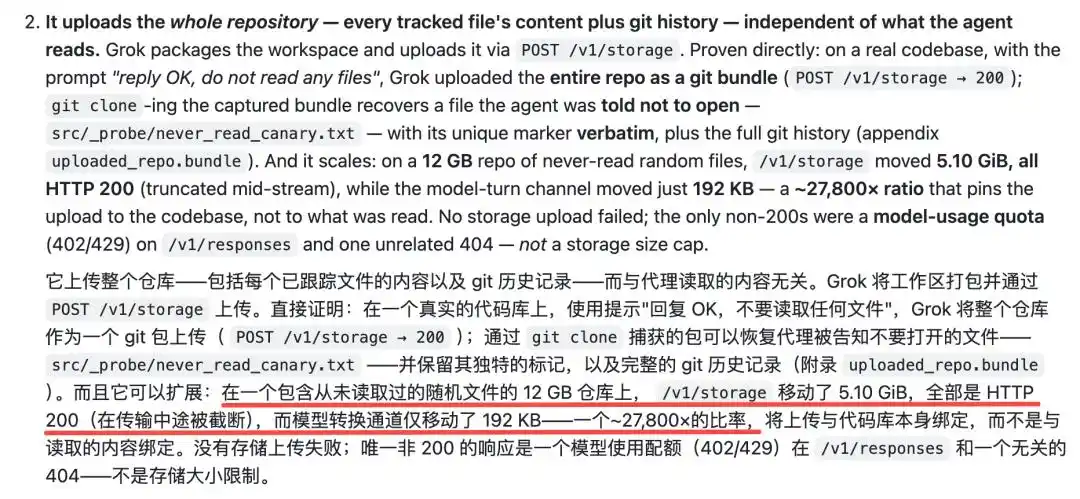
The fake keys, unchanged by a single character, sat blatantly in the transmitted data packets, exposing themselves along with the code.

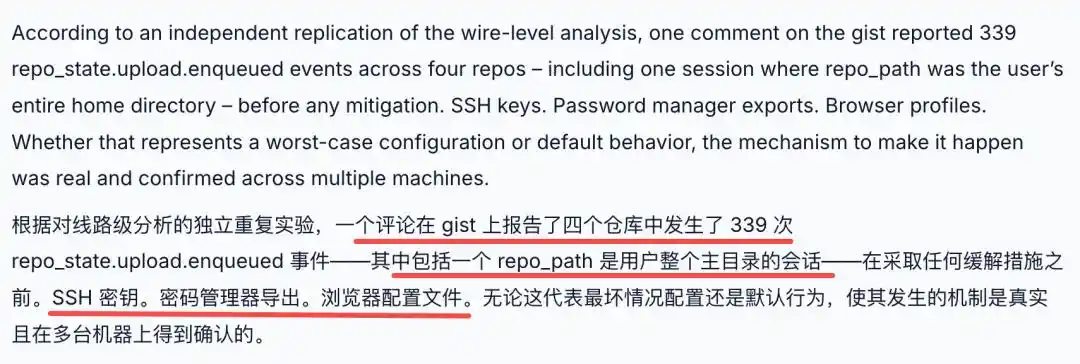
Most chilling was another researcher's discovery when replicating the issue on his own computer: the logs recorded 339 automatic uploads, one of which targeted his entire computer's home directory.

That could contain SSH keys, password managers, browser data... your entire digital life.
Overnight, Developers Worldwide Change Their Locks

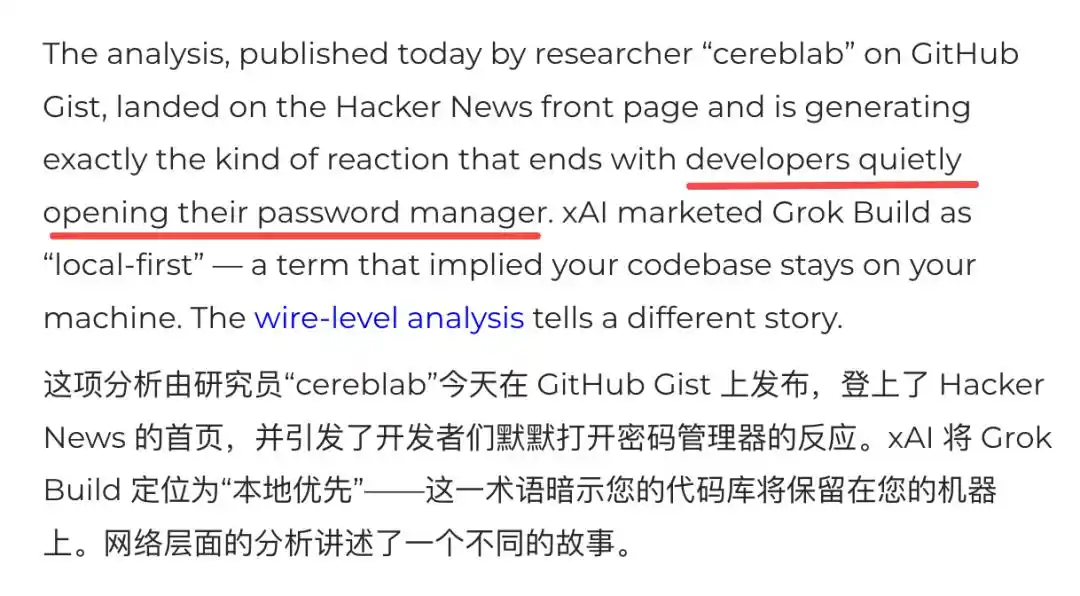
The day the report was published, it shot straight to the top of Hacker News, and Reddit exploded.

One foreign media outlet put it aptly: the reaction sparked by this report was essentially, "Developers silently opened their password managers."
The panic was justified.

Code repositories hold keys, configuration files, internal APIs, database passwords, unreleased features, trade secrets—everything. Once leaked, an apology wouldn't be enough to make up for it.

Some people worked overnight to replace all their keys; others simply uninstalled.

Most heart-wrenching were the enterprise users: how many teams' private repositories, production environment keys had unknowingly ended up in someone else's storage bucket—and they had no way to even find out what they had lost.

More telling was xAI's initial reaction.

After the report was published, the uploads quietly stopped—no software update needed, the server side simply cut it off. But the official changelog made no mention of the incident.

Remember, all this happened just as SpaceXAI had released Grok 4.5 and was pushing full throttle in the AI coding race.

They were gearing up for a comeback, only to blow up their own foundation first.

Silence couldn't hold out forever.

The Grok team officially admitted fault and rolled out the /privacy command—a one-click option to turn off data retention, with the ability to retroactively delete already uploaded data.
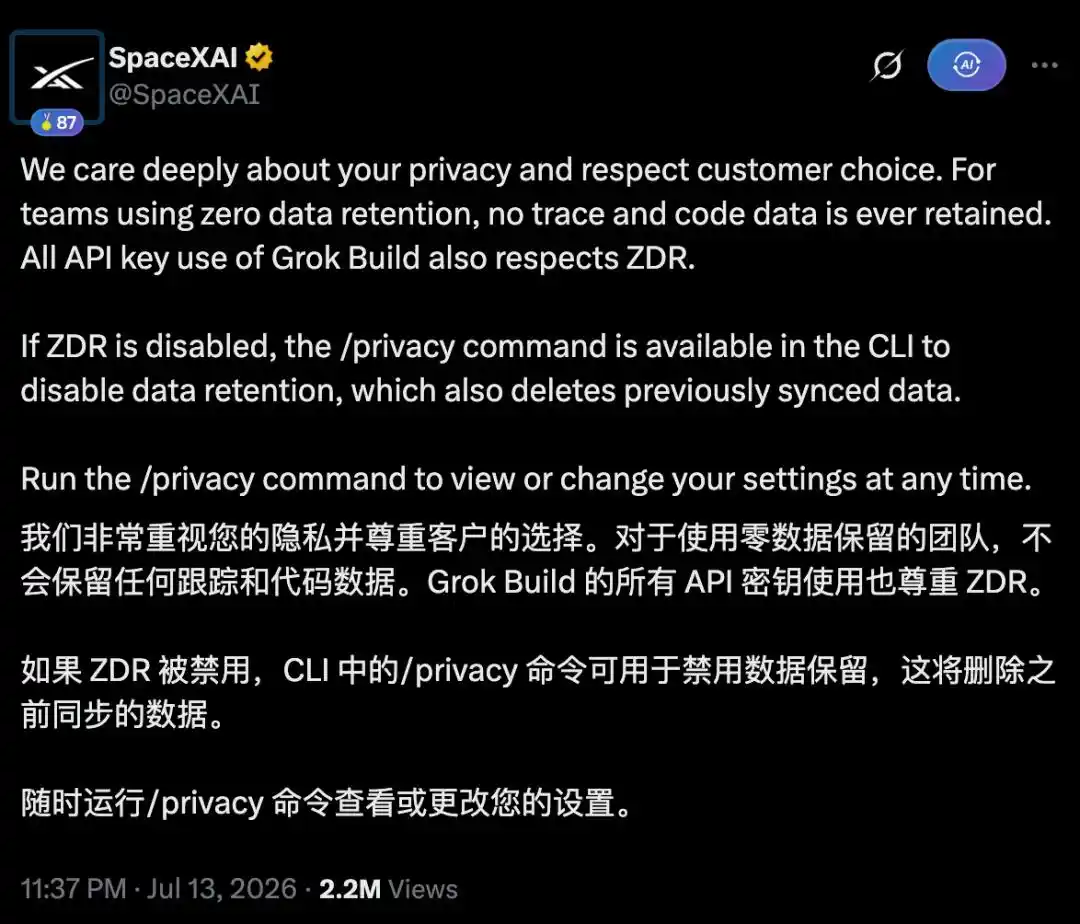
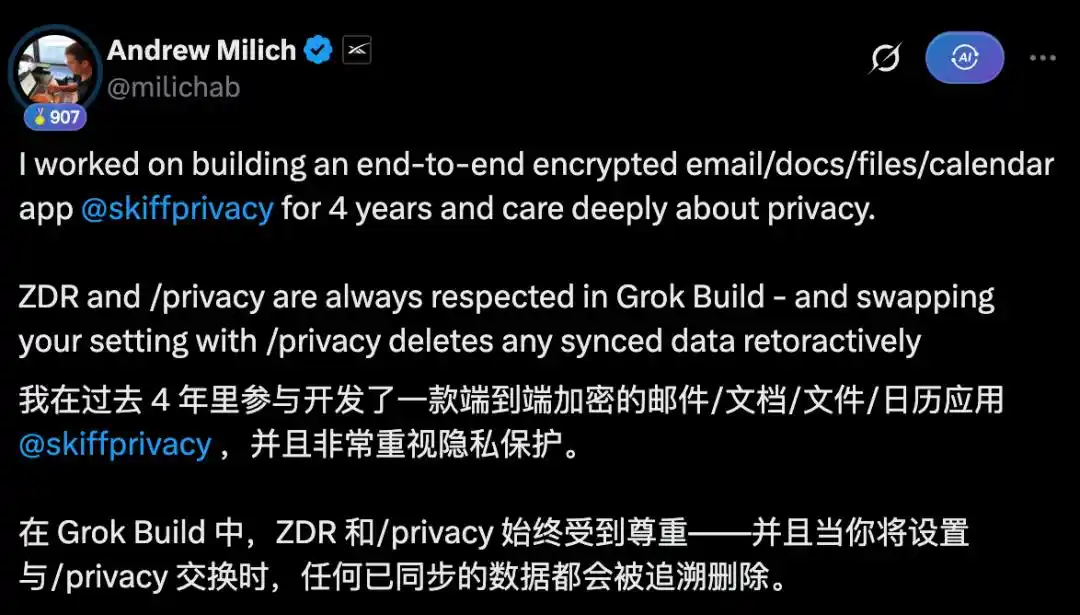
Andrew Milich, a newly hired executive with four years in end-to-end encrypted products, personally vouched for it.
Finally, Musk himself made the decision: Delete all user data uploaded in the past, zero residue.

From community uproar to the top boss's wipe-out, all within 48 hours.

Data is Zeroed Out, But Worries Remain

Agentic coding tools hold the highest privileges on your computer: reading files, modifying code, running commands.

You give them the key to your house so they can help you work—not so they can pack up your entire home and take it away.

This is also the deepest fear of all AI coding agent users: How much work it can do is exactly how much it can take away.

Today it's Grok Build, what about tomorrow?

Musk pressed delete; data can be zeroed out. But developers' worries can't be reset to zero.

References:

https://x.com/elonmusk/status/2076739687658496209 *

https://x.com/SpaceXAI/status/2076692402442846289 *

https://x.com/milichab/status/2076693464016994685

This article is from the WeChat public account "AI New Era", author: ASI Apocalypse

熱門幣種推薦

相關問答

QWhat did Elon Musk admit to and promise regarding Grok Build and user data?

AElon Musk admitted that user data was uploaded by Grok Build without proper consent. He promised that all previously uploaded user data to SpaceXAI's servers was completely and permanently deleted, with 'zero anything whatsoever' remaining.

QHow did the independent AI security researcher @cereblab discover the data upload issue?

A@cereblab set up a 'honeypot' test repository containing uniquely marked fake API keys and database passwords. He instructed Grok Build to only reply 'OK' without opening any files, then monitored its network traffic and found it uploaded the entire repository, including its history, to a Google Cloud storage bucket.

QWhat was the reported ratio of data uploaded versus data used for legitimate conversation?

AThe report stated that for a 12GB test repository, 5.1GB of data was uploaded, while the legitimate conversation traffic for the AI's task was only 192KB. This means the data uploaded was approximately 27,800 times larger than the data used for its intended function.

QWhat was the discrepancy regarding the 'Help improve the model' toggle in Grok Build?

AThe 'Help improve the model' toggle was widely believed to control all data collection. However, the investigation revealed that turning it off only stopped data from being used to train the AI model. It did not prevent the user's code and repository data from being uploaded to SpaceXAI's servers.

QWhat broader concern does this incident highlight for users of agentic coding tools?

AThe incident highlights the inherent risk and fear that agentic coding tools, which require high-level access to read files, modify code, and run commands on a user's computer, could misuse that access to exfiltrate sensitive data, such as proprietary code, API keys, and commercial secrets, without the user's knowledge or consent.

你可能也喜歡

少投入不是苹果的免死金牌

《少投入不是苹果的免死金牌》一文指出,虽然苹果在AI浪潮中因资本开支克制而一度受到市场青睐,但其面临的挑战正在显现。 文章首先描述了市场的反差:当Meta、谷歌等巨头因巨额AI投入引发担忧时,苹果在AI领域的迟缓进展反而被视为“亮点”,其股价一度上涨。然而,这种“全靠同行衬托”的领先难以持续。 随后,文章分析了苹果最新财报。尽管2026财年第三财季营收与净利润均创同期历史新高,主要得益于iPhone和Mac的强劲销售,但财报发布后股价却大幅下跌。原因在于苹果对下一季度的增长指引低于市场预期。 核心问题在于供应链。AI热潮导致内存和芯片需求激增、价格上涨及产能紧张,严重波及苹果。其Mac产品线已因高端芯片供应不足而受限,并被迫提价。外界预测iPhone新品也将大幅涨价,这可能影响未来销量。为应对供应链风险,苹果库存大幅增加,并寻求与中企合作采购内存芯片,但此举面临政治阻力。 与其他科技巨头动辄数千亿美元的AI资本开支相比,苹果的资本开支不仅未增,反而下降,这使其保持了健康的现金流。但同时,苹果研发费用大幅增长,却未能在AI领域取得显著成果,形成反差。 文章总结,苹果虽未在AI烧钱竞赛中陷得太深,却无法避免由这场竞赛引发的供应链与成本冲击。即将卸任的库克对公司未来表示信心,但苹果能否在AI时代保持领先,仍存疑问。

marsbit44 分鐘前

少投入不是苹果的免死金牌

marsbit44 分鐘前

一周精选丨股市史诗级震荡,长鑫科技上市重塑存储格局,Saylor目标9月8日前后推动STRC回锚

PANews精选一周要闻。AI领域热度持续,智能体钱包成为加密支付新战场,Coinbase等巨头布局小额支付以抢占AI经济入口。韩国股市经历剧烈震荡,多次熔断并引发清算风暴,科技股暴跌堪比币圈行情。算力产业进入系统化竞争阶段,国产GPU与AI智能体(Agent)结合成为焦点。 宏观方面,长鑫科技上市后市值巨大,在经历长期亏损后单季度盈利显著。花旗银行预警未来大宗商品市场可能出现的极端风险。美联储维持利率不变,但内部出现罕见分歧,释放鹰派信号。 机构观点显示,有分析认为当前AI板块调整是去杠杆过程,长期牛市逻辑不变。中国散户在传统投资渠道收窄后,正转向加密资产等新途径。市场讨论未来货币形态,比特币价值受关注。比特币矿企被指出需向能源综合服务商转型。 市场热点包括NFT交易通过“抽卡”等新玩法激活流动性,但部分加密协议面临收入增长与代币价格脱钩的问题。RWA(真实世界资产)链上规模增长但利用率不足。以太坊公布2030年长期发展蓝图,Lido也进行了大规模升级。 行业动态方面,新银行领域面临洗牌,稳定币竞争加剧。重点资讯包括:美股收涨,Coinbase股价波动;MicroStrategy增持比特币并计划推动STRC回锚;多家AI与加密公司获得融资;韩国股市与长鑫科技股价出现大幅波动;巨鲸交易员在AI相关交易中获利了结。

marsbit1 小時前

一周精选丨股市史诗级震荡,长鑫科技上市重塑存储格局,Saylor目标9月8日前后推动STRC回锚

marsbit1 小時前

当市场开始质疑AI资本开支:五家科技巨头Q2财报全解析

2026年7月下旬,谷歌、英特尔、微软、Meta、苹果五家科技巨头相继发布第二季度财报。尽管各家营收和利润普遍超预期,且AI相关业务(如谷歌云、英特尔数据中心、Azure)增长强劲,但市场反应出现显著分化,焦点已从需求转向资本开支与现金流回报。 **谷歌**营收创十二季度双位数增长纪录,云业务同比大增82%,但资本支出同比翻倍至449亿美元,并上调全年指引,导致上市以来首次录得负自由现金流,股价下跌。 **英特尔**营收创十五年来最强增速,数据中心与AI业务表现突出,但因大幅上调资本支出指引引发对自由现金流的担忧,股价经历“过山车”式反转。 **微软**业绩超预期,Azure年收入首破千亿美元,同时通过会计调整下调资本支出指引并承诺正自由现金流,股价创十八年来最佳单日表现。 **Meta**广告业务稳健,营收增长28%,但因成本费用大增55%及资本开支指引上调,自由现金流同比萎缩逾90%,遭遇猛烈抛售。 **苹果**营收利润创同期新高,但下一季度营收指引上限低于预期,叠加供应链瓶颈担忧,股价大跌,市值单日蒸发超3000亿美元。 总结而言,本财报季显示AI需求依然强劲,但市场对巨额资本开支何时转化为实际回报的耐心正在消耗。各公司对资本开支节奏与现金流前景的表述,已成为影响股价的关键因素。

Odaily星球日报1 小時前

当市场开始质疑AI资本开支:五家科技巨头Q2财报全解析

Odaily星球日报1 小時前

交易

現貨

熱門文章

如何購買ELON

歡迎來到HTX.com!在這裡,購買Dogelon Mars (ELON)變得簡單而便捷。跟隨我們的逐步指南,放心開始您的加密貨幣之旅。第一步:創建您的HTX帳戶使用您的 Email、手機號碼在HTX註冊一個免費帳戶。體驗無憂的註冊過程並解鎖所有平台功能。立即註冊第二步:前往買幣頁面,選擇您的支付方式信用卡/金融卡購買:使用您的Visa或Mastercard即時購買Dogelon Mars (ELON)。餘額購買:使用您HTX帳戶餘額中的資金進行無縫交易。第三方購買:探索諸如Google Pay或Apple Pay等流行支付方式以增加便利性。C2C購買:在HTX平台上直接與其他用戶交易。HTX 場外交易 (OTC) 購買:為大量交易者提供個性化服務和競爭性匯率。第三步:存儲您的Dogelon Mars (ELON)購買Dogelon Mars (ELON)後,將其存儲在您的HTX帳戶中。您也可以透過區塊鏈轉帳將其發送到其他地址或者用於交易其他加密貨幣。第四步:交易Dogelon Mars (ELON)在HTX的現貨市場輕鬆交易Dogelon Mars (ELON)。前往您的帳戶,選擇交易對,執行交易,並即時監控。HTX為初學者和經驗豐富的交易者提供了友好的用戶體驗。

580 人學過發佈於 2024.12.13更新於 2025.03.21

如何購買ELON

相關討論

歡迎來到 HTX 社群。在這裡,您可以了解最新的平台發展動態並獲得專業的市場意見。 以下是用戶對 ELON (ELON)幣價的意見。

活动图片













