AAVE Rallies 30% in a Week, Is It Back on Track?

Foresight News發佈於 2026-06-30更新於 2026-06-30

文章摘要

Over the past week, the price of AAVE surged from around $70 to nearly $100, a rebound exceeding 30%. This occurred despite Aave's TVL continuing to decline following the Kelp DAO security incident. The price movement was partly driven by market rumors, first reported by CoinDesk, that Kraken was negotiating to acquire a stake in Aave. While Aave founder Stani Kulechov denied the specific terms, he confirmed discussions with multiple parties about purchasing Aave Labs' AAVE tokens. He also revealed ongoing work on Tokenomics 3.0, featuring an automated buyback mechanism, and plans to expand into securities-backed lending. Analysts remain optimistic about Aave's long-term prospects. Standard Chartered gave an extremely bullish $3,500 price target for 2030, citing DeFi revival and RWA tokenization. Grayscale offered a more conservative one-year target of $175. However, competitors like Morpho are gaining traction, with recent reports highlighting its advantages in capital efficiency and customization. Morpho also secured a massive $175 million funding round. Fundamentally, Aave maintains its dominance as the leading DeFi lending protocol. Its TVL is nearly double that of second-place Morpho and rivals the combined total of the next several competitors. Key metrics like active borrowing, total supply, and revenue significantly outpace rivals. While Aave faces challenges from newer, more flexible protocols, its deep liquidity and established position make it a preferred choice ...


Written by: Eric, Foresight News


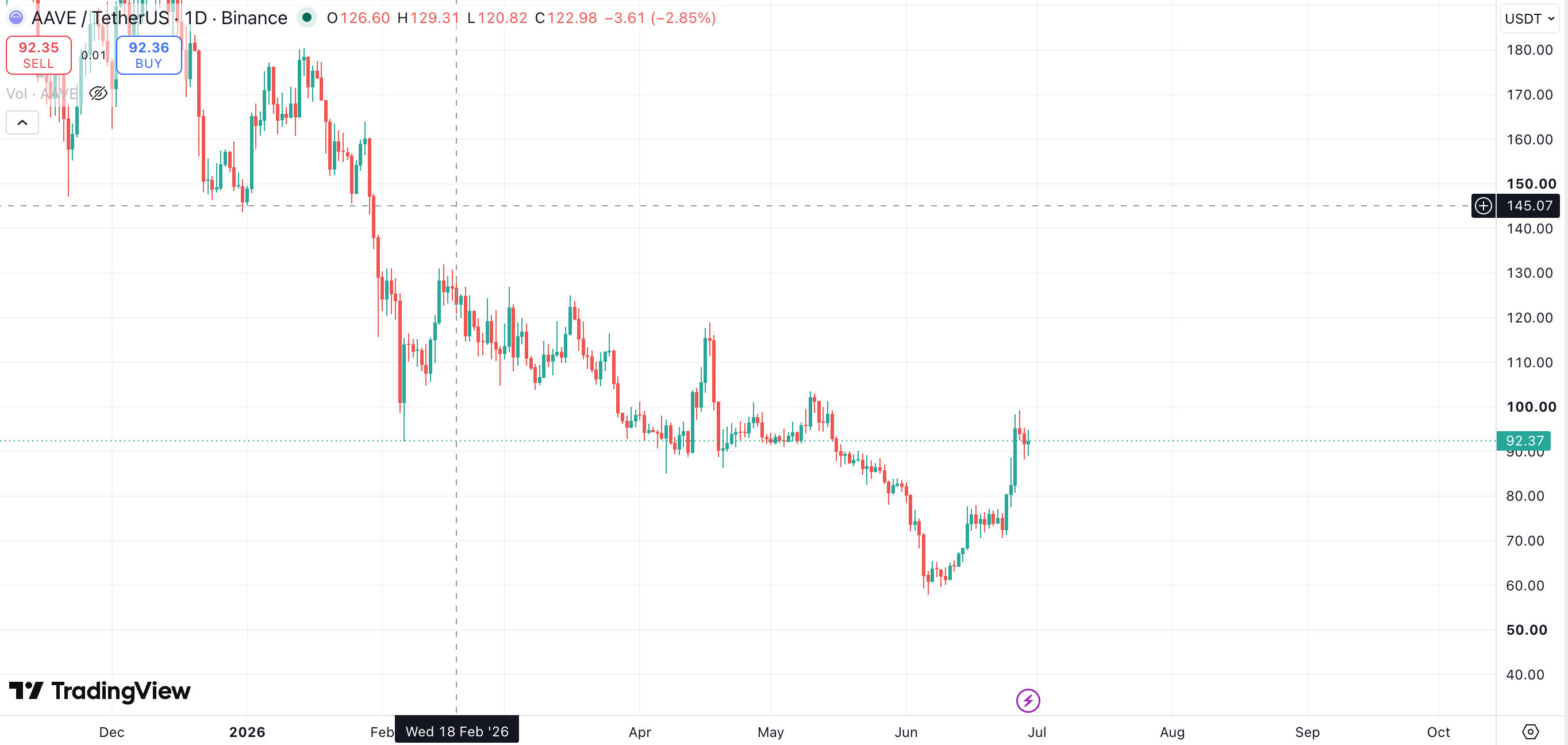
In the past week, the price of AAVE surged from around $70 to nearly $100, marking a rebound of over 30%.


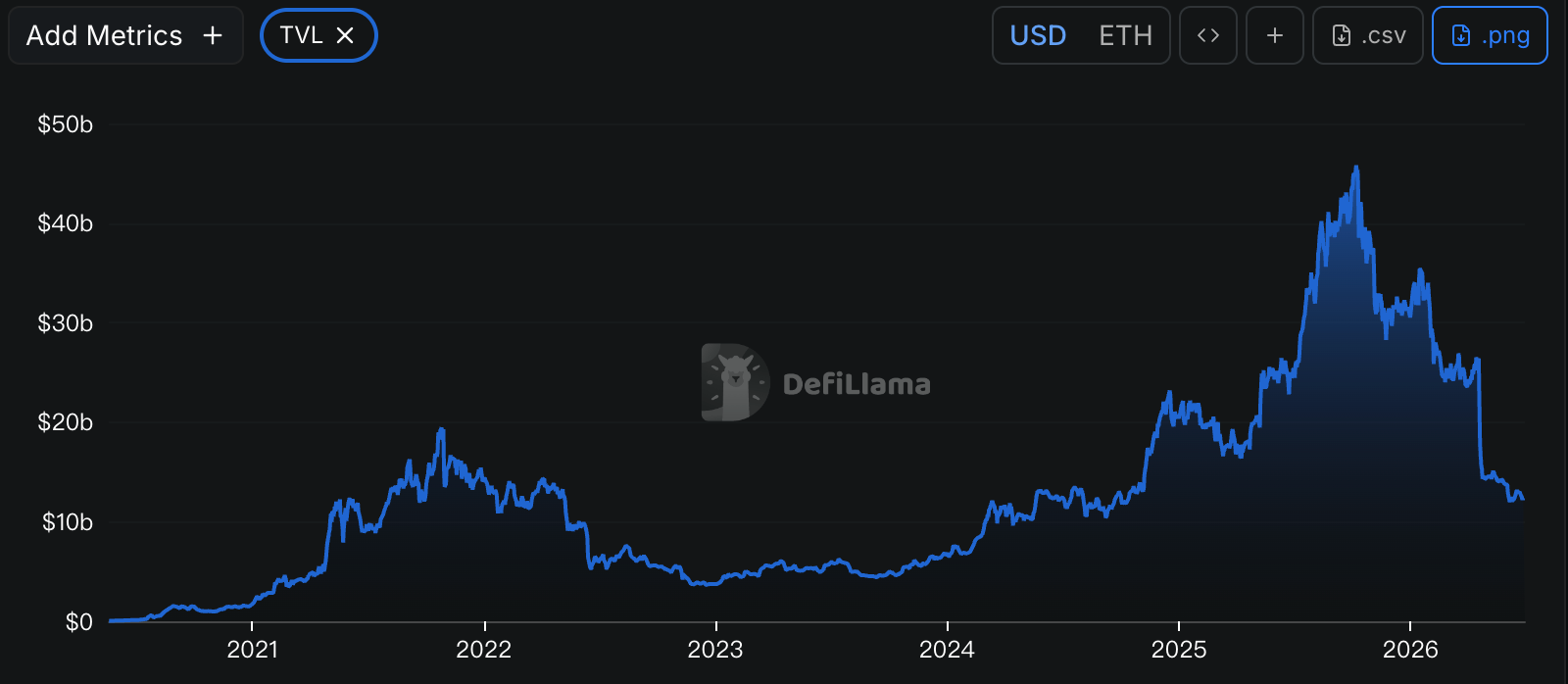
Looking solely at the TVL data, Aave still hasn't recovered from the Kelp DAO attack incident. In fact, its TVL has declined further compared to the panic-driven levels seen during that period.


Despite the underwhelming data, Aave continues to attract capital interest. In the early hours of June 26, CoinDesk, citing sources, reported that Kraken was in talks to acquire a stake in Aave. The potential deal involved exchanging 35,000 ETH for 250,000 AAVE tokens and 15% equity in Aave Group, valuing the entire transaction at $71 million.


This report from sources was quickly refuted by Aave founder Stani Kulechov, as the reported valuation would imply Kraken valuing Aave at less than one-third of its token's market capitalization. Stani denied any intention to "sell tokens at a 70% discount" but acknowledged that "multiple market participants have discussed directly or indirectly purchasing AAVE tokens held by Aave Labs through deeper, long-term partnerships."


The prospect of someone buying the dip naturally spurred others to front-run. Aave's price rose for three consecutive days on June 24, 25, and 26, with the peak gain on the 26th exceeding 20%. Beyond the acquisition rumors, Stani also revealed, while refuting the report, that research is underway for Tokenomics 3.0, which would introduce an automated buyback mechanism. Furthermore, on the evening of the 26th, he stated that Aave is expanding its target market from crypto assets to all asset classes through securities-backed lending and securities lending operations.


Standard Chartered Bank has given an extremely optimistic price prediction of $3,500 for Aave by 2030, citing bullishness on a future DeFi revival and the development of RWA tokenization. While more conservative, Grayscale also believes that, catalyzed by RWA tokenization, AAVE's price could reach $175 within a year.


Explicitly bearish views on Aave in the market are relatively few. However, reports released this year by Eco, Fensory, Coinstancy, among others, have pointed out that Morpho Blue surpasses Aave in rate optimization, capital efficiency, and custom market creation. Tiger Research went even further, suggesting that Morpho represents the "modular" trend, while Aave resembles a "traditional unified pool," lagging in flexibility.


From the initial source leak, to implicitly confirming the existence of potential AAVE token investors during the refutation, followed by successive revelations of protocol developments, the sequence carries a sense of strategic pacing. Setting these aside and looking purely at fundamentals, despite experiencing community division, security concerns, capital outflows, and other setbacks, Aave's TVL still firmly holds the top position among DeFi lending protocols. It is not only nearly double that of the second-place Morpho but also almost equal to the combined TVL of the 2nd, 3rd, and 4th place protocols.
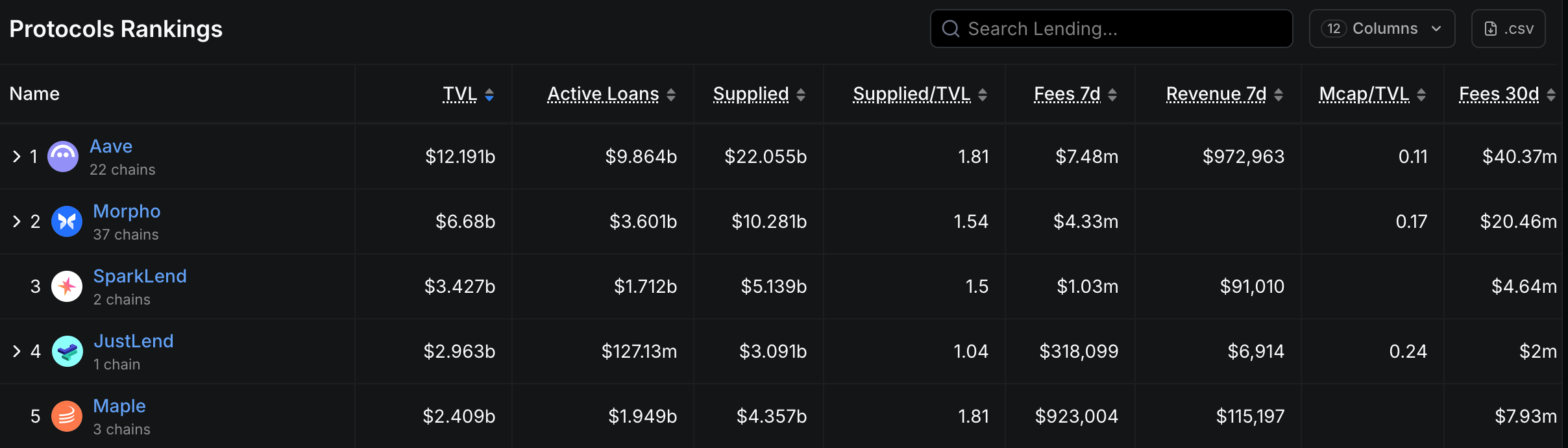


It's not just TVL; metrics like active borrowing, total supply, revenue, and fees also show significant leads. It has been nearly 9 years since ETHLend launched. Conflicts within the team and community, along with protocol risks, are not unforeseen, especially during an overall industry downturn. For a protocol whose code is immutable on-chain, as long as the protocol's core fundamentals haven't suffered a severe decline, the advantages accumulated over years are difficult to be fully eroded in a short period.


On the other hand, Morpho indeed shows a rising momentum. On June 9th, Morpho raised $175 million in a funding round led by Paradigm, Ribbit Capital, and a16z crypto, valuing the project at $2 billion, making it one of the largest single fundraising events in DeFi history. However, some also argue that Morpho and Aave have taken different paths, not competing directly on the same dimension, as each possesses core strengths that are difficult for the other to challenge.


Aave's lending depth makes it the preferred choice for whale users, and its not-high-but-stable yields are favored by many stablecoin holders—at least, this remained true before the Kelp DAO incident. Projects inevitably encounter bumps along the road. In a cryptocurrency market where quality investment targets are becoming increasingly scarce, projects that have withstood the test of time deserve sustained attention.


熱門幣種推薦

相關問答

QWhat is the main reason for the recent 30% price surge of AAVE, according to the article?

AThe main reason for the surge is reportedly a combination of rumors about a potential investment from Kraken and strategic announcements from the Aave team, such as working on Tokenomics 3.0 and expanding into securities-backed lending.

QWhat event significantly impacted Aave's TVL, and how is its TVL currently positioned compared to competitors?

AAave's TVL was significantly impacted by the Kelp DAO hack. Despite this, it remains the top DeFi lending protocol by TVL, holding nearly double the TVL of its closest competitor (Morpho) and almost the combined total of the second, third, and fourth places.

QHow did Aave founder Stani Kulechov respond to the Kraken acquisition rumors, and what key information did he confirm?

AStani Kulechov denied the specific details of the Kraken acquisition rumor, particularly the valuation at a 70% discount. However, he confirmed that discussions have been held with multiple market participants regarding potential long-term partnerships involving the purchase of AAVE tokens held by Aave Labs.

QWhat are the key future catalysts for AAVE's price mentioned by financial institutions in the article?

AFinancial institutions like Standard Chartered and Grayscale cite the revival of DeFi and the growth of Real World Asset (RWA) tokenization as key future catalysts for AAVE's price. Standard Chartered gave an extremely optimistic long-term target, while Grayscale provided a more conservative one-year target.

QWhat is the primary competitive challenge to Aave mentioned in the article, and how do their approaches differ?

AThe primary competitive challenge mentioned is Morpho. The article notes that reports highlight Morpho's advantages in interest rate optimization, capital efficiency, and custom markets. However, it also presents a view that Aave and Morpho operate on different dimensions: Aave excels in liquidity depth for large users, while Morpho represents a more flexible, 'modular' trend.

你可能也喜歡

Token经济如何改写AI“度量衡”的商业规则丨ToB产业观察

本文探讨了AI时代中Token经济的兴起及其如何重塑商业规则。文章指出,随着AI技术的快速发展,特别是大模型和算力的指数级增长,企业面临如何评估AI投资价值的难题。Token作为AI服务的计量单位,正成为衡量其价值的关键。 Token调用量在中国呈现爆发式增长,从2024年初的日均1000亿跃升至2026年3月的140万亿,增长超千倍。专家将其类比为“智能时代的电”,预示其巨大潜力。然而,Token的价值在不同行业和场景下差异巨大,例如药物研发领域的Token价值远高于闲聊场景,关键在于其产生的“智力水平”和是否为“有效Token”。 针对Token定价与价值评估的混乱,联想集团副总裁阿不力克木提出了Token经济的“三大定律”: 1. **惯性定律**:单位Token成本将持续下降,得益于芯片、能源、模型的技术创新,系统调优以及运行时智能调度。 2. **加速定律**:单位Token创造的价值将加速释放,这取决于AI嵌入业务流程的深度、工程化程度以及配套的人才、基础设施和治理体系的完善。 3. **奇点定律**:企业AI应用存在一个成本与价值的转折点(奇点)。奇点之前,AI主要节省成本;奇点之后,AI将创造前所未有的增量价值,实现“创新的规模化”。 现实中,许多企业如Uber、Meta已面临AI使用成本超预算的困境,问题根源包括Token定价不透明、计费方式复杂以及智能体应用导致Token消耗量剧增。为应对挑战,产业界正推动建立“高质量Token”标准,并发展如Token工厂、算力套餐等更高效、透明的服务模式。 文章最后强调,Token经济的核心在于让每次AI调用产生真实价值。AI的终极目标并非替代人力,而是让创新本身能够规模化,其意义如同电力普及一样深远。

marsbit33 分鐘前

Token经济如何改写AI“度量衡”的商业规则丨ToB产业观察

marsbit33 分鐘前

交易

現貨

熱門文章

如何購買AAVE

歡迎來到HTX.com!在這裡,購買Aave Protocol (AAVE)變得簡單而便捷。跟隨我們的逐步指南,放心開始您的加密貨幣之旅。第一步:創建您的HTX帳戶使用您的 Email、手機號碼在HTX註冊一個免費帳戶。體驗無憂的註冊過程並解鎖所有平台功能。立即註冊第二步:前往買幣頁面,選擇您的支付方式信用卡/金融卡購買:使用您的Visa或Mastercard即時購買Aave Protocol (AAVE)。餘額購買:使用您HTX帳戶餘額中的資金進行無縫交易。第三方購買:探索諸如Google Pay或Apple Pay等流行支付方式以增加便利性。C2C購買:在HTX平台上直接與其他用戶交易。HTX 場外交易 (OTC) 購買:為大量交易者提供個性化服務和競爭性匯率。第三步:存儲您的Aave Protocol (AAVE)購買Aave Protocol (AAVE)後,將其存儲在您的HTX帳戶中。您也可以透過區塊鏈轉帳將其發送到其他地址或者用於交易其他加密貨幣。第四步:交易Aave Protocol (AAVE)在HTX的現貨市場輕鬆交易Aave Protocol (AAVE)。前往您的帳戶,選擇交易對,執行交易,並即時監控。HTX為初學者和經驗豐富的交易者提供了友好的用戶體驗。

785 人學過發佈於 2024.12.11更新於 2026.06.02

如何購買AAVE

相關討論

歡迎來到 HTX 社群。在這裡,您可以了解最新的平台發展動態並獲得專業的市場意見。 以下是用戶對 AAVE (AAVE)幣價的意見。

活动图片