SharpLink CEO: How to Interpret Ethereum Developers Surpassing 1 Million?

marsbit發佈於 2026-06-16更新於 2026-06-16

文章摘要

SharpLink CEO reflects on the milestone of Ethereum surpassing one million historical developers, a figure unmatched in crypto. Based on Electric Capital data and observations from Asian developer hubs, the article argues that Ethereum’s true strength isn't raw speed, but where top builders choose to build long-term. The core advantage is a decade-deep ecosystem of standards, tools, liquidity, and culture. Of the over one million developers, about 232,000 were active in the past year, working on hard problems: protocol scalability (e.g., the upcoming Glamsterdam upgrade), synchronous composability across rollups, and post-quantum security preparedness. Ethereum’s defensibility stems from network effects beyond numbers: deep composability (the "financial Lego" of DeFi), the universal EVM/Solidity stack, credible neutrality (secured by ~900k validators), and its role as the trusted settlement layer for major institutions. The convergence of top researchers, a modular rollup ecosystem, and a culture of long-term thinking create a compounding advantage that is difficult to replicate. The conclusion is that Ethereum has consolidated its position as the default operating system for programmable finance and internet-native capital, attracting the builders who are architecting the next generation of financial infrastructure.

Author: Joseph Chalom

Compiled by: Jiahuan, ChainCatcher

I just returned from Asia, where I spent time with Ethereum developers and ecosystem leaders. Special thanks to Nonce Classic, Four Pillars, and DSRV in Seoul, our friends at SNZ, and the newly opened Ethereum Community Hub in Hong Kong. This hub is the first long-term, physically operational Ethereum community space in Asia, supported by the Ethereum Foundation.

What impressed me most was not just the vibrancy, but the rigor and ambition of the builders. The high-caliber projects, the spirit of experimentation, and the long-term thinking emerging from the global Ethereum ecosystem were truly inspiring.

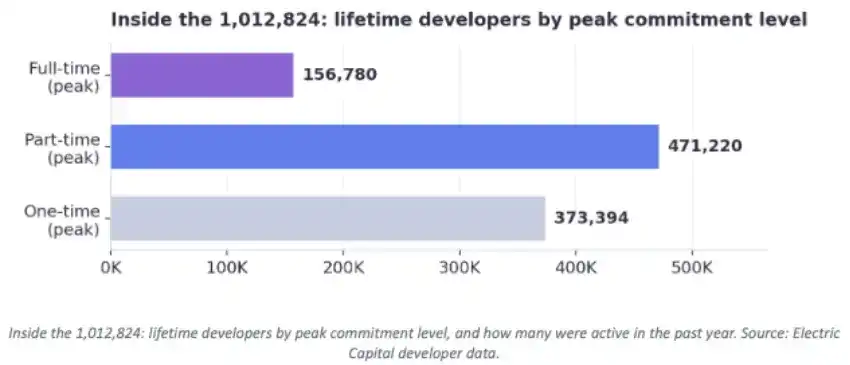
This also gave life to a statistic: According to Electric Capital's data, the total number of historical Ethereum developers has now surpassed one million, with 1,012,824 individuals having contributed to the ecosystem. No other ecosystem in the crypto space comes close.

A Milestone Worth Noting

One million is a round number, and round numbers can sometimes feel hollow. But this one is not. It represents the largest pool of technical talent ever assembled around an open, permissionless blockchain network. More importantly, this pool continues to deepen and broaden.

Of these one million developers, approximately 232,000 have remained active in the past twelve months.
Why Ethereum: The Truly Important Question

For years, discussions in the crypto industry have revolved around speed, fees, and throughput. Every new chain claims to be "faster than Ethereum." But the core question in crypto has never been which chain is the fastest, but rather another:

"Where will the most talented builders choose to build long-term?"

On this question, Ethereum still holds a significant advantage. This advantage isn't merely technical; it's institutional, cultural, economic, and ecological—a complex of a decade's accumulation of developers, infrastructure, standards, tools, liquidity, research, applications, and social coordination that no other ecosystem can replicate.

Ethereum has become the default operating system for programmable finance and internet-native capital formation.

What These Million Builders Are Building, and Why It Strengthens the Moat

The importance of the million builders lies crucially in what they are doing now. The current focus is on the hardest, riskiest problems in the industry: core protocol scalability, privacy, quantum resistance, and the autonomous agent systems that will run on top of it.

The Glamsterdam Upgrade: Innovating Without Compromising Core Principles. The Glamsterdam upgrade, expected in 2026, exemplifies how Ethereum progresses while holding fast to its core values. Core changes include enshrined Proposer-Builder Separation (ePBS) and Block-Level Access Lists (BALs), unlocking parallel execution and higher throughput, potentially raising the Gas limit and significantly increasing Layer 1 capacity.

Scaling for future demand while defending credible neutrality, security, and MEV fairness is a moat that evolves.

Synchronous Composability: Making Many Rollups Act Like One Chain. Composability has always been Ethereum's superpower; the next leap is extending it to Layer 2. Native Rollups and Based Rollups, combined with synchronous composability, solve this. A contract on one rollup can call a contract on the mainnet or another rollup in a single atomic transaction—no bridges, no waiting.

Linea, the Ethereum Economic Zone, Gnosis, Zisk, and the Ethereum Foundation are collaborating to couple this design with live proofs. The result is that dozens of rollups no longer function as isolated networks but begin to operate like a unified chain. This is a direct response to fragmentation criticism.

Quantum Resistance: Ethereum's Most Obvious Lead. No mainstream ecosystem is better prepared for the post-quantum era. The "Lean Ethereum" roadmap, the Ethereum Foundation's Post-Quantum Security team established in early 2026, pq.ethereum.org, and over a dozen client teams already running weekly post-quantum interoperability devnets constitute a coordinated open-source migration targeting readiness by 2029.

When quantum risk materializes, institutions holding trillions in assets will care about one thing above all: which chain prepared the earliest and most thoroughly.

The Moat Beyond Developers: Composability, Standards, and Trust

The aggregation of developer talent creates compound interest, thanks to how Ethereum is built. Its deepest network effect isn't liquidity; it's the depth of composability: applications interact like interoperable financial LEGO bricks.

Lending, stablecoins, exchanges, wallets, tokenized assets, oracles, and Layer 2 rollups all interact through shared standards, and developers never need to start from scratch. The EVM is the application layer of crypto; Solidity skills are transferable across Base, Arbitrum, Optimism, Polygon, zkSync, Scroll, Linea, and hundreds of other networks.

Learning the Ethereum tech stack maximizes optionality, which in turn spins the flywheel: more developers, more tools, more liquidity, more institutions, attracting even more developers to build composable protocols and assets. Liquidity begets liquidity, and composability begets composability.
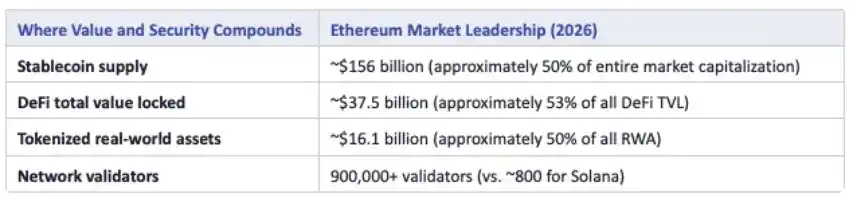
Moreover, Ethereum dominates where true value settles, not just where the most noise is made:

Three forces reinforce this lead.

Credible Neutrality: Ethereum is secured by over 900,000 validators, compared to roughly 800 for Solana. Major institutions place immense value on this degree of decentralization and platform neutrality.

Modularity: Rollups like Base, Arbitrum, and Optimism don't fragment Ethereum; they extend it into an increasingly connected modular internet economy that inherits the security of the mainnet.

Culture: Ethereum attracts top researchers, cryptographers, and EIP standards drafters far beyond any other ecosystem, setting the direction for the entire industry. This is also the advantage most difficult for others to copy.

There's Only One Ethereum

There's a fundamental difference between generating on-chain activity and being the long-term coordination layer for internet-native finance. The latter means being the layer trusted by the world's largest financial institutions.

Ethereum firmly holds the mindshare of large asset holders, institutions that value trust, security, and liquidity above all. I witnessed this firsthand from the front row during my tenure at BlackRock.

In technology markets, ecosystems consolidate over time around standards, liquidity, and developer mindshare. This is Ethereum's moat.

After meeting these developers, builders, and ecosystem leaders in Seoul and Hong Kong, I am more convinced than ever of Ethereum's competitive edge. I met the talent building the next generation of financial infrastructure—the future founders of our industry and the architects of agentic finance. It is these individuals and teams who will change the world.

The future of Ethereum is happening now.

相關問答

QAccording to the article, what is the significance of Ethereum surpassing 1 million total developers?

AIt represents the largest and most skilled technical talent pool ever assembled around an open, permissionless blockchain network. It signifies deep, broad, and sustainable developer engagement that forms a critical competitive moat for Ethereum.

QBeyond just technical speed, what does the author argue is the most important question in the crypto space?

AThe most important question is not which chain is the fastest, but: 'Where will the very best builders choose to build for the long term?'

QWhat are three key technical areas the article highlights where Ethereum's large developer base is focusing to build its moat?

A1) Core protocol scalability through upgrades like Glamsterdam (ePBS, BALs). 2) Synchronous composability across rollups to unify the ecosystem. 3) Post-quantum resistance via coordinated research and migration efforts.

QWhat three reinforcing forces does the article identify as strengthening Ethereum's leading position?

A1) Credible neutrality, secured by extensive decentralization (e.g., ~900k+ validators). 2) A modular architecture where rollups extend rather than fragment the network. 3) A deeply rooted culture that attracts top-tier researchers and sets industry standards.

QHow does the article describe the difference between generating on-chain activity and being a long-term coordination layer for internet-native finance?

AThe latter means becoming the trusted layer for the world's largest financial institutions. It involves capturing the 'mindshare' of large asset holders who prioritize trust, security, and liquidity over mere transaction speed or volume.

你可能也喜歡

XRP Ledger 发布 3.2.0 版本升级并启用 XRPLd 新品牌名

XRP Ledger发布了3.2.0版本,这是对其底层区块链基础设施的一次重要升级。本次更新的核心是将运行网络的软件名称从“rippled”更名为“xrpld”,以更好地反映整个项目生态。 与此前侧重于前端功能的版本不同,3.2.0版本优先进行了后端升级和效率提升,旨在增强网络性能并为未来的扩展做准备。关键改进包括内存优化措施,预计可节省高达40%的服务器内存使用。 此次升级引入了名为“fixCleanup3_2_0”的修改,为单资产金库、借贷协议、权限系统、去中心化交易所、多用途代币和权限域等多个模块带来了安全性增强。开发团队还新增了不变性检查,以确保已删除账户不会在账本上留下不一致的数据,从而加强整个网络的完整性和可靠性。 对于开发者而言,新版本增加了一项重要功能:应用程序无需连接服务器即可检索XRP Ledger协议和服务器定义信息,这将极大便利钱包、区块链浏览器和API等的开发工作。 在可扩展性和稳定性方面,更新包括可配置的区块大小、通过nuDB实现的高效数据库存储,以及将gRPC服务器的TLS/双向TLS支持改为可选,以提升企业用户的性能和连接性。此外,默认对等端口从51235更改为2459,并修复了涉及自动做市商、支付、代币托管、多用途代币、订单簿和RPC等多个方面的问题。出于性能考虑,3.2.0版本暂时禁用了交易不变性检查,但开发团队表示这不会构成安全威胁。

TheNewsCrypto8 小時前

XRP Ledger 发布 3.2.0 版本升级并启用 XRPLd 新品牌名

TheNewsCrypto8 小時前

交易

現貨
合約

熱門文章

什麼是 ETH 2.0

ETH 2.0:以太坊的新時代 介紹 ETH 2.0,廣為人知的以太坊 2.0,標誌著對以太坊區塊鏈的一次重大升級。這次過渡不僅僅是表面上的改造;其目標是從根本上增強網絡的可擴展性、安全性和可持續性。ETH 2.0 透過從能量密集型的工作量證明(PoW)共識機制轉向更高效的權益證明(PoS),承諾為區塊鏈生態系統帶來變革性的改變。 什麼是 ETH 2.0? ETH 2.0 是一系列獨特且相互連接的更新,專注於優化以太坊的能力和性能。這次全面改革旨在解決現有以太坊機制所面臨的主要挑戰,特別是交易速度和網絡擁堵問題。 ETH 2.0 的目標 ETH 2.0 的主要目標圍繞著改善三個核心方面: 可擴展性:旨在顯著提升網絡每秒可以處理的交易數量,ETH 2.0 希望突破目前約每秒 15 笔交易的限制,潛在地達到數千筆。 安全性:增強的安全措施是 ETH 2.0 的核心,特別是提高抵抗網絡攻擊的能力以及保護以太坊的去中心化精神。 可持續性:新的 PoS 機制旨在不僅提高效率,還大幅降低能耗,讓以太坊的運營框架與環保考量相符。 誰是 ETH 2.0 的創造者? ETH 2.0 的創建可追溯至以太坊基金會。這個非營利組織在支持以太坊發展方面發揮著關鍵作用,由著名的聯合創始人 Vitalik Buterin 主導。他對於更可擴展和更可持續以太坊的願景,是這次升級的推動力,並吸引了來自全球的開發者和愛好者的貢獻,共同致力於改善協議。 誰是 ETH 2.0 的投資者? 雖然有關 ETH 2.0 的投資者的具體信息尚未公開,但以太坊基金會已知方向來自區塊鏈及技術領域的各種組織和個人支持。這些合作夥伴包括創投公司、技術公司和慈善機構,它們共同致力於支持去中心化技術和區塊鏈基礎設施的發展。 ETH 2.0 如何運作? ETH 2.0 以引入一系列關鍵特性而著稱,使其與前身有所區別。 權益證明(PoS) 轉向 PoS 共識機制是 ETH 2.0 的標誌性變化之一。與依賴於能量密集型挖礦進行交易驗證的 PoW 不同,PoS 允許用戶根據他們在網絡中抵押的 ETH 數量來驗證交易和創建新區塊。這導致能量效率的提升,能耗降低約 99.95%,使以太坊 2.0 成為一個相當綠色的替代方案。 分片鏈 分片鏈是 ETH 2.0 的另一個關鍵創新。這些較小的鏈與主要的以太坊鏈平行運行,使得多筆交易可以同時處理。這種方法增強了網絡的整體容量,解決了困擾以太坊的可擴展性問題。 信標鏈 在 ETH 2.0 的核心是信標鏈,它協調網絡並管理 PoS 協議。它在某種程度上充當了組織者:它監督驗證者,確保各分片與網絡的連接,並監控整體區塊鏈生態系統的健康狀況。 ETH 2.0 的時間軸 ETH 2.0 的旅程標誌著幾個關鍵里程碑,描繪了這次重大升級的演變: 2020年12月:信標鏈的啟動標誌著 PoS 的引入,為 ETH 2.0 的遷移鋪平了道路。 2022年9月:“合併”的完成代表著以太坊網絡成功從 PoW 轉型為 PoS 框架,預示著以太坊的新時代。 2023年:預期分片鏈的推出旨在進一步增強以太坊網絡的可擴展性,鞏固 ETH 2.0 作為去中心化應用和服務的強大平台。 主要特性和優勢 改進的可擴展性 ETH 2.0 最重要的優勢之一是其改進的可擴展性。PoS 和分片鏈的結合使網絡能夠擴大容量,允許其處理的交易量遠超舊有系統。 能源效率 PoS 的實施對於區塊鏈技術中的能源效率來說是一個巨大的進步。通過大幅降低能源消耗,ETH 2.0 不僅減少了運營成本,還與全球可持續發展目標更加一致。 增強的安全性 ETH 2.0 的更新機制提高了網絡的安全性。PoS 的部署,加上通過分片鏈和信標鏈建立的創新控制措施,確保了對潛在威脅更高程度的保護。 降低用戶成本 隨著可擴展性的改善,交易成本也會明顯降低。預期增強的容量和減少的擁堵將轉化為用戶更低的手續費,使以太坊在日常交易中變得更可及。 結論 ETH 2.0 標誌著以太坊區塊鏈生態系統的一次重要演變。隨著其解決可擴展性、能源消耗、交易效率和整體安全性等關鍵問題,這次升級的重要性不言而喻。轉向權益證明、引入分片鏈以及信標鏈的基礎性工作,顯示出以太坊未來能夠滿足去中心化市場日益增長的需求。在一個由創新和進步推動的行業中,ETH 2.0 是區塊鏈技術在為更可持續和高效的數字經濟鋪路方面能力的見證。

169 人學過發佈於 2024.04.04更新於 2024.12.03

什麼是 ETH 2.0

什麼是 ETH 3.0

ETH3.0 與 $eth 3.0:以深入分析以太坊的未來 介紹 在快速發展的加密貨幣和區塊鏈技術領域,ETH3.0,通常標記為 $eth 3.0,已成為一個備受關注和猜測的話題。該術語包含兩個主要概念,值得說明: 以太坊 3.0:這代表潛在的未來升級,旨在增強現有的以太坊區塊鏈的能力,特別集中於提高可擴展性和性能。ETH3.0 表情符號代幣:這個獨特的加密貨幣項目旨在利用以太坊區塊鏈創建一個以表情符號為中心的生態系統,促進加密貨幣社區的參與。 理解這些 ETH3.0 的方面不僅對加密愛好者至關重要,也對觀察數字空間中的更廣泛技術趨勢的人有所幫助。 什麼是 ETH3.0? 以太坊 3.0 以太坊 3.0 被認為是對已建立的以太坊網絡的擬議升級,自其誕生以來,它一直是許多去中心化應用程式(dApps)和智能合約的支柱。預想的增強主要集中於可擴展性——整合先進技術,如分片和零知識證明(zk-proofs)。這些技術創新旨在促進每秒交易數量的前所未有(TPS),潛在地達到數百萬筆,從而解決當前區塊鏈技術面臨的最重大限制之一。 這次改進不僅是技術性的,更是戰略性的;它旨在為以太坊網絡的普遍採用和未來的實用性做準備,因為該未來將面臨對去中心化解決方案日益增長的需求。 ETH3.0 表情符號代幣 與以太坊 3.0 不同,ETH3.0 表情符號代幣進入了一個更輕鬆和更具玩樂性的領域,通過將互聯網表情符號文化與加密貨幣動態相結合。該項目使用戶能夠在以太坊區塊鏈上購買、出售和交易表情符號,提供一個促進社區通過創造力和共同利益參與的平台。 ETH3.0 表情符號代幣旨在展示區塊鏈技術如何與數字文化交匯,創造出既有趣又具有經濟價值的使用案例。 誰是 ETH3.0 的創造者? 以太坊 3.0 對以太坊 3.0 的倡議主要由以太坊社區內的一個開發者和研究人員的聯盟推動,特別是包括 Justin Drake。他因對以太坊演變的見解和貢獻而聞名,Drake 在關於將以太坊轉變為新共識層的討論中是一個重要人物,這被稱為「Beam Chain」。 這種協作開發的方式標誌著以太坊 3.0 不是單一創造者的產品,而是集中精力促進區塊鏈技術進步的集體智慧的體現。 ETH3.0 表情符號代幣 關於 ETH3.0 表情符號代幣的創造者的詳細資料目前無法追溯。表情符號代幣的特性通常導致更分散和社區驅動的結構,這可以解釋為什麼缺乏具體的歸屬感。這與更廣泛的加密社區的精神相符,該社區的創新往往源於協作而非個人努力。 誰是 ETH3.0 的投資者? 以太坊 3.0 對以太坊 3.0 的支持主要來自以太坊基金會以及一個充滿熱情的開發者和投資者社區。這種基礎聯繫提供了相當程度的合法性,並增強了成功落實的前景,因為它利用了多年網絡運營建立的信任和可信度。 在快速變化的加密貨幣氣候中,社區支持在推動開發和採用中發揮了關鍵作用,將以太坊 3.0 置於未來區塊鏈進步的重要競爭者地位。 ETH3.0 表情符號代幣 雖然目前可用的來源並沒有明確提供支持 ETH3.0 表情符號代幣的投資機構或組織的具體信息,但這反映出表情符號代幣典型的資金模型,通常依賴於基層支持和社區參與。此類項目的投資者通常由因社區驅動的創新潛力以及在加密社區中發現的合作精神而受到激勵的個人組成。 ETH3.0 如何運作? 以太坊 3.0 以太坊 3.0 的區別特點在於其擬議的分片和零知識證明技術的實施。分片是一種將區塊鏈劃分為更小、更易管理的單元或「分片」的方法,這些分片能夠同時處理交易,而不是按序處理。這種處理的去中心化有助於避免擁堵,並確保即使在高負載下,網絡也能保持響應。 零知識證明(zk-proof)技術通過允許交易驗證而不揭示涉及的基本數據,增加了一層複雜性。這一方面不僅增強了隱私性,還提高了整個網絡的效率。還有討論將零知識以太坊虛擬機(zkEVM)納入此次升級,進一步擴大網絡的能力和實用性。 ETH3.0 表情符號代幣 ETH3.0 表情符號代幣通過利用表情符號文化的受歡迎程度而脫穎而出。它建立了一個市場,讓用戶參與表情符號交易,不僅僅是為了娛樂,也是為了潛在的經濟利益。通過整合質押、流動性供應和治理機制等特性,該項目營造了一種促進社區互動和參與的環境。 通過提供娛樂和經濟機會的獨特結合,ETH3.0 表情符號代幣旨在吸引多樣的觀眾,範圍從加密愛好者到隨便的表情符號愛好者。 ETH3.0 的時間表 以太坊 3.0 2024年11月11日:Justin Drake 暗示即將到來的 ETH 3.0 升級,重點是可擴展性改進。這一公告標誌著關於以太坊未來架構正式討論的開始。2024年11月12日:預期中的以太坊 3.0 提案將在曼谷的 Devcon 上公佈,為更廣泛的社區反饋和潛在的開發後續步驟奠定基礎。 ETH3.0 表情符號代幣 2024年3月21日:ETH3.0 表情符號代幣正式在 CoinMarketCap 上列出,標誌著其進入公眾加密領域,並增強了其基於表情符號的生態系統的可見性。 關鍵要點 總之,以太坊 3.0 代表了以太坊網絡內的重要演變,集中於通過先進技術克服可擴展性和性能的限制。其擬議的升級反映出對未來需求和可用性的主動應對。 另一方面,ETH3.0 表情符號代幣 encapsulates 加密貨幣領域中以社區為驅動文化的本質,利用表情符號文化來創建鼓勵用戶創造力和參與的平台。 理解 ETH3.0 和 $eth 3.0 的不同目的和功能對於任何對加密領域中正在進行的發展感興趣的人來說都是至關重要的。隨著這兩個倡議鋪展獨特的道路,它們共同凸顯了區塊鏈創新動態和多樣化的本質。

173 人學過發佈於 2024.04.04更新於 2024.12.03

什麼是 ETH 3.0

如何購買ETH

歡迎來到HTX.com!在這裡,購買Ethereum (ETH)變得簡單而便捷。跟隨我們的逐步指南,放心開始您的加密貨幣之旅。第一步:創建您的HTX帳戶使用您的 Email、手機號碼在HTX註冊一個免費帳戶。體驗無憂的註冊過程並解鎖所有平台功能。立即註冊第二步:前往買幣頁面,選擇您的支付方式信用卡/金融卡購買:使用您的Visa或Mastercard即時購買Ethereum (ETH)。餘額購買:使用您HTX帳戶餘額中的資金進行無縫交易。第三方購買:探索諸如Google Pay或Apple Pay等流行支付方式以增加便利性。C2C購買:在HTX平台上直接與其他用戶交易。HTX 場外交易 (OTC) 購買:為大量交易者提供個性化服務和競爭性匯率。第三步:存儲您的Ethereum (ETH)購買Ethereum (ETH)後,將其存儲在您的HTX帳戶中。您也可以透過區塊鏈轉帳將其發送到其他地址或者用於交易其他加密貨幣。第四步:交易Ethereum (ETH)在HTX的現貨市場輕鬆交易Ethereum (ETH)。前往您的帳戶,選擇交易對,執行交易,並即時監控。HTX為初學者和經驗豐富的交易者提供了友好的用戶體驗。

4.1k 人學過發佈於 2024.12.10更新於 2026.06.02

如何購買ETH

相關討論

歡迎來到 HTX 社群。在這裡,您可以了解最新的平台發展動態並獲得專業的市場意見。 以下是用戶對 ETH (ETH)幣價的意見。

活动图片