Two Japanese companies made a specialty electronic gas a world leader, with even TSMC and Samsung having to heed them.
Then overnight, they announced a permanent production halt. It wasn't a technology failure; it was a raw material cutoff. And that material, they had been buying entirely from China.
Cut Off
On January 6, 2026, the Ministry of Commerce issued Announcement No. 1 of the year. There was no press conference, no explanatory article, just quietly posted on the official website.
The Japanese didn't notice, Kanto Denka Kogyo didn't notice, Central Glass didn't notice.
They still had inventory. High-purity tungsten powder was piled in warehouses, enough for several months. The procurement department placed orders as usual, emails went out, ton-level shipments arrived—cheap, stable.
No one saw this as a risk.
February, customs data came out: Exports of tungsten carbide powder and tungsten powder to Japan—zero.
March, zero. April, still zero.
According to Kyodo News citing General Administration of Customs data, China's tungsten powder exports to Japan remained at zero for three consecutive months from February to April 2026.
Kanto Denka's inventory fell below the red line. Central Glass scrambled to find alternative suppliers. Mitsubishi Materials poured 10 billion yen into boosting tungsten scrap recycling.
Buying from other countries, the price was 3 times higher. As for purity, it fell far short of the 6N grade.
The two Japanese firms together accounted for nearly one-fourth of the global high-end tungsten hexafluoride production capacity. Kanto Denka Kogyo's president, Junichi Hasegawa, and Central Glass's president, Kazuhiko Maeda, now faced a brutal reality:
The raw material for making high-end tungsten hexafluoride—6N grade high-purity tungsten powder—was no longer available. And this powder, it's almost entirely in China.
Critical Point
First, what is tungsten hexafluoride?
The soul of AI chips is HBM (High Bandwidth Memory), where over a dozen layers of memory chips are stacked. These chips are densely packed with nanoscale contact holes, thousands of times thinner than a human hair.
Although other metals can be used for these contact holes, tungsten remains the absolute primary material for now. And the key specialty gas that deposits tungsten into these micro-holes is tungsten hexafluoride.
Without tungsten hexafluoride, there is no HBM. Without HBM, Nvidia's GPUs are just scrap metal.
In making this specialty gas, the Japanese were once the best in the world. Kanto Denka could achieve a purity of six nines (6N)—meaning only one impurity molecule per one million molecules.
But a six-nine gas needs six-nine powder.
For over a decade, Chinese tungsten powder was bought by the ton—cheap, stable. To the Japanese, the distillation column was the moat. What was powder? In a sense, just dirt.
But at the critical moment, what choked the Japanese was precisely this dirt.
The Japanese did struggle.
They tried using low-purity coarse powder, relying on distillation columns for forced purification. But the most deadly impurity in coarse powder is molybdenum—molybdenum and tungsten are in the same group on the periodic table, their chemical properties like twins.
Once in the reactor, reacting with fluorine gas, they both turn gaseous. Their boiling points are too close to separate.
You have money, policy, a sense of crisis, but you are powerless against the limits of chemical engineering.
Hard Grind
Leveling this wall was no overnight success for the Chinese either.
Purifying tungsten powder requires removing impurities, and one of the hardest to remove is molybdenum.
Molybdenum and tungsten have similar chemical properties; dissolved in water, they behave the same way. Separating molybdenum from tungsten is no less difficult than separating salt from MSG in a pot of soup.
The solution is to add a sulfidizing agent to the solution. Molybdenum, being more sulfur-loving than tungsten, rushes in first—grabbing the sulfur while tungsten remains unmoved. In that instant, the molybdenum is pulled away.
Sounds simple.
How narrow is that instant? If the pH is off by a bit, molybdenum lets go, mixing back with tungsten. The parameter window is as narrow as walking a tightrope.
To break through, there were no shortcuts, only the most arduous method:
Adjust pH, change adsorbents, modify extraction solutions, grinding through experiments group by group, even redesigning the adsorbents themselves.
Generations, grinding for decades, finally reducing molybdenum in the solution to an acceptable level.
Huang Changgeng, chairman of Xiamen Tungsten, joined the company in 1987 and never left until his recent retirement.
During that time, from the workshop to management, 39 years focused on just this one thing, leading the team from coarse powder to 6N, pushing Chinese tungsten powder to the global ceiling.
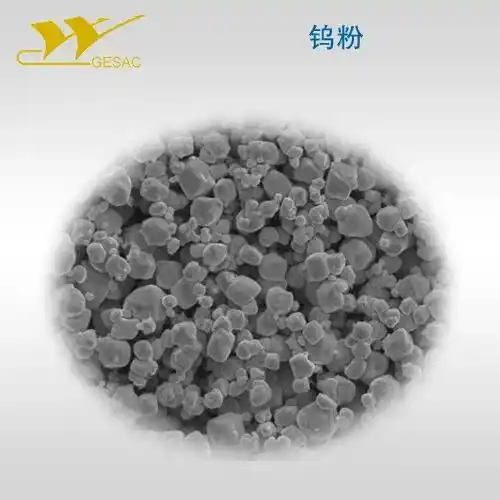
Image source: Xiamen Tungsten
Besides Xiamen Tungsten, there's also China Tungsten and Hightech.
These two are also, so far, among the very few companies globally capable of mass-producing 6N grade high-purity tungsten powder.
China had the high-purity tungsten powder. The Japanese bought the powder, produced tungsten hexafluoride, sold it to Samsung and TSMC, doubling the price.
This business seemed like easy money.
Then, the Japanese themselves smashed the door shut.
Turning the Tables
According to multiple media reports, Kanto Denka Kogyo and Central Glass have officially notified major customers like Samsung and SK Hynix:
June 30th, the last shipment. From July 1st, permanent production halt.
Since January 2026, imports of high-purity tungsten powder from China have essentially been zero. The two Japanese companies' inventories held out for five months, finally running dry.
Not only was the raw material cut off, but more crucially, the uncertainty. Even if they scraped together tungsten powder to restart the line, what about the next cutoff?
During shutdowns, residual tungsten hexafluoride in the pipelines hydrolyzes upon contact with water, producing hydrofluoric acid that corrodes valves and welds. Restarting and repairing is costly.
Repeated shutdowns and restarts are suicide.
When the news reached Seoul, Samsung and SK Hynix panicked. These two South Korean semiconductor giants had previously sourced most of their tungsten hexafluoride from Japan. Samsung's inventory wouldn't last past June.
No tungsten hexafluoride means no HBM, and Nvidia's orders go down the drain.
The certification cycle, the headache for Chinese companies, suddenly wasn't a problem anymore. Chinese tungsten hexafluoride suppliers became the darlings of leading wafer fabs.
The door is open, the players have changed.
Thirty years ago, China mined, others counted the money. Low-purity coarse powder was sold by the ton. Others purified it, made it into gas, into targets, and flipped it for dozens of times the value.
Thirty years later, the Chinese ground their way from 3N to 6N purity. The lowliest dirt overturned the highest throne.
On July 1st, the tungsten hexafluoride production line at Kanto Denka's Shibukawa factory will shut down.
Meanwhile, in Chinese high-purity tungsten powder production lines and tungsten hexafluoride factories, domestic materials are flowing out nonstop, loaded onto trucks heading for ports.
Only this time, Japanese manufacturers are absent from the destination list.
This article is from the WeChat public account "Huashang Strategic" (ID: hstl8888), author: Huashang Strategic