China's Export Controls to Japan Create Bottleneck; 'White-Haired Stock God' Serenity Claims South Korea's Foosung to Become a 'Big Winner'

marsbit發佈於 2026-06-15更新於 2026-06-15

文章摘要

China's export controls on tungsten have triggered a supply crisis in the AI memory chip sector. Japan, accounting for 25% of global WF6 (tungsten hexafluoride) production, faces imminent shutdowns due to shortages of tungsten precursor from China. This forces major Korean chipmakers like Samsung and SK Hynix to urgently seek alternatives. Korean suppliers SK Specialty and Foosung are moving to fill the gap. SK Specialty has signed a long-term contract to supply Samsung with 150 tons of WF6 monthly. Foosung has begun certification with China's CSSC Specialty Gases to start large-scale WF6 imports by August. Market analysts, including social media figure "White-Haired Stock God" Serenity, have labeled Foosung a potential "big winner," with its stock rising significantly. The crisis has led to drastic price increases, with 2026 WF6 contract prices set to rise 70-90%. Japanese suppliers warn their key inventories could be depleted by mid-2026. However, the opportunity for Korean firms hinges on continued access to Chinese tungsten powder—a geopolitical choice rather than a permanent technological advantage. The situation highlights the fragility of the concentrated WF6 supply chain and the strategic risks for downstream chip manufacturers.

Author: Ada, Deep Tide TechFlow

The ripple effects of China's tungsten export controls to Japan have now reached the upstream AI memory chip sector.

Japan's 25% share of global WF6 (tungsten hexafluoride) production capacity has entered a countdown to shutdown, forcing Samsung and SK Hynix to urgently seek alternative supplies overnight. South Korea's SK Specialty signed a long-term contract with Samsung for a monthly supply of 150 tons, while Foosung initiated certification with China's CSSC Specialty Gases, aiming for large-scale imports starting August; 2026 WF6 contract prices have been locked in for increases of 70% to 90%. Japanese suppliers warn that key inventories could be depleted by mid-2026. On social platform X, the 'White-Haired Stock God' Serenity singled out Foosung as a 'big winner,' but the inherent risks in this substitution game are equally clear—Korean manufacturers themselves rely on imports for the tungsten powder needed to produce the gas.

Japan's two main WF6 suppliers, Kanto Denka Kogyo and Central Glass, have notified South Korean clients like Samsung, SK Hynix, and DB HiTek that they cannot guarantee supply after May or June. This is a major blow to the downstream memory chip sector following China's implementation of export controls on tungsten-related items in February 2025.
Chain Reaction from China's APT Export Controls, Japan's WF6 Capacity Feels Pressure First

As early as February 2025, China's Ministry of Commerce and the General Administration of Customs jointly announced the inclusion of tungsten-related items into the dual-use items export control list. The impact of this move is now being fully realized over a year later. According to industry analysis firm CTOL Digital, since the controls took effect, Japan's imports of APT (Ammonium Paratungstate, a precursor to tungsten powder) from China on key trade routes plummeted by up to 70%, a figure that directly chokes the supply chain for Japanese WF6 producers.

The pressure arrived faster than the industry anticipated. According to a report on April 3 by South Korean semiconductor media The Elec, citing multiple industry sources, Kanto Denka and Central Glass have begun notifying South Korean chipmakers like Samsung and DB HiTek of potential imminent supply disruptions. One informed source stated, 'Supply can be maintained with existing tungsten inventories in May and June, but the outlook for the second half is unclear.' Japanese producers have suggested their South Korean clients turn to domestic alternatives, SK Specialty and Foosung.

Japan holds about 25% of the global WF6 supply. This means that a production cut by Japanese firms would instantly remove a quarter of the world's tungsten film precursor. According to information agency SunSirs, Samsung and SK Hynix sourced approximately 80% of their WF6 from Japan in the past, placing them squarely on the front lines of the crisis. Among them, Samsung's exposure is significantly higher than SK Hynix's, as the latter's supply portfolio is more diversified, including SK Specialty, Foosung, and China's Peric Special Gases.

SK Specialty Signs 150-ton Monthly Long-Term Supply Deal with Samsung, Korean Leaders Ramp Up Production

In the face of the crisis, South Korean companies demonstrated exceptional execution speed. According to SunSirs, SK Specialty has signed a long-term supply agreement with Samsung for a monthly volume of 150 tons. This scale is unusual under normal circumstances, as WF6 is a high-purity specialty gas, not a bulk commodity that can be easily scaled up.

SK Specialty is South Korea's largest WF6 supplier and benefits from natural group synergy with downstream clients. It belongs to the SK Group, closely tied to SK Hynix within the same group; now, by adding Samsung to its long-term contract list, it essentially secures positions with both of South Korea's top memory manufacturers.

Time is the scarcest resource in this scramble for orders. WF6 is a highly corrosive, hazardous gas requiring purity levels of 5N to 6N (99.999% to 99.9999%). The certification process for new suppliers typically takes 12 to 18 months, covering process testing, yield verification, equipment adaptation, and more. However, according to The Elec, some foundries are 'shortening or skipping parts of the process' for one reason only: urgency.

Foosung Initiates Certification with CSSC Specialty Gases, Targets Large-Scale Imports Starting August

Foosung (Korean code 093370) is taking another route. This South Korean fluorochemical company, with a market cap of about $1.2 billion, is one of SK Hynix's three existing WF6 suppliers, alongside SK Specialty and China's Peric. Beyond WF6, it is also South Korea's sole producer of anhydrous hydrogen fluoride (HF), the country's second-largest WF6 manufacturer, and the sole producer of battery electrolyte salt LiPF6. Its Ulsan plant integrates three fluorochemical production lines, representing highly concentrated technological assets.

According to industry information cited by SunSirs and futunn among other media, Foosung has initiated the certification process with China Shipbuilding Industry Group's CSSC Specialty Gases, aiming to begin large-scale WF6 imports from August. The hidden implication of this move is worth unpacking: Japan halts WF6 production due to tungsten powder shortages, while South Korea's Foosung turns to importing finished WF6 from China. The same tungsten supply chain is segmented by China's export controls into parts that 'restrict Japan' and 'allow South Korea.'

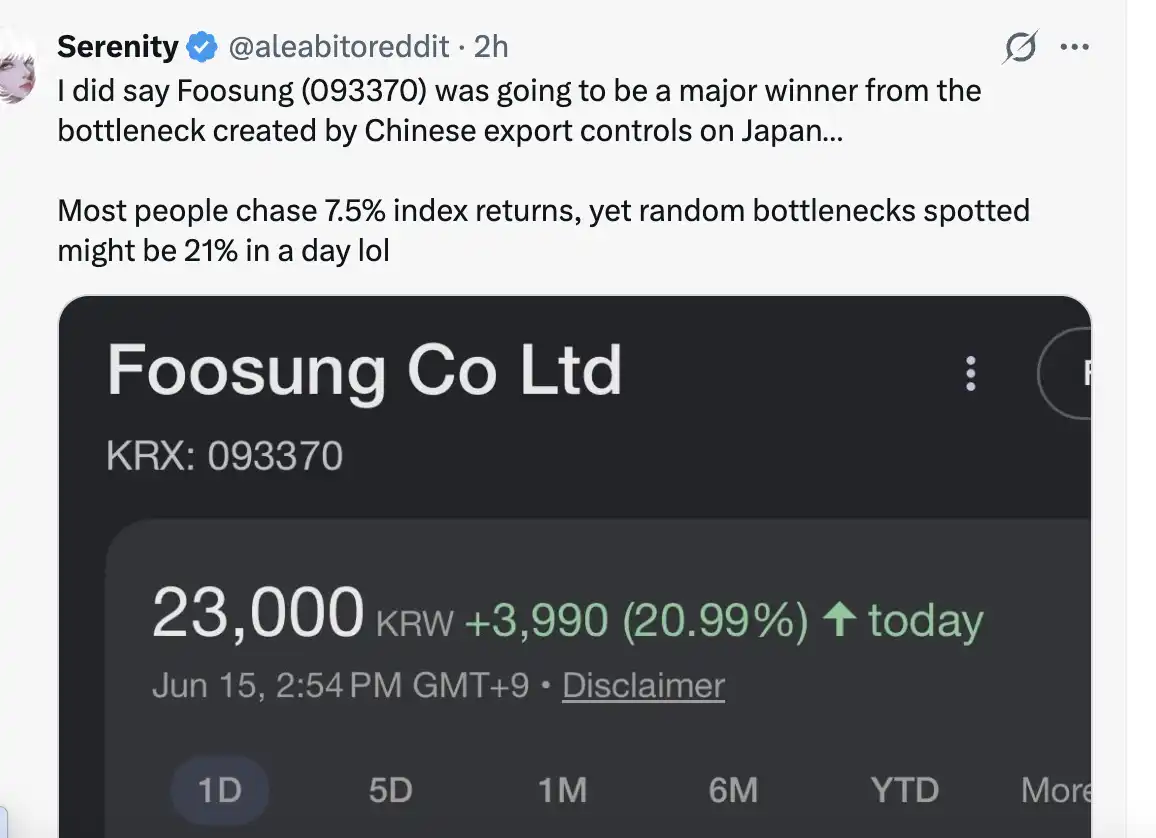
The 'White-Haired Stock God' Serenity on platform X has noted this thread. He posted on June 13, naming Foosung: 'Foosung looks like it will become a huge beneficiary soon. Basically, China's export controls on Japan have caused Japan's WF6 supply chain to collapse, and the 25% of global supply needed by SK Hynix, Samsung, TSMC will have to find alternatives elsewhere.'

The secondary market has already reacted to this logic. According to CTOL Digital, Foosung's stock price has risen approximately 196% over the past 12 months, despite its TTM EPS still being negative.

2026 WF6 Contract Prices to Rise 70% to 90%; Japanese Suppliers Warn of Mid-2026 Inventory Depletion

Price signals at the contract level have already emerged. According to CTOL Digital, South Korea's SK Specialty, Foosung, and Japan's Kanto Denka have formally notified Samsung, SK Hynix, DB HiTek, and Magnachip that 2026 WF6 contract prices will increase by 70% to 90%. This is a collective pricing action within an oligopolistic market, leaving downstream buyers with few alternative options.

An even more cautionary signal comes from the supply side. Also per CTOL Digital, Japanese suppliers have warned that key inventories could be depleted by mid-2026. This implies that even South Korean clients with signed long-term contracts face uncertainty regarding physical deliveries.

The irreplaceability of WF6 is being repriced by the market. Chipmakers cannot simply swap gas cylinders between different suppliers; any deviation in impurities could scrap millions of dollars worth of wafer inventories. This is the fundamental reason for the stringent 12 to 18-month certification process for new suppliers and the underlying logic that sustains the oligopolistic structure.

The stock price reaction is already ahead. According to CTOL Digital, Japan's Kanto Denka's stock price has risen about 374% over the past year, with its market capitalization soaring to 240.3 billion yen and a TTM P/E ratio exceeding 63 times. Foosung's gain in the same period is about 196%, and despite its negative TTM EPS, the market has granted it a significant premium. These valuations reflect not a short-term, event-driven spike but a structural market revaluation of the WF6 oligopoly.

South Korea's Substitution Window Supported by Geopolitics, Not Determined by Technical Barriers

The South Korean companies poised to benefit from Japan's supply disruption are not entirely self-sufficient either. SK Specialty and Foosung, as domestic South Korean WF6 producers, also rely on imported tungsten powder for gas production. The difference so far is that they are being treated differently from their Japanese counterparts. SunSrs states: 'China's export controls have so far primarily targeted Japan. South Korea can still continue importing tungsten powder. This is a geopolitical choice, not a natural outcome of market forces.'

The Chinese domestic supply side is rapidly rising. According to futunn citing industry data, CSSC Specialty Gases will reach a WF6 production capacity of 2,000 tons/year by the end of 2025, with purity reaching 6N levels, and its products have already entered the supply chains of global chipmakers. SunSrs data further indicates that the localization rate of China's fluorine-containing specialty gases has significantly increased to 50% over the past two years.

This reality adds a clear footnote to Foosung's 'winner' narrative. The current window of opportunity is premised on the assumption that 'China continues to allow tungsten powder exports to South Korea,' not locked in by irreplaceable technical barriers. Decision-makers at Samsung and SK Hynix may already be asking themselves the question posed by SunSirs: 'If Japan can be shut down due to raw material shortages, what could prevent South Korea from facing the same fate tomorrow?'


熱門幣種推薦

相關問答

QWhat is WF6 and why is its supply disruption significant for the AI and semiconductor industries?

AWF6 (tungsten hexafluoride) is a high-purity, corrosive specialty gas used as a precursor for tungsten thin films in semiconductor manufacturing, particularly for DRAM and AI memory chips. Its supply disruption is significant because Japan, which accounts for approximately 25% of global WF6 capacity, is facing production shutdowns due to China's export controls on tungsten feedstocks. This directly threatens the supply chains for major memory chipmakers like Samsung and SK Hynix, which heavily rely on Japanese suppliers, potentially causing production bottlenecks and price surges.

QHow are South Korean companies like SK Specialty and Foosung responding to the potential shortage of WF6 from Japan?

ASouth Korean companies are responding by rapidly securing alternative supplies and expanding their roles. SK Specialty has signed a long-term contract with Samsung to supply 150 tons of WF6 per month. Foosung, an existing supplier to SK Hynix, has initiated the qualification process with China's CSSC Specialty Gases to begin large-scale imports of finished WF6 by August 2025. These moves aim to fill the supply gap left by Japanese producers.

QWho is Serenity and what investment thesis did he present regarding Foosung in relation to the supply chain disruption?

ASerenity, a prominent stock commentator known as the 'White-Haired Stock God' on social media platform X, identified South Korean company Foosung as a major potential beneficiary of the supply chain crisis. His thesis is that China's export controls, which crippled Japan's WF6 supply chain, will force major chipmakers (Samsung, SK Hynix, TSMC) to find new sources for the 25% of global WF6 previously supplied by Japan, positioning Foosung to gain significant market share and revenue.

QWhat are the reported projected changes in WF6 contract prices for 2026, and what is driving this increase?

AMajor WF6 suppliers, including SK Specialty, Foosung, and Japan's Kanto Denka, have reportedly notified their customers that contract prices for 2026 will increase by 70% to 90%. This dramatic price hike is driven by the impending supply shortage and the resulting seller's market. With Japanese production shutting down and new supply sources taking time to qualify, the remaining suppliers hold significant pricing power in an oligopolistic market where WF6 is difficult to substitute.

QWhat underlying risk does the article highlight for South Korean companies like Foosung, despite their potential short-term gains?

AThe article highlights that the opportunity for South Korean companies is not based on unassailable technical superiority but on a geopolitical concession. While South Korea can still import tungsten powder from China, Japan cannot. Both SK Specialty and Foosung themselves depend on imported tungsten powder to produce WF6. Therefore, their 'winning' position is contingent on China's continued willingness to supply tungsten to South Korea, making their advantage potentially fragile and subject to future policy shifts by China.

你可能也喜歡

交易

現貨
合約

熱門文章

什麼是 $S$

理解 SPERO:全面概述 SPERO 簡介 隨著創新領域的不斷演變,web3 技術和加密貨幣項目的出現在塑造數字未來中扮演著關鍵角色。在這個動態領域中,SPERO(標記為 SPERO,$$s$)是一個引起關注的項目。本文旨在收集並呈現有關 SPERO 的詳細信息,以幫助愛好者和投資者理解其基礎、目標和在 web3 和加密領域內的創新。 SPERO,$$s$ 是什麼? SPERO,$$s$ 是加密空間中的一個獨特項目,旨在利用去中心化和區塊鏈技術的原則,創建一個促進參與、實用性和金融包容性的生態系統。該項目旨在以新的方式促進點對點互動,為用戶提供創新的金融解決方案和服務。 SPERO,$$s$ 的核心目標是通過提供增強用戶體驗的工具和平台來賦能個人。這包括使交易方式更加靈活、促進社區驅動的倡議,以及通過去中心化應用程序(dApps)創造金融機會的途徑。SPERO,$$s$ 的基本願景圍繞包容性展開,旨在彌合傳統金融中的差距,同時利用區塊鏈技術的優勢。 誰是 SPERO,$$s$ 的創建者? SPERO,$$s$ 的創建者身份仍然有些模糊,因為公開可用的資源對其創始人提供的詳細背景信息有限。這種缺乏透明度可能源於該項目對去中心化的承諾——這是一種許多 web3 項目所共享的精神,優先考慮集體貢獻而非個人認可。 通過將討論重心放在社區及其共同目標上,SPERO,$$s$ 體現了賦能的本質,而不特別突出某些個體。因此,理解 SPERO 的精神和使命比識別單一創建者更為重要。 誰是 SPERO,$$s$ 的投資者? SPERO,$$s$ 得到了來自風險投資家到天使投資者的多樣化投資者的支持,他們致力於促進加密領域的創新。這些投資者的關注點通常與 SPERO 的使命一致——優先考慮那些承諾社會技術進步、金融包容性和去中心化治理的項目。 這些投資者通常對不僅提供創新產品,還對區塊鏈社區及其生態系統做出積極貢獻的項目感興趣。這些投資者的支持強化了 SPERO,$$s$ 作為快速發展的加密項目領域中的一個重要競爭者。 SPERO,$$s$ 如何運作? SPERO,$$s$ 採用多面向的框架,使其與傳統的加密貨幣項目區別開來。以下是一些突顯其獨特性和創新的關鍵特徵: 去中心化治理:SPERO,$$s$ 整合了去中心化治理模型,賦予用戶積極參與決策過程的權力,關於項目的未來。這種方法促進了社區成員之間的擁有感和責任感。 代幣實用性:SPERO,$$s$ 使用其自己的加密貨幣代幣,旨在在生態系統內部提供多種功能。這些代幣使交易、獎勵和平台上提供的服務得以促進,增強了整體參與度和實用性。 分層架構:SPERO,$$s$ 的技術架構支持模塊化和可擴展性,允許在項目發展過程中無縫整合額外的功能和應用。這種適應性對於在不斷變化的加密環境中保持相關性至關重要。 社區參與:該項目強調社區驅動的倡議,採用激勵合作和反饋的機制。通過培養強大的社區,SPERO,$$s$ 能夠更好地滿足用戶需求並適應市場趨勢。 專注於包容性:通過提供低交易費用和用戶友好的界面,SPERO,$$s$ 旨在吸引多樣化的用戶群體,包括那些以前可能未曾參與加密領域的個體。這種對包容性的承諾與其通過可及性賦能的總體使命相一致。 SPERO,$$s$ 的時間線 理解一個項目的歷史提供了對其發展軌跡和里程碑的關鍵見解。以下是建議的時間線,映射 SPERO,$$s$ 演變中的重要事件: 概念化和構思階段:形成 SPERO,$$s$ 基礎的初步想法被提出,與區塊鏈行業內的去中心化和社區聚焦原則密切相關。 項目白皮書的發布:在概念階段之後,發布了一份全面的白皮書,詳細說明了 SPERO,$$s$ 的願景、目標和技術基礎設施,以吸引社區的興趣和反饋。 社區建設和早期參與:積極進行外展工作,建立早期採用者和潛在投資者的社區,促進圍繞項目目標的討論並獲得支持。 代幣生成事件:SPERO,$$s$ 進行了一次代幣生成事件(TGE),向早期支持者分發其原生代幣,並在生態系統內建立初步流動性。 首次 dApp 上線:與 SPERO,$$s$ 相關的第一個去中心化應用程序(dApp)上線,允許用戶參與平台的核心功能。 持續發展和夥伴關係:對項目產品的持續更新和增強,包括與區塊鏈領域其他參與者的戰略夥伴關係,使 SPERO,$$s$ 成為加密市場中一個具有競爭力和不斷演變的參與者。 結論 SPERO,$$s$ 是 web3 和加密貨幣潛力的見證,能夠徹底改變金融系統並賦能個人。憑藉對去中心化治理、社區參與和創新設計功能的承諾,它為更具包容性的金融環境鋪平了道路。 與任何在快速發展的加密領域中的投資一樣,潛在的投資者和用戶都被鼓勵進行徹底研究,並對 SPERO,$$s$ 的持續發展進行深思熟慮的參與。該項目展示了加密行業的創新精神,邀請人們進一步探索其無數可能性。儘管 SPERO,$$s$ 的旅程仍在展開,但其基礎原則確實可能影響我們在互聯網數字生態系統中如何與技術、金融和彼此互動的未來。

96 人學過發佈於 2024.12.17更新於 2024.12.17

什麼是 $S$

什麼是 AGENT S

Agent S:Web3中自主互動的未來 介紹 在不斷演變的Web3和加密貨幣領域,創新不斷重新定義個人如何與數字平台互動。Agent S是一個開創性的項目,承諾通過其開放的代理框架徹底改變人機互動。Agent S旨在簡化複雜任務,為人工智能(AI)提供變革性的應用,鋪平自主互動的道路。本詳細探索將深入研究該項目的複雜性、其獨特特徵以及對加密貨幣領域的影響。 什麼是Agent S? Agent S是一個突破性的開放代理框架,專門設計用來解決計算機任務自動化中的三個基本挑戰: 獲取特定領域知識:該框架智能地從各種外部知識來源和內部經驗中學習。這種雙重方法使其能夠建立豐富的特定領域知識庫,提升其在任務執行中的表現。 長期任務規劃:Agent S採用經驗增強的分層規劃,這是一種戰略方法,可以有效地分解和執行複雜任務。此特徵顯著提升了其高效和有效地管理多個子任務的能力。 處理動態、不均勻的界面:該項目引入了代理-計算機界面(ACI),這是一種創新的解決方案,增強了代理和用戶之間的互動。利用多模態大型語言模型(MLLMs),Agent S能夠無縫導航和操作各種圖形用戶界面。 通過這些開創性特徵,Agent S提供了一個強大的框架,解決了自動化人機互動中涉及的複雜性,為AI及其他領域的無數應用奠定了基礎。 誰是Agent S的創建者? 儘管Agent S的概念根本上是創新的,但有關其創建者的具體信息仍然難以捉摸。創建者目前尚不清楚,這突顯了該項目的初期階段或戰略選擇將創始成員保密。無論是否匿名,重點仍然在於框架的能力和潛力。 誰是Agent S的投資者? 由於Agent S在加密生態系統中相對較新,關於其投資者和財務支持者的詳細信息並未明確記錄。缺乏對支持該項目的投資基礎或組織的公開見解,引發了對其資金結構和發展路線圖的質疑。了解其支持背景對於評估該項目的可持續性和潛在市場影響至關重要。 Agent S如何運作? Agent S的核心是尖端技術,使其能夠在多種環境中有效運作。其運營模型圍繞幾個關鍵特徵構建: 類人計算機互動:該框架提供先進的AI規劃,力求使與計算機的互動更加直觀。通過模仿人類在任務執行中的行為,承諾提升用戶體驗。 敘事記憶:用於利用高級經驗,Agent S利用敘事記憶來跟蹤任務歷史,從而增強其決策過程。 情節記憶:此特徵為用戶提供逐步指導,使框架能夠在任務展開時提供上下文支持。 支持OpenACI:Agent S能夠在本地運行,使用戶能夠控制其互動和工作流程,與Web3的去中心化理念相一致。 與外部API的輕鬆集成:其多功能性和與各種AI平台的兼容性確保了Agent S能夠無縫融入現有技術生態系統,成為開發者和組織的理想選擇。 這些功能共同促成了Agent S在加密領域的獨特地位,因為它以最小的人類干預自動化複雜的多步任務。隨著項目的發展,其在Web3中的潛在應用可能重新定義數字互動的展開方式。 Agent S的時間線 Agent S的發展和里程碑可以用一個時間線來概括,突顯其重要事件: 2024年9月27日:Agent S的概念在一篇名為《一個像人類一樣使用計算機的開放代理框架》的綜合研究論文中推出,展示了該項目的基礎工作。 2024年10月10日:該研究論文在arXiv上公開,提供了對框架及其基於OSWorld基準的性能評估的深入探索。 2024年10月12日:發布了一個視頻演示,提供了對Agent S能力和特徵的視覺洞察,進一步吸引潛在用戶和投資者。 這些時間線上的標記不僅展示了Agent S的進展,還表明了其對透明度和社區參與的承諾。 有關Agent S的要點 隨著Agent S框架的持續演變,幾個關鍵特徵脫穎而出,強調其創新性和潛力: 創新框架:旨在提供類似人類互動的直觀計算機使用,Agent S為任務自動化帶來了新穎的方法。 自主互動:通過GUI自主與計算機互動的能力標誌著向更智能和高效的計算解決方案邁進了一步。 複雜任務自動化:憑藉其強大的方法論,能夠自動化複雜的多步任務,使過程更快且更少出錯。 持續改進:學習機制使Agent S能夠從過去的經驗中改進,不斷提升其性能和效率。 多功能性:其在OSWorld和WindowsAgentArena等不同操作環境中的適應性確保了它能夠服務於廣泛的應用。 隨著Agent S在Web3和加密領域中的定位,其增強互動能力和自動化過程的潛力標誌著AI技術的一次重大進步。通過其創新框架,Agent S展現了數字互動的未來,為各行各業的用戶承諾提供更無縫和高效的體驗。 結論 Agent S代表了AI與Web3結合的一次大膽飛躍,具有重新定義我們與技術互動方式的能力。儘管仍處於早期階段,但其應用的可能性廣泛且引人入勝。通過其全面的框架解決關鍵挑戰,Agent S旨在將自主互動帶到數字體驗的最前沿。隨著我們深入加密貨幣和去中心化的領域,像Agent S這樣的項目無疑將在塑造技術和人機協作的未來中發揮關鍵作用。

868 人學過發佈於 2025.01.14更新於 2025.01.14

什麼是 AGENT S

如何購買S

歡迎來到HTX.com!在這裡,購買Sonic (S)變得簡單而便捷。跟隨我們的逐步指南,放心開始您的加密貨幣之旅。第一步:創建您的HTX帳戶使用您的 Email、手機號碼在HTX註冊一個免費帳戶。體驗無憂的註冊過程並解鎖所有平台功能。立即註冊第二步:前往買幣頁面,選擇您的支付方式信用卡/金融卡購買:使用您的Visa或Mastercard即時購買Sonic (S)。餘額購買:使用您HTX帳戶餘額中的資金進行無縫交易。第三方購買:探索諸如Google Pay或Apple Pay等流行支付方式以增加便利性。C2C購買:在HTX平台上直接與其他用戶交易。HTX 場外交易 (OTC) 購買:為大量交易者提供個性化服務和競爭性匯率。第三步:存儲您的Sonic (S)購買Sonic (S)後,將其存儲在您的HTX帳戶中。您也可以透過區塊鏈轉帳將其發送到其他地址或者用於交易其他加密貨幣。第四步:交易Sonic (S)在HTX的現貨市場輕鬆交易Sonic (S)。前往您的帳戶,選擇交易對,執行交易,並即時監控。HTX為初學者和經驗豐富的交易者提供了友好的用戶體驗。

1.8k 人學過發佈於 2025.01.15更新於 2026.06.02

如何購買S

相關討論

歡迎來到 HTX 社群。在這裡,您可以了解最新的平台發展動態並獲得專業的市場意見。 以下是用戶對 S (S)幣價的意見。

活动图片