TL;DR
After entering the public market in the form of SPCX, investors are not buying an ordinary tech IPO stock.
On one side are words like Musk, Starlink, space transportation, defense contracts, and the Mars narrative—terms that inherently carry valuation premiums. On the other side is a stock that surged on its first day, closing with a market cap of approximately $2.1 trillion, but with a very small float of tradable shares in the initial listing period. The real question for ordinary investors is straightforward: Is buying SPCX now a bet on the public market's most scarce space asset, or is it providing liquidity for existing shareholders to exit in the future?
Discussions on X and among Chinese investors in recent days have also centered on this divide. Bulls believe that the low float, FOMO, the Musk narrative, and potential passive buying from future index inclusion could continue to push the stock price higher before the first unlock. Bears are looking at another table: aside from the IPO shares, existing shareholders still hold over 95%+ of the shares. As lock-up periods expire in phases, the secondary market will face more low-cost shares entering the trading pool.
What's being traded in SPCX right now is not just the ultimate vision of SpaceX, but a timing gap: How high can price be squeezed by supply scarcity before the first unlock? And after the first unlock, how much of the narrative premium will be digested by the new supply?
First-Day Surge Amplifies the Low-Float Squeeze
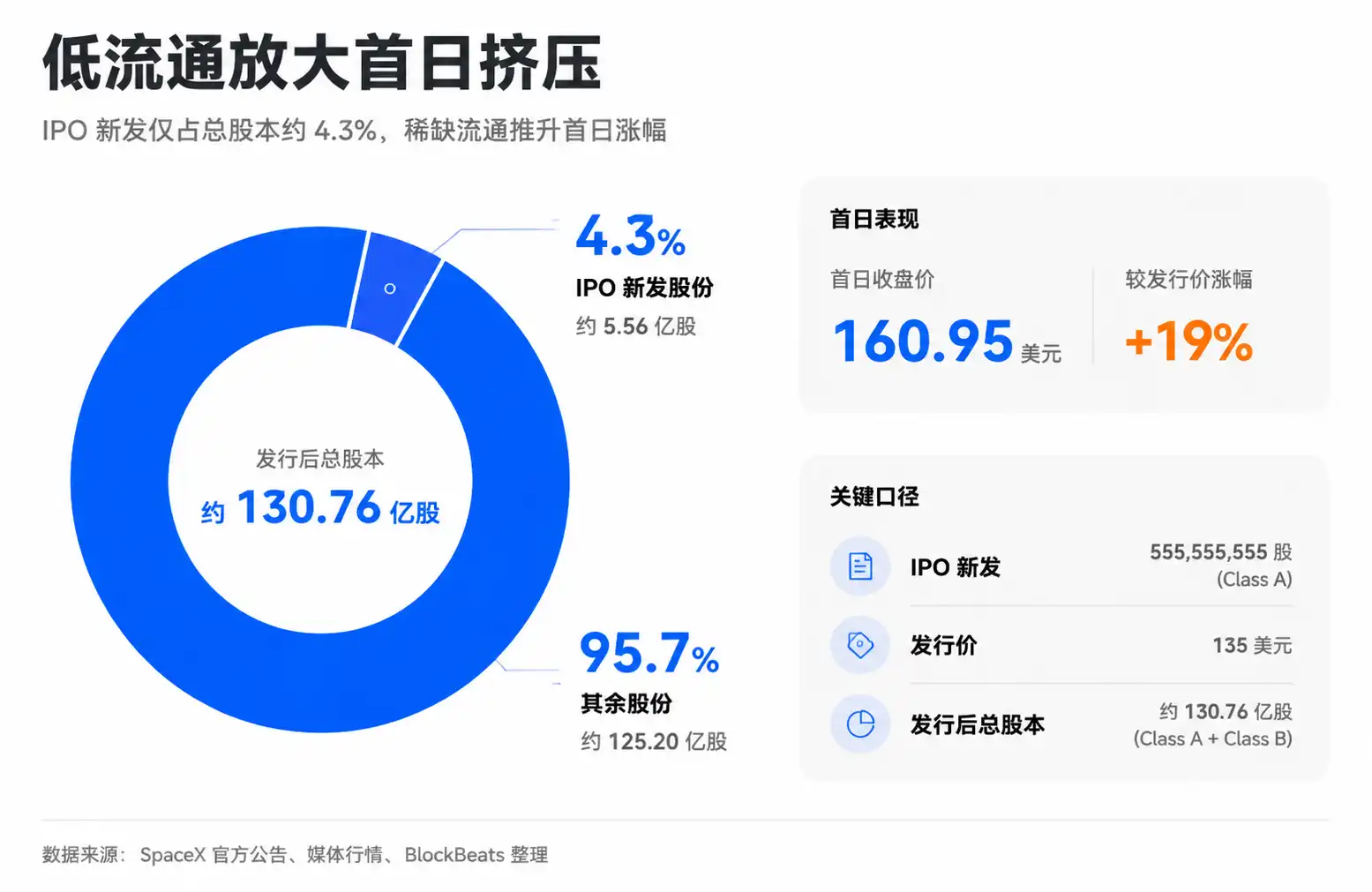
According to SpaceX's official announcement, the company's IPO issued 555,555,555 Class A shares at an offering price of $135, expected to trade as 'SPCX' on the Nasdaq Global Select Market and Nasdaq Texas starting June 12, with an additional 83,333,333 shares in an over-allotment option. Multiple media reports indicate that SPCX closed at around $160.95 on its first day, up approximately 19% from the offering price, with a closing market cap of about $2.1 trillion.
This leaves ample room for short-term capital imagination. For a newly listed large-cap stock, this isn't just about IPO hype; it's the market pricing a scarce asset at an extremely high valuation.
Low float is the first building block to understand this trading round. The prospectus shows that post-IPO, there are approximately 7.38 billion Class A shares and 5.696 billion Class B shares. The IPO newly issued shares account for just over 4% of the total shares outstanding. In other words, the proportion of shares actually entering public trading initially through the IPO is very low.
When a stock has limited supply, and buying interest is pushed up by hype, media, social platforms, and institutional imagination, prices are prone to a squeeze. It's not that the fundamentals suddenly became stronger overnight, but that there are many wanting to buy and few able to sell.
This explains why some investors see SPCX as a short-term trading opportunity rather than viewing it solely through traditional valuation models. Starlink provides a clearer revenue base, space launch and defense businesses offer scarcity, and Musk himself amplifies the asset's narrative. For short-term capital, these factors don't necessarily need to immediately translate into profits; as long as they can attract sustained buying interest, that's enough to support strength in the initial listing period.
Potential index fund inflows are another variable in the bull narrative. The logic is simple: If SPCX is included in major indices in the future, funds tracking those indices must allocate according to the rules. This type of buying is usually not due to active bullishness on the company, but because they must follow the index. When the float is small, passive buying could further amplify the supply-demand mismatch.
But this remains a trading hypothesis for now. There is no official confirmation of index inclusion, and the so-called allocation window cannot be considered a definite arrangement. For SPCX, index fund flows are not a realized positive catalyst, but an option bulls use to explain why short-term buying interest might persist.
The First Unlock Will Change the Supply Curve
The risk for SPCX is not that "the company isn't great," but that the relationship between its stock price and the supply of tradable shares will change.
The purpose of IPO lock-up periods is to prevent existing shareholders and employees from selling immediately after listing, which would impact the new stock's price. What many ordinary investors often overlook is that lock-ups are, first and foremost, a supply issue. The pressure the market can bear is completely different for the same company's stock when the float is tiny versus when a large number of shares become sellable.
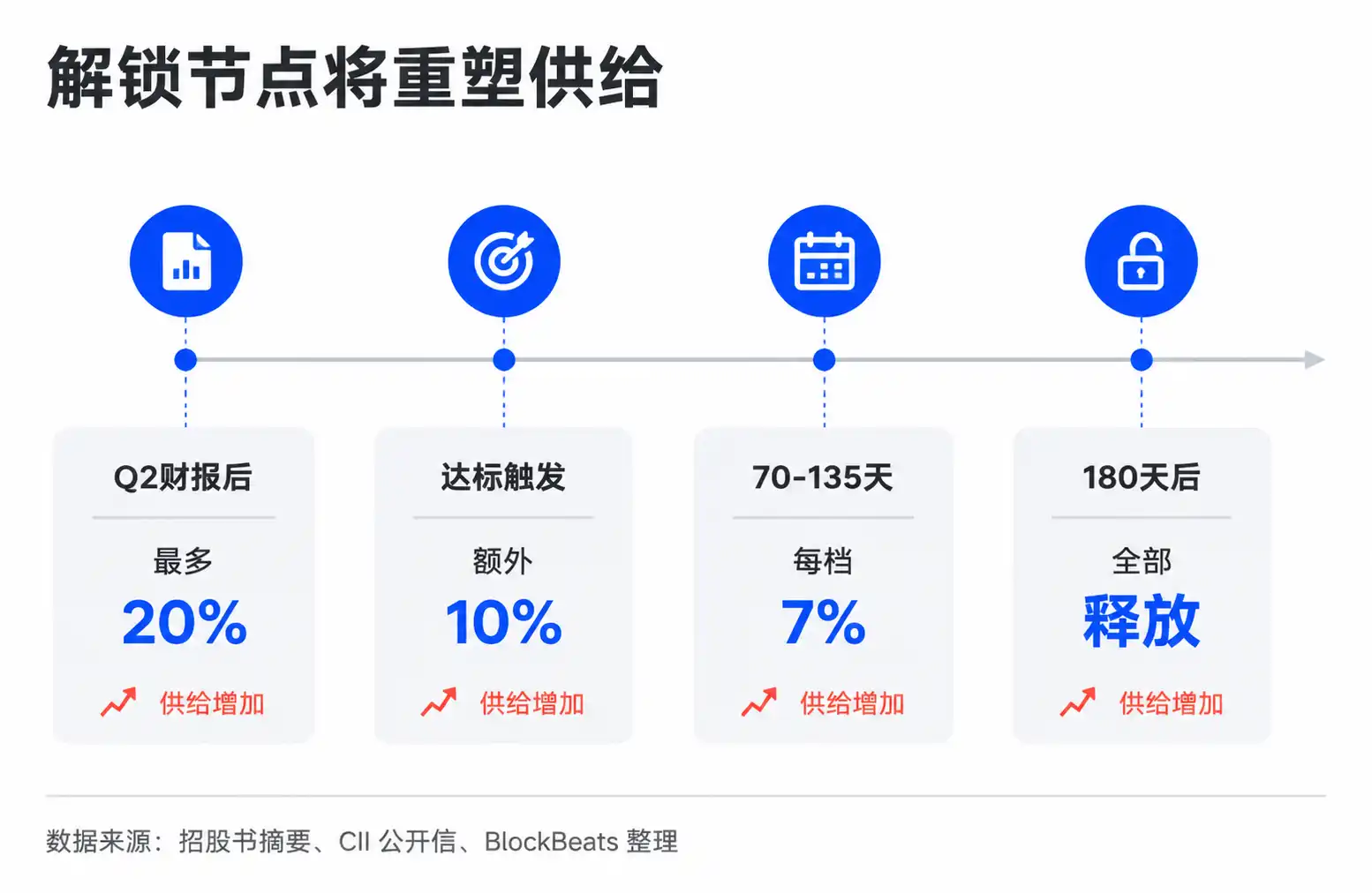
SPCX's unlock schedule is not a simple "one-time release after 180 days." The prospectus shows that 180-day locked-up shares become transferable in phases starting the second full trading day after the Q2 2026 earnings release, with up to 20% initially. If the stock price meets certain conditions at that time, such as being at least 30% above the IPO price for at least 5 out of 10 consecutive trading days, an additional 10% may be released. Subsequently, 7% can be released at each of the 70, 90, 105, 120, and 135-day marks, with the full release after 180 days.
The specific release date for Q2 earnings has not been confirmed yet. Based on typical disclosure timelines, the initial window discussed in the market could fall around August, but this remains subject to subsequent announcements and SEC filings. The documents also show that Musk's shares are locked for 366 days, with some major shareholders extending their lock-up until after the Q2 2027 earnings release, also releasing in stages.
This is the core of what bears are focused on. As long as the first unlock hasn't arrived, the low float is the bull's friend. Once the unlock approaches, the low float becomes a risk warning, because the market will start asking in advance: Exactly how many low-cost shares are preparing to be sold?
Potential selling pressure does not mean a certain crash on the unlock day. Its more common impact is to make buying more cautious, make rebounds easier to encounter selling, and make valuation expansion more difficult. Especially when a stock has already been pushed above $2 trillion in its early listing period, new supply—even if not dumped all at once—will change the market's judgment on "who will be the buyer."
Therefore, "Can it still rise before the first unlock?" and "Is it worth chasing in the medium term?" can both be valid questions. Short-term, tight supply, hot sentiment, and a strong narrative could still squeeze the price higher. Medium-term, the exit demand from existing shareholders and employees is real, and their cost basis is typically far lower than that of secondary market buyers. These two assessments are looking at different timeframes.
High Valuation Makes Earnings an Amplifier
If SPCX were just a low-float new stock, the unlock pressure would already be significant enough. What makes it more complex is that it's also a low-float new stock placed in an extremely high valuation range.
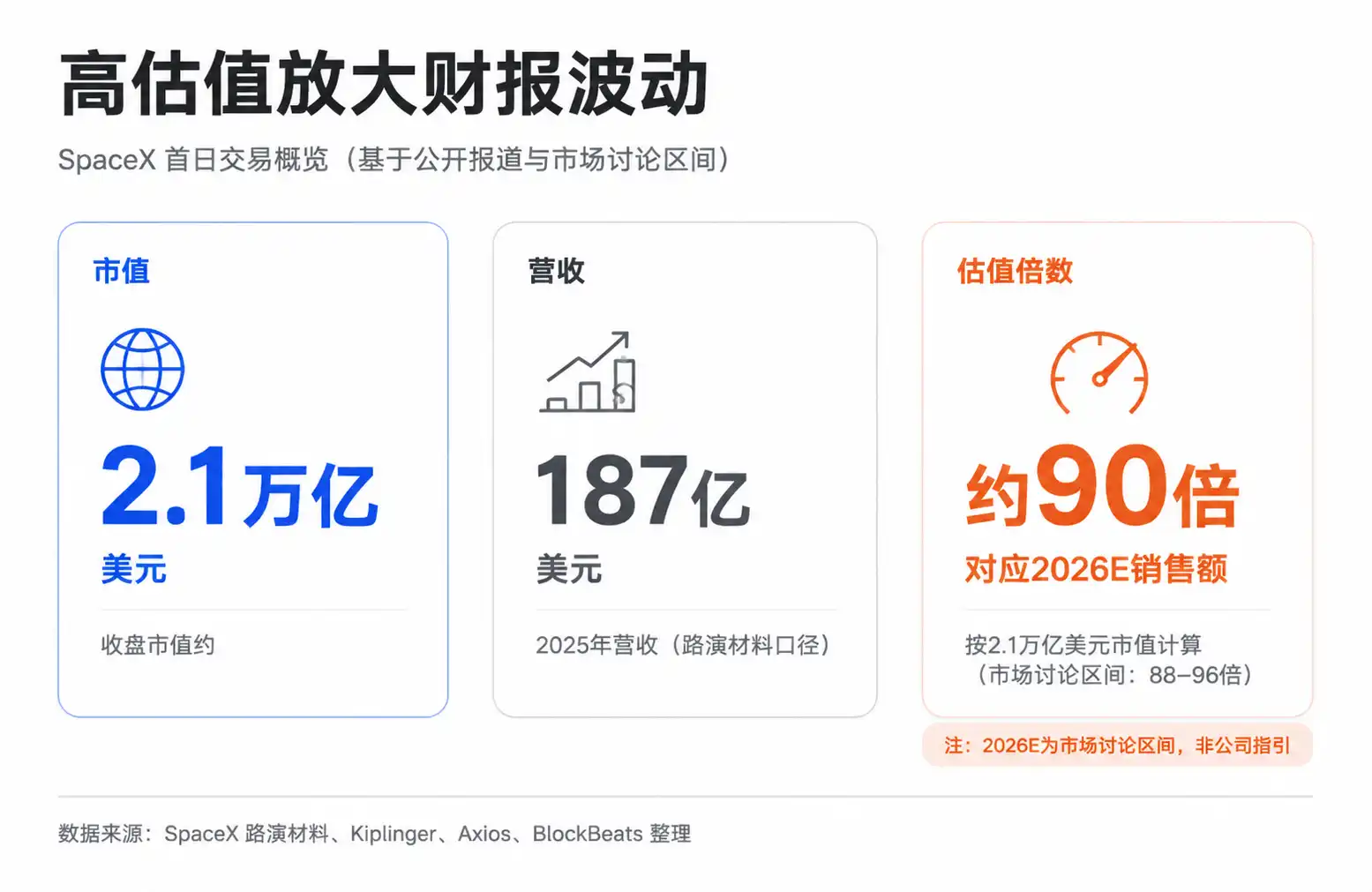
According to SpaceX's roadshow materials, the company's 2025 revenue was approximately $18.7 billion. Market discussions for 2026 revenue mostly range from $22 billion to $24 billion, but this is not company-confirmed guidance. Based on the first-day closing market cap of about $2.1 trillion, the market is clearly not buying just the current Starlink revenue, but a long-term option on satellite internet, commercial space, defense partnerships, Starship transport capability, and even the synergy of the Musk ecosystem.
Paying a high price for a future story is not inherently a problem. This state has repeatedly occurred in tech stock history: when the market believes a company holds a scarce gateway, it discounts profits many years out into the current price. The problem is, this kind of pricing is very sensitive to timing. Once earnings, orders, profit margins, or user growth fail to keep pace with the imagination, the market doesn't necessarily deny the endgame, but will reassess the speed of realization.
This makes the Q2 earnings a critical node before the first unlock. It's not just the first report card after listing; it could also become an amplifier for unlock expectations. If earnings are strong, bulls will argue that fundamentals can support the valuation, and the short-term squeeze logic can continue. If earnings are weak, bears will link it to the unlock window: fundamentals haven't yet justified the current market cap, and more shares are about to be released—why should the secondary market buy at these highs?
This is another difference between SPCX and mature tech stocks. Earnings impacts for mature tech stocks are more reflected in profit forecasts and valuation multiples. SPCX's earnings will also affect trading confidence around the lock-up period. It needs to answer two questions simultaneously: Can business growth support the long-term narrative, and when tradable supply is about to increase, will there still be enough buying interest to absorb it?
Analogy to TGE: The Core is Low Float with an Expiration Date
Within the Chinese investor community, some have drawn an analogy between SPCX and "small float trading post-TGE for top-tier VC projects."
TGE is the token generation event for crypto projects. When many top projects first launch, the circulating supply is low, the narrative is strong, and early investor and team tokens are locked. In the initial period post-launch, due to scarce buyable tokens and high attention, prices are easily pushed up. But as the unlock cycle approaches, the market starts pricing in future selling pressure ahead of time, and prices may enter a digestion phase.
This analogy isn't entirely accurate. Stock IPOs and crypto token offerings differ in regulation, information disclosure, and investor structure. But it captures the same market mechanism: Low float is not a long-term positive, but a supply-demand mismatch with an expiration date.
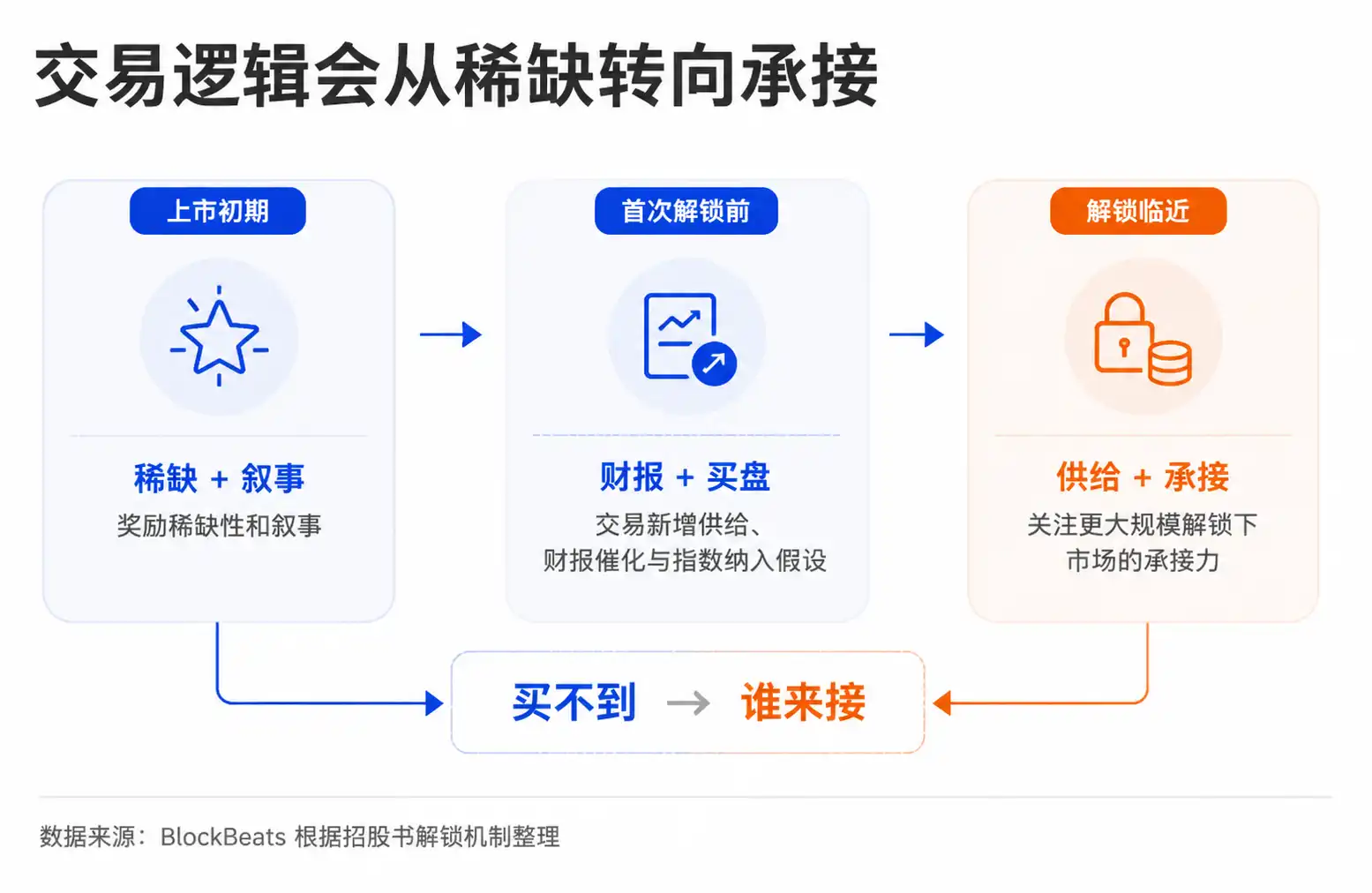
Within this framework, SPCX's post-listing trading can be broken into several stages. In the initial listing period, the market primarily rewards scarcity and narrative, with buyers focused on whether the squeeze can continue. Approaching the first unlock, trading becomes more complex, with investors simultaneously calculating new supply, earnings catalysts, and potential index inclusion. As larger-scale unlocks approach, the market shifts from "can't buy" to "can it be absorbed?".
This also explains why community discussions feature a combination of "short-term optimistic, medium-term cautious" views. It's not indecision, but different time slices within the same supply-demand framework. During the low-float phase, bulls have an easier advantage. During the unlock phase, bear logic begins to strengthen. What needs to be judged is not whether SpaceX is great, but whether the current price has already priced in the scarcity premium expected before the first unlock.
The Path Forward Depends on Unlock Details, Earnings, and Passive Buying
The key validation points for SPCX's subsequent price action lie not in the Mars narrative or social media sentiment, but in several more concrete variables.
The first thing to watch is the final documents and subsequent company disclosures regarding the unlock arrangements. The initial transferable percentage, price trigger conditions, earnings release timing, and scope of extended lock-up shareholders will all directly impact the future supply curve. For investors, this is more important than single-day price movements.
Next is whether the Q2 earnings can support the current valuation. SPCX's long-term story is vast, but what the secondary market needs to watch in the short term is still revenue, orders, profit margins, and cash flow. Stronger earnings make it easier for the low-float squeeze to persist. Weaker earnings make unlock selling pressure more likely to become the main pricing driver.
Index inclusion also needs continued observation, but before clear announcements, it remains merely a bullish trading hypothesis. If subsequent inclusion and allocation demand materialize, it may cushion some unlock pressure in the short term, but it does not equate to permanently absorbing the exit demand from existing shareholders and employees.
Right now, SPCX resembles more of a supply-demand experiment with a countdown. Before the first unlock, low float and a strong narrative could still keep prices resilient. After the first unlock, the market will begin testing how much real buying power this $2 trillion-plus space asset truly commands. For ordinary investors, more important than guessing a target price is to watch this inflection point: When the story shifts from "can't buy" to "who will buy," the trading logic has already changed.