Author: Jason Rosenthal, Operating Partner at a16z crypto
Compiled by: Chopper, Foresight News
Throughout business history, the success logic of many enduring enterprises has been inseparable from the link of capital flow: undertaking businesses that create and transfer value within the ecosystem and extracting revenue from them. The larger the volume of value flowing through the ecosystem, the larger the scale of the enterprise tends to be.
Cryptographic technology is the first modern technology inherently suited to this business logic. If a startup does not base its product design and business model architecture on this logic during the planning stages, it misses out on tremendous opportunities. The proliferation of stablecoins has endowed capital and value with internet-level transfer speeds, enabling 24/7 global settlement with end-to-end programmability. Now, the underlying channels for capital flow are fully open, unit economic models are transparent, and every circulating dollar globally represents potential flow in this arena.
Underlying Business Logic
Blockchain is fundamentally a network-based business model. All transactions are uniformly recorded on a shared ledger, and each new participant reinforces this underlying system for subsequent developers. The more people who use the ecosystem and build applications, the greater the value of the entire network for all users.
Most traditional enterprises spend years building network effects on top of outdated infrastructure; whereas entrepreneurs in the crypto space start with inherent network effects from the outset.
Network tokens further amplify this advantage. A well-designed token system can bind users, developers, service providers, node validators, and the protocol ecosystem to a common goal—driving network growth—while distributing revenue according to each party's contributions. The revenue generated by the protocol ultimately belongs to all ecosystem participants. There are no secret rebates, no special deals, only the formation of a positive feedback loop: value circulates within the system, and returns flow back to everyone building the ecosystem.
This business logic is not new; it's just that the crypto industry is the first to enable startups to implement and scale it more easily.
The profit core of railroad companies was never selling locomotives, but charging a toll for every freight train transporting grain, coal, or steel. Standard Oil, U.S. Steel, and AT&T were all giants rooted in the links of value flow. Google and Meta replaced traditional print and television media not merely because their advertising formats were better, but because they occupied the critical node where attention converts into commercial transactions, taking a cut from trillions of dollars in commercial flow. Amazon Web Services occupies the central position for computing resources.
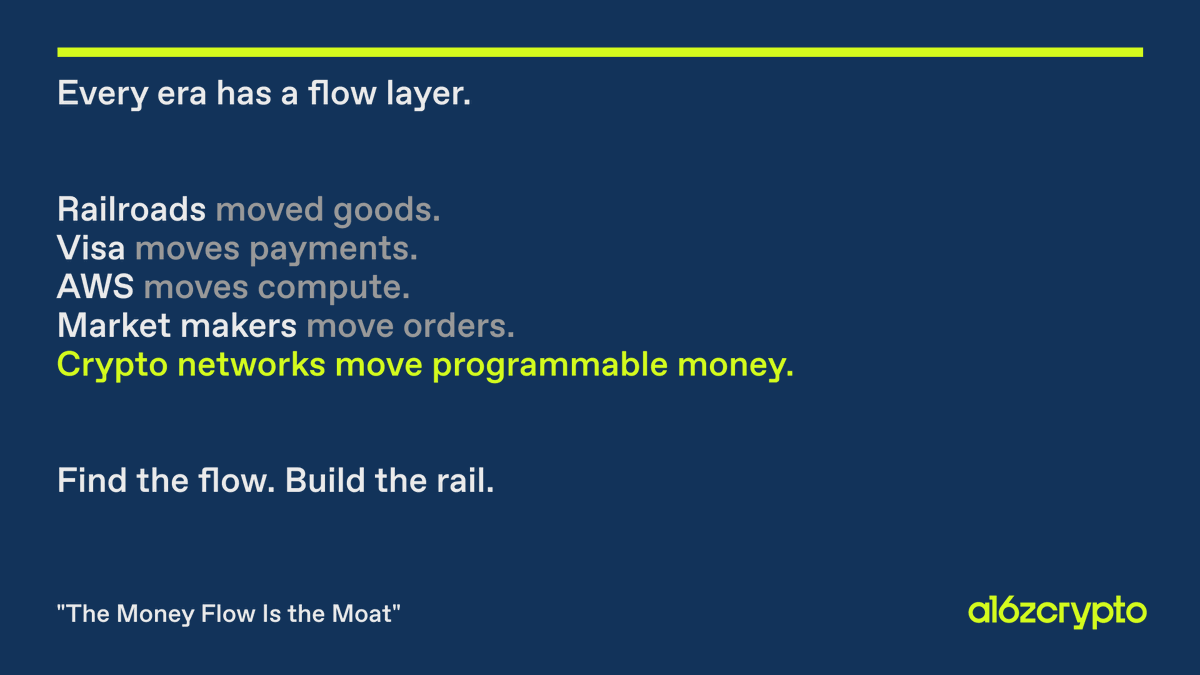
The pattern remains consistent: find the core path of value flow and occupy a key position within it.
This logic is vividly reflected in financial markets. In fiscal year 2024, Visa processed payment volumes totaling $15.7 trillion, generating net revenue of $35.9 billion. The well-known market maker Jane Street's trading net revenue reached $20.5 billion last year, surpassing Citibank and Bank of America. The top five market makers in the US handled 87% of order flow payments: they don't predict market ups and downs, they just need to reside in the flow path of every order; the higher the trading volume, the greater their earnings.
Such enterprises share another commonality: powerful network effects. The more merchants that accept Visa cards, the more valuable the card is to cardholders; conversely, the more cardholders, the more merchants are attracted to offer the service. The order flow market is similar: the more brokers connected, the narrower the bid-ask spread, which in turn attracts more brokers, bringing even larger order flow.
Cash flow coupled with network effects is one of the most robust business models in the commercial world.
Your Margin Is My Opportunity
Jeff Bezos once proposed a classic viewpoint: "Your margin is my opportunity." This statement originally targeted the retail industry, but it fits even more aptly in the traditional financial services sector—the industry with the largest scale of profit capture globally. This holds true across subsectors like payments, asset custody, lending, foreign exchange, asset securitization, trade settlement, and market making.
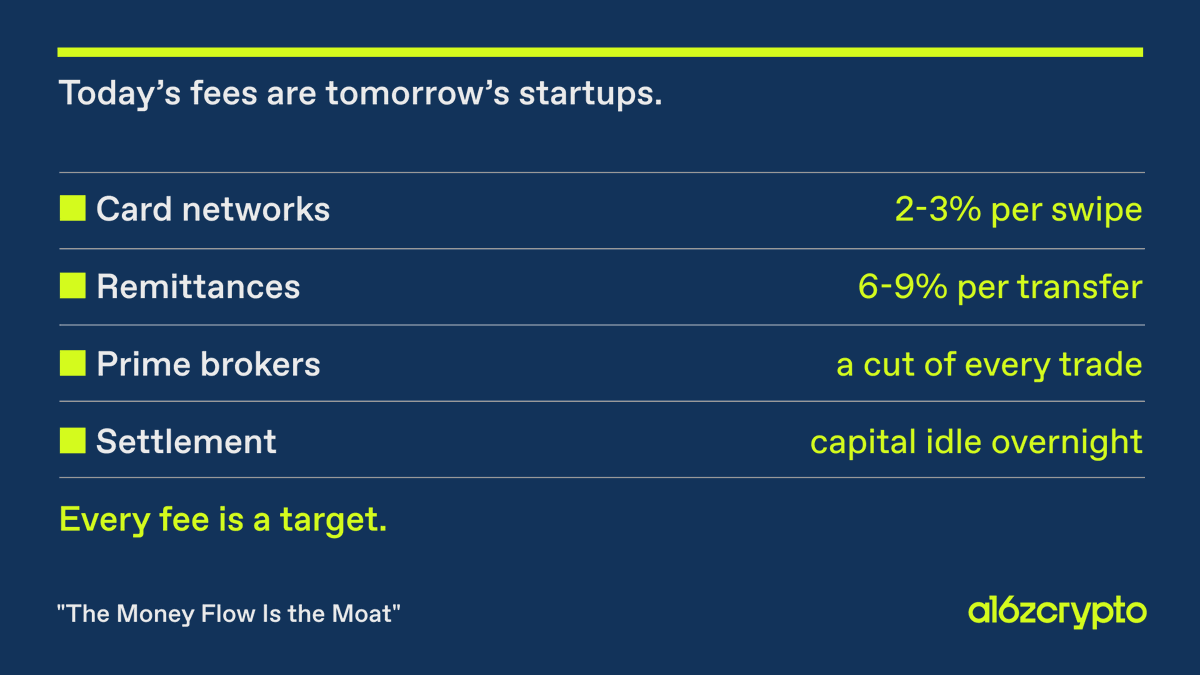
Visa and Mastercard, based on networks built in the 1960s, charge transaction fees of 2% to 3%; cross-border remittance channels have fees as high as 6% to 9%; prime brokers and asset custodians take a cut from every securities transaction. Even though the US shortened the securities settlement cycle to T+1 in 2024, funds can still sit idle overnight, which constitutes a structural cost borne by all market participants.
The existing profit margins in these industries are all potential entry points for disruption. Reducing transaction costs, improving capital flow efficiency, and potentially further expanding the overall market size. Stripe and Square have proven this model works in payments.
Entrepreneurs in the crypto industry have the opportunity to build the next-generation infrastructure: programmable, transactions settled instantly, globally accessible services, and rooted in the capital flow chain from its inception.
The opportunities also extend far beyond financial services. Markets for computing power and GPU trading, storage chips, AI training data, energy, robotics, aerospace, rare earth metals, and more are all on the verge of experiencing large-scale global value flow, for which existing traditional channels are completely inadequate.
The aforementioned sectors represent entirely new blue-ocean markets built on programmable infrastructure, centered on the cash flow model. Here, there are no deeply entrenched legacy platforms, no tangled webs of middlemen, and no old structures to defend.
As an entrepreneur, ask yourself a few questions: Is your current business positioned in the core link of value flow? When the transaction volume and value scale of your product ecosystem grow tenfold, can your revenue grow in sync? If you are developing a new product, in your target market, which link has the highest profit capture relative to the value it creates?
Where the answer lies, there lies the opportunity. Compress the costs of the original links, enter new value flow tracks, and then achieve sustained growth by leveraging network effects.