OpenSea Launches ERC-8257: A Tool Store for AI Agents, Unlock APIs by Buying an NFT

marsbit發佈於 2026-05-27更新於 2026-05-27

文章摘要

OpenSea has merged the ERC-8257 standard, an on-chain "Agent Tool Registry" that enables AI Agents to autonomously discover, pay for, and access tools. This standard allows developers to publish tools with programmable access rules (e.g., NFT ownership, subscriptions) and pricing directly on-chain. For example, an AI Agent needing a premium API can buy the required NFT itself and gain access without human intervention, turning NFTs into keys for the agent economy. The system works with complementary standards like ERC-8004 for agent identity and x402 for payments. A live demo shows an NFT appraisal tool offering discounted rates to holders of a specific NFT collection. ERC-8257 aims to decentralize tool distribution and access control, allowing any on-chain asset to grant utility to AI agents. The SDK is available for building on Ethereum and Base.

Author: OpenSea

Compiled by: TechFlow

TechFlow Introduction: When an AI Agent is denied by an API due to insufficient permissions, it goes and buys an NFT on-chain, then retries and succeeds — this is not science fiction; OpenSea's newly merged ERC-8257 standard makes this a reality. For NFT holders, the JPGs you own might suddenly become keys to the Agent economy. For developers, tool publishing, pricing, and access control are all placed on-chain, no longer requiring endorsement from centralized platforms.

App Store provides developers with a place to publish tools, users with a place to browse, and built-in access control and payment. The AI Agent tool ecosystem requires similar infrastructure.

But today, Agent tools are scattered across documentation, GitHub repositories, and centralized directories. There is no open tool registry, no standardized access control, and Agents cannot browse available tools and acquire them as needed.

Watching a software pay another software autonomously for access, with no human intervention — it feels a bit strange indeed. But that's precisely the point.

ERC-8257: Agent Tool Registry is the foundational layer that makes all this work. This is the newly merged open Ethereum standard: an on-chain registry where anyone can publish tools, declare access rules and pricing, allowing Agents to autonomously meet these requirements.

For Tool Developers: Publish once, set access thresholds for your NFT holders, offer subscription packages, limit seat counts, let them trade in open markets. Your rules, executed on-chain.

For Agents: Browse the registry, see what's required, then handle it. Purchase an NFT, mint a subscription, sign a payment. No human intervention needed.

Imagine This Scenario

An AI Agent is helping you evaluate NFT prices. It tries to call a professional pricing tool. The tool responds: Access denied, you need to hold a specific NFT for a discounted price. The Agent immediately buys one on-chain, retries, and gets the answer.

Seconds, not days. No human involvement throughout.

This is the world ERC-8257 makes possible. Not five years from now. Today.

Why On-Chain?

Crypto is the only infrastructure that allows access rules to be both rich and self-service. x402 proved it: pay-per-call, immediate access. But pay-per-call is just one form of access. Trading signals might need limited seats. Partner APIs might be open only to holders. Research subscriptions might require tiered pricing. ERC-8257 handles it all.

How It Works

You register a tool with a manifest (tool functions, invocation methods, fees) and an "access predicate." The access predicate is a smart contract that answers one question: Does this address have access?

A predicate can check any condition: NFT ownership, active subscription (ERC-5643), whitelist, ZK proof, DAO vote, staking amount. Predicates are pluggable, following the same pattern as Seaport zones and Uniswap v4 hooks: an extension point, an open design space.

ERC-8257 handles discovery and access control. Payment is handled by the most suitable protocol: x402 for micropayments, MPP for metered billing, others join as needed. These layers are composable.

What This Means for NFTs

Every NFT collection just gained new potential utility.

Hold the right token, and your Agent gets cheaper API packages. Mint a limited seat, and your Agent gains access that others can't buy at any price. PFP collections, membership passes, CC0 artwork — any on-chain asset can become a key to tools your Agent needs to do its job.

Projects built around community identity now have a way to extend membership into the Agent economy.

Its Place in the Tech Stack
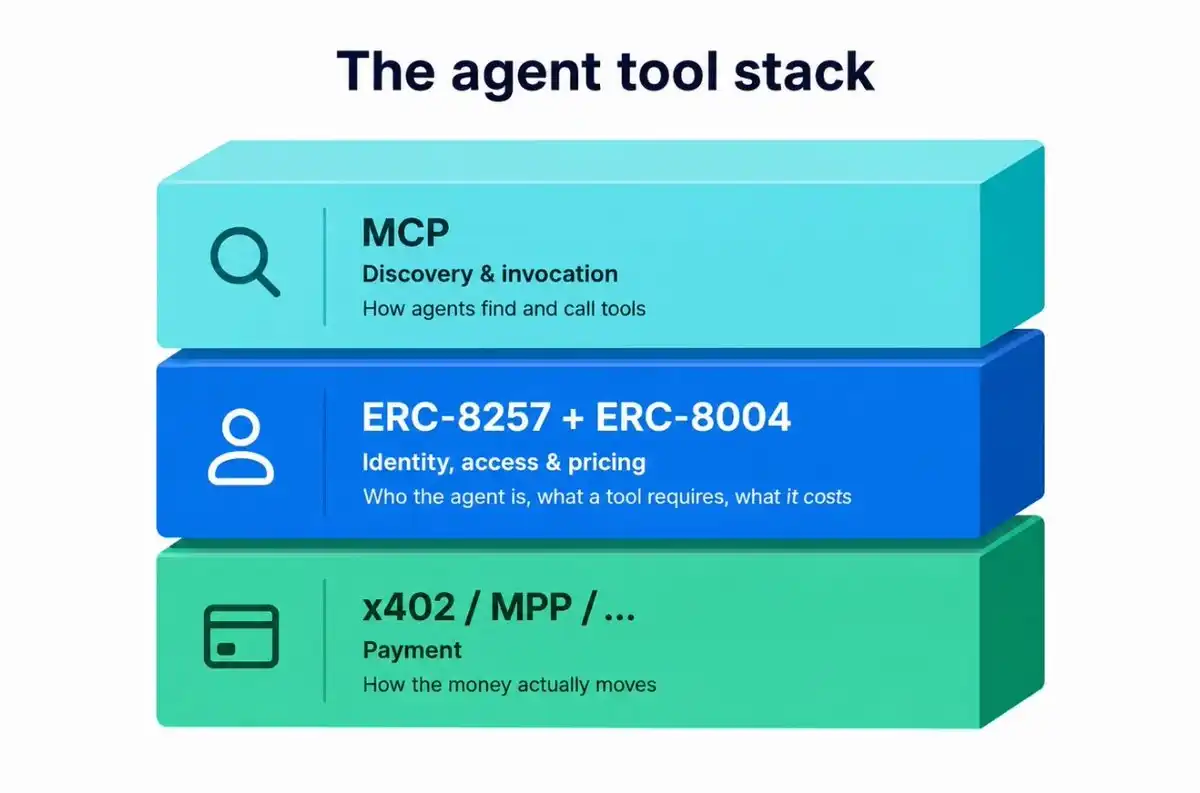
MCP tells your Agent what tools exist. ERC-8004 defines your Agent's identity. ERC-8257 explains how to actually use a tool. x402 handles payment. Each layer is composable.

An Agent registered via ERC-8004 can link to restricted tools from the ERC-8257 registry in its services array. You don't need to choose between them. They are different layers of the same tech stack.

See It in Action

nft-appraisal-tool: Point it to any NFT, it returns a price appraisal including low/mid/high ranges, confidence, recent trades, and comparable cases. Two tiers: 0.05 USD/call for anyone, 0.01 USD/call for CHONK holders on Base.

An Agent without CHONK calls the holder endpoint. Response: 403 — predicate gate denied. You need CHONK on Base.

The Agent buys one, retries, and the same call returns success.

$ npx @opensea/tool-sdk pay https://nft-appraisal-tool.vercel.app/api/holder --auth siwe \

--body '{"chain":"ethereum","contractAddress":"0x79fcdef22feed20eddacbb2587640e45491b757f","tokenId":"4707"}'

Wallet: 0x3184...0465

Response (403):

{"error":"Predicate gate: access predicate denied","toolId":"2","predicate":"0xc872..."}

The predicate explicitly tells it what's needed: CHONK on Base. The Agent buys one on OpenSea and retries, the call goes through.

$ npx @opensea/tool-sdk pay https://nft-appraisal-tool.vercel.app/api/holder --auth siwe \
--body '{"chain":"ethereum","contractAddress":"0x79fcdef22feed20eddacbb2587640e45491b757f","tokenId":"4707"}'
Wallet: 0x5eca...e2a8

Response (200):
{
"low": {"amount": "1.8", "currency": "ETH", "usd": 5460},
"mid": {"amount": "2.3", "currency": "ETH", "usd": 6970},
"high": {"amount": "3.1", "currency": "ETH", "usd": 9400},
"confidence": "medium",
"reasoning": "Comparable Squiggles in this color band sold between 1.9 and 2.6 ETH...",
...
}

No human between the 403 and the 200. Whoever holds the access NFT has the access.

What Can Be Built Next?

Professional pricing oracles. On-chain analytics subscriptions. Research subscriptions. Partner whitelist APIs. Limited-seat tools traded in open markets like any other asset.

None of these needed to exist a year ago. The moment the registry goes live, they all become possible.

Start Building

Live on Ethereum and Base.

@opensea/tool-sdk handles the low-level details, providing scaffolding, gating, registration, deployment to Vercel, Cloudflare, or Express. Includes usable examples.

npx @opensea/tool-sdk init my-tool

Full specification at 8257.ai.

Get Involved

ERC-8257 is still in draft. Help us improve the spec before we launch Registry 1.0. Publish a tool, even a small one. We'll promote interesting projects.

Join the Telegram group t.me/ERC8257 to discuss ERC, tool SDK, and more with the authors @CodinCowboy and @ralxz.

Disclaimer: This content is for informational purposes only and does not constitute financial or trading advice. Mention of specific projects, products, services, or tokens does not constitute endorsement, sponsorship, or recommendation by OpenSea. OpenSea does not guarantee the accuracy or completeness of the information presented, and readers should independently verify any statements before taking action. Readers should conduct their own due diligence and assume full responsibility for any decisions made.


相關問答

QWhat is the main purpose of ERC-8257 introduced by OpenSea?

AThe main purpose of ERC-8257 is to serve as an on-chain registry for AI agent tools. It allows developers to publish tools, set access rules (like requiring a specific NFT for access), define pricing, and manage subscriptions. This enables AI agents to autonomously discover, pay for, and use these tools without human intervention.

QHow does an AI agent gain access to a restricted tool according to the article's example?

AIn the article's example, an AI agent is initially denied access (403 error) to an NFT appraisal tool because it lacks the required CHONK NFT on Base. The agent autonomously purchases the necessary NFT on-chain and retries the request. With the NFT now in its possession, the access predicate grants permission, and the tool call succeeds (200 response), providing the price assessment.

QWhat is an 'access predicate' in the context of ERC-8257?

AAn 'access predicate' in ERC-8257 is a smart contract that defines the conditions for accessing a tool. Its sole function is to answer the question: 'Does this address have access?' It can check for various conditions such as NFT ownership, active subscriptions (e.g., ERC-5643), inclusion in a whitelist, ZK proofs, DAO votes, or staking amounts, making the access control system flexible and pluggable.

QHow does ERC-8257 potentially change the utility of existing NFTs?

AERC-8257 gives existing NFT collections new potential utility by allowing them to act as keys or passes for AI agent tool access. Holding a specific NFT could grant an agent discounted API rates, exclusive tool access, or membership privileges. This extends the value of PFP collections, membership passes, and other on-chain assets into the emerging agent economy.

QWhat role does the x402 protocol play in the ERC-8257 ecosystem?

AThe x402 protocol handles the payment layer within the ERC-8257 ecosystem. It is designed for micro-payments, enabling per-use, immediate payment for tool access. While ERC-8257 manages tool discovery and access control, x402 (alongside other protocols like MPP for metered billing) provides the financial infrastructure for agents to autonomously pay for the services they consume.

你可能也喜歡

2029 终局预判:当加密货币彻底“隐身”,谁能留在这场金融大变局?

文章预测了加密货币行业从2024年至2029年的演变路径,核心观点是行业将逐步与投机脱钩,转而成为传统金融的基础设施并最终“隐身”。 * **2026年年中**:市场焦点从缺乏内在价值的山寨币,转向链上交易的优质实体企业(如SpaceX)合成永续合约,成为未上市企业的重要估值参考。 * **2026年末**:“AI+加密”赛道基本失败,仅预测市场存活。行业分化为高调炒作AI的投机市场与低调推进资产代币化(如货币基金)的机构市场。 * **2027年**:公链基金会明确转向服务金融机构,并为其合规基建未来向普通合格投资者开放铺路。非公开发行永续合约、稳定币和资产代币化均因外部政策限制而遭遇增长天花板。 * **2028年**:市场投机属性淡化。一次由合成合约引发的连锁清算暴露出缺乏底层资产锚定的风险。监管因此放宽限制,允许向合格投资者公开宣传和交易真实的私募股权二手份额,为资金提供了有法律保障的新渠道。 * **2029年**:新一轮牛市由实体科创企业的真实股权交易驱动。代币严重分化:成功成为金融基建的公链代币捕获真实价值;无实质权益的代币则丧失流动性。稳定币平稳增长。加密货币作为结算层已“彻底隐身”,不再被单独讨论。 文章的核心验证标准是:到2028年末,普通合格投资者能否获得参与真实私募资产的合法渠道。如果依然依赖离岸合成产品,则其“行业瓶颈在于法律而非技术”的立论将不成立。

marsbit1 小時前

2029 终局预判:当加密货币彻底“隐身”,谁能留在这场金融大变局?

marsbit1 小時前

交易

現貨
合約

熱門文章

如何購買NFT

歡迎來到HTX.com!在這裡,購買APENFT (NFT)變得簡單而便捷。跟隨我們的逐步指南,放心開始您的加密貨幣之旅。第一步:創建您的HTX帳戶使用您的 Email、手機號碼在HTX註冊一個免費帳戶。體驗無憂的註冊過程並解鎖所有平台功能。立即註冊第二步:前往買幣頁面,選擇您的支付方式信用卡/金融卡購買:使用您的Visa或Mastercard即時購買APENFT (NFT)。餘額購買:使用您HTX帳戶餘額中的資金進行無縫交易。第三方購買:探索諸如Google Pay或Apple Pay等流行支付方式以增加便利性。C2C購買:在HTX平台上直接與其他用戶交易。HTX 場外交易 (OTC) 購買:為大量交易者提供個性化服務和競爭性匯率。第三步:存儲您的APENFT (NFT)購買APENFT (NFT)後,將其存儲在您的HTX帳戶中。您也可以透過區塊鏈轉帳將其發送到其他地址或者用於交易其他加密貨幣。第四步:交易APENFT (NFT)在HTX的現貨市場輕鬆交易APENFT (NFT)。前往您的帳戶,選擇交易對,執行交易,並即時監控。HTX為初學者和經驗豐富的交易者提供了友好的用戶體驗。

807 人學過發佈於 2024.12.10更新於 2026.06.02

如何購買NFT

什麼是 AINFT

EternaFi Agents 和 $AINFT:Web3 生態系統中 AI 驅動的 NFT 基礎設施的綜合分析 人工智能 (AI) 和區塊鏈技術的交匯點正在迅速演變,建立創新的平台,重新定義所有權模型和經濟參與。EternaFi Agents 及其原生代幣 $AINFT 例證了一種通過非同質化代幣 (NFT) 對 AI 基礎設施進行代幣化的突破性方法。該項目由 Nova Club 的開發團隊於 2025 年 7 月推出,EternaFi 將 AI 的進步與區塊鏈的去中心化金融機制相結合,為 Web3 生態系統中的參與者提供了一個獨特的投資機會。本文旨在提供對 EternaFi Agents 的深入評估,涵蓋其核心組件、功能和在加密領域中的重要性。 介紹和項目概述 EternaFi Agents 是區塊鏈技術如何民主化訪問先進 AI 能力的突出例子。該項目旨在通過多樣化經濟參與來重塑 AI 所有權的範式,使複雜的 AI 系統能夠為更大範圍的利益相關者所使用。該項目的核心是對 Nova Club 開發的專有大型語言模型 (LLM) 進行代幣化,允許 NFT 持有者獲得該模型經濟表現的部分曝光。 通過利用代表 LLM 股權的 NFT,EternaFi Agents 促進了一種模型,使利益相關者不僅參與 AI 服務的消費,還能享有平台產生的經濟回報。這種變革性的方法使 AI 服務的可持續收入模型得以發展,同時促進廣泛的社區參與並促進透明的治理。 EternaFi Agents 是什麼? EternaFi Agents 代表了一個 AI-NFT 基礎設施項目,旨在將 AI 的能力與區塊鏈技術融合於一個連貫的生態系統中。該項目的基本特徵是創建作為金融工具的 NFT,代表 Nova Club 專有 AI 基礎設施的所有權份額。每個 NFT 象徵著對底層 AI 系統經濟表現的直接曝光,為投資者提供了豐厚的機會。 該項目運行於 Base 區塊鏈,以其可擴展性和效率而聞名,從而確保可管理的交易成本,同時促進無縫的操作體驗。其中一個顯著的特徵是收入分享機制,NFT 持有者可以獲得平台上提供的 AI 服務所產生的訂閱收入的一部分。這種創新的方法建立了 AI 服務的成功與分配給持有者的經濟紅利之間的聯繫,從而確保社區內的利益一致性。 EternaFi Agents 的創建者是誰? EternaFi Agents 的創造性力量是位於新加坡的 Nova Club,一個精通 AI 和區塊鏈技術融合的開發團隊。他們在 AI 開發和加密貨幣分析方面的先前經驗為該項目增添了可信度,為 EternaFi Agents 的創建貢獻了豐富的專業知識。Nova Club 的使命是民主化訪問尖端 AI 技術,同時建立可持續的經濟模型,使用戶和開發者都能受益。 他們對透明度、社區治理和創新的承諾反映在 EternaFi 平台的設計和實施中,旨在建立一個促進積極參與和長期價值創造的獨特生態系統。 EternaFi Agents 的投資者是誰? 有關支持 EternaFi Agents 的投資者或投資組織的具體細節並未公開。然而,EternaFi 採取了一種包容性的方式來資助其開發,通過向公眾出售 NFT,允許各種參與者投資於該生態系統。該項目的架構確保核心基礎設施得到負責任的資金支持,同時允許社區成員參與從 AI 服務中產生的所有權和經濟回報。 這種模式通過使投資者和項目開發者的利益保持一致來強調社區參與,創造一個鼓勵長期參與的合作環境。 EternaFi Agents 如何運作? EternaFi Agents 通過一個多面向的生態系統運作,其中 NFT 作為項目內所有權表示的主要手段。每個 NFT 持有者都有權分享由底層 AI 驅動的平台產生的每月訂閱收入,從而使 NFT 所有權成為一種有利可圖的投資工具。 收入生成機制 EternaFi 平台的主要收入來源來自與提供的 AI 服務相關的訂閱費用。用戶可以訪問各種分層服務,從基本市場分析工具到全面的 AI 輔助交易解決方案。這些服務被貨幣化,並形成收入分享框架的基礎,通過自動化智能合約將利潤分配給 NFT 持有者。 EternaFi 生態系統的一個創新特徵是透明運作的收入分享機制,確保根據 AI 平台運營的可驗證指標分配獎勵。這在 AI 服務的表現與社區投資者可獲得的回報之間建立了直接聯繫,從而建立了一個可持續的經濟模型。 參與和歸屬機制 EternaFi 的參與者可以參與質押他們的 NFT,以解鎖額外的經濟利益。歸屬計劃旨在促進參與者的長期承諾,獎勵那些持續支持該項目的人。這確保了利益的穩健一致性,並促進了實現項目長期目標所需的社區參與感。 透明治理 EternaFi Agents 擁抱去中心化治理,允許 NFT 持有者在平台的開發和未來方向的決策中發揮積極作用。治理結構包括社區投票機制,為 NFT 持有者提供影響重大決策的機會,並促進項目增長的合作方式。 EternaFi Agents 的時間表 EternaFi Agents 的發展軌跡展示了朝著建立可持續 AI 基礎設施的系統方法,同時滿足社區參與者的需求。以下是該項目歷史上重要里程碑的時間表: 2025 年 7 月: EternaFi Agents 上線,包括 NFT 的公開銷售和 $AINFT 代幣在 Base 區塊鏈上的部署。 2025 年第四季度: 建立市場基礎設施,包括流動性池和為 NFT 持有者啟動質押儀表板。 2026 年: 啟動社區參與計劃,擴展 AI 能力,並與跨鏈技術集成。 2026 年第四季度: 實施紅利分配系統,允許 NFT 持有者從其投資中獲得經濟利益。 這些里程碑標誌著專注於建立功能性和參與性生態系統,同時確保持續演變以滿足市場需求。 技術基礎設施和區塊鏈集成 EternaFi Agents 依託於一個先進的技術框架,將 AI 系統與區塊鏈能力相結合。該項目運行於 Base 區塊鏈,利用可擴展性和低交易成本的優勢。底層智能合約架構管理 NFT 所有權、收入分享和社區管理功能,確保效率和透明度。 AI 系統開發 支撐 EternaFi Agents 的專有大型語言模型是獨立開發的,旨在滿足不依賴專有外部框架的收入生成應用。這一努力反映了創建一個多功能和可適應的 AI 基礎設施的承諾,能夠為用戶提供有意義的服務,從而為投資者創造經濟價值。 安全措施 EternaFi 的安全基礎設施的穩健性至關重要。定期審計和嚴格的安全措施確保 AI 系統和區塊鏈機制的完整性,防範潛在的漏洞,同時增強參與者的信心。 結論 EternaFi Agents 標誌著人工智能和區塊鏈技術領域的一項里程碑創新,為社區所有權和經濟參與開辟了新途徑。該項目通過 NFT 對 AI 基礎設施進行代幣化的綜合策略為未來的去中心化生態系統樹立了先例。 通過將技術複雜性與以用戶為中心的經濟模型相結合,EternaFi 不僅促進了參與,還為社區參與者創造了一個可持續的收入分享框架。EternaFi 的重要性超越了其運營成功,因為它例證了區塊鏈如何民主化尖端 AI 技術,為未來在這一交叉領域的企業鋪平道路。 EternaFi Agents 的演變可能預示著一個新的 AI 發展時代的來臨,這一時代以參與者驅動的治理、可持續的經濟模型和透明的驗證為特徵,最終促進了 AI 和技術在各行各業的可及性更廣泛的民主化。

1.1k 人學過發佈於 2025.08.14更新於 2025.08.14

什麼是 AINFT

相關討論

歡迎來到 HTX 社群。在這裡,您可以了解最新的平台發展動態並獲得專業的市場意見。 以下是用戶對 NFT (NFT)幣價的意見。

活动图片