Elon Musk's landmark lawsuit against OpenAI finally saw Ilya take the stand!
May 11, 2026, Oakland Federal Court, California.
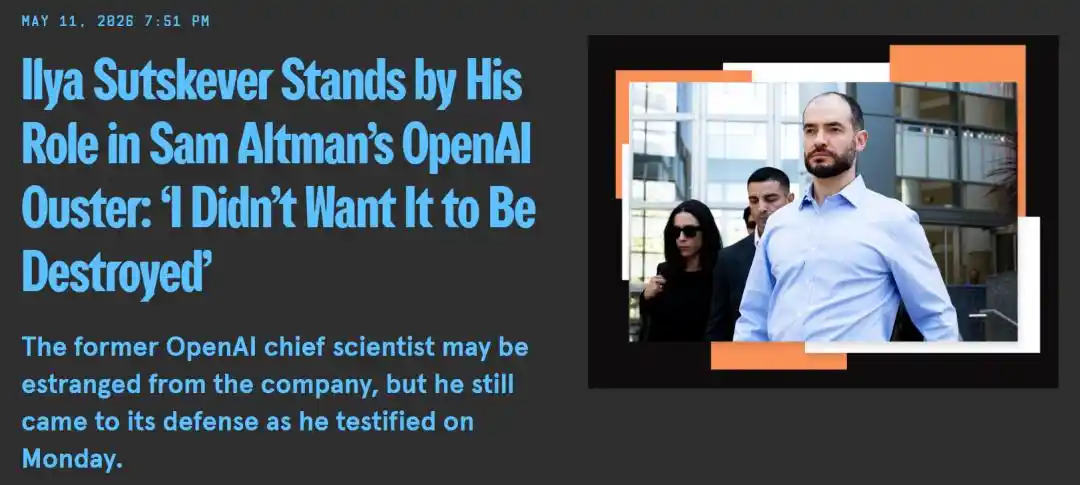
When that curly-haired, slightly melancholic genius scientist Ilya Sutskever slowly walked up to the witness stand, everyone in the courtroom held their breath.
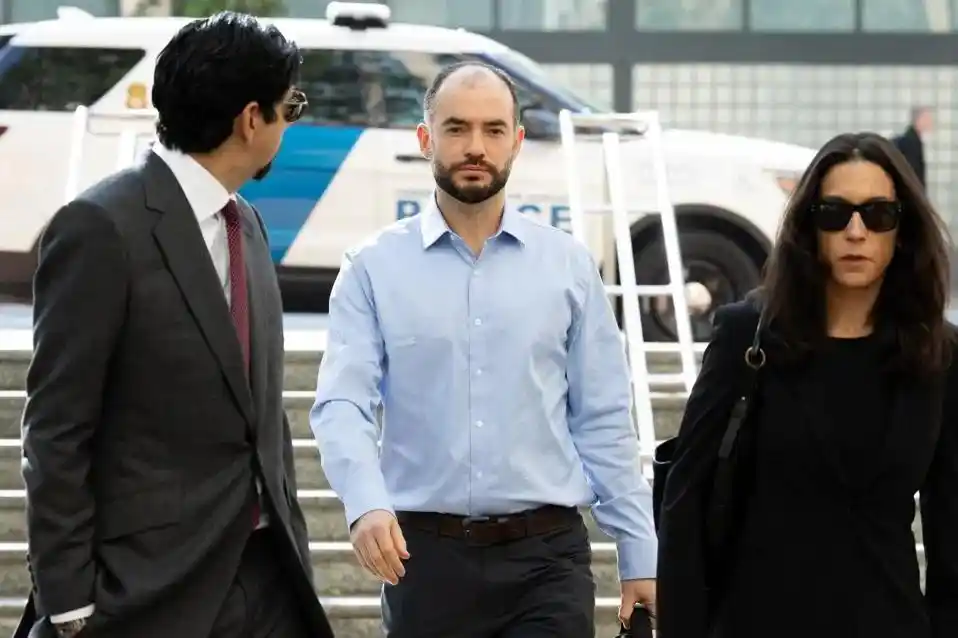
Wherever he appears, Ilya commands attention, especially here, at the trial of Elon Musk vs. OpenAI.
This time, Ilya was no longer the apologizer posting "I deeply regret" on social media, but an avenger returning with a 'bombshell'.
He not only personally confirmed Altman's habitual lying but also revealed to the world the power vacuum beneath OpenAI's glamorous facade.
This is destined to be the final chapter in the historic 'AI Palace Drama'.
This trial may decide the future of OpenAI—a company preparing for a trillion-dollar IPO, valued at $850 billion.
Altman is expected to take the stand himself as early as Tuesday to respond.
52 Pages of 'Lying Evidence': Altman Through That Man's Eyes
"He habitually lied, sowed discord among executives, and undermined corporate governance."
When Ilya said these words under oath, the current OpenAI management sitting in the defendant's seats turned pale.
This was no longer rumor, but courtroom testimony from OpenAI's former Chief Scientist.
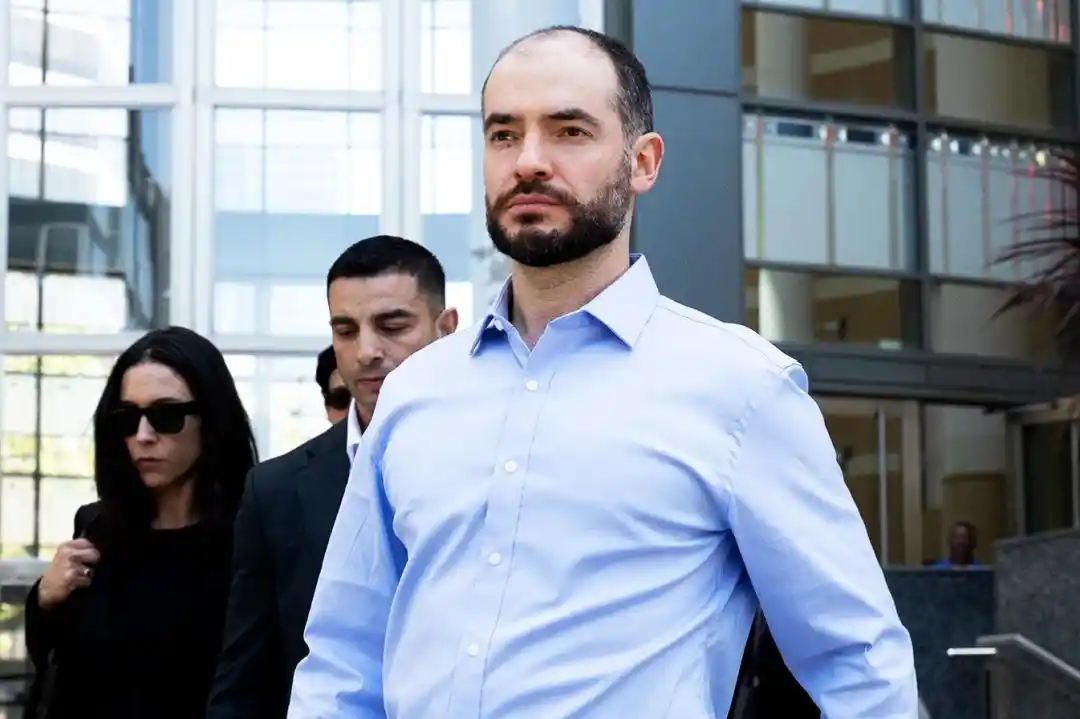
This time, Ilya revealed a previously unknown shocking detail: before the global-shocking 'November Coup' in 2023, he had been secretly gathering evidence for an entire year.
This evidence file was 52 pages long.
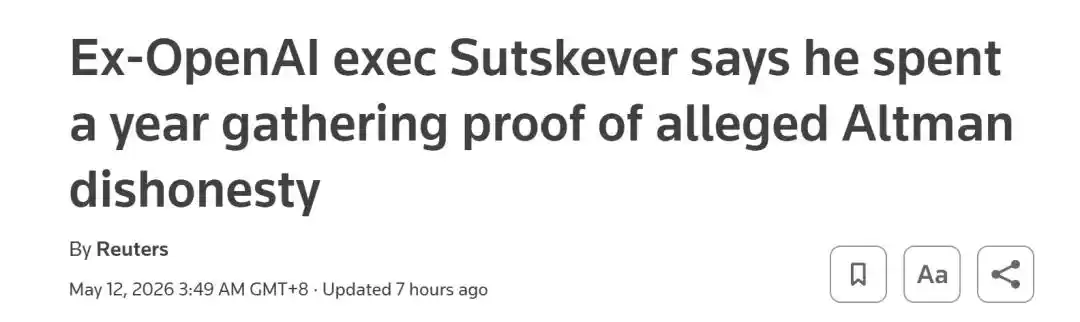
This 'Complete Collection of Altman's Dirty Laundry' detailed Altman's day-to-day political maneuvering.
For example, his specialty was sowing discord.
He frequently created conflicts between CTO Mira Murati and other executives, making them suspicious of each other to establish his own absolute authority.
Additionally, he was very skilled at manipulating information.
Ilya testified that Altman created an environment where "executives could not access correct information." In such an environment, any serious discussion about AI safety would be diluted by Altman with false market visions.
This time, Ilya bluntly stated that Altman's behavior was "detrimental to achieving any grand goal," especially the development of safe AGI.
"I spent a year observing and thinking, and ultimately I believed firing him was appropriate."
Ilya's tone was calm, yet every word was cutting. He admitted he had spoken with Murati in detail many times, both feeling profound unease about Altman's behavior.
The $70 Billion 'Traitor': The Expensive Price Tag of an Idealist
Next came another climax of the trial.
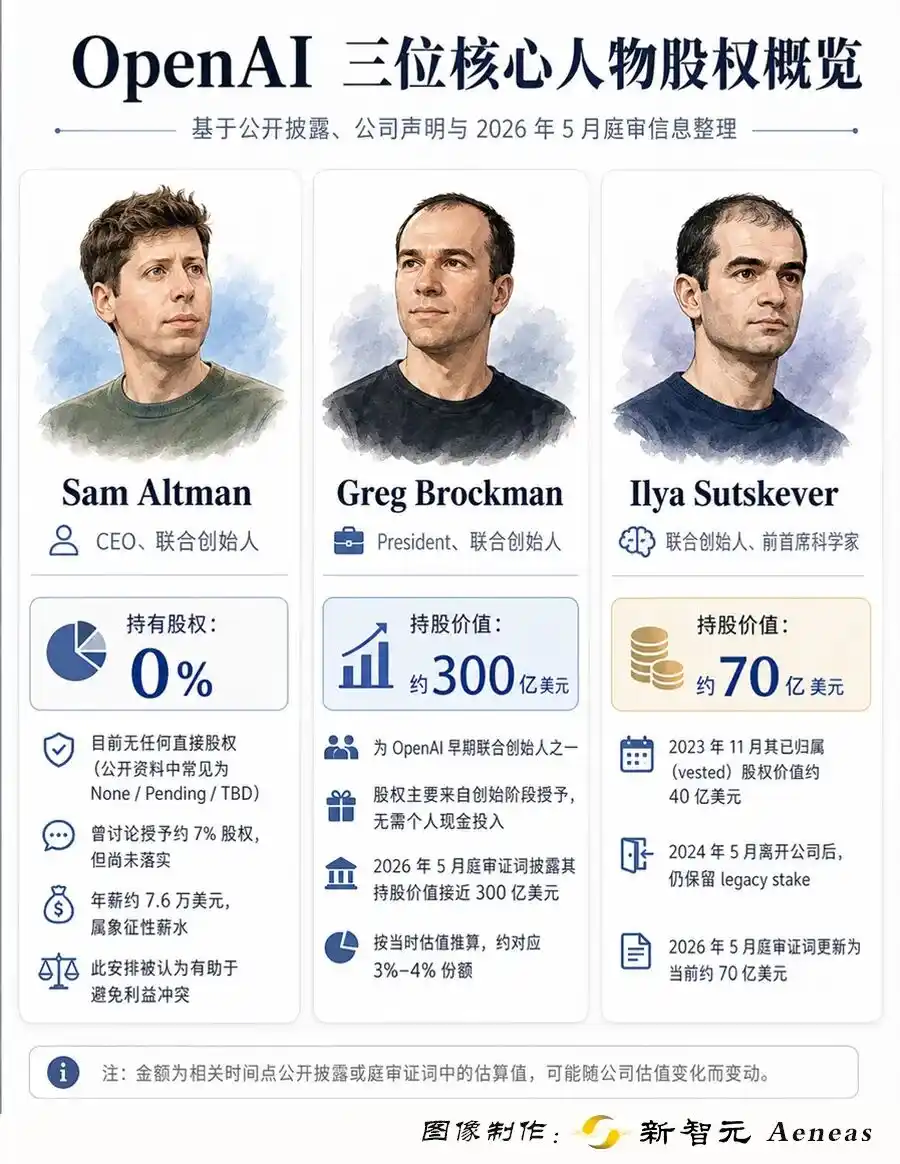
As a co-founder of OpenAI, Ilya had always been seen as a "pure scientist." But when the judge asked about the value of his shares, the number shocked the courtroom: $70 billion.
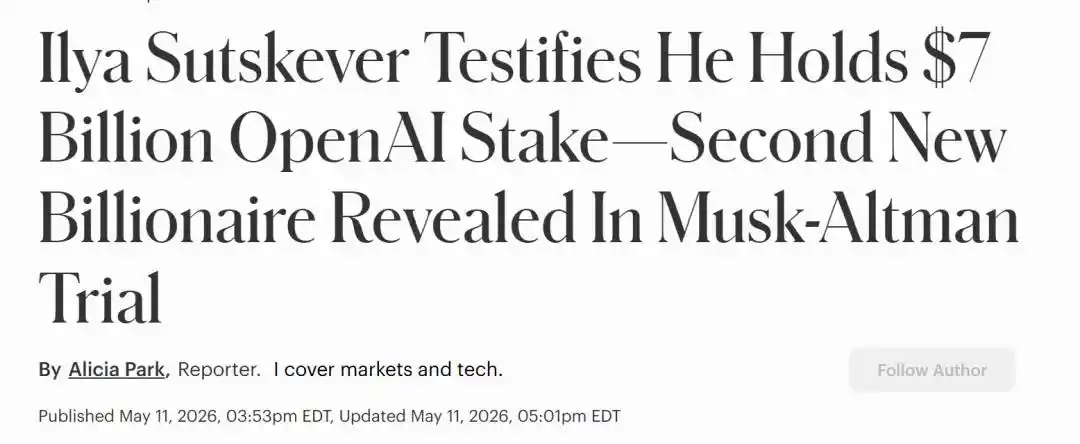
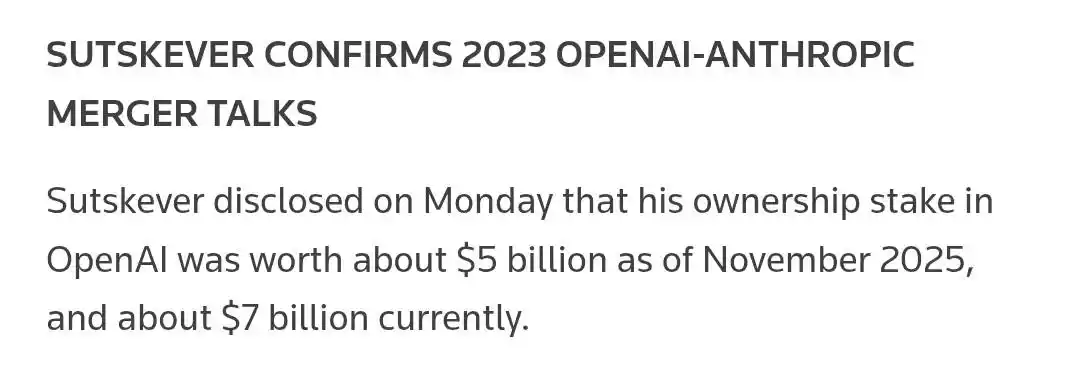
Just a week prior, OpenAI President Greg Brockman had admitted to holding shares worth $30 billion.
And Altman, whom Musk accused of being "blinded by greed," had a net worth of about $3.5 billion (mainly from his external investments).
A scene of irony unfolded: these former believers who championed "non-profit" had become the fastest-accumulating wealthy individuals in human history.
But Ilya displayed a near-tragic sense of contradiction in court.
He mentioned that back then, to join OpenAI, he rejected Google's renewal offer of $6 million per year—at the time, it seemed like "an astronomical figure" to him.
He explained why, on the weekend of the coup, he suddenly changed course and signed the petition calling for Altman's return.
"It was a 'Hail Mary,'" Ilya said in a low voice, "I saw the company was about to collapse, and Microsoft was ready to swallow us all."
At the time, the situation deteriorated faster than anyone expected. A large number of employees indicated they would leave with Altman. The company faced dissolution.
Ilya later expressed regret—not for gathering evidence or voting for removal, but for "participating in the board's action." He criticized his board colleagues for lacking experience, accepting "not very good legal advice," and acting too hastily.
On Monday in court, when he said these words, the entire gallery fell silent.
"I have a strong sense of belonging to OpenAI. I feel like I've poured my life into it. I just care about it. I don't want it to be destroyed."
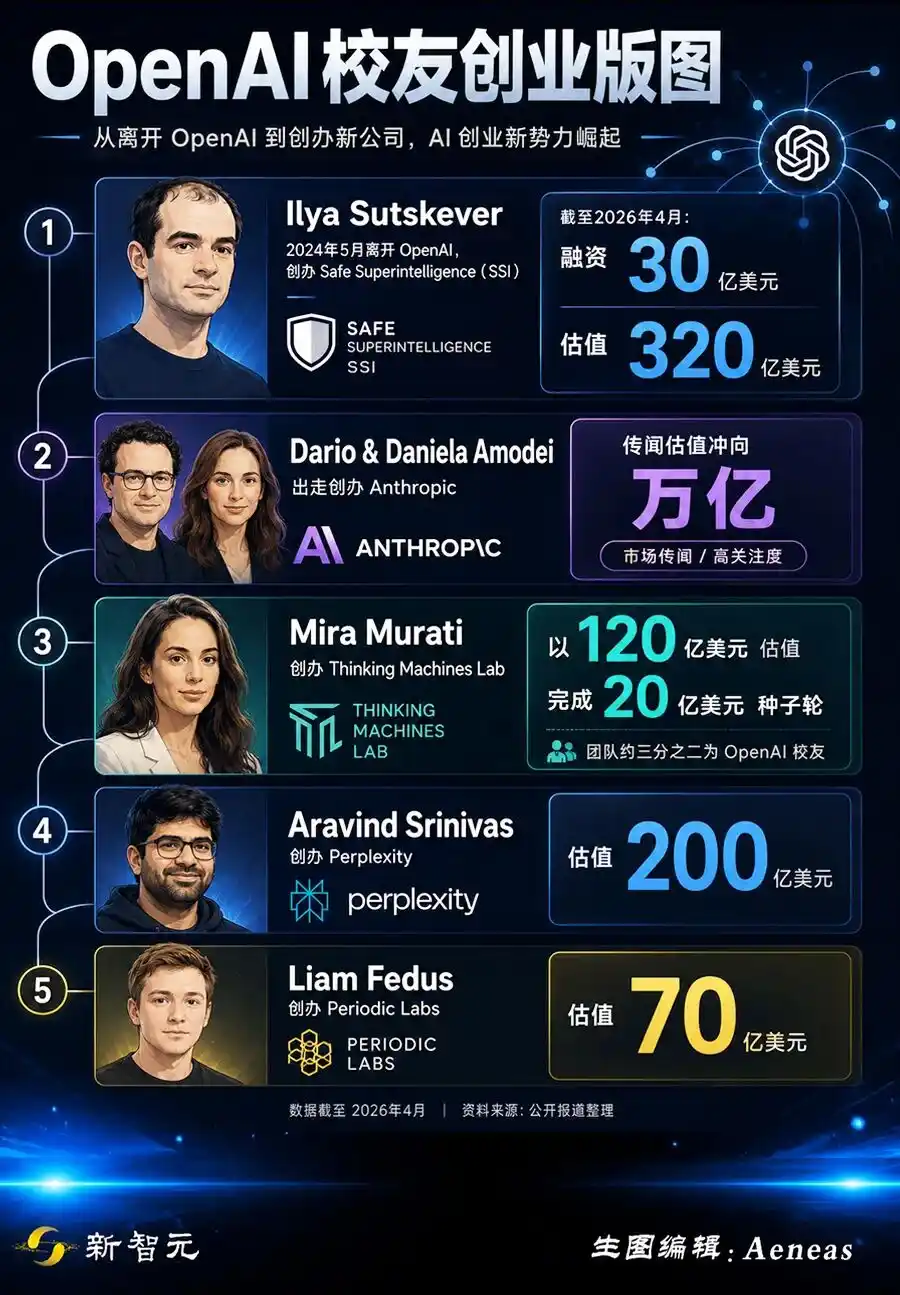
The OpenAI Mafia Panorama
Furthermore, this trial incidentally unveiled a panoramic view of the "OpenAI Mafia."
In May 2024, he left OpenAI and founded Safe Superintelligence. By April 2026, this company had raised $3 billion with a valuation of $32 billion.
Dario and Daniela Amodei left to found Anthropic, rumored to be racing towards a trillion-dollar valuation.
Mira Murati founded Thinking Machines Lab, which completed a $2 billion seed round last year at a $12 billion valuation, with two-thirds of the team being OpenAI alumni.
Aravind Srinivas founded Perplexity, valued at $20 billion. Liam Fedus founded Periodic Labs, valued at $7 billion.
It's intriguing that while their reasons for leaving varied, almost every one was related to Altman's leadership style.
The Almost-Happened Anthropic Merger
Ilya's testimony wasn't just about Altman.
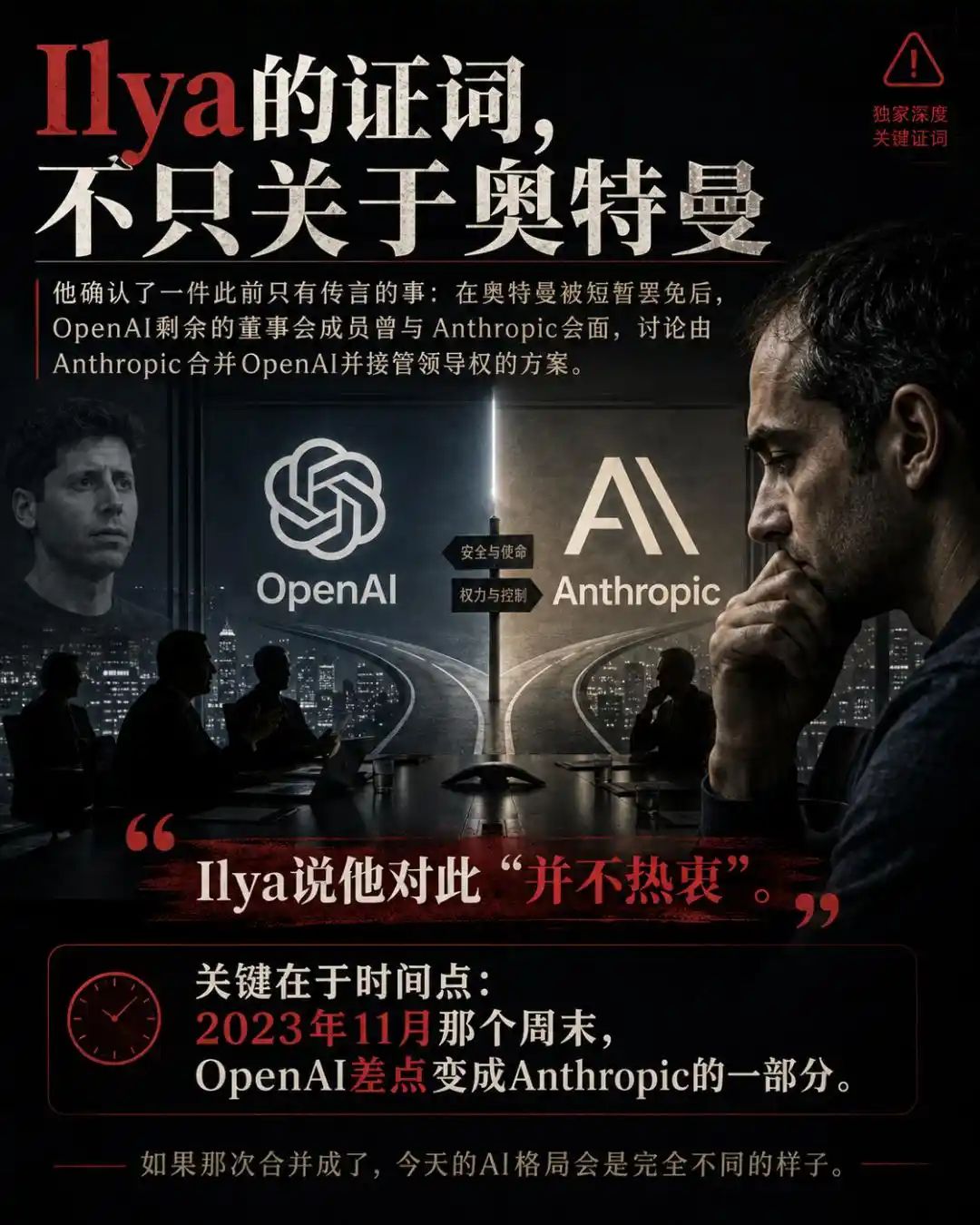
He confirmed something previously only rumored: after Altman's brief ousting, the remaining OpenAI board members met with Anthropic to discuss a plan for Anthropic to merge with and take over leadership of OpenAI.
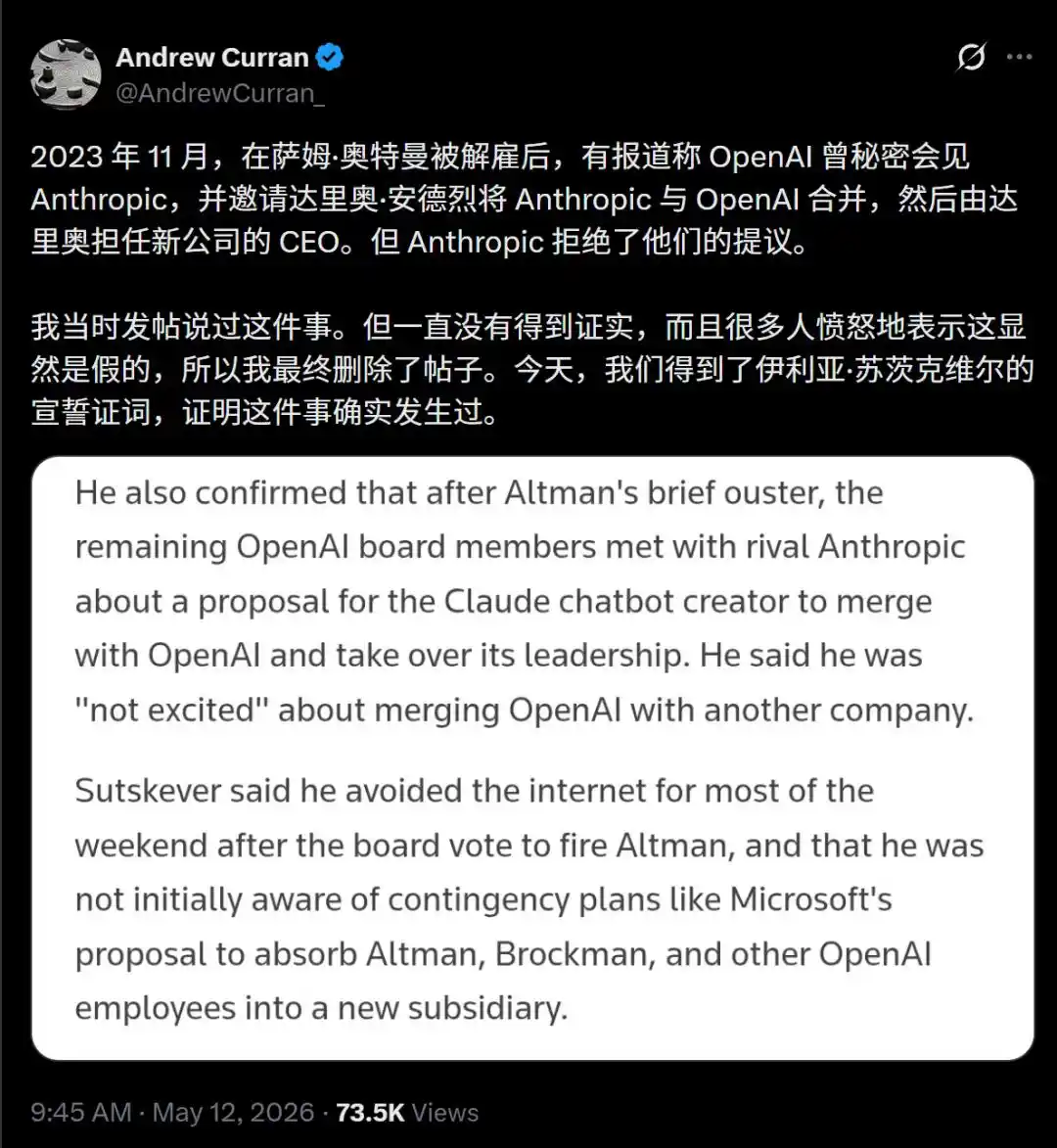
Ilya said he was "not enthusiastic" about it.
The damaging nature of this detail lies in the timing—that weekend in November 2023, OpenAI almost became part of Anthropic.
If that merger had happened, today's AI landscape would be completely different.
Microsoft's Shadow: Nadella's 'Power Grab' Ambition
If Ilya exposed internal rot, then Microsoft CEO Satya Nadella, who took the stand next, demonstrated the cold logic of capital.
Nadella described the ousting incident at the time as "amateur city," saying he "never got a clear explanation."
But court documents revealed another side of Nadella himself.
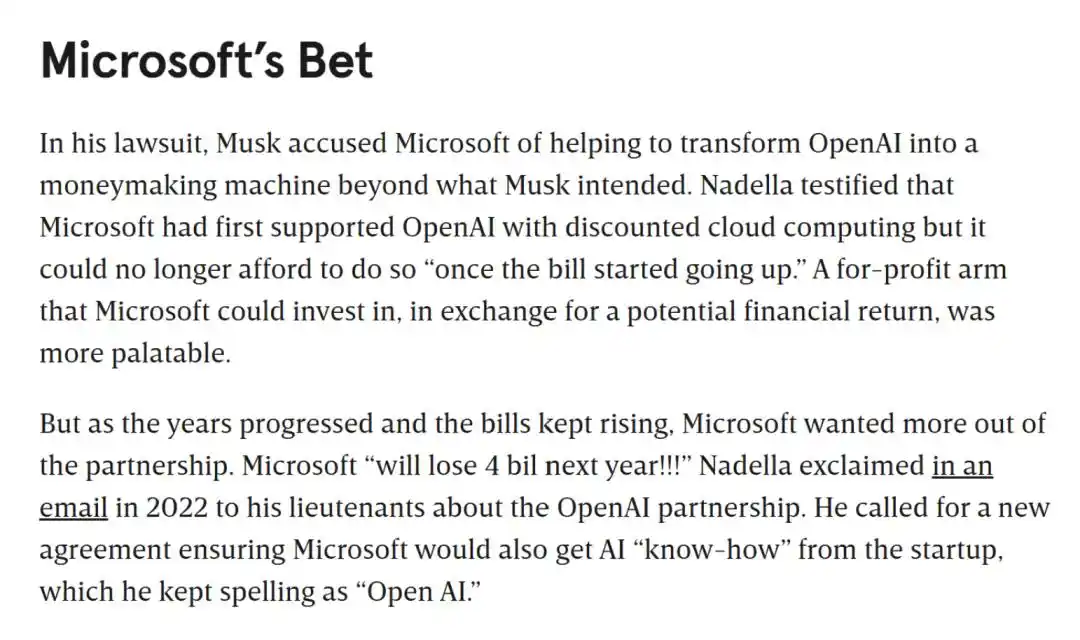
A 2022 email made public in court showed Nadella furiously raging to a subordinate: "If we're putting this much money in and have no control, it makes no sense at all!"
Under questioning by Musk's lawyer, Nadella admitted that when the 2023 coup occurred, Microsoft had already prepared a 14-person "takeover board list" and exercised de facto "veto power" over new OpenAI board members.
Even more explosive, Nadella had texted Altman repeatedly in early 2023 urging him: "Launch the paid subscription version of ChatGPT as soon as possible. The sooner, the better."
Two weeks later, he was inquiring about subscriber numbers.
This directly confirmed Musk's accusation: OpenAI was no longer a research lab, but Microsoft's 'IT department' and monetization machine.
And this, precisely this, was at the core of Musk's accusation—that OpenAI had deviated from its non-profit mission.
Musk's Fury: A Dream 'Exploited'?
Sitting in the audience, Musk perhaps wore a complex smile.
The core of this trial is: Did Altman use false promises of "non-profit" to deceive Musk into providing early investment and brand endorsement, then turn around and sell the results to Microsoft?
While Ilya's testimony didn't fully side with Musk (he denied ever promising Musk that OpenAI would never seek profit), his denunciation of Altman's character undoubtedly provided the strongest ammunition for Musk's lawsuit.
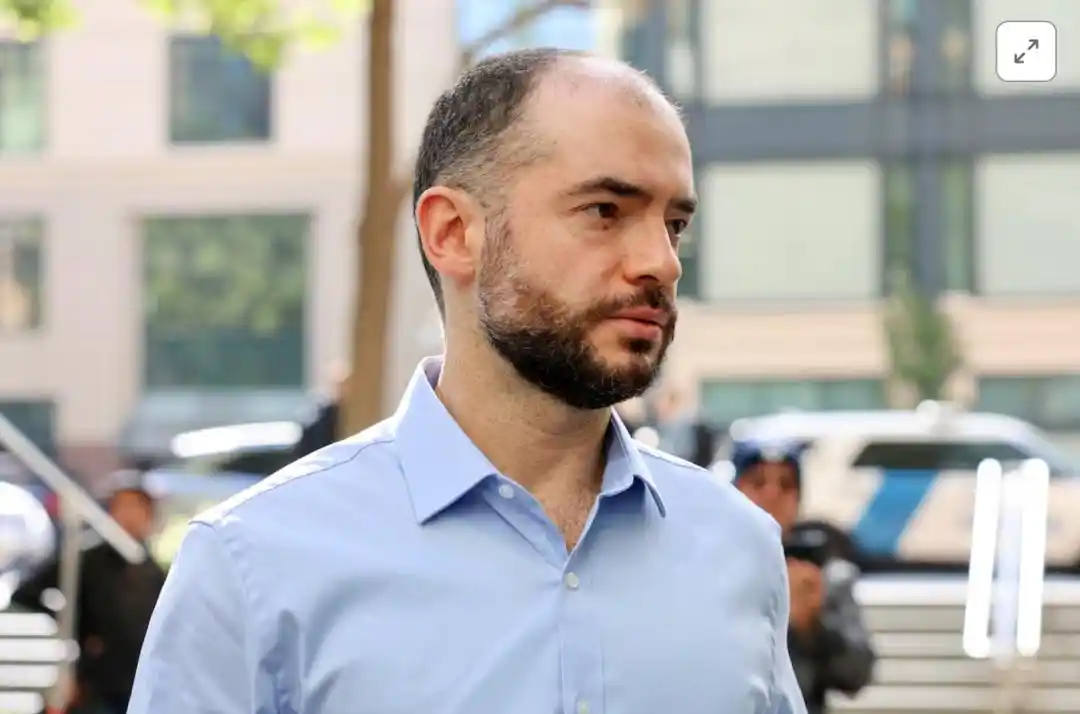
Ilya mentioned that he also opposed Musk's proposal to merge OpenAI into Tesla back then, considering Musk too "aggressive."
Musk's core accusation is: Altman and Brockman violated the promise that OpenAI would remain forever non-profit, turning instead to pursue profit.
Ilya's testimony on this issue actually favored OpenAI.
He said he "never promised Musk that OpenAI would remain non-profit."
He said something that will likely be repeatedly quoted: "OpenAI's mission is greater than its non-profit or for-profit structure."
At this point in the lawsuit, there are no absolute heroes left. It's more like a group of geniuses, on their path to godhood, engaged in the dirtiest brawl over interests, power, and the right to define humanity's future.
Approaching the Endgame: OpenAI or OpenMoney?
The trial continues.
Altman himself will take the stand this Tuesday.
The current situation is extremely dangerous for OpenAI.
If the judge ultimately rules that OpenAI violated its original non-profit charter, its for-profit entity valued at $850 billion could face structural reorganization.
Ilya sat in the witness stand for about an hour. According to a Wired reporter's observation, he made almost no eye contact with anyone throughout.
This man was once the soul of OpenAI, the leader who chanted "Feel the AGI" with employees at company gatherings.
Now, wearing a shirt without a suit jacket, he looked lonely and weary. In court, he said: "I've poured my life into OpenAI, I don't want it to be destroyed."
But the reality is, that pure OpenAI he deeply loved perhaps died the moment the first page of that 52-page evidence was written.
This trial is not about the success or failure of a company, but the core contradiction in Silicon Valley today: when technology granting god-like power (AGI) collides with ultimate human greed, can we still hold onto the last vestiges of integrity?
Next Thursday, the judge will deliver closing arguments.
And humanity's right to define the future of AI may be quietly rewritten within these few pages of testimony.
References:
https://www.reuters.com/business/former-openai-executive-sutskever-discloses-nearly-7-billion-stake-ai-firm-2026-05-11/
https://www.forbes.com/sites/aliciapark/2026/05/11/Ilya-sutskever-testifies-he-holds-7-billion-openai-stake-second-new-billionaire-revealed-in-musk-altman-trial/
https://www.wired.com/story/Ilya-sutskever-testifies-musk-v-altman-trial/
This article is from the WeChat public account "New Zhiyuan," author: New Zhiyuan, editor: Aeneas