
Author: Lawyer Shao Shiwei's Team
Xiao Wang is a programmer at a large tech company. In recent years, wanting to break through his professional bottleneck and seek new career possibilities, he began considering a transition to Web3. After communicating with headhunters and seeking referrals from friends in the industry, Xiao Wang received multiple job offers in Web3. The job descriptions (JDs) roughly stated:
Design and develop core prediction market contracts (AMM, liquidity pools, settlement, adjudication models);
Design and develop decentralized applications for gambling games;
Urgently hiring Java engineers, mandatory experience with perpetual contracts, matching systems, etc.
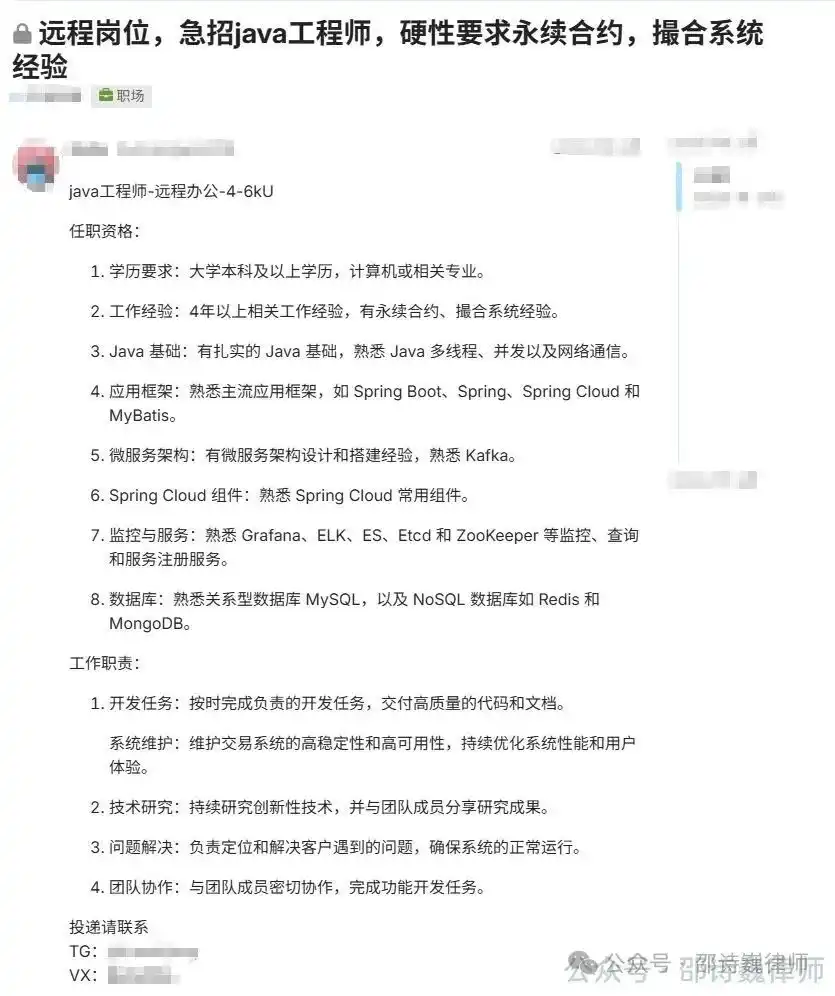


Faced with terms like "perpetual contracts, on-chain gambling, prediction markets," Xiao Wang felt he somewhat understood but also vaguely uneasy: the salary offered by the headhunter was good, significantly higher than his current income, and most importantly, it offered remote work—a lifestyle of a digital nomad he had always yearned for.
But, "Is there domestic risk in this type of work? But even if the project is risky, so what? I'm just a technician; even if something happens, it shouldn't implicate me, right?"... This conflicting psychology kept him in a state of persistent hesitation.
In daily case handling and consultations, Lawyer Shao has found that many job seekers share similar thoughts: attracted by the high salary and remote work on one hand, yet worried about crossing legal red lines on the other. So, for programmers transitioning to Web3, how should they choose job positions? How can they "avoid pitfalls" to stay clear of legal risks?
This article will summarize common types of high-risk projects related to gambling from the perspective of Web3 job seekers, helping you "identify them at a glance." You can compare the job description, project whitepaper, and official website introduction to self-check if the job you're about to take is a Web3 project involved in gambling, avoiding unintentionally working for a "casino."
1. Web3 Gaming Platforms: The Disguised Packaging of On-Chain Gambling
Many Web3 job seekers first encounter this type of position with JDs that often sound very appealing:
Decentralized chain games, fair on-chain gambling, smart contract automatic settlement, USDT instant settlement—at first glance, it seems like a cutting-edge Web3 game (GameFi) or innovative project.
But if you strip away these buzzwords and just look at how the money flows, you'll find the business essence is not that complicated: users use USDT, ETH, or other virtual currencies as chips, choose a game style (dice, roulette, lottery, sports betting, etc.) on the front end, and then write the transaction into a smart contract via a Web3 library; after the contract receives the funds, it determines win/loss based on preset random number + odds rules, then pays profits to the winner from the fund pool, while the platform and the house take a commission.
What's transparent on the chain is only the process; its essence is still organizing an unspecified majority to bet online on wins and losses, with the platform profiting through commissions.
In such projects, the programmer's daily work is often akin to a technical architect for a casino:
Responsible for writing betting contracts, drawing logic, fund pool management; researching on-chain random numbers to ensure apparent fairness; creating various betting interfaces, odds displays, drawing animations; setting up data dashboards in the backend to track wins/losses and agent rebates.
Many technical personnel believe they are just ordinary employees writing code, or that "technology is neutral." However, from the judicial authorities' perspective, technical personnel are identified as key roles providing technical support for the gambling platform.
For example, in the EOS gambling case 【Case: (2023) Su 09 Xing Zhong No. 372】, the involved parties developed a gambling platform named BigGame on the EOS blockchain and accepted bets. The technical personnel were responsible for platform product design, contract code writing, and platform client code writing, and were identified as accomplices in the crime of operating a gambling establishment. Practice has clearly established that using blockchain and other technologies to establish gambling websites and accepting bets from participants using virtual currency as chips constitutes the "operation of a gambling establishment" behavior specified in the second paragraph of Article 303 of the Criminal Law.
2. Perpetual Contract Development: The Gambling Nature of High-Leverage Trading
Another very common type in Web3 job hunting is positions under the guise of digital currency exchanges or contract platforms. JD descriptions include: responsible for perpetual contract matching engine development, participating in high-concurrency trading system design, building risk control and forced liquidation mechanisms... If the job seeker has experience in traditional finance or matching systems, it's easy to interpret this as working on a high-end financial product.
But the reality is often: the platform focuses on high-leverage perpetual contracts. Users use USDT to bet whether a coin's price will rise or fall, configuring up to 150x leverage. If the direction is wrong, they are instantly liquidated to zero, while the platform steadily collects fees and continuously takes a cut from liquidations, settlements, and funding rates.
In Web3 contract projects, programmers are often working on the underlying support of the "trading engine": implementing high-performance matching systems, margin models, liquidation, and forced closing logic; building so-called risk control systems, but more to prevent platform losses; simultaneously cooperating with product design for signal following, agent rebates, partnership systems, and other user acquisition and裂变 mechanisms.
Although similar contract businesses may operate legally in some regions overseas, in publicly available judgments in China, the courts'定性 of such businesses is becoming increasingly clear: high-leverage contracts are in most cases regarded as gambling activities using virtual currency as chips. Relevant technical, operational, and agency personnel find it difficult to completely sever responsibility with "I'm just an employee."
For example, in the CCFOX case 【Case No.: (2024) Ji 06 Xing Zhong No. 10】, the court determined that the virtual currency contract trading provided by the CCFOX platform had speculative and偶然性 characteristics and was not supervised by the state. The CCFOX platform should be identified as a gambling platform. Shen某, as a technical developer for the CCFOX website, responsible for website function development and providing technical services, was identified as an accomplice in the crime of operating a gambling establishment.
3. On-Chain Prediction Markets: Betting Games Under the Guise of Financial Innovation
Another type of seemingly more advanced position in Web3 job hunting involves so-called prediction markets, event contracts, and price prediction games. These platforms like to use flashy narratives:
Using market prices to aggregate collective wisdom, using trading to predict the future, assetizing all events... It sounds like a financial experiment.
But if you actually click into the official website to see the gameplay, you'll find the core logic is still the same set: the platform launches predictions on whether a coin price will reach a certain level by a certain date, whether a macro event will occur (e.g., the possibility of Trump being impeached again before the end of 2026, when the Fed will cut rates, the end time of the Russia-Ukraine conflict, etc.). Users use virtual currency to bet yes or no, rise or fall. Upon expiration, the platform or an oracle determines the result, pays out according to the odds, and the platform takes a cut. This is no different in substance from binary options or betting on big/small, just wrapped in a "prediction market" cloak.
Technical positions are often packaged to sound very technical: designing prediction contract mechanisms, implementing event creation, betting, expiration settlement contract logic, integrating oracles, arbitration systems... But what you are actually doing is still fund pool management, odds curve design, and settlement rules—from a judicial perspective, this is a complete set of 'bet on results, divide the赌资' casino rules.
Judging from the spirit of the Supreme People's Court's guiding Case No. 146, the玩法 of such prediction markets is not本质上 different from the traditional "betting on big/small, winning/losing"玩法. What technicians consider financial innovation projects will most likely be evaluated and handled according to their gambling attributes in domestic judicial practice.
4. Gambling Payment Platforms: High-Risk Payment and Clearing Services
This last category is the one where many Web3 job seekers are most likely to let their guard down, yet it carries extremely high criminal risk: providing the underlying payment system for gambling platforms (i.e., gambling platforms or betting websites) for充值, withdrawal, and exchange.
Some companies often package themselves externally as payment technology, clearing and settlement platforms, or fourth-party payment, focusing on keywords like aggregated payment, cross-border settlement, USDT payment gateways; the team rhetoric claims they are "USDT payment solution or wallet service providers."
If you only look at the work content, it seems like just对接 various payment channels and wallets, all very normal business. But the actual business model is often:
-
Packaging legal payment tools like Alipay, WeChat Pay, and bank cards into an "aggregated channel" and connecting it to overseas gambling websites;
-
Or using USDT, game coins, points as an intermediate medium to help players complete the two-way conversion between RMB and chips;
-
Then using multi-layer accounts, channels, or中转 wallets to "launder" the funds.
In such companies, programmers' daily work often focuses on:
Developing充值/withdrawal systems, integrating fiat and on-chain wallet interfaces, writing currency and chip exchange logic, building transaction流水 and clearing and settlement backends, and even optimizing "pass-through rates" and reducing risk control interceptions.
But from a criminal judicial perspective, these behaviors are often summarized in one sentence: "providing fund settlement and exchange services for gambling websites." For example, in the cross-province arrest case of Web3 wallet company employees previously discussed by Lawyer Shao (➡️《Reflections Triggered by the Cross-Province Arrest Case of a Web3 Programmer: Three Legal Cognitive Blind Spots for Practitioners》), the team where the当事人 worked was investigated because some of its partner merchants were suspected of operating online gambling establishments, leading to employees being taken away for investigation.
5. Lawyer Shao's Advice: Two-Step Self-Check to Stay Away from Legal Risks
Based on the four common types of gambling platforms above, Lawyer Shao's core advice for Web3 job seekers is as follows:
First,刻下 a red line in your mind:凡是 the business essence is "someone uses money to bet on wins and losses, and the platform profits through odds or leverage commissions," regardless of whether it's called contracts, GameFi, prediction markets, or payment technology, it will most likely be treated as a gambling-related project in judicial practice.
When具体 job hunting, you can judge the risk using the "two-step self-check method":
First, look at the platform's overall model (look at the big picture): Carefully study the project whitepaper, official website introduction, and product gameplay. As long as the overall logic is similar to the Web3 gambling platforms, contract gambling, or gambling payment channels described above, be highly vigilant and carefully consider joining.
Then, look at your own job responsibilities (look at the details): Clarify whether the functions you are actually responsible for involve high-risk links such as betting logic, drawing rules, odds models, forced liquidation mechanisms,充值/withdrawal, credit/debit points, or fund clearing and settlement; as long as you are deeply involved, it is difficult to sever responsibility with "I just write code."
If you can identify risks in advance and decisively refuse offers, you can often avoid criminal implication. Once involved in such projects, job seekers often face not just "changing jobs," but the dual代价 of loss of personal freedom and interruption of their professional career.