Veteran Chinese Public Chain NEO's Two Founders in a Feud, Financial Opacity as the Core Reason

marsbit發佈於 2026-01-01更新於 2026-01-01

文章摘要

Summary: A public conflict has erupted between Erik Zhang (Zhang Zhengwen) and Da Hongfei, the two co-founders of the Chinese-origin blockchain project NEO. The core issue is a lack of financial transparency within the NEO Foundation. Zhang, who had left NEO years ago and officially returned in September, accused Da of maintaining a "black box" of assets. He claims Da has sole control over the Foundation's non-token assets and lacks a proper audit mechanism. Zhang also alleged that Da was using NEO's resources to develop a separate project, EON, which prompted his return. The dispute escalated in December when Zhang publicly demanded financial disclosures and unilaterally announced that Da would be removed from NEO mainnet affairs to focus on sidechain and new project development starting January 1, 2026. In response, Da countered that Zhang actually controls the majority of the ecosystem's funds (NEO/GAS tokens) and consensus node voting power. He accused Zhang of delaying the transfer of these funds to a multi-signature wallet for years. Da committed to releasing a financial report for 2025 by Q1 2026.

It's unexpected that a veteran domestic public chain could come to such a day. What's even more lamentable is that top domestic AI projects like Manus, Kimi, and Minimax have had major news for two consecutive days—either being acquired for billions of dollars or raising hundreds of millions in funding—while this old-school public chain has started a feud.

As it stands, the two co-founders of the NEO public chain, founded in 2014, Zhang Zhengwen (Erik Zhang) and Da Hongfei, have essentially completely fallen out, continuing to trade barbs on X. Based on their statements and publicly available information online, let's try to figure out what exactly happened between the two founders of this veteran public chain.

Financial Black Box

Actually, Zhang Zhengwen had left NEO a few years ago, which he confirmed on his own Twitter, and then officially returned in September this year. The trigger for this feud was in November. According to community news and public information, Zhang Zhengwen, as the technical core, encountered obstacles when seeking to obtain the detailed financial report and fund flow of the Neo Foundation.
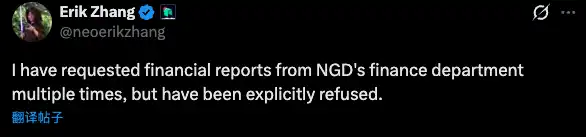
Subsequently, Zhang Zhengwen accused the Neo Foundation of long-term opaque operations, with its financial status resembling a "black box." He pointed out that Da Hongfei has long solely controlled the foundation's assets other than NEO/GAS tokens, and there is a lack of a complete, auditable disclosure mechanism.

In today's exchange of accusations, we also discovered the reason for Zhang Zhengwen's previous departure. He said that Da Hongfei approached him alone, stating that it was inefficient for the two of them to be responsible for NEO, so he chose to temporarily withdraw from management to "improve efficiency." However, he found that Da Hongfei was using NEO's resources to develop an independent public chain project, EON. This prompted him to return and intervene in the foundation's governance.

In community discussions in November, Zhang Zhengwen stated that NEO had previously relied on hackathons to create "false prosperity," with no real users, and many hackathon projects disappeared after receiving awards.

Escalation of Conflict

In December, Zhang Zhengwen publicly issued a statement demanding that Da Hongfei fulfill the financial disclosure obligations promised since December 9th. More explosively, Zhang Zhengwen unilaterally announced that, according to a previous phone agreement between them, starting January 1, 2026, Da Hongfei will no longer participate in NEO mainnet affairs and will instead focus on the development and operation of the sidechain NeoX and the new project SpoonOS.

Da Hongfei (Da Shu) responded immediately, stating that Zhang Zhengwen actually controls the vast majority of the funds in the NEO ecosystem (including the core assets NEO and GAS tokens) and dominates the voting rights of consensus nodes. He also accused Zhang Zhengwen of delaying the transfer of funds to the foundation's multi-signature address (Multisig) for years under various pretexts (such as waiting for the completion of the N3 migration).

Da Hongfei承诺将在 2026 年第一季度发布 2025 年末的财务报告,并会提前分享初步数据。

相關問答

QWhat is the core reason for the public conflict between the two co-founders of NEO, as mentioned in the article?

AThe core reason is financial opacity, with Erik Zhang accusing Da Hongfei of controlling the foundation's assets (excluding NEO/GAS tokens) in a 'black box' manner without a complete, auditable disclosure mechanism.

QAccording to the article, why did Erik Zhang initially leave NEO's management?

AHe left because Da Hongfei told him that having two people in charge was inefficient. Zhang agreed to step back temporarily to 'improve efficiency'.

QWhat specific event prompted Erik Zhang to return and get involved in the NEO Foundation's governance?

AHe returned after discovering that Da Hongfei was using NEO's resources to develop an independent public chain project called EON.

QWhat did Erik Zhang unilaterally announce regarding Da Hongfei's role starting January 1, 2026?

AHe announced that, based on a prior phone agreement, Da Hongfei would no longer be involved in NEO mainnet affairs and would instead focus on developing and operating the sidechain NeoX and a new project called SpoonOS.

QHow did Da Hongfei counter Erik Zhang's accusations about financial control?

ADa Hongfei stated that Zhang actually controls the vast majority of the funds in the NEO ecosystem (including the core NEO and GAS tokens) and the consensus node voting power. He also accused Zhang of delaying the transfer of funds to the foundation's multi-signature address for years.

你可能也喜歡

谷歌TPU出货量,上修50%

近期,多家海外机构上调了谷歌TPU的出货预期,将2027年需求预测从1000万颗上修至1500万颗,增幅达50%。这一变化扭转了市场对算力硬件的保守看法,并带动整条配套产业链需求同步提升。 谷歌TPU采用标准化全光互联架构,硬件配套关系固定。其中,NPO光引擎与TPU芯片按1:1匹配,光模块、OCS光交换、服务器电源、光纤及液冷等环节的需求均随芯片规模增长而确定增加。 液冷成为核心受益方向。因新一代TPU功耗大幅提升,风冷已达物理极限,谷歌集群已全面转向液冷方案。预计2026年为放量元年,下半年开始大规模交付。同时,海外厂商面临技术迭代慢、产能不足的瓶颈,为国产液冷厂商让出替代窗口。凭借快速迭代和稳定交付能力,国内企业正切入谷歌供应链,行业迎来“业绩提速+格局洗牌”的双击行情。预计伴随TPU出货量从2027年的1500万颗增长至2028年的3000-3500万颗,专属液冷市场规模将从千亿级突破至3000亿级。 光纤赛道逻辑亦被重塑。AI算力中心建设催生海量光纤需求,但光纤预制棒扩产周期长,导致供需缺口持续扩大。全球云厂商为锁定货源纷纷签订长期协议,使光纤价格与出货趋稳,摆脱周期性波动。国产光纤凭借产能与成本优势,预计2026年出口量将达2-3亿芯公里,占据全球AIDC需求的半壁江山。 此外,1.6T光模块、OCS光交换、服务器电源等配套环节均将受益于TPU放量,需求持续扩容。投资重心正从芯片算力博弈转向基础设施配套的确定性增量,产业链未来两年业绩确定性进一步增强。

marsbit34 分鐘前

谷歌TPU出货量,上修50%

marsbit34 分鐘前

币圈故事退潮后,华尔街真正想要的是什么

币圈故事退潮后,华尔街正将传统金融的核心资产与业务系统性地迁移至区块链上,其目标并非投机或去中心化叙事,而是构建一套可控、生息且合规的链上金融基础设施。 核心动向包括: 1. **资产代币化**:以贝莱德的BUIDL基金为例,它将短期美国国债等低风险资产代币化,提供链上即时结算与每日复投,成为链上金融的基石资产。过户代理机构Securitize即将上市,并与纽交所合作,旨在建立全天候的链上股票清算系统。 2. **波动率变现**:针对比特币等波动资产,贝莱德、高盛等机构推出备兑看涨期权ETF(如BITA),通过系统性卖出期权将波动转化为稳定的月度现金收益,将其包装为标准化的生息产品,以吸引传统大型资金。 3. **稳定币支付与清算**:稳定币正被定位为高效的支付与结算工具。Stripe支持商户用稳定币收款,万事达卡升级系统支持稳定币进行跨时区清算,连SWIFT也计划推出基于分布式账本的跨境清算方案,旨在释放被冻结的巨额结算准备金,提升效率。 4. **监管与合规驱动**:美国《GENIUS法案》等监管框架将合规稳定币明确定义为“支付工具”(禁止派息)并纳入强监管,使其成为美元金融体系的可编程延伸。 总之,华尔街正利用区块链技术的可编程性与效率,在链上复制并优化国债、期权、清算网络等传统金融产品与服务,每一步都紧密依托美元信用与现有监管体系,旨在打造一个更高效且由其主导的新金融管道。

marsbit51 分鐘前

币圈故事退潮后,华尔街真正想要的是什么

marsbit51 分鐘前

交易

現貨
合約

熱門文章

如何購買CORE

歡迎來到HTX.com!在這裡,購買Core DAO (CORE)變得簡單而便捷。跟隨我們的逐步指南,放心開始您的加密貨幣之旅。第一步:創建您的HTX帳戶使用您的 Email、手機號碼在HTX註冊一個免費帳戶。體驗無憂的註冊過程並解鎖所有平台功能。立即註冊第二步:前往買幣頁面,選擇您的支付方式信用卡/金融卡購買:使用您的Visa或Mastercard即時購買Core DAO (CORE)。餘額購買:使用您HTX帳戶餘額中的資金進行無縫交易。第三方購買:探索諸如Google Pay或Apple Pay等流行支付方式以增加便利性。C2C購買:在HTX平台上直接與其他用戶交易。HTX 場外交易 (OTC) 購買:為大量交易者提供個性化服務和競爭性匯率。第三步:存儲您的Core DAO (CORE)購買Core DAO (CORE)後,將其存儲在您的HTX帳戶中。您也可以透過區塊鏈轉帳將其發送到其他地址或者用於交易其他加密貨幣。第四步:交易Core DAO (CORE)在HTX的現貨市場輕鬆交易Core DAO (CORE)。前往您的帳戶,選擇交易對,執行交易,並即時監控。HTX為初學者和經驗豐富的交易者提供了友好的用戶體驗。

502 人學過發佈於 2024.12.13更新於 2026.06.02

如何購買CORE

相關討論

歡迎來到 HTX 社群。在這裡,您可以了解最新的平台發展動態並獲得專業的市場意見。 以下是用戶對 CORE (CORE)幣價的意見。

活动图片