REX Shares says it will list the first US exchange-traded fund offering spot exposure to XRP this week, trading under the ticker XRPR. “The REX-Osprey™ XRP ETF is coming this week!” the issuer posted on X, adding that the product will be the first US ETF to deliver investors spot exposure, currently the third-largest cryptoasset by market value.
XRP Makes Wall Street History
Unlike the SEC-approved spot bitcoin and ether products—structured as ’33 Act commodity trusts—the REX-Osprey fund is being launched as a ’40 Act open-end ETF. That structure permits an ETF to operate as a registered investment company and can mix exposures, rather than holding only a single commodity in a trust format. The SEC itself emphasizes that spot bitcoin and ether “ETPs” are not ’40 Act ETFs, underscoring the distinct regulatory regimes at play here.
In its latest Form N-1A filing, the fund is presented alongside sister products and described as seeking results that correspond to the performance of the token. The principal strategy commits to investing at least 80% of net assets in XRP and/or other assets that provide exposure to the token, either directly or via a wholly-owned Cayman subsidiary.
The filing also caps investment in that subsidiary at 25% of total assets. Creation and redemption are available to authorized participants, with the fund reserving the right to settle redemptions in cash and noting a standard T+2 payout timeline, extendable to seven days under stress.
The prospectus further allows the ETF to invest in other investment companies (including ETFs) subject to Section 12(d)(1) limits and contemplates the use of derivatives as permitted under the ’40 Act—language that provides flexibility, but does not make derivatives the primary exposure.
Bloomberg’s James Seyffart, who tracks crypto ETPs, cautioned that the product is not “pure” spot, explaining “it will hold spot directly and other spot XRP ETFs from around the world to get its exposure.” He added: “The fund documents also have language that would allow derivatives usage for exposure if needed but that definitely isn’t the primary exposure method.”
ETF Store president Nate Geraci framed the launch as a regulatory maneuver enabled by the ’40 Act: “First ETF offering spot XRP exposure set to launch this week…REX-Osprey using clever regulatory end-around via ‘40 Act structure to bring this to market. Will be another good litmus test for ‘33 Act spot XRP ETF demand. Futures-based XRP ETFs already nearing $1bil in assets.”
Market Backdrop And Futures Momentum
The debut comes as derivatives set records. In late August, CME XRP futures surpassed $1 billion in open interest, the fastest pace for any new contract on the venue, and industry commentators now peg US futures-based ETFs as nearing $1 billion in assets—a relevant yardstick for gauging initial demand for spot exposure in an ETF wrapper.
A broader wave of ’33 Act spot proposals is also in the queue. Any eventual approvals of ’33 Act spot trusts would add a second, more direct structural path to US spot exposure, alongside the REX-Osprey ’40 Act route.
Notably, REX-Osprey previously introduced the Solana + Staking ETF (SSK) via a comparable framework—context for how the firm is threading the regulatory needle. Separately, the issuer has guided that a Dogecoin ETF (DOJE) is also on deck this week, highlighting how alternative structures are opening US markets to non-BTC/ETH assets.
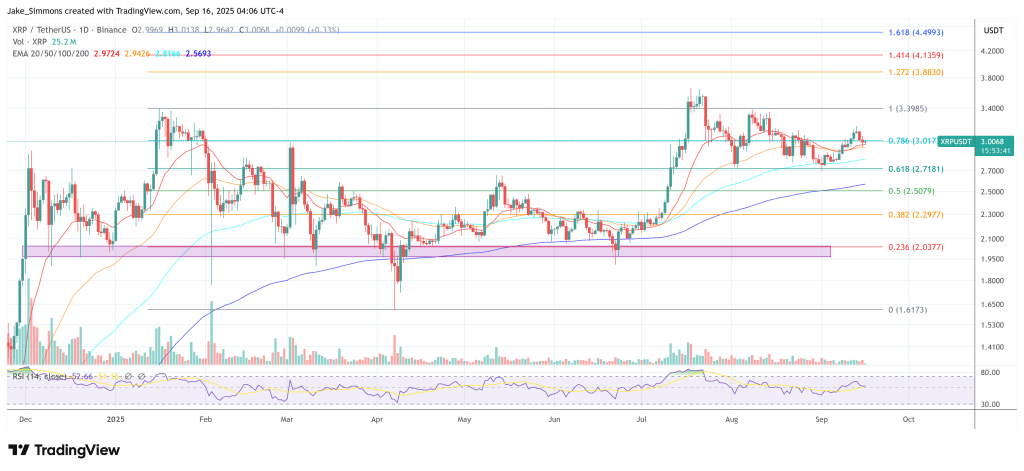
At press time, XRP traded at $3.00.

Related Posts