XRP Ledger Security Debate Intensifies After BatchGate Scare

bitcoinist发布于2026-03-03更新于2026-03-03

文章摘要

Following the near-miss incident known as BatchGate, a significant security concern has sparked a broader debate around governance and safety protocols on the XRP Ledger. Validator operator Daniel Keller criticized the existing review process as a "systemic failure" and withdrew support for all pending amendments. He emphasized that validators are governance participants, not unpaid auditors, and called for amendment proposers—particularly Ripple—to provide comprehensive documentation, testing, and security proofs. Keller also urged Ripple to increase investment in core protocol engineering and security. Other community members, like validator Vet, advocated for slower amendment rollouts, paid audits, and larger bug bounty programs. Keller disagreed with simply slowing down development, instead pushing for better incentives and resources to maintain progress without compromising security. The incident has raised fundamental questions about whether the XRPL’s amendment process has sufficient safeguards for the scale of changes being proposed. At the time of reporting, XRP was trading at $1.3566.

The fallout from the XRP Ledger’s BatchGate scare is turning into a broader argument about who is actually responsible for protocol safety and how much scrutiny major amendments should face before they get anywhere near mainnet. In a statement published Monday, longtime validator operator Daniel Keller said the near-miss around XLS-56 exposed “a systemic failure in review processes” and prompted him to withdraw support for all amendments currently under consideration.

Keller’s post was framed as a clarification of what dUNL validators are supposed to do, after what he described as widespread confusion following the Batch incident. His central point was that validators are governance participants, not unpaid auditors. “The role of dUNL validators is specific and limited: We coordinate the activation (or rejection) of amendments by casting ‘Yay’ or ‘Nay’ votes once an amendment is proposed,” he wrote. “We are supposed to judge pending amendments. That is our primary governance function.”

That distinction matters because XLS-56, also known as Batch, was halted only after a logic flaw in signature validation was uncovered shortly before mainnet activation. The bug could have enabled unauthorized transaction execution and potentially put billions in XRP at risk before the amendment was paused and patched in rippled 3.1.1.

XRP Ledger Governance Concerns, With Ripple in Focus

For Keller, the episode was not an isolated mistake but the latest example of a deeper structural problem. “The dUNL is not a free code-review or protocol-auditing body. Expecting validators to spend dozens of unpaid hours reviewing complex amendment code was never part of the design and never will be,” he wrote. “Instead, parties proposing amendments should be required to deliver comprehensive documentation, test suites, security analyses, and formal proofs upon request. If you want my vote, prove the change is safe and beneficial.”

He argued that the burden now falls on Ripple to fund that process more aggressively. “I will not vote in favour of any future amendments until Ripple makes a credible, concrete commitment to substantially increase investment in XRPL core protocol engineering, security review, and long-term sustainability,” Keller said. “If XRP is truly Ripple’s ‘North Star,’ as repeatedly stated, then the network’s foundational security and decentralisation must receive the attention and resources they deserve.”

Keller’s immediate response was blunt: withdraw all current “Yay” votes, except for pending fixes, and refuse to upgrade to rippled 3.1.1 unless staying on the earlier version risks removal from the network. He also said the fact that an independent researcher and an AI tool were ultimately needed to prevent harm underscored how thin the current safety net has become.

Other prominent XRPL voices agreed that the process needs to change, though not all backed a slowdown. Vet, a well-known XRPL validator, called the Batch incident “a massive opportunity” for the community and the XRPL Foundation to rethink how the protocol evolves. He argued for a slower amendment schedule, more paid reviews, multiple audits for larger changes, “attackathons” on testnet, and a bug bounty program big enough to attract elite researchers.

Keller, however, pushed back on the idea that the answer is simply to move slower. “In the short term, we need some sort of agreement with Cantina. They have proven themself and it’s the best we have right now,” he wrote. “Mid-term, the bug bounties need to be elevated and pay serious money. First, people need to be incentivised to look at the code; second, it must pay off to do a responsible disclosure.”

He went further in a follow-up that captured the mood of the debate: “I do not want to slow down our dev speed; it took us years to get to the current level, and we are still slow. More resources need to be allocated, and the process needs to start yesterday.”

That leaves the XRP Ledger in a tense but familiar place: a network trying to add functionality without compromising the credibility of its base layer. BatchGate did not become a live exploit. But it did force a sharper question into the open, whether XRPL’s amendment pipeline is still operating with enough review depth for the scale of change now being proposed.

At press time, XRP traded at $1.3566.
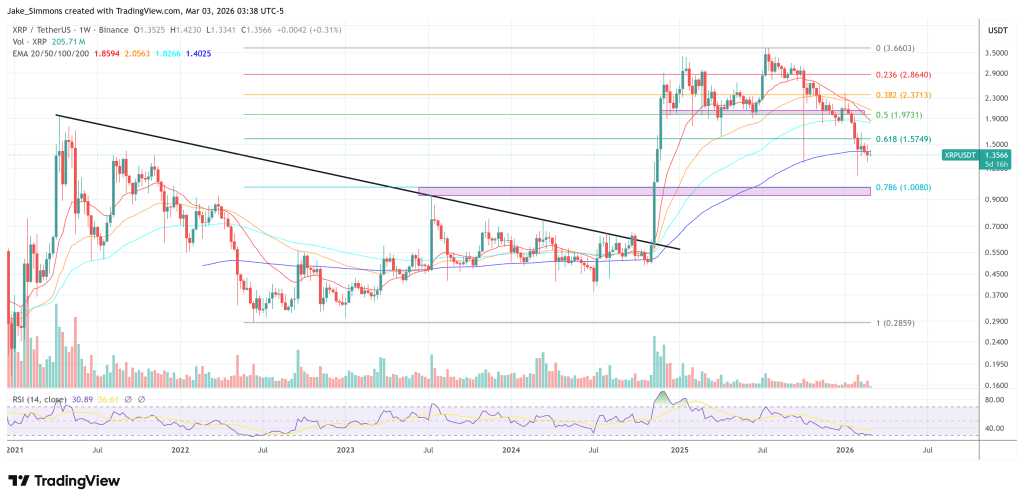
XRP falls below the 200-week EMA agan, 1-week chart | Source: XRPUSDT on TradingView.com

热门币种推荐

相关问答

QWhat was the main issue with the XLS-56 (Batch) amendment that caused the 'BatchGate scare'?

AThe main issue was a logic flaw in signature validation that could have enabled unauthorized transaction execution, potentially putting billions in XRP at risk before the amendment was paused and patched.

QAccording to Daniel Keller, what is the specific and limited role of dUNL validators in the XRP Ledger governance?

AKeller stated that the role of dUNL validators is to coordinate the activation or rejection of amendments by casting 'Yay' or 'Nay' votes once an amendment is proposed, and that they are governance participants, not unpaid auditors.

QWhat specific commitment does Daniel Keller demand from Ripple before he will vote in favor of future amendments?

AKeller demands that Ripple make a credible, concrete commitment to substantially increase investment in XRPL core protocol engineering, security review, and long-term sustainability.

QWhat was the immediate response of Daniel Keller following the Batch incident?

AHis immediate response was to withdraw all current 'Yay' votes (except for pending fixes) and refuse to upgrade to rippled 3.1.1 unless staying on the earlier version risked removal from the network.

QWhat broader structural problem does the Batch incident represent, according to the validator Daniel Keller?

AKeller believes the incident is not an isolated mistake but the latest example of a deeper structural problem, highlighting a systemic failure in review processes and that the dUNL is not a free code-review or protocol-auditing body.

你可能也喜欢

TradeXYZ脱离Hyperliquid单飞的可能性有多高

**TradeXYZ脱离Hyperliquid单飞的可能性分析** 随着TradeXYZ业务规模持续扩大,并长期占据Hyperliquid HIP-3市场超过90%的份额,近期社区对其是否可能脱离Hyperliquid并独立搭建交易平台的讨论升温。 **自立门户的驱动力** TradeXYZ已借助Hyperliquid成长为RWA永续合约市场的巨擘,其贡献的交易量占Hyperliquid总交易量70%以上。若选择自立门户,核心商业驱动力可能是为了**捕获全部底层交易手续费**。目前,TradeXYZ与Hyperliquid的交易费用分成固定为50/50,这意味着近一半收入归属于Hyperliquid。对于一个创造超4000亿美元交易量的项目而言,调整分成比例或独立运营以获取全部收益,具有显著吸引力。行业历史上也存在类似案例,如Uniswap、dYdX等项目在壮大后选择构建自有基础设施。 **制约与风险** 然而,TradeXYZ独立面临多重制约: 1. **性能挑战**:Hyperliquid提供了强大的底层技术(HyperCore),管理着撮合、清算等核心功能。自建同等性能的基础设施短期内难以实现,可能影响产品体验和市场叙事。 2. **渠道依赖**:尽管TradeXYZ拥有自己的交易前端,但大部分用户仍习惯通过Hyperliquid前端访问其流动性市场。Hyperliquid是其主要的分发渠道,失去渠道支持的价值难以估量。 3. **合作关系与信任**:TradeXYZ创始人Shoku是Hyperliquid的早期支持者,双方团队关系密切,存在深厚的信任基础。“背刺”合作方可能引发舆论争议,损害信誉。 **双输的潜在结局** 分析指出,若TradeXYZ真的选择分裂,很可能导致**双输局面**: * 对Hyperliquid而言,将失去最大的增长点和叙事基础(RWA合约龙头地位),总交易量可能骤降超50%,其代币HYPE估值或受重创。 * 对TradeXYZ而言,将面临从零开始构建基础设施和培养用户习惯的挑战,同时可能因竞争关系失去原有渠道优势,并在激烈的市场中被其他竞争者趁虚而入。 **结论** 综合来看,虽然TradeXYZ市场影响力日益增强,拥有议价能力,但考虑到技术依赖、渠道价值、双方信任关系以及可能引发的双输竞争,**其脱离Hyperliquid自立门户的可能性较低,也并非理智选择**。更可能的发展路径是在维持现有合作集成优势的基础上,协商更有利的条款,并逐步将发展重点向自身品牌和用户生态建设倾斜。

marsbit28分钟前

TradeXYZ脱离Hyperliquid单飞的可能性有多高

marsbit28分钟前

从韩国到美国:多亏了AI,蓝领越来越吃香了

人工智能正在重塑劳动力市场,传统四年制大学学位的吸引力下降,而电工、焊工等技术型蓝领职业的需求和薪酬显著上升。数据显示,美国职业学校收入大幅增长,同时AI导致的白领裁员创下新高。供需两端变化推动年轻人重新规划职业路径,调查显示多数Z世代认为蓝领工作在AI时代更具就业保障。 职业教育热度近半年急剧攀升,年轻人主动寻求不易被AI替代且有实际用工需求的职业,技术岗位招聘甚至比程序员更困难。专家指出,这既是经济计算,也源于对高额学位债务和纯屏幕工作的反思。技术职业薪资中位数已追平或超越许多需要学位的工作,且提供边学边赚的学徒路径及创业可能。韩国半导体高中毕业生就业率极高,进入三星等企业可获得丰厚薪酬。 美国面临结构性技术工人短缺:大量婴儿潮一代即将退休,而新一代劳动力数量不足,缺口达数百万。同时,数据中心等基建扩张推高了相关技术工种需求。为此,摩根大通、Meta等企业正投资巨额资金开展培训项目。 尽管市场信号明确,但社会对职业教育的传统偏见仍构成“认知差距”。产业界需主动推广,让公众认识到技术职业不仅收入稳定,还是通向创业的快速路径,以真正缓解人才短缺。

marsbit1小时前

从韩国到美国:多亏了AI,蓝领越来越吃香了

marsbit1小时前

交易

现货

热门文章

如何购买S

欢迎来到HTX.com!我们已经让购买Sonic(S)变得简单而便捷。跟随我们的逐步指南,放心开始您的加密货币之旅。第一步:创建您的HTX账户使用您的电子邮件、手机号码注册一个免费账户在HTX上。体验无忧的注册过程并解锁所有平台功能。立即注册第二步:前往买币页面,选择您的支付方式信用卡/借记卡购买:使用您的Visa或Mastercard即时购买Sonic(S)。余额购买:使用您HTX账户余额中的资金进行无缝交易。第三方购买:探索诸如Google Pay或Apple Pay等流行支付方法以增加便利性。C2C购买:在HTX平台上直接与其他用户交易。HTX场外交易台(OTC)购买:为大量交易者提供个性化服务和竞争性汇率。第三步:存储您的Sonic(S)购买完您的Sonic(S)后,将其存储在您的HTX账户钱包中。您也可以通过区块链转账将其发送到其他地方或者用于交易其他加密货币。第四步:交易Sonic(S)在HTX的现货市场轻松交易Sonic(S)。访问您的账户,选择您的交易对,执行您的交易,并实时监控。HTX为初学者和经验丰富的交易者提供了友好的用户体验。

3.3k人学过发布于 2025.01.15更新于 2026.06.02

如何购买S

相关讨论

欢迎来到HTX社区。在这里,您可以了解最新的平台发展动态并获得专业的市场意见。以下是用户对S(S)币价的意见。

活动图片