Global payment giant Visa has announced the launch of stablecoin settlement in the United States using Circle’s USDC on the Solana Blockchain. The expansion follows the company’s ongoing efforts to modernize its settlement layer and be at the forefront of the emerging sector.
Visa Expands USDC Settlement To The US
On Tuesday, Visa unveiled the expansion of its stablecoin settlement service to financial institutions in the US, allowing local issuer and acquirer partners to settle with Visa in Circle’s USDC for the first time.
In the statement, the payments giant highlighted that issuers will benefit from faster fund movement over blockchains, seven‐day availability, and enhanced operational resilience across weekends and holidays “without any change to the consumer card experience.”
Initial participants include Cross River Bank and Lead Bank, which have started settling with Visa in USDC on the Solana blockchain. Meanwhile, a wider rollout in the US is planned through 2026.
In addition, Visa shared its plan to utilize Arc, a new Layer 1 blockchain developed by Circle, which is currently in public testnet, for USDC settlement within its network and to operate a validator node once Arc goes live.
The global payments giant underscored that the launch marks a significant milestone in the company’s stablecoin settlement pilot program and strategy to modernize its settlement layer, which underpins global commerce.
Notably, Visa first experimented with USDC settlement in 2021 and became one of the first major payments networks to pilot stablecoin settlement using USDC in 2023. Now, Visa has reported more than 130 stablecoin-linked card issuing programs in over 40 countries.
Last month, the company announced the expansion of its stablecoin settlement in Central and Eastern Europe, the Middle East, and Africa (CEMEA) with a partnership with crypto infrastructure company Aquanow.
“Visa is expanding stablecoin settlement because our banking partners are not only asking about it – they’re preparing to use it,” affirmed Rubail Birwadker, Global Head of Growth Products and Strategic Partnerships, Visa.
“Financial institutions are looking for faster, programmable settlement options that integrate seamlessly with their existing treasury operations. By bringing USDC settlement to the U.S., Visa is delivering a reliable, bank‐ready capability that improves treasury efficiency while maintaining the security, compliance and resiliency standards our network requires,” he added.
Meanwhile, Circle emphasized the importance of integrating fully reserved stablecoins into institutions’ settlement flows. Nikhil Chandhok, Chief Product and Technology Officer at Circle, noted that “it helps card-issuing financial institutions modernize treasury and unlock new services while retaining the transparency and trust that USDC is known for.”
Visa’s New Stablecoin Advisory Unit
This week, Visa also announced the launch of its Stablecoins Advisory Practice (SAP) service by Visa Consulting & Analytics (VCA) for insights and recommendations to guide banks, fintechs, merchants, and businesses on market fit, strategy, and implementation.
The new stablecoins advisory unit is set to offer a suite of services “designed to guide strategy and implementation amid the growing prevalence and stability of stablecoin infrastructure and emerging regulatory standards.”
Notably, it will provide training and market trend programs, including a new Visa University course, strategy development, market entry planning, use case sizing, go-to-market planning, and Technology enablement for stablecoin integration.
Visa affirmed that it recorded a $3.5 billion stablecoin settlement volume as of November 30, which has led businesses to its new Stablecoins Advisory Practice for growth opportunities.
Matt Freeman, senior vice president at the Navy Federal Credit Union, stated that “Stablecoins may represent an opportunity to enhance speed and lower cost in payments, so with the support of Visa, we are evaluating how this technology could fit into our broader strategy to deliver meaningful value to our 15 million members worldwide.”
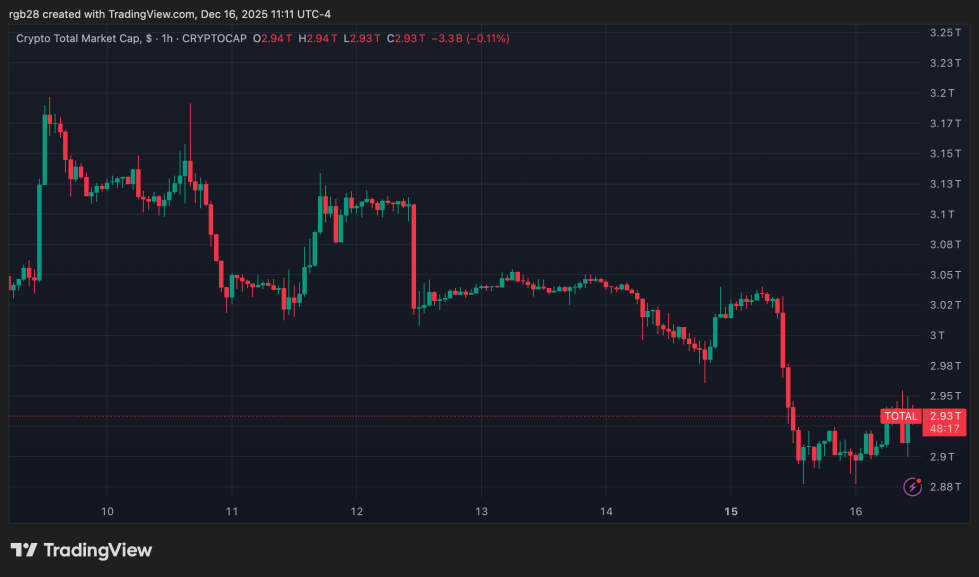
The total crypto market capitalization is at $2.93 trillion on the one-week chart. Source: TOTAL on TradingView