Tether Fails $500B Evaluation Amidst Investor Pushback as HYPER Gains Momentum

bitcoinist发布于2026-02-04更新于2026-02-04

文章摘要

The cryptocurrency market is experiencing a significant shift as Tether (USDT) faces investor resistance and fails to achieve a $500 billion valuation, driven by transparency concerns and a move towards decentralized alternatives. This has led to a rotation of liquidity into Bitcoin Layer 2 solutions, which aim to unlock Bitcoin's dormant capital by enhancing its utility. Bitcoin Hyper ($HYPER) is emerging as a key player, integrating the Solana Virtual Machine (SVM) to offer high-speed execution and smart contract capabilities while maintaining Bitcoin's security. It enables sub-second transactions, decentralized finance (DeFi) applications, and seamless BTC transfers, addressing scalability issues. The project has raised over $31.2 million in its presale, indicating strong institutional confidence. With a current token price of $0.0136751, it offers staking rewards and aims to attract long-term investors amid growing interest in Bitcoin's programmability.

The cryptocurrency market is witnessing a decoupling event play out in real-time.

Tether (USDT), long considered the unshakeable bedrock of stablecoin liquidity, has hit a wall in its pursuit of a $500B-implied market valuation.

Institutional investors have reportedly balked at the metrics, spooked by transparency concerns and a regulatory landscape shifting toward decentralized alternatives. This stalemate at the half-trillion-dollar mark isn’t just a pricing failure; it’s a signal that risk appetite is rotating.

But here’s the kicker: liquidity isn’t leaving the ecosystem. It’s just moving deeper into the Bitcoin infrastructure. The market is bored with simple store-of-value assets; traders want utility layers capable of unlocking Bitcoin’s dormant capital.

That shift explains the sudden surge in Bitcoin Layer 2 solutions, which are quietly absorbing the liquidity Tether failed to capture.

Investors appear to be hedging against stablecoin stagnation by betting on the ‘programmability’ of Bitcoin. The logic holds up: if Bitcoin is the gold standard, the rails allowing it to transact like Solana or Ethereum are the ultimate pick-and-shovel plays.

This environment created a perfect storm for emerging protocols like Bitcoin Hyper ($HYPER), which is seeing its valuation climb while Tether’s dominance faces scrutiny.

You can buy your $HYPER here.

Bitcoin Hyper Bridges the Gap Between Store of Value and High-Speed Execution

The core friction point in the current market isn’t a lack of assets, it’s a lack of velocity.

Bitcoin holds over a trillion dollars in value, yet that capital remains largely inert, trapped by slow block times and the absence of native smart contracts. Bitcoin Hyper ($HYPER) answers this bottleneck not just as a sidechain, but as the first Bitcoin Layer 2 to integrate the Solana Virtual Machine (SVM).

Why does this technical architecture matter? It solves the ‘trilemma’ without sacrificing Bitcoin’s security, which is one of Bitcoin Hyper’s mantras.
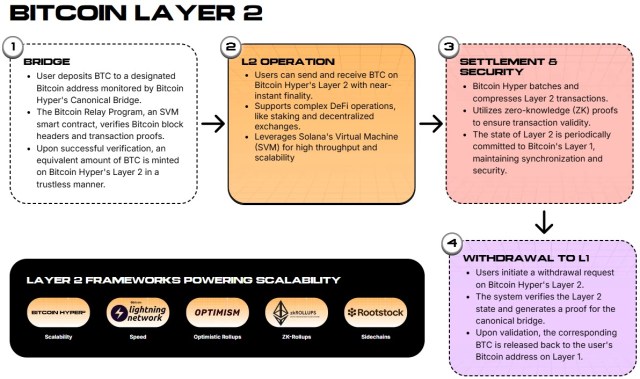
By using the SVM for execution, Bitcoin Hyper achieves the sub-second finality and low-latency performance DeFi developers require, all while anchoring its state to Bitcoin L1.

Finally, developers can write in Rust and deploy high-speed dApps that actually settle on Bitcoin. For the market, that utility is tangible. The protocol offers a Decentralized Canonical Bridge for seamless $BTC transfers and supports SPL-compatible tokens modified for Layer 2 operations.

This opens the door for high-frequency trading, gaming, and complex lending protocols directly on the Bitcoin network, use cases that were previously impossible. Plus, the integration of high-speed payments in wrapped $BTC with negligible fees addresses the precise scalability issues that have historically held the ecosystem back.

Check the $HYPER presale.

Whale Accumulation Signals Confidence With Over $31M Raised

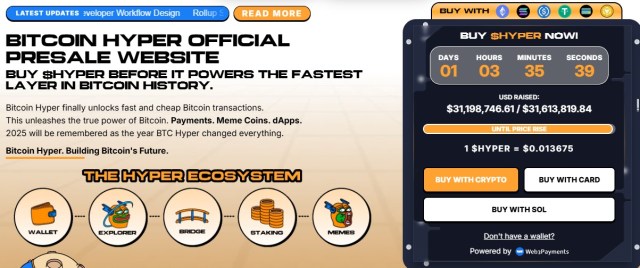
While Tether struggles to justify its valuation, smart money is aggressively positioning itself in the Bitcoin Hyper presale. The sentiment contrast is stark. According to official data, the project has raised over $31.2M. That figure suggests robust institutional confidence, even as the broader market hesitates on stablecoins.
Traders watching this setup will notice this pattern often precedes retail adoption, as whales position themselves before the Token Generation Event.

Frankly, the tokenomics look designed to discourage mercenary capital rotation. With the token currently priced at $0.0136751, early participants are eyeing immediate staking opportunities post-TGE. The protocol offers high APY staking rewards, with a modest 7-day vesting period for presale stakers to prevent immediate dump pressure.

For investors fatigued by the regulatory ambiguity surrounding centralized stablecoins, the programmatic certainty of a Bitcoin L2 offers a compelling alternative, while the presale performance creates the expected FOMO.

Buy your $HYPER today.

Disclaimer: The content of this article is for informational purposes only and does not constitute financial advice. Cryptocurrency investments, including presales and Layer 2 tokens, carry inherent risks. Always perform your own due diligence before investing.


相关问答

QWhy has Tether (USDT) failed to achieve a $500 billion market valuation according to the article?

AInstitutional investors balked at the metrics due to transparency concerns and a regulatory landscape favoring decentralized alternatives, signaling a shift in risk appetite.

QWhat is Bitcoin Hyper ($HYPER) and how does it address the limitations of Bitcoin?

ABitcoin Hyper is a Bitcoin Layer 2 solution that integrates the Solana Virtual Machine (SVM) to enable sub-second finality, low-latency performance, and support for high-speed dApps, gaming, and DeFi on Bitcoin, solving its scalability and smart contract limitations.

QHow much has the Bitcoin Hyper ($HYPER) presale raised and what does this indicate?

AThe Bitcoin Hyper presale has raised over $31.2 million, indicating robust institutional confidence and smart money positioning ahead of retail adoption, contrasting with Tether's struggles.

QWhat technical feature allows Bitcoin Hyper to achieve high-speed execution while maintaining Bitcoin's security?

ABitcoin Hyper uses the Solana Virtual Machine (SVM) for execution, achieving sub-second finality and low-latency performance while anchoring its state to Bitcoin L1, thus maintaining Bitcoin's security.

QWhat are the benefits of Bitcoin Hyper's integration of SPL-compatible tokens and a Decentralized Canonical Bridge?

AThe integration allows seamless $BTC transfers, supports Layer 2 operations for SPL-compatible tokens, and enables high-frequency trading, gaming, and complex lending protocols directly on the Bitcoin network with negligible fees.

你可能也喜欢

TradeXYZ脱离Hyperliquid单飞的可能性有多高

**TradeXYZ脱离Hyperliquid单飞的可能性分析** 随着TradeXYZ业务规模持续扩大,并长期占据Hyperliquid HIP-3市场超过90%的份额,近期社区对其是否可能脱离Hyperliquid并独立搭建交易平台的讨论升温。 **自立门户的驱动力** TradeXYZ已借助Hyperliquid成长为RWA永续合约市场的巨擘,其贡献的交易量占Hyperliquid总交易量70%以上。若选择自立门户,核心商业驱动力可能是为了**捕获全部底层交易手续费**。目前,TradeXYZ与Hyperliquid的交易费用分成固定为50/50,这意味着近一半收入归属于Hyperliquid。对于一个创造超4000亿美元交易量的项目而言,调整分成比例或独立运营以获取全部收益,具有显著吸引力。行业历史上也存在类似案例,如Uniswap、dYdX等项目在壮大后选择构建自有基础设施。 **制约与风险** 然而,TradeXYZ独立面临多重制约: 1. **性能挑战**:Hyperliquid提供了强大的底层技术(HyperCore),管理着撮合、清算等核心功能。自建同等性能的基础设施短期内难以实现,可能影响产品体验和市场叙事。 2. **渠道依赖**:尽管TradeXYZ拥有自己的交易前端,但大部分用户仍习惯通过Hyperliquid前端访问其流动性市场。Hyperliquid是其主要的分发渠道,失去渠道支持的价值难以估量。 3. **合作关系与信任**:TradeXYZ创始人Shoku是Hyperliquid的早期支持者,双方团队关系密切,存在深厚的信任基础。“背刺”合作方可能引发舆论争议,损害信誉。 **双输的潜在结局** 分析指出,若TradeXYZ真的选择分裂,很可能导致**双输局面**: * 对Hyperliquid而言,将失去最大的增长点和叙事基础(RWA合约龙头地位),总交易量可能骤降超50%,其代币HYPE估值或受重创。 * 对TradeXYZ而言,将面临从零开始构建基础设施和培养用户习惯的挑战,同时可能因竞争关系失去原有渠道优势,并在激烈的市场中被其他竞争者趁虚而入。 **结论** 综合来看,虽然TradeXYZ市场影响力日益增强,拥有议价能力,但考虑到技术依赖、渠道价值、双方信任关系以及可能引发的双输竞争,**其脱离Hyperliquid自立门户的可能性较低,也并非理智选择**。更可能的发展路径是在维持现有合作集成优势的基础上,协商更有利的条款,并逐步将发展重点向自身品牌和用户生态建设倾斜。

marsbit1分钟前

TradeXYZ脱离Hyperliquid单飞的可能性有多高

marsbit1分钟前

从韩国到美国:多亏了AI,蓝领越来越吃香了

人工智能正在重塑劳动力市场,传统四年制大学学位的吸引力下降,而电工、焊工等技术型蓝领职业的需求和薪酬显著上升。数据显示,美国职业学校收入大幅增长,同时AI导致的白领裁员创下新高。供需两端变化推动年轻人重新规划职业路径,调查显示多数Z世代认为蓝领工作在AI时代更具就业保障。 职业教育热度近半年急剧攀升,年轻人主动寻求不易被AI替代且有实际用工需求的职业,技术岗位招聘甚至比程序员更困难。专家指出,这既是经济计算,也源于对高额学位债务和纯屏幕工作的反思。技术职业薪资中位数已追平或超越许多需要学位的工作,且提供边学边赚的学徒路径及创业可能。韩国半导体高中毕业生就业率极高,进入三星等企业可获得丰厚薪酬。 美国面临结构性技术工人短缺:大量婴儿潮一代即将退休,而新一代劳动力数量不足,缺口达数百万。同时,数据中心等基建扩张推高了相关技术工种需求。为此,摩根大通、Meta等企业正投资巨额资金开展培训项目。 尽管市场信号明确,但社会对职业教育的传统偏见仍构成“认知差距”。产业界需主动推广,让公众认识到技术职业不仅收入稳定,还是通向创业的快速路径,以真正缓解人才短缺。

marsbit59分钟前

从韩国到美国:多亏了AI,蓝领越来越吃香了

marsbit59分钟前

交易

现货
活动图片




