The American Federation of Teachers (AFT), a union championing educators in the United States, has voiced its opposition to crypto market structure legislation moving through the Senate, claiming it “threatens the stability of their retirement security.”
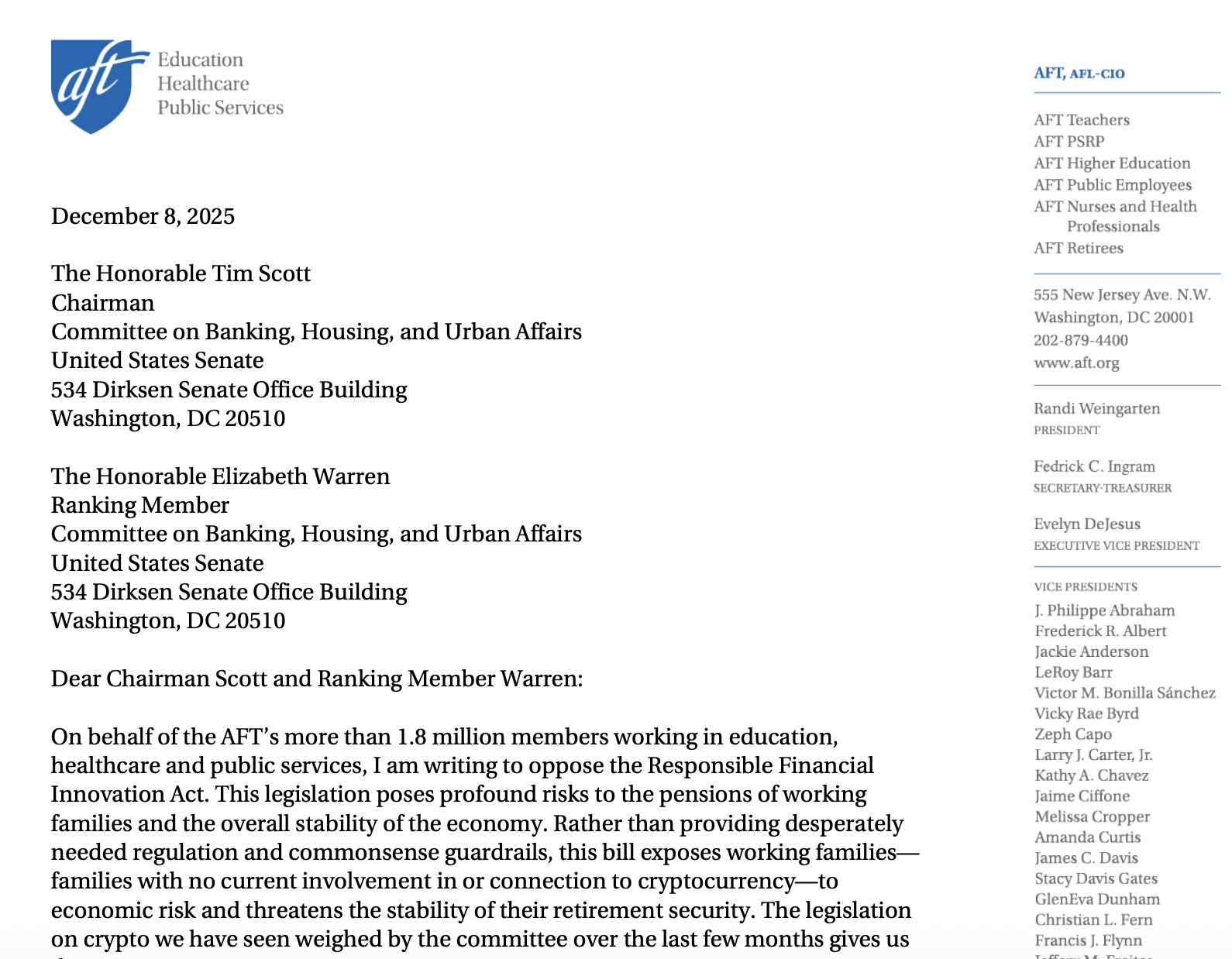
In a Monday letter to Republican and Democratic leaders on the US Senate Banking Committee provided by CNBC, the AFT said it opposed passage of the Responsible Financial Innovation Act, the bill that senators said “built on” the House of Representatives’ proposed solution to market structure, the CLARITY Act. According to the teachers’ union, the bill presents “profound risks” to economic stability and retirement plans.
“This bill fails to provide a regulatory structure for crypto assets and stablecoin that is equivalent to that for other pension holdings,” said the letter. “Most pensions do not carry crypto assets because of their risk. This legislation pretends that crypto assets are stable and mainstream, and they are not.”
The CLARITY Act, a July draft of the market structure bill proposed by the Senate Banking Committee, and a November draft from the Senate Agriculture Committee did not explicitly mention allowing digital assets to be used in pensions or retirement funds. The AFT claimed that if the bill were to be passed, “Pensions and 401(k) plans will end up having unsafe assets even if they were invested in traditional securities.”
The American Federation of Labor and Congress of Industrial Organizations raised similar concerns over the market structure bill posing risks to “retirement funds and to the overall financial stability of the US economy” in an October letter to the banking committee. The group claimed that the legislation would “increase workers’ exposure by greenlighting retirement plans like 401(k)s and pensions to hold this risky asset.”
Related: Japan plans major shift as crypto moves from payments to securities law
The AFT represents 1.8 million members working in education, healthcare and public services. According to the National Association of State Retirement Administrators, aggregate public pension assets, including teachers, totaled more than $6.5 trillion as of the second quarter of 2025, while the Investment Company Institute reported in September that total retirement assets in the US were about $45.8 trillion.
Trump is addressing crypto in retirement funds through executive orders
Separate from the Senate’s efforts to pass market structure, US President Donald Trump has attempted to change policy to allow cryptocurrencies to be included in 401(k) retirement plans. In August, Trump signed an executive order directing the Labor Department to reevaluate restrictions around alternative assets in defined-contribution plans, including digital assets.
Asset management companies have already been making moves signaling openness to adding digital assets to individual retirement arrangements (IRAs) and 401(k)s.
In October, Morgan Stanley reportedly began allowing its advisers to suggest crypto funds as part of its clients’ retirement portfolios. State-managed retirement funds, such as those in Michigan and Wisconsin, also have exposure to crypto through digital asset-linked exchange-traded funds.
It’s unclear when the Senate will vote on a market structure bill in the full chamber. Wyoming Senator Cynthia Lummis, one of the bill’s most outspoken proponents, said on Tuesday that she anticipated the banking committee releasing an updated draft this week, with a possible markup hearing before Congress broke for the holidays.
Magazine: When privacy and AML laws conflict: Crypto projects’ impossible choice