Original | Odaily Planet Daily (@OdailyChina)
Author | Azuma (@azuma_eth)

Beijing time, July 31, the Bitcoin treasury company Strategy officially released its second-quarter financial report for 2026 after the US stock market closed.
The report shows that Strategy achieved total revenue of $122 million in the second quarter, a year-on-year increase of 6.9%; however, affected by Bitcoin price fluctuations, the company recorded a net loss of $8.22 billion, with unrealized losses from changes in the fair value of digital assets reaching $8.32 billion.
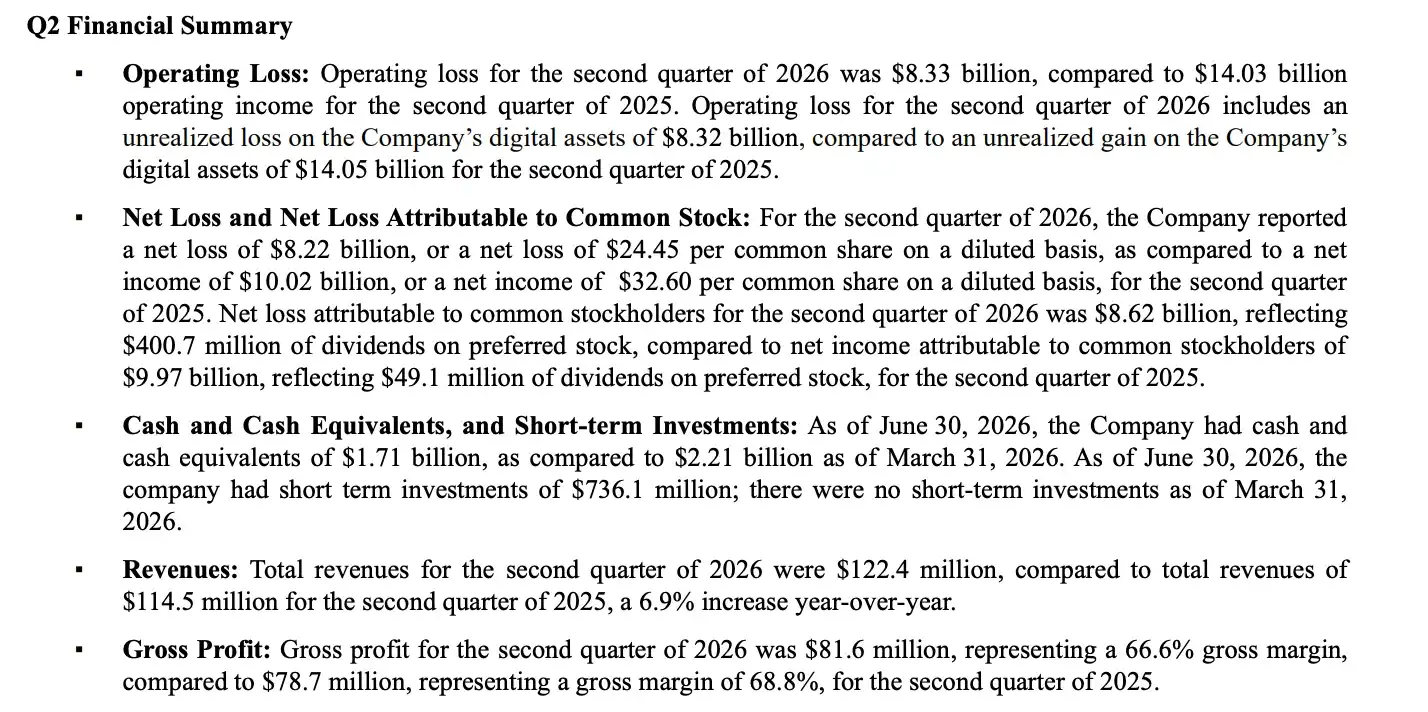
Viewed purely from a traditional financial perspective, this is undoubtedly a poor report card. But for Strategy, the market had already anticipated the decline in the net value of reserve assets during the BTC downturn. The question investors are more concerned about is — after experiencing its most severe capital structure stress test since its inception, can Strategy prove the sustainability of its financing model once again?
Since May this year, Strategy's most important financing tool, STRC, has gradually deviated from its target face value of $100, once hitting a low of $74.57. It temporarily closed at $89.5 after today's US market close, still failing to re-peg.
Today's financial report can be understood as the first detailed answer sheet submitted by Strategy since the STRC crisis intensified. The results show that Strategy is still adhering to its Bitcoin strategy, but its capital model has undergone a dramatic shift — transitioning from the relatively fixed pattern of continuous financing to accumulate Bitcoin in the past, to more proactive capital management through cash reserves, preferred stock, common stock, and BTC assets themselves.
BTC Reserves Still Growing, But "Buying" Is No Longer the Only Option
In the second quarter, Strategy's overall BTC holdings continued to grow.
Financial report data shows, as of the end of Q2, Strategy held 843,775 BTC, an increase of approximately 11% from the previous quarter. The company's current Bitcoin reserves are valued at approximately $55 billion, with an average holding cost per BTC of about $75,000. This means that despite recording huge book losses due to BTC price fluctuations, Strategy is still adhering to its core "Bitcoin Treasury" strategy.
Furthermore, Strategy's Bitcoin Per Share increased from 201,170 sats to 210,824 sats in Q2. From this metric, Strategy still achieved positive asset accumulation in Q2.
However, it is important to note that since the launch of the "Digital Credit Capital Framework" at the end of Q2 (June 29th) aimed at addressing the STRC de-pegging issue, Strategy's current BTC capital system is confirmed to no longer have only the "buy" direction.
- Odaily Note: For details on the "Digital Credit Capital Framework," refer to "Lightning Five-Whip! Strategy's Self-Rescue Plan Officially Unveiled."
In this earnings report, the company systematically disclosed for the first time the progress of the BTC "Monetization Program" (part of the "Digital Credit Capital Framework" plan) — as of July 26th, Strategy has sold approximately $218.4 million worth of BTC through this program.
This signifies that for Strategy, BTC is gradually shifting from being a purely long-term reserve asset in the past to an actively managed tool on the balance sheet.
Although Strategy still emphasizes treating BTC as a core reserve asset, as the digital credit system continues to expand, Strategy is attempting to establish a more flexible capital structure — during favorable market conditions, raise funds by issuing securities to expand BTC reserves; during market pressures, conduct liquidity management through cash reserves, security buybacks, and the BTC monetization plan.
The Top Priority Remains Fixing STRC
During the investor conference call following the earnings release, Strategy's management clearly stated: "Returning STRC to face value is the company's core task at present."
Facing the discount situation where STRC remains around $89.5, Strategy's management outlined several feasible paths to push STRC back to its target range during the call.
Strategy founder Michael Saylor emphasized that before STRC recovers to its target range, Strategy will not issue a single share of STRC at a discount, to avoid harming existing investor interests. In other words, Strategy's current priority is not to continue stimulating financing, but to first repair market trust in its digital credit system.
Addressing market speculation that the company might continuously increase the dividend yield to stimulate STRC buying pressure, Strategy CEO Phong Le clarified that raising the STRC interest rate is not an effective way to drive the price back to face value, and the company plans to maintain the annualized dividend yield at 12%. Compared to further increasing yields, Strategy currently hopes to restore market confidence by thickening its cash safety cushion — as of July 26th, Strategy's USD reserves have increased to $3.75 billion, sufficient to cover over 2.1 years of preferred stock dividends and debt interest payments.
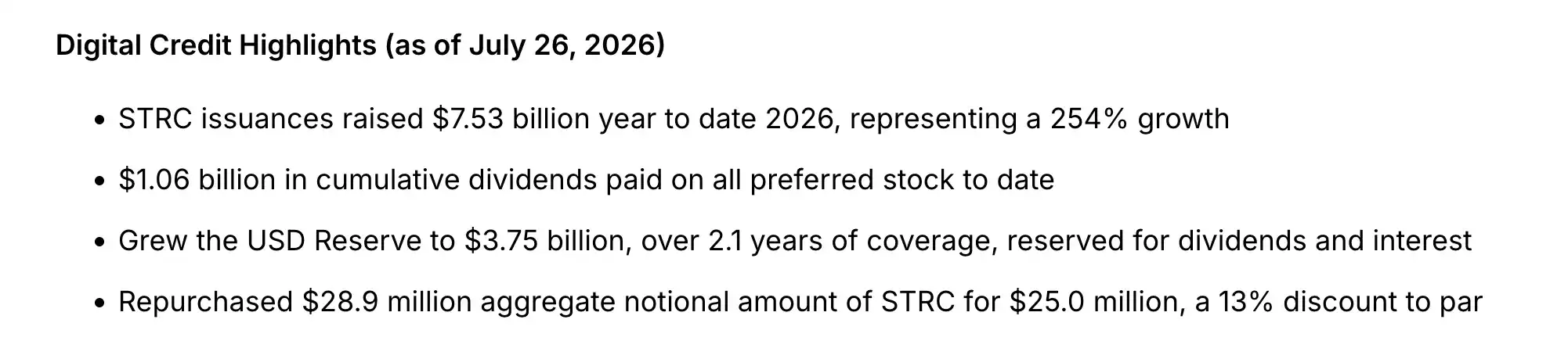
In the previously mentioned "Digital Credit Capital Framework," Strategy disclosed the initiation of a digital credit securities buyback plan of up to $1 billion, which would prioritize repurchasing STRC trading at a discount. To date, Strategy has repurchased approximately $28.9 million face value of STRC, actually paying $25 million.
Saylor also emphasized that this buyback plan still has $975 million available. If $975 million is insufficient to fill the gap, Strategy's total reserves of up to $58.5 billion can provide backup funding.
Saylor provided a clear timeline reference for re-pegging during the call — when STRC was first listed, the company spent about 70 trading days pushing it from around $90 back to near face value. Since STRC fell below the $99 pegging range on May 28th, 40 trading days had passed as of the earnings call. Strategy's management is targeting the same 70-trading-day repair cycle, setting September 8th (the 70th trading day) as the key reference node for pushing STRC back to its peg.
Strategy Shifts to Active Capital Management
If Strategy's previous capital flywheel logic could be summarized as a one-way cycle of "issue stock/bonds to raise funds ➡️ buy BTC ➡️ drive NAV and stock price up ➡️ continue financing ➡️ continue buying BTC," then this quarter's report clearly declares the end of this one-way model, replaced by "two-way active capital management."
During the call, Phong Le elaborated on this shift. Strategy is no longer just a one-way "buyer." Instead, it has integrated the four core elements on its balance sheet — BTC, USD cash reserves, common stock (MSTR), and digital credit (STRC and other preferred shares/convertible bonds) — forming a dynamic management matrix for multi-directional allocation:
- BTC Transforms from "One-Way Accumulation" to "Flexible Monetization": It can not only serve as underlying reserves but also be monetized when necessary to bolster USD reserves, pay preferred stock dividends, and even fund security buybacks.
- Capital Tools Shift from "One-Way Issuance" to "Two-Way Arbitrage and Buyback": When STRC or common stock trades at a discount or is undervalued in the market, the company can initiate buyback plans of up to $1 billion each to capture gains in Bitcoin Per Share (BPS); when a certain asset is at a premium, targeted issuance can be conducted.
- Active Optimization of Debt Structure: In Q2, Strategy took advantage of a market pullback to repurchase $1.5 billion of convertible bonds at an 8% discount, reducing long-term debt from $8.2 billion to $6.7 billion, an 18% decrease in net debt.
Through flexible allocation of various assets, Strategy aims to prove that it is not merely a passive ETF alternative fluctuating with the coin price, but an operating company capable of self-regulation and liability management by utilizing capital market volatility.
Future Challenges: STRC Re-pegging & BTC Price
Overall, the Q2 financial report demonstrates to some extent Strategy's resilience and adaptability in adjusting its model. However, whether this capital flywheel can regain acceleration still fundamentally depends on one short-term and one long-term challenge.
The short-term challenge is the result of STRC repair. Although STRC's discount has eased somewhat since the "Digital Credit Capital Framework" was announced, it has not fully re-pegged yet. As the cornerstone of the digital credit system, whether STRC can return to its face value trading range as soon as possible will directly determine the market's baseline trust in its credit expansion capability and is a prerequisite for restarting the flywheel's fundraising through issuance.
The long-term challenge is the trend of BTC's price. All of Strategy's capital arbitrage and liability management are essentially still built upon the long-term appreciation expectation of Bitcoin. Only when BTC emerges from its slump and returns to an upward trajectory can its growth logic find genuine support.