SkyBridge’s Scaramucci Buys the Dip, Signaling Institutional Confidence as $LIQUID Emerges

bitcoinist发布于2026-02-11更新于2026-02-11

文章摘要

Anthony Scaramucci’s SkyBridge Capital is buying the Bitcoin dip, signaling strong institutional confidence during current market consolidation. Despite recent ETF outflows, major players view this as an accumulation phase. The next wave of value lies in deploying capital efficiently, as trillions remain trapped in isolated ecosystems like Bitcoin, Ethereum, and Solana due to liquidity fragmentation. LiquidChain ($LIQUID) aims to solve this with a Layer 3 protocol that unifies liquidity across major blockchains, enabling seamless cross-chain transactions and applications. Positioned as an infrastructure play, it has raised over $535K in its presale, targeting developers with a “deploy-once” model to boost interoperability and capital efficiency in DeFi.

While Bitcoin consolidates below its all-time highs, institutional players are sending a clear signal: this is an accumulation zone, not a time to panic. SkyBridge Capital, led by Anthony Scaramucci, has been actively buying the Bitcoin dip, he shared at Consensus Hong Kong, reinforcing a narrative of long-term conviction in the face of short-term volatility.

This kind of strategic buying matters less for its immediate price impact and more for what it represents, a deeply-held belief that the current market lull is just a foundational reset before the next major leg up.

Right now, the market is wrestling with conflicting data. On one hand, spot Bitcoin ETFs have seen some pretty big outflows lately, dragging the price down. On the other hand, macro players like Scaramucci are stepping in, viewing prices in the low-$60Ks as a discount.

This divergence gets at a crucial theme. While first-gen institutions are busy scooping up Bitcoin, the next wave of value is going to come from putting that capital to work. The digital gold needs its own financial rails.

History shows that after every major consolidation, capital starts hunting for new, high-growth verticals. The problem? Trillions in liquidity remain trapped in isolated ecosystems like Bitcoin, Ethereum, and Solana.

So, what’s the knock-on effect of all this institutional buying? A growing, urgent demand for infrastructure that can finally bridge these islands of capital.

Unifying Trillions in Fragmented Liquidity

The core challenge holding DeFi back from hitting its full potential? Liquidity fragmentation. Bitcoin’s ~$1.3T market cap is largely passive, unable to interact seamlessly with Ethereum’s smart contracts or Solana’s high-speed applications without relying on risky, centralized bridges and wrapped assets.

This digital segregation creates friction, kills capital efficiency, and, let’s be honest, opens up huge security risks. What happens when you can execute a trade or deploy an application that draws on the native liquidity of all three giants simultaneously?

That’s the exact problem LiquidChain ($LIQUID) is engineered to solve. It’s a Layer 3 protocol that acts as a cross-chain liquidity layer, creating one single execution environment that fuses the strengths of Bitcoin, Ethereum, and Solana.
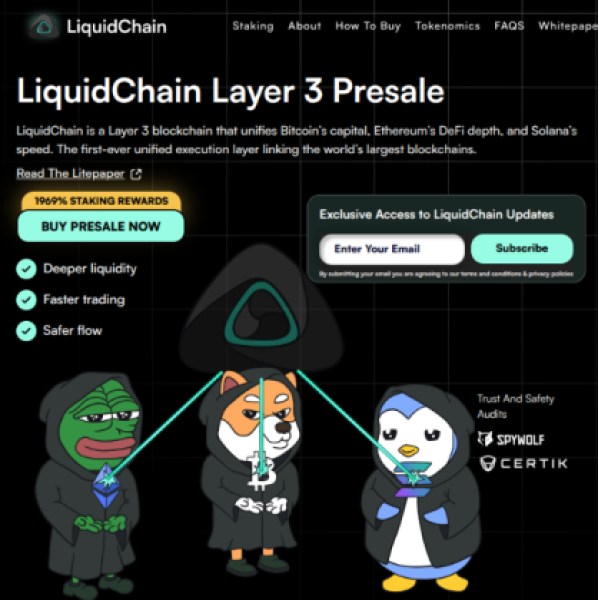
Its architecture is built around a Unified Liquidity Layer. This lets developers deploy an application once to give users access to the combined liquidity and user bases of these powerhouse chains. Frankly, it’s a paradigm shift from the current clunky model.

Instead of cumbersome multi-step bridging and swapping, users could perform complex cross-chain actions in a single, verifiable transaction. Of course, the risk, as with any ambitious infrastructure play, is in the execution. But the thesis is undeniably powerful.

FIND OUT MORE ABOUT THE LIQUIDCHAIN ECOSYSTEM

The Infrastructure Play for the Next Cycle

While Scaramucci is buying spot Bitcoin, a parallel opportunity is brewing: building the infrastructure that will service this growing pool of capital. Historically, infrastructure projects that solve fundamental problems are some of the most resilient and highest-performing investments when the market expands.

They’re the picks and shovels in a digital gold rush. LiquidChain is positioning itself squarely in this category, aiming to become the connective tissue for the market’s largest liquidity pools. It’s why we think it’s one of the best crypto to watch.

The project is still in its early stages, offering what looks like a ground-floor entry point. According to its official site, the LiquidChain presale has already raised over $535K, with the $LIQUID token priced at just $0.0136. That kind of early traction suggests its vision of a truly interoperable future is resonating with investors who are looking beyond the daily price charts.

By creating a ‘Deploy-Once’ architecture, LiquidChain drastically lowers the barrier for developers to build cross-chain dApps. That alone could spark a new wave of innovation. If DeFi is going to onboard the next 100M users, the experience has to be seamless. Unifying liquidity is the first, and most critical, step.

VISIT THE OFFICIAL LIQUIDCHAIN ($LIQUID) PRESALE SITE

This article does not constitute financial advice. The cryptocurrency market is volatile, and readers should conduct their own research before investing in any digital assets.


相关问答

QWhat action has SkyBridge Capital's Anthony Scaramucci taken regarding Bitcoin, and what does it signal?

AAnthony Scaramucci has been actively buying the Bitcoin dip, signaling long-term institutional conviction and viewing the current market as an accumulation zone rather than a reason to panic.

QAccording to the article, what is the core challenge preventing DeFi from reaching its full potential?

AThe core challenge is liquidity fragmentation, where large amounts of capital in ecosystems like Bitcoin, Ethereum, and Solana remain isolated and cannot interact seamlessly.

QWhat specific solution does LiquidChain ($LIQUID) provide to the cryptocurrency market?

ALiquidChain is a Layer 3 protocol that acts as a cross-chain liquidity layer, creating a single execution environment that unifies the native liquidity of Bitcoin, Ethereum, and Solana.

QHow does the article characterize the investment opportunity presented by infrastructure projects like LiquidChain?

AThe article characterizes them as the 'picks and shovels in a digital gold rush'—resilient, high-performing investments that solve fundamental problems and service the growing pool of capital.

QWhat milestone has the LiquidChain ($LIQUID) presale achieved, according to the article?

AThe LiquidChain presale has raised over $535,000, with the $LIQUID token priced at $0.0136, indicating early investor traction for its vision of interoperability.

你可能也喜欢

比特币矿场变AI数据中心:Sangha的“卖身”抉择

2025年12月,Spencer Marr在美国德州为名为Genesis的比特币矿场剪彩。这座规模19.9兆瓦的矿场采用“表后直供”模式,直接从相邻的太阳能农场获取低价电力,实现了低至约32美元/兆瓦时的运营成本,使其在比特币行情下行时仍能盈利。 然而,通电仅半年后的2026年6月,Marr的公司Sangha便通过投行放出消息,考虑出售、合资或引入战略伙伴。其根本原因并非经营不善,而是AI算力需求爆发带来了新的估值逻辑。对于亟需电力与数据中心资源的AI公司而言,Genesis这样一个已通电、有扩容潜力(规划至110.4兆瓦)且电力接入手续齐全的站点,价值远超过其作为矿场的本身。 Sangha的商业模式是项目制,通过设立特殊目的载体(SPV)吸引投资。如今,他们计划在估值高点出售这份“电力资产”,这比自行扩建为AI数据中心更为划算。其推介重点也已从比特币挖矿转向AI计算、高性能计算等多元场景。 这一转变并非个例,Core Scientific等上市矿企也已纷纷转向AI/HPC业务。Sangha的案例凸显了一个趋势:在AI的巨大需求下,拥有稳定、低价电力资源的比特币矿场基础设施,正成为被争抢的稀缺资产。矿工们面临的抉择是:是坚守挖矿,还是将阵地拱手让给AI,换取丰厚的资本回报。

marsbit6分钟前

比特币矿场变AI数据中心:Sangha的“卖身”抉择

marsbit6分钟前

历史底部信号再现?估值3亿的Messari以1000万贱卖

加密数据平台Messari曾估值3亿美元,近期以约1000万美元被竞争对手Blockworks收购,标志其八年创业历程结束。该公司衰落部分源于AI技术冲击——传统需耗时数周的研究报告如今可借AI工具快速生成,导致其核心业务价值锐减。 Messari的处境并非个例。2025年至2026年间,加密行业众多不发币、依赖产品服务营收的公司陷入困境:数据平台DappRadar、Parsec相继关停,CoinGecko寻求出售;媒体CoinDesk、Bankless大幅裁员或低价被购;链上数据公司Dune也进行了裁员。行业收缩浪潮明显。 风险投资(VC)领域同样遇冷。加密基金数量减半,新基金募资额骤降至峰值期的12%,投资额在半年内暴跌超80%。资本与人才大量流向AI领域,连Multicoin Capital等知名加密基金创始人也转向AI。有投资人形容当前环境为“大灭绝”。 然而,极端悲观信号集聚或暗示底部临近。比特币自高点跌近50%,恐慌贪婪指数长期处于“极度恐惧”区间;比特币长期持有者占比逼近80%,历史上类似情况常对应市场底部。VC交易活跃度回落至2020年水平,而当时正是新一轮牛市前夜。部分机构如Dragonfly Capital已逆势募资,Blockworks也正低价整合行业资产。历史显示,当多个底部信号共振后,往往孕育着下一轮周期起点。

marsbit1小时前

历史底部信号再现?估值3亿的Messari以1000万贱卖

marsbit1小时前

谷歌TPU出货量,上修50%

近期,多家海外机构上调了谷歌TPU的出货预期,将2027年需求预测从1000万颗上修至1500万颗,增幅达50%。这一变化扭转了市场对算力硬件的保守看法,并带动整条配套产业链需求同步提升。 谷歌TPU采用标准化全光互联架构,硬件配套关系固定。其中,NPO光引擎与TPU芯片按1:1匹配,光模块、OCS光交换、服务器电源、光纤及液冷等环节的需求均随芯片规模增长而确定增加。 液冷成为核心受益方向。因新一代TPU功耗大幅提升,风冷已达物理极限,谷歌集群已全面转向液冷方案。预计2026年为放量元年,下半年开始大规模交付。同时,海外厂商面临技术迭代慢、产能不足的瓶颈,为国产液冷厂商让出替代窗口。凭借快速迭代和稳定交付能力,国内企业正切入谷歌供应链,行业迎来“业绩提速+格局洗牌”的双击行情。预计伴随TPU出货量从2027年的1500万颗增长至2028年的3000-3500万颗,专属液冷市场规模将从千亿级突破至3000亿级。 光纤赛道逻辑亦被重塑。AI算力中心建设催生海量光纤需求,但光纤预制棒扩产周期长,导致供需缺口持续扩大。全球云厂商为锁定货源纷纷签订长期协议,使光纤价格与出货趋稳,摆脱周期性波动。国产光纤凭借产能与成本优势,预计2026年出口量将达2-3亿芯公里,占据全球AIDC需求的半壁江山。 此外,1.6T光模块、OCS光交换、服务器电源等配套环节均将受益于TPU放量,需求持续扩容。投资重心正从芯片算力博弈转向基础设施配套的确定性增量,产业链未来两年业绩确定性进一步增强。

marsbit2小时前

谷歌TPU出货量,上修50%

marsbit2小时前

交易

现货
合约

热门文章

如何购买S

欢迎来到HTX.com!我们已经让购买Sonic(S)变得简单而便捷。跟随我们的逐步指南,放心开始您的加密货币之旅。第一步:创建您的HTX账户使用您的电子邮件、手机号码注册一个免费账户在HTX上。体验无忧的注册过程并解锁所有平台功能。立即注册第二步:前往买币页面,选择您的支付方式信用卡/借记卡购买:使用您的Visa或Mastercard即时购买Sonic(S)。余额购买:使用您HTX账户余额中的资金进行无缝交易。第三方购买:探索诸如Google Pay或Apple Pay等流行支付方法以增加便利性。C2C购买:在HTX平台上直接与其他用户交易。HTX场外交易台(OTC)购买:为大量交易者提供个性化服务和竞争性汇率。第三步:存储您的Sonic(S)购买完您的Sonic(S)后,将其存储在您的HTX账户钱包中。您也可以通过区块链转账将其发送到其他地方或者用于交易其他加密货币。第四步:交易Sonic(S)在HTX的现货市场轻松交易Sonic(S)。访问您的账户,选择您的交易对,执行您的交易,并实时监控。HTX为初学者和经验丰富的交易者提供了友好的用户体验。

2.6k人学过发布于 2025.01.15更新于 2026.06.02

如何购买S

相关讨论

欢迎来到HTX社区。在这里,您可以了解最新的平台发展动态并获得专业的市场意见。以下是用户对S(S)币价的意见。

活动图片