Ripple has backed AI infrastructure startup t54 in a $5 million seed round, a move that ties the company more closely to the emerging market for autonomous payments and agent-driven financial activity. The investment also puts the XRP Ledger in the frame as one of the networks being positioned for machine-to-machine commerce.
Ripple And The XRP Ledger Enter The Agentic Payments Race
t54 announced on February 25 that its seed round was led by Anagram, PL Capital, and Franklin Templeton, with strategic participation from Ripple, alongside Virtuals Ventures, Blockchain Coinvestors, and ABCDE. The company describes itself as a “trust layer for the agentic economy,” focused on a problem that is starting to attract more attention as AI systems move from recommendation to execution: how to verify an agent’s identity, evaluate its risk, and assign accountability when something goes wrong.
That framing was echoed by Ripple President Monica Long, who wrote on X that “as autonomous agents begin managing and transacting with real capital, trust infrastructure becomes a foundational piece of the equation.” She added that Ripple was “proud to be at the forefront of AI innovation,” calling out t54 as a team “building the trust layer for the agentic economy.”
The company’s pitch is that existing financial rails were built around humans, not software agents acting on delegated authority. In the press release, founder Chandler Fang laid that out directly:
“We are building trust infrastructure for the agentic economy. Financial systems were designed around human identity and human decision-making. As agents become autonomous participants, we need agent-native financial primitives—verifiable agent identity (KYA), real-time risk assessment, and programmable accountability—built for how agents operate.”
That thesis is not just about identity in the abstract. t54 says its platform is built across four pillars: identity and verification, risk and fraud, credit, and a broader operating platform that combines controls with settlement. The idea is to give institutions a way to bind agents to verified developers or human operators, monitor their behavior in real time, and decide when they should be allowed to transact, borrow, or execute payment flows.
The company is also making a direct bet on crypto rails as part of that stack. Among the products it listed is an “XRPL x402 Facilitator,” described as infrastructure that lets AI agents pay for services using XRP and RLUSD. It also highlighted an open-source secure layer on x402 and said its ecosystem spans XRPL, Solana, Base, and Virtuals, suggesting it is not building for a single chain, even if Ripple’s involvement gives XRPL special relevance.
That matters because Ripple’s interest here goes beyond venture exposure. Markus Infanger, SVP at RippleX, framed the opportunity as a shift in the nature of economic actors themselves:
“Autonomous systems are becoming participants in economic activity, not just tools. The financial infrastructure that supports them must evolve accordingly. We support t54’s efforts to build the identity and risk capabilities that will be foundational as AI agents operate across payments, treasury, and capital markets.”
Tony Pecore, Franklin Templeton SVP and director of digital asset management, said:
“As institutions embrace tokenization and autonomous systems, the infrastructure layer must evolve to match. t54 is building the trust and verification framework that institutional finance will require as AI agents become participants in financial markets.”
t54 also backed its market argument with survey data. It cited a recent YouGov study showing 42% of US consumers would allow an AI agent to make purchases on their behalf if it secured the lowest price.
At the same time, research from Keyfactor found 86% of cybersecurity professionals believe autonomous systems and AI agents should have unique, dynamic digital identities. Together, those figures capture the tension t54 is trying to monetize: growing willingness to delegate financial actions to software, but only with tighter controls.
For Ripple and XRPL, the bet is clear. If autonomous agents do become active users of payment rails, then Ripple wants XRP Ledger infrastructure to be part of that next layer.
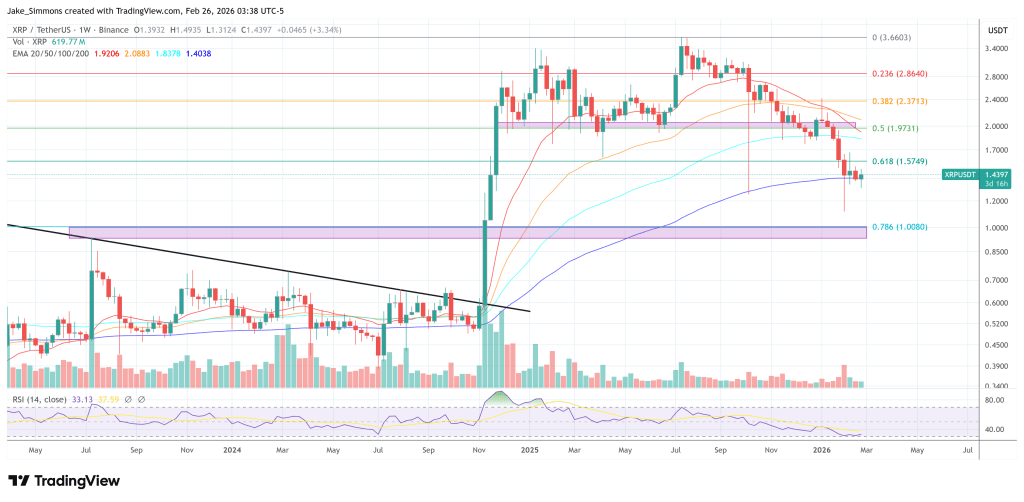
At press time, XRP traded at $1.4397.