Author: Deep Tide TechFlow
Deep Tide Introduction: IDC data shows that China's total shipments of AI accelerator cards in 2025 will be approximately 4 million units, with domestic manufacturers collectively delivering 1.65 million units, accounting for 41% of the market. NVIDIA's share has dropped from about 95% before the sanctions to 55%.
Huawei leads the domestic camp with 812,000 chips delivered, and its newly released Atlas 350 accelerator card claims to have 2.87 times the inference performance of NVIDIA's H20.
In November of last year, Beijing ordered state-owned data centers to fully adopt domestic alternatives, accelerating the reshaping of the market landscape.
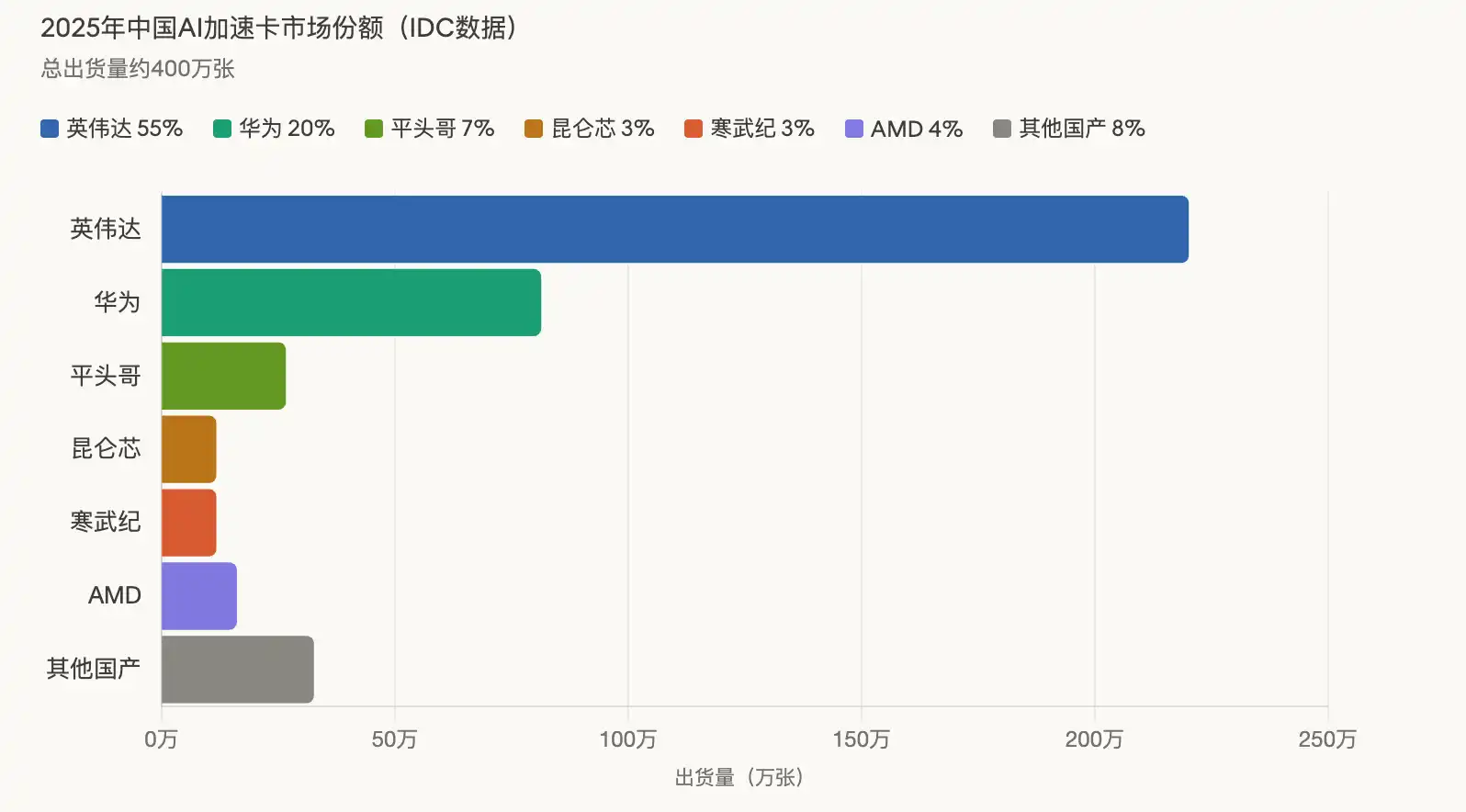
Three years ago, NVIDIA almost monopolized China's AI chip market. Today, this landscape has completely changed.
According to Reuters, citing data from market research firm IDC, China's total shipments of AI accelerator cards (specialized computing chips for AI servers) in 2025 will be approximately 4 million units. NVIDIA remains the largest single supplier, shipping about 2.2 million units, accounting for 55% of the market share. However, this figure has significantly shrunk by nearly 40 percentage points compared to its pre-sanction market share of about 95%. Meanwhile, Chinese domestic manufacturers collectively shipped about 1.65 million units, capturing 41% of the market. AMD ranks third with about 160,000 units shipped, accounting for 4%.
The rise of domestic manufacturers is both a passive result of U.S. export controls and an active outcome of the "domestic substitution" policy.
Huawei Leads the Domestic Camp, Atlas 350 Competes with NVIDIA H20
Among domestic AI chip manufacturers, Huawei is the biggest winner.
IDC data shows that Huawei shipped approximately 812,000 AI chips in 2025, accounting for about 20% of the total market and nearly half of the domestic manufacturers' shipments. Alibaba's chip design division, T-Head, ranks second with about 265,000 units shipped, while Baidu's Kunlun Core and Cambricon each shipped about 116,000 units, tying for third place. Additionally, Hygon, MetaX, and Iluvatar CoreX account for 5%, 4%, and 3% of domestic manufacturers' shipments, respectively.
Last month, Huawei released the new-generation AI accelerator card Atlas 350 at the China Partner Conference 2026 in Shenzhen, equipped with its self-developed Ascend 950PR chip. Zhang Dixuan, head of Huawei's Ascend Computing business, stated at the launch that the Atlas 350 delivers 1.56 PFLOPS (peta floating-point operations per second) in FP4 low-precision computing, with performance 2.87 times that of NVIDIA's China-specific H20. The card is equipped with 112GB of self-developed high-bandwidth memory HiBL 1.0, with a memory bandwidth of 1.4TB/s and a power consumption of 600W.
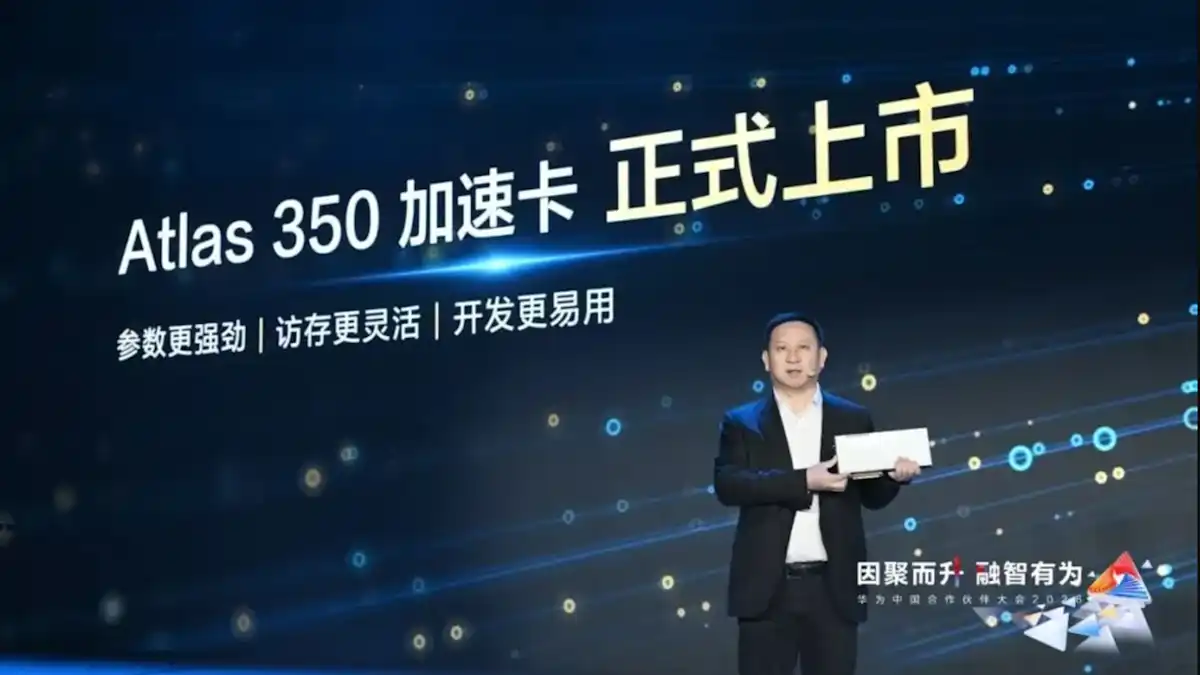
However, this performance comparison has issues with calibration. NVIDIA's Hopper architecture GPU does not natively support FP4 precision, while the Atlas 350 is the first domestic accelerator card optimized for FP4. The two cannot be directly compared at the same precision. Huawei's real competitiveness lies in the inference side: the Atlas 350 is positioned for inference workloads during the AI model deployment phase, rather than large model training.
Seven Huawei partners have already released complete server products based on the Atlas 350, and iFlytek has also announced that its next-generation Spark large model will be adapted to the Ascend 910/950 computing base.
Dual Drivers: Export Controls and Domestic Substitution
The collapse of NVIDIA's market share in China is the result of the dual pressures of escalating U.S. export controls and Beijing's domestic substitution policy.
The timeline is roughly as follows: The U.S. began restricting AI chip exports to China in October 2022, after which NVIDIA launched compliant downgraded versions such as the H20 and A800/H800. In April 2025, the Trump administration completely banned the export of all AI GPUs to China; in July of the same year, it restored export licenses for the H20 and AMD MI308; in October, NVIDIA CEO Jensen Huang stated at a public event that NVIDIA's share in China's advanced AI accelerator card market had "dropped from 95% to zero." In December, Trump allowed NVIDIA to export the H200 to China, but Chinese companies were advised to suspend orders for NVIDIA chips.
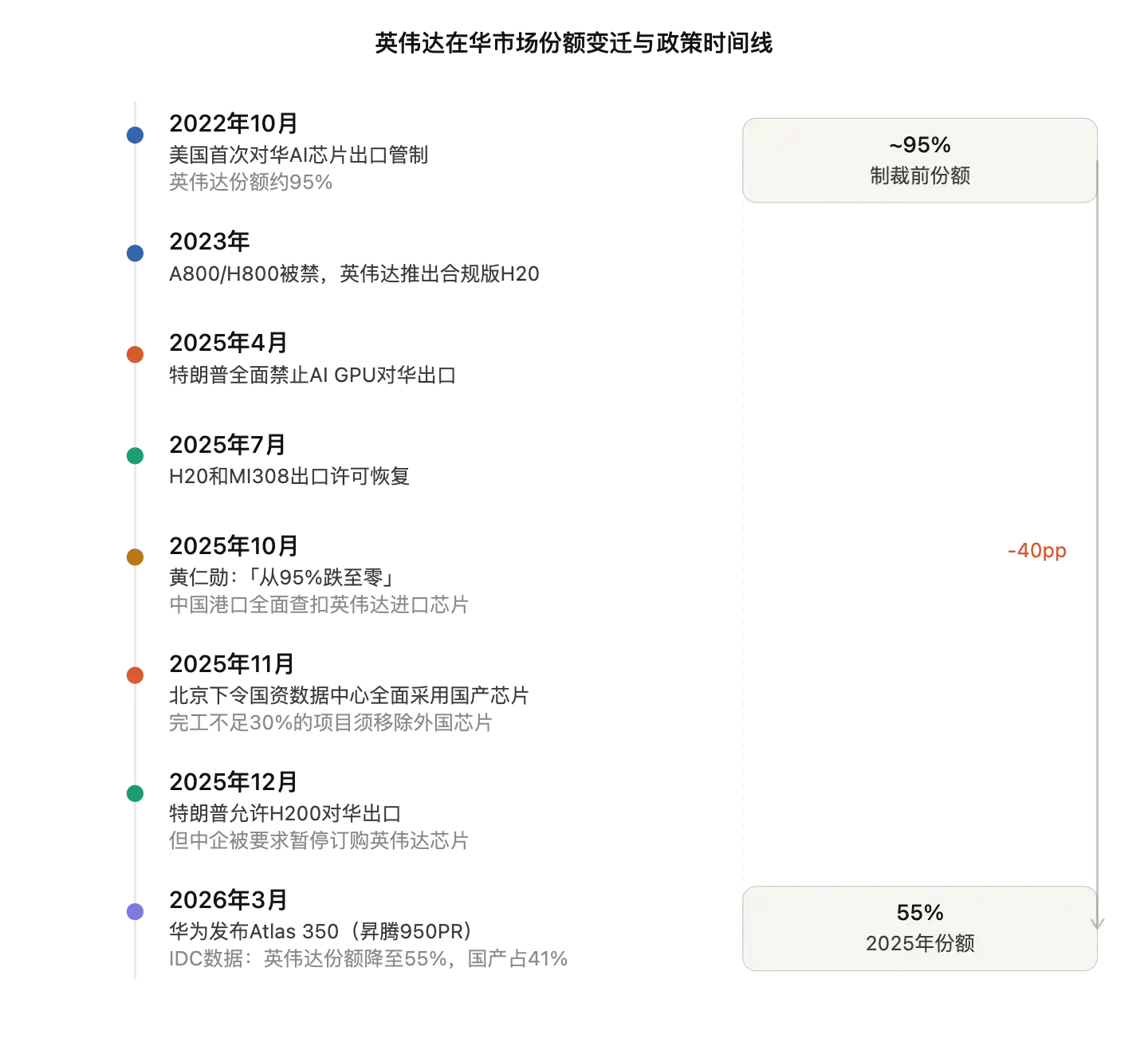
The policy push on the other side is equally fierce. According to a Reuters report in November 2025, Beijing issued guidance to newly built data centers using state-owned capital, requiring them to fully adopt domestic AI chips. Projects with less than 30% completion were required to remove already installed foreign chips or cancel procurement plans.
Reuters statistics show that since 2021, China's AI data center projects have received more than $100 billion in state capital investment, and most data centers in China have received some form of state support during the construction phase, meaning this policy has an extremely wide coverage.
China Unicom's large data center project in Qinghai was reported by Reuters as a landmark case of this strategy: the project, worth $390 million, is entirely powered by domestic AI chips such as T-Head.
Technical Gap Exists, but Inference Side Has Reached the "Good Enough" Threshold
The rise in market share of domestic chips does not mean the technical gap has been eliminated.
Most industry analysts estimate that China's domestic AI chips still lag behind NVIDIA by 5 to 10 years in data center training. When training trillion-parameter large language models (LLMs), NVIDIA's high-end GPUs remain the preferred choice. The use of a 50,000-unit Hopper series GPU cluster by DeepSeek to train the R1 model is a practical example.
However, the situation is different on the inference side. Industry observers believe that for 90% of commercial application scenarios (including image recognition, chatbots, autonomous driving, etc.), domestic chips have reached the "good enough" threshold, making the switch from NVIDIA to domestic solutions a viable business decision. Further strengthened expectations of sanctions have accelerated the motivation for this switch.
The real bottleneck lies in the software ecosystem. NVIDIA's CUDA platform, after more than a decade of accumulation, has become the de facto standard for AI development. Domestic chip manufacturers have invested heavily in compatibility: MetaX announced that its C500 series will support CUDA compatibility, while Huawei fully open-sourced its CANN platform in 2025 to expand its developer ecosystem. Cambricon and Moore Thread have also built their own translation tools from CUDA to their programming languages. The progress of ecosystem catch-up will determine the ceiling for domestic chip market share.
Domestic AI Chip Companies Rush to Capital Markets
The transfer of market share is simultaneously being realized in the capital markets.
Since the beginning of 2026, China's GPU field has seen a wave of IPOs. Biren Technology and MetaX have already listed on the Science and Technology Innovation Board (STAR Market), Iluvatar CoreX has listed on the Hong Kong Stock Exchange Main Board, and Enflame Technology's STAR Market listing application has been accepted. Baidu announced plans to spin off Kunlun Core for an independent listing, and according to informed sources, Alibaba is also considering a similar spin-off for T-Head.
Huawei's R&D investment in 2025 reached 192.3 billion yuan, accounting for 22% of its revenue, with a focus on chips, software, and manufacturing tools to further reduce dependence on U.S. technology. Huawei's rotating chairman, Xu Zhijun, stated at MWC 2026 that Huawei will become "an alternative option to ensure uninterrupted global AI computing power supply." According to Reuters, Huawei's new-generation Ascend 950PR chip has attracted ordering interest from giants such as ByteDance and Alibaba, with a shipment target of about 750,000 units in 2026, and mass production will begin in the second half of the year.
For NVIDIA, even though the H200 has been approved for export to China, the foundation has been shaken. Beijing's autonomous and controllable policy is no longer just a vision but an established fact constituted by every domestic chip running in data centers. When the 2026 market share data is released, whether the 55% figure will rebound or continue to decline will depend on whether Washington's export policy shifts again and the speed at which domestic chips catch up on the training side.