Kraken, the US’s second-largest crypto exchange, has reportedly secured access to the Federal Reserve’s (Fed) core payment systems, marking a significant milestone as the first crypto firm to operate on the same infrastructure utilized by thousands of banks and credit unions.
Kraken Scores Major Victory For The Crypto Industry
On Wednesday, Kraken’s banking arm, Kraken Financial, became the first crypto company with direct access to the Federal Reserve’s core payment system after winning the Kansas City Fed’s approval for a Fed master account, the Wall Street Journal (WSJ) first reported.
According to the Wednesday report, the Kraken unit, which holds a special Wyoming state bank charter specifically designed for crypto companies, is not receiving the full range of services available to banks, such as interest payments on reserves held at the central bank.
However, the milestone represents a major victory for the crypto industry, which had been repeatedly denied access to the Fed system for years. The company previously relied on intermediary banks to facilitate transfers to other firms.
The Fed master account approval will allow Kraken Financial to “handle transactions more quickly and seamlessly for big clients and professional traders,” the company told the WSJ. Moreover, it will grant Kraken’s banking unit direct access to Fedwire, a major interbank payment system that processes over $4 trillion in transfers a day.
Arjun Sethi, co-chief executive of Kraken, told the WSJ that the direct access to the Fed’s payment rails “improves reliability and efficiency for moving fiat deposits in and out of digital-asset markets.”
Meanwhile, Kansas City Fed President Jeff Schmid highlighted the payments landscape’s constant evolution in the statement cited by Reuters. “Throughout this transformation, the integrity and stability of the U.S. payments system remain our priority,” he affirmed.
Kraken Financial’s master account has been approved for an initial term of one year, the news media outlet reported.
Banks Push Back On Crypto Firm’s Access To Fed’s Rails
The Kraken unit’s limited access to the master account is akin to the “skinny” master account concept first proposed by the Federal Reserve Board of Governors in October 2025.
The proposal would allow payment fintechs and crypto companies to access the Fed’s payment rails, but excludes other benefits that are more aligned with banks, including its discount window lending facility.
This has raised major concerns among traditional banks, which have shared their opposition to granting crypto and fintech companies direct access to the Fed’s payment systems, warning that even limited access could pose a significant threat to the US payments system and overall financial stability.
In a joint letter, the Bank Policy Institute (BPI), The Clearing House Association (TCHPA), and Financial Services Forum (FSF) demanded a 12-month waiting period before firms can apply for payment accounts. The banking groups argued the Fed “should block access until newly licensed stablecoin issuers prove they can operate safely.”
Meanwhile, the American Bankers Association (ABA) asked the Office of the Comptroller of the Currency (OCC) last month to postpone its approval of applications for crypto bank charters, suggesting that the agency should wait until the regulatory uncertainties are resolved.
In December, the OCC approved conditional bank charters for Ripple, Circle, BitGo, Paxos, and Fidelity. The approval raised concerns that it could blur the lines between banking activities and lead to regulatory arbitrage.
The banking lobby raised concerns about the uncertainty surrounding emerging business models, the need for increased transparency in the charter application and decision-making processes, and the absence of finalized federal oversight.
Ultimately, the ABA proposed delaying the review process until Congress completes the rules that will ultimately govern many recent applicants for the OCC’s charter.
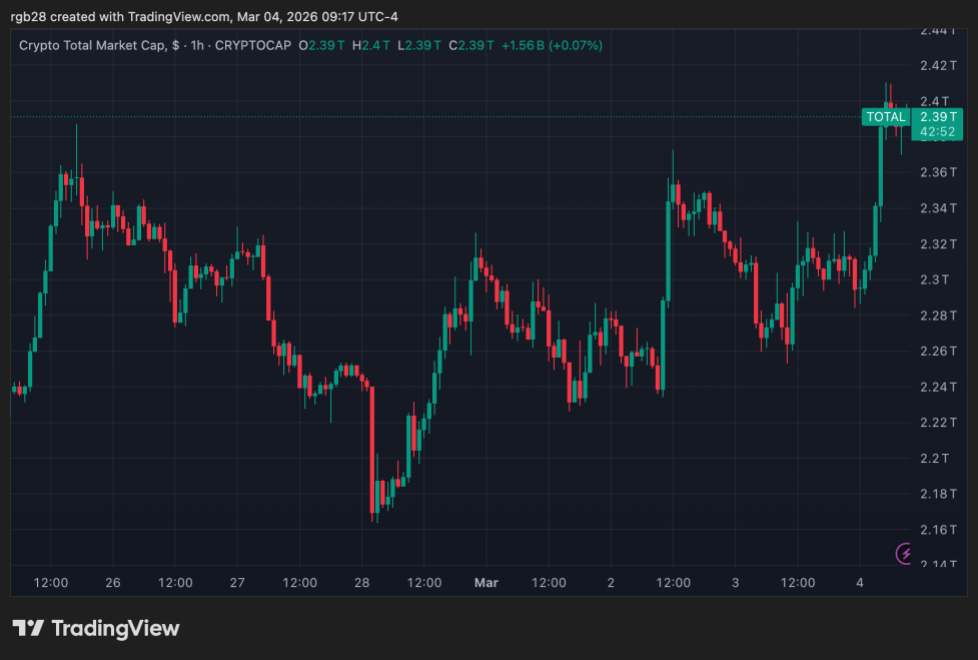
The total crypto market capitalization is at $2.39 trillion in the one-week chart. Source: TOTAL on TradingView