Iran Launches Bitcoin Payment Platform For Strait Of Hormuz Insurance

bitcoinist发布于2026-05-18更新于2026-05-18

文章摘要

Iran has launched a maritime insurance platform named "Hormuz Safe" for cargo transiting the Strait of Hormuz, with insurance payments settled in Bitcoin. According to a report from Iran's Fars News Agency, the state-backed initiative could generate significant revenue and embeds Bitcoin into a critical global shipping corridor. The platform offers cryptographically verifiable policies for cargo moving through the Persian Gulf and surrounding waterways, with coverage beginning upon payment confirmation. This move occurs amid heightened geopolitical tensions in the strait, a vital chokepoint for global oil shipments. The report did not specify technical details on Bitcoin payment processing or identify external partners.

Iran has launched a new maritime insurance platform for cargo moving through the Strait of Hormuz, with payments settled in Bitcoin, according to a report from Iran’s semi-official Fars News Agency. The project places Bitcoin inside one of the world’s most politically sensitive shipping corridors, where energy flows, sanctions pressure and maritime risk have become increasingly intertwined.

Iran Officially Turns To Bitcoin

Fars reported that the platform, called “Hormuz Safe,” has begun offering insurance for maritime cargo passing through the Strait of Hormuz. The outlet said a document obtained by its reporter showed Iran’s Ministry of Economic Affairs and Finance had been working since early Ordibehesht, the second month of the Iranian calendar, on a plan to make management of the strait possible through insurance. The same report said the scheme could issue maritime insurance policies and financial responsibility certificates, potentially generating more than $10 billion in revenue for Iran.

The most crypto-relevant element is the settlement layer. Fars said the platform’s rules provide “fast, cryptographically verifiable” insurance policies for cargo moving through the Persian Gulf, the Strait of Hormuz and surrounding waterways. “Payments are settled with Bitcoin,” the report said, adding that cargo is covered “from the moment of confirmation” and that owners receive a signed receipt.

That wording makes the story more specific than a generic Bitcoin-payment initiative. The Fars report names Bitcoin directly, rather than referring only to crypto assets, stablecoins or blockchain-based payment rails. It also frames the product not as a consumer-facing wallet or exchange service, but as infrastructure for a maritime insurance and compliance process around ships and cargo.

Related Reading: Bitcoin Social Euphoria Hits Yearly High Amid CLARITY Act Buzz

The launch comes amid heightened scrutiny of the Strait of Hormuz, the narrow waterway between Iran and Oman that connects the Persian Gulf with the Gulf of Oman and Arabian Sea. The US Energy Information Administration has called Hormuz the world’s most important oil chokepoint, noting that oil flows through the strait averaged 21 million barrels per day in 2022, equal to about 21% of global petroleum liquids consumption.

The geopolitical context has become even more acute in recent months. Iran had begun allowing some Chinese vessels to transit the Strait of Hormuz after an understanding over Iranian management protocols for the waterway. Iran had severely restricted transit following the start of US and Israeli strikes on February 28, while a US blockade on Iranian ports after an early-April ceasefire had prolonged the crisis in a corridor through which one-fifth of global oil and natural gas transit.

Fars did not provide technical details on how Bitcoin payments are received, whether the platform uses on-chain settlement directly, third-party custody, internal accounting, or conversion into local or foreign currency. It also did not identify counterparties, underwriters, wallet infrastructure, or any external insurers connected to the platform.

At press time, BTC traded at $76,685.
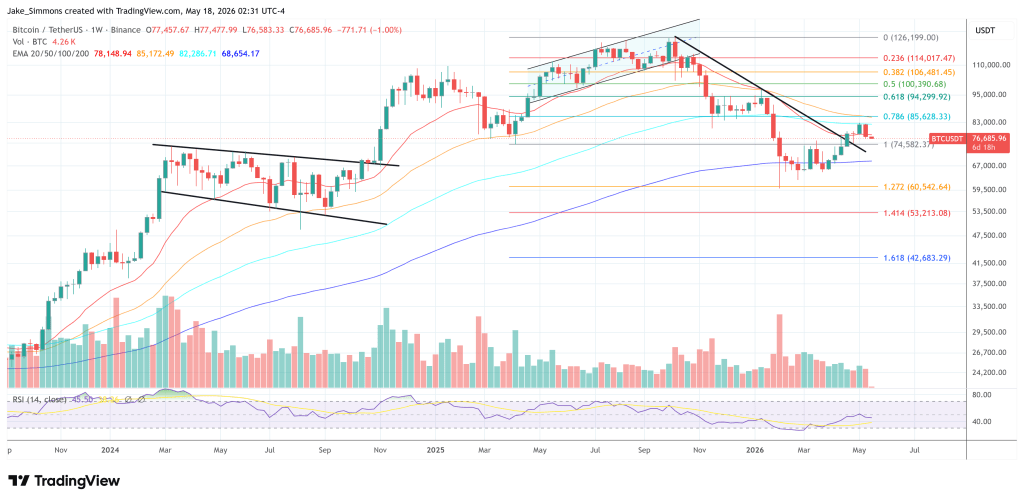
Bitcoin bulls rejected at the 100-week EMA, 1-week chart | Source: BTCUSDT on TradingView.com

相关问答

QWhat is the name of the new Bitcoin-based maritime insurance platform launched by Iran, and which waterway does it specifically cover?

AThe platform is called 'Hormuz Safe,' and it offers insurance for maritime cargo passing through the Strait of Hormuz and surrounding waterways like the Persian Gulf.

QAccording to the Fars News Agency report, what specific cryptocurrency is used for payment settlement on the 'Hormuz Safe' platform?

APayments on the 'Hormuz Safe' platform are settled with Bitcoin.

QWhat major geopolitical and economic significance does the Strait of Hormuz hold, as mentioned in the article?

AThe Strait of Hormuz is described as the world's most important oil chokepoint, with oil flows averaging 21 million barrels per day in 2022, equal to about 21% of global petroleum liquids consumption.

QWhat details about the Bitcoin payment process did the Fars report notably NOT provide, according to the article?

AThe report did not provide technical details on how Bitcoin payments are received, whether the platform uses on-chain settlement directly, third-party custody, internal accounting, or currency conversion. It also did not identify counterparties, underwriters, wallet infrastructure, or any external insurers.

QWhat was the approximate price of Bitcoin (BTC) at the time the article was published?

AAt press time, BTC traded at $76,685.

你可能也喜欢

解读资产上链背后的杠杆、流动性与风险真相

RWA(现实世界资产)代币化常被讨论,但其价值不在于简单的资产上链,而在于能否在DeFi生态中实现高效、有韧性的金融运作。文章指出,代币化仅是赋予资产一个可识别的数字凭证(如同条形码),真正的变革来自DeFi提供的杠杆、流动性和风险管理能力。 核心挑战在于RWA与DeFi存在多重“时间时钟”冲突:区块链实时结算,而底层传统资产交易、赎回和处理存在延迟。这导致在压力情景下(如周末清算),链上快速处置需求与现实世界缓慢流程之间产生缺口,低波动资产(如国债代币)可能因流动性不足而比高波动加密资产风险更高。 真正的流动性并非总锁定价值(TVL),而是在需要时能否在限定时间内以可接受价格退出。资产需具备多条清晰的退出路径(二级市场卖出、发行方赎回、抵押借贷)。 杠杆能释放资产效用(如抵押借贷),但也引入脆弱性。抵押率的设定需综合考虑法律可执行性、数据新鲜度、赎回延迟、市场深度等多重风险,而不仅是资产波动率。因此,某些情况下国债代币的抵押率应低于ETH。 RWA的风险是一张相互关联的图谱,涉及发行方、托管、预言机、流动性提供者、协议等多节点,需持续监控链下指标(如赎回排队、市场深度)而不仅依赖价格信号。 展望未来,国债代币仅是起点。算力、能源等复杂资产以及代币化股票与永续合约的结合将带来更大机遇与更复杂的风险,需要精心设计风险隔离、动态抵押等机制。 最终,RWA的意义不在于代币本身,而在于其能否融入一个健壮的、可编程的市场体系,在压力下完成估值、融资、对冲和处置,实现资本的高效配置和风险管理。代币是条形码,市场才是运转的机器。

marsbit12分钟前

解读资产上链背后的杠杆、流动性与风险真相

marsbit12分钟前

数学的终结:40位顶尖数学家齐聚OpenAI秘密会议

今年8月初,刚刚获得菲尔兹奖的Jacob Tsimerman与OpenAI科学家Sébastien Bubeck在旧金山召集约40位顶尖数学家举行闭门峰会。会议上一场报告标题为“数学的终结”,引发对人工智能可能终结人类数学研究的深度担忧。 近期AI在数学领域取得一系列突破性成果:5月,OpenAI未发布模型推翻了悬置多年的“单位距离猜想”;8月,该公司又公布了10项AI生成的数学与计算机科学新发现;Anthropic员工利用Claude构造出668维超立方体上的垂直向量对。这些成果绕过了传统的学术发表流程,通过社交媒体等方式快速传播。 数学界的反应出现分裂。超过3000名数学家签署“莱顿宣言”,呼吁负责任地使用AI并确保成果的可验证性。另一些学者则主张抵制AI以保住人类在数学中的位置。与会者指出,AI目前虽能证明问题,但难以解释论证中最困难的部分,也无法自主提出新概念。人类的理解与阐释仍是数学知识成为文献的关键。 峰会探讨了数学未来的几种可能形态:或如软件工程般大规模协作;或如物理学般依赖算力;或人类转为AI产出的“策展人”;抑或数学家集体转向AI安全研究。组织者强调“必须把人放在第一位”,数学的意义在于人类能从中学习。然而会议并未达成共识,数学界仍在寻找自身在AI时代的定位。Tsimerman选择加入OpenAI从事AI安全研究,这一举动本身已折射出该领域面临的深刻变革。

marsbit17分钟前

数学的终结:40位顶尖数学家齐聚OpenAI秘密会议

marsbit17分钟前

交易

现货
活动图片