
Quick Facts:
- ➡️ The crypto market is down roughly 2% due to fears of a U.S. government shutdown, causing a short-term liquidity crunch and risk-off behavior in major assets like BTC and ETH.
- ➡️ Despite the downturn, smart money is rotating out of correlated assets and into infrastructure plays that offer fundamental utility, specifically in the Layer 2 sector.
- ➡️ Bitcoin Hyper leverages the Solana Virtual Machine to bring high-speed smart contracts to Bitcoin, securing over $31M in funding by solving the network’s scalability bottleneck.
- ➡️ Large-scale wallet accumulation during a market dip signals strong institutional conviction in the Bitcoin L2 narrative over short-term macro noise.
Global crypto markets have retracted by roughly 2% in the last 24 hours, largely due to escalating fears of a U.S. government shutdown.
It’s a classic setup: when Capitol Hill gridlock threatens federal operations, risk assets usually face immediate sell-pressure. Crypto is no exception. Bitcoin ($BTC) has slipped below key support, and Ethereum ($ETH) is mirroring the downturn as institutional desks de-risk before the legislative deadline.
Good news, though, the Fear and Greed Index is now pushing into Neutral.
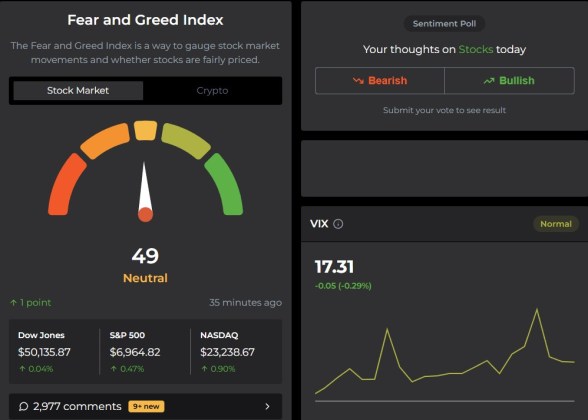
That matters. The correlation between traditional finance (TradFi) macros and crypto price action is sitting at a local peak right now. Investors aren’t necessarily bearish on the tech; they’re terrified of liquidity crunches.
When government operations stall, economic data releases get delayed and regulatory clarity vanishes. The result? A ‘wait and see’ paralysis that drains volume from order books. Just look at the sea of red across the top 100 tokens, it’s a clear flight to safety.
Dig a bit deeper into the on-chain data, though, and you’ll spot a divergence. While the macro-correlated majors stumble, capital isn’t actually leaving the building. Instead, it’s rotating into infrastructure plays that operate independently of immediate regulatory noise.
Smart money is seeking a ‘flight to utility’, assets solving fundamental scalability issues regardless of the macro environment. Bitcoin Hyper ($HYPER) is leading this counter-trend charge, attracting serious inflows while the broader market hesitates.
Learn more about Bitcoin Hyper here.
Bitcoin Hyper Brings High-Speed SVM Tech To The Old Guard
While Bitcoin remains the pristine collateral of the crypto world, its utility as a transactional layer is severely limited by 10-minute block times.
Frankly, the lack of native smart contract capability is a headache developers have dealt with for a decade. That’s the specific bottleneck Bitcoin Hyper addresses (and it explains why the project is decoupling from general market sentiment).
By integrating the Solana Virtual Machine (SVM) as a Layer 2 solution on top of Bitcoin, the protocol offers a combo investors find hard to ignore: Bitcoin’s ironclad security with Solana’s blistering speed.
The interest here is driven by the ‘execution layer’ thesis. Developers have been itching to build high-speed DeFi and gaming platforms secured by Bitcoin for years, but the base layer’s rigid scripting language made it nearly impossible. Bitcoin Hyper fixes this with a modular architecture. It uses Bitcoin L1 for final settlement while employing a real-time SVM L2 for execution.
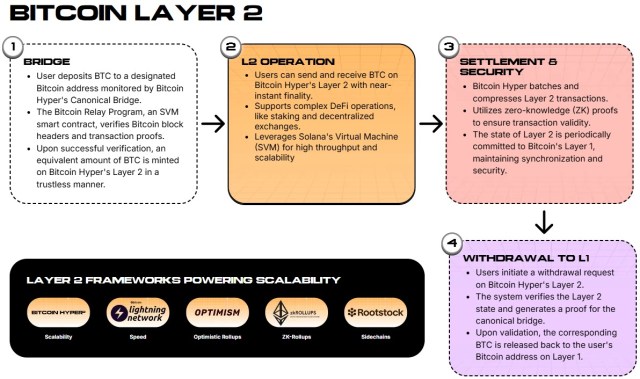
This allows for sub-second finality and negligible transaction costs, effectively solving the ‘Blockchain Trilemma’ for the crypto king.
For devs, it’s a zero-friction environment. They can use Rust, the industry standard for high-performance dApps, to deploy applications tapping into Bitcoin’s trillion-dollar liquidity.
Plus, a Decentralized Canonical Bridge ensures trustless transfers between layers, removing the centralization risks we often see in wrapped token bridges. This utility-first approach acts as a hedge; even when prices dip, the demand for faster, cheaper transactions doesn’t disappear.
Buy $HYPER here.
Whales Accumulate $HYPER As Presale Crosses Major Milestone
This split between the market’s 2% dip and Bitcoin Hyper’s ($HYPER) trajectory shows up clearly in the funding numbers. While retail traders panic-sell majors, sophisticated investors are quietly accumulating positions in this pre-market infrastructure.
According to the official presale page, Bitcoin Hyper has already raised $31.3M a number that suggests high conviction from early backers despite the external gloom.

Smart money behavior is often the canary in the coal mine. Etherscan records show that 3 whale wallets have accumulated over $1M in recent transactions. The largest buy, a chunky $500K, happened on Jan 15, 2026.
This accumulation during a ‘risk-off’ period highlights a specific appetite for Bitcoin Layer 2 protocols. Whales appear to be positioning themselves for the Token Generation Event (TGE), betting that the SVM-on-Bitcoin narrative will outperform legacy altcoins once market sentiment stabilizes.
With tokens priced at $0.0136754, the entry point looks primed for those hunting asymmetry. The protocol also pushes for long-term holding via a staking model offering immediate APY after TGE, paired with a short 7-day vesting period for presale stakers.
This structure is designed to reduce post-launch sell pressure (a common pitfall). In a market paralyzed by government shutdown fears, $HYPER offers a narrative that doesn’t depend on congressional budgets.
Buy $HYPER here.
The information provided in this article is for educational purposes only and does not constitute financial advice. Cryptocurrency investments are volatile and carry a high risk of loss. Always conduct your own research before investing.

Related Posts

Dogecoin Tries to Hold $0.09370 – Is 2026 the Doge Year or Will $MAXI Take Over?

US Debt Spiral Eyes $39T: Why Bitcoin Hyper ($HYPER) Is The Hedge to Watch

Crypto Exchange Backpack Targets Token Launch Soon, as BMIC Fires Up Quantum Defense

Ethereum Foundation Backs SEAL Initiative as LiquidChain L3 Protocol Gains Traction

Vitalik Buterin Outlines Ethereum’s AI Future, While SUBBD Token Targets the Creator Economy








