Ghana is launching a 12-month virtual-asset sandbox, the country’s first operational step to formalize crypto trading and related services.
A Regulatory Crypto Sandbox
On March 10, the Securities and Exchange Commission of Ghana (SEC) announced that it has finalized its regulatory sandbox framework for Virtual Asset Service Providers (VASPs), Bloomberg reports. The framework will allow 11 approved firms to pilot their products and services in a controlled environment under the direct oversight of the Commission, the announcement states. This new sandbox sits under Ghana’s recently enacted Virtual Asset Service Providers Act, 2025 (Act 1154), which sets the legal basis for licensing and monitoring crypto‐asset businesses in the country.
How The Sandbox Will Work
The official announcement details that the sandbox will run for 12 months, during which a limited group of approved Virtual Asset Service Providers (VASPs) can offer real products and services to users under close regulatory supervision. After the first 6 months, firms that are considered “market ready” and fully compliant may start transitioning toward full activity‐based licenses or registrations, while others can continue testing for the remainder of the period.
What It Means For Regulators
From the regulator’s perspective, the sandbox is a way to encourage innovation without sacrificing core objectives such as investor protection, market integrity, and AML/CFT standards. As stated in the announcement:
This sandbox period aims to support responsible innovation while strengthening investor protection, market integrity, and compliance with anti-money laundering and counter-terrorism financing standards.
Instead of relying only on theoretical impact assessments or industry lobbying, regulators can use the sandbox to gather real‐world data on investor behavior, platform resilience, and market abuse risks. The pilot will also allow the SEC to validate and refine detailed guidelines for each licensing category defined under the Virtual Asset Service Providers Act, 2025 (Act 1154), before opening the regime to the wider market. The announcements claims that “lessons from the pilot will inform future policy and licensing frameworks for virtual assets services”.
By limiting participation to a small, vetted group, the SEC can respond quickly to issues (e.g., security incidents, mis‐selling, liquidity problems) and adjust rules or technical requirements before granting full licenses.
What It Means For Participants
The SEC press released details the 11 firms that have been admitted in the pilot. The list includes tokenization projects, custodial services and exchanges, such as WhiteBit, a centralized exchange with spot trading, custody and fiat/crypto gateways.
The 11 participants must operate within predefined risk, disclosure, and compliance parameters, giving the regulator a controlled environment to observe how their trading, custody, and tokenization models behave in practice. The successful sandbox participants will effectively become the reference models for what a “good” licensed VASP should look like.
The 12‐month sandbox is a probation period: if they perform well, they move to full licensing; if they fall short, they risk being shut out of a regulated Ghanaian market once the framework is fully rolled out.
Ghana In The African Crypto Context
Multiple African countries are rolling out new crypto laws and sandbox regimes, with Ghana now joining peers like Zambia that are already testing crypto regulation technology to supervise services before they enter the market, signaling a broader African shift toward sandbox‐style oversight. Ghana, one of Africa’s biggest gold producers, is seeing a rapid virtual‐asset uptake, with local estimates suggesting millions of adults already trade crypto. Bitcoinist has also covered how Ghana’s central bank has been working on draft crypto rules to move the sector into a formal regulatory framework.
If the sandbox delivers clean data and limited incidents, Ghana could fast‐track a fully regulated environment for exchanges and tokenization platforms.
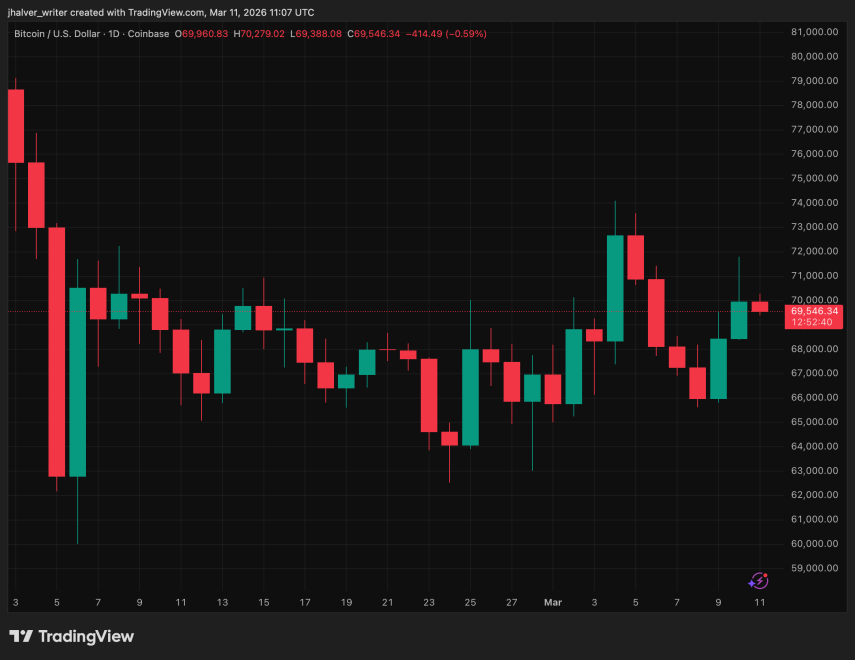
BTC’s price trends to the downside on the daily chart. Source: BTCUSD on Tradingview
Cover image from Perplexity, BTCUSD chart from Tradingview







