Bitcoin introduced the model now called the "Nakamoto consensus," but Ethereum, $BNB Smart Chain, $XRP Ledger, Solana, and Tron have taken different paths, while Dogecoin and Zcash still operate much closer to Bitcoin's original model. Excluding stablecoins, all the cryptocurrencies listed below are leading digital assets by market capitalization.
What a Consensus Algorithm Actually Does
A blockchain is essentially a shared ledger replicated on computers worldwide. When two machines see different transactions or competing blocks simultaneously, the network needs a hard rule to determine which chain of transactions will remain valid. This is the task of the consensus algorithm. It determines who gets the next update, how competing transaction chains are ranked, what prevents the network from being flooded with fake participants, and when a transaction reversal becomes difficult or impossible. These details are important because simply labeling a chain as "proof-of-work" or "proof-of-stake" hides the mechanism that determines who wins when disagreements arise in the network.
Nakamoto Consensus Made Bitcoin's Open Network Possible
The Nakamoto consensus is not a single button Bitcoin presses or one specific algorithm mentioned in Satoshi Nakamoto's white paper. It is a set of rules. Miners compete and earn through proof-of-work (PoW), running nodes independently reject invalid blocks, miners are rewarded for valid work, and conflicts between competing chains are resolved by following the valid chain that carries the greatest cumulative computational work.
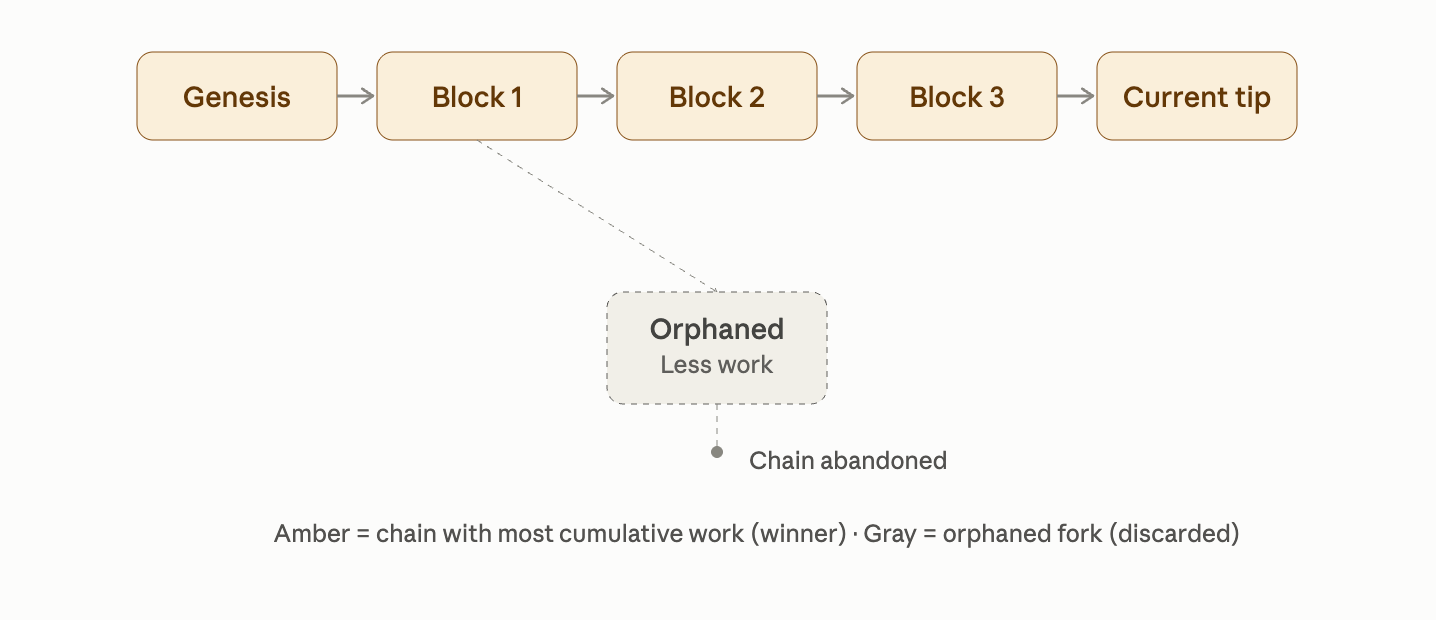
Two miners can find blocks practically at the same time, causing a short-lived network split. The next successful block usually pulls one branch ahead, and the network converges again. This leads to probabilistic finality: reversing a transaction becomes increasingly difficult as more work accumulates on it, but Bitcoin never declares a payment irreversible after six confirmations.
Bitcoin Sets the Baseline for Nakamoto Consensus
Bitcoin is the benchmark because it started this model. Miners using the SHA-256 proof-of-work (PoW) algorithm compete in an unpredictable computational lottery, akin to rolling dice, aiming to mine a block roughly every ten minutes. Difficulty is recalculated every 2,016 blocks, so changes in mining power don't permanently alter the emission rate. Running nodes follow the valid chain carrying the greatest total work, not just the branch with more blocks. There is no scheduled committee of producers or validators.
Ethereum Replaced Mining with Validators and Staking
Ethereum abandoned PoW during "The Merge" and replaced miners with a proof-of-stake (PoS) system—a hybrid consensus protocol called Gasper. The chain runs in 12-second slots, with validators staking their ETH to propose blocks and vote on the branch. LMD-GHOST weights the latest validator votes based on stake size to determine the leading branch, while Casper FFG adds finality through checkpoints.

Under normal conditions, Ethereum achieves finality in about two epochs, or roughly 12.8 minutes. A key difference from Bitcoin is where consensus power comes from: Bitcoin accounts for computational work, while Ethereum accounts for economic stake, which can be slashed for certain provable dishonest actions.
$BNB Smart Chain Traded Mining Races for Speed
Today, $BNB consensus primarily means $BNB Smart Chain, as the $BNB Beacon Chain was shut down in 2024. BSC uses a Proof-of-Staked-Authority algorithm, combining delegated stake, scheduled block production, and validator voting instead of an open mining race. Its elected structure consists of 45 validators, including 21 "Cabinet" validators and 24 candidates.
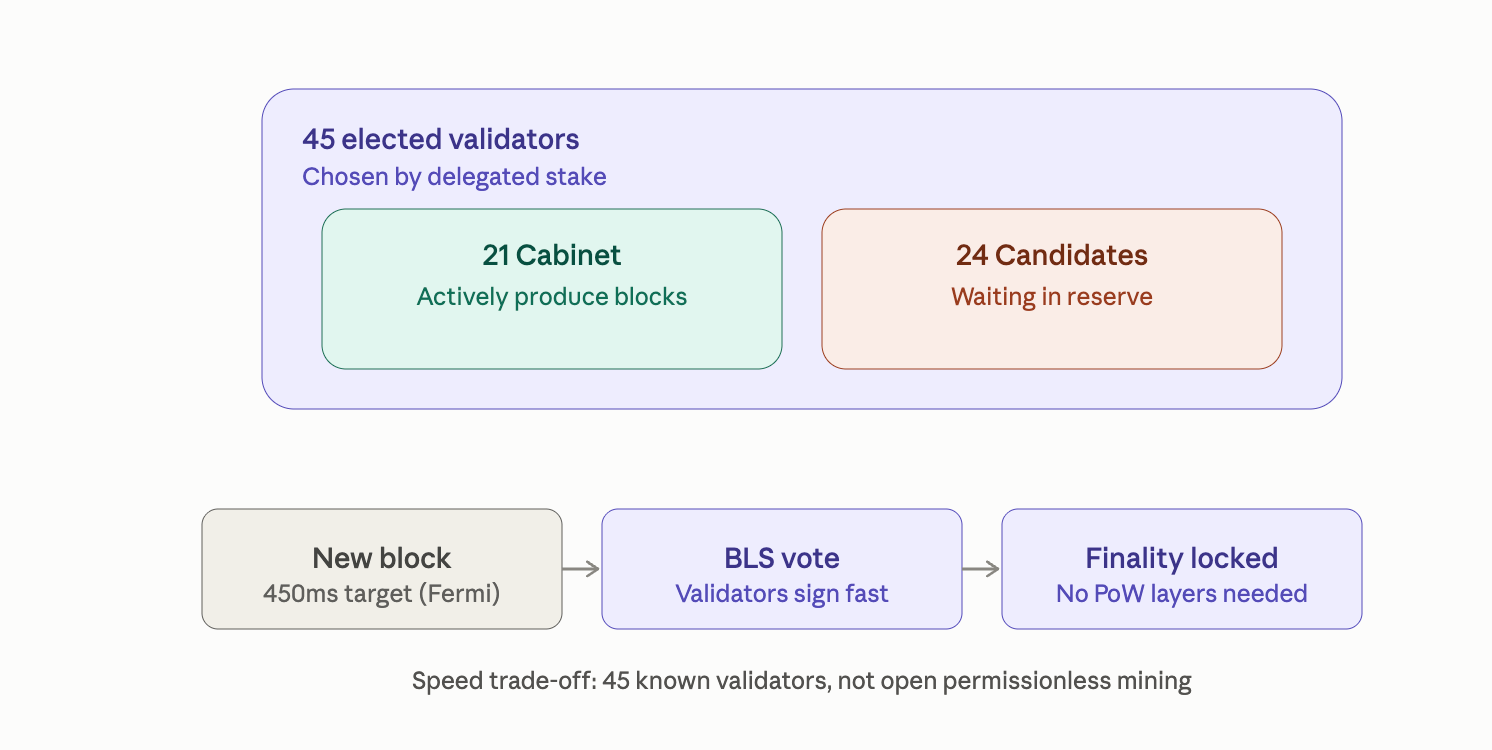
The Fermi upgrade, released in January 2026, reduced the target block interval to 450 milliseconds, and validator voting via the BLS algorithm allows transaction finality to be secured without a multi-layer proof-of-work system.
The win is speed, but the trade-off is clear: much more responsibility for achieving consensus lies with a known, limited group of professional validators than with Bitcoin's permissionless mining market.
The $XRP Ledger Bakes Trust Lists into Its Consensus Mechanism
The $XRP Ledger (XRPL) goes in a completely different direction. There are no PoW miners or PoS lottery systems. Servers maintain Unique Node Lists (UNLs) containing validators they believe are unlikely to collude, and participants repeatedly compare proposed transaction sets until enough trusted validators agree.
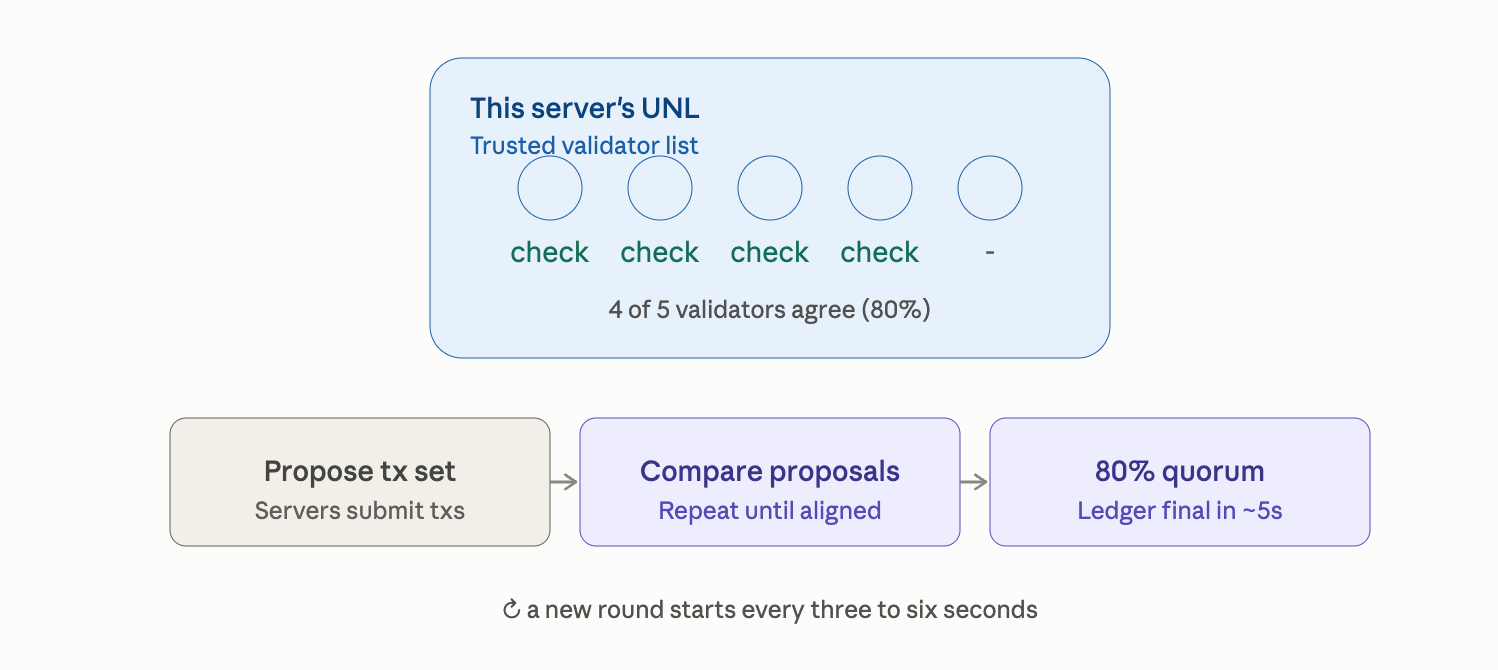
The standard validation quorum is 80%, and once the ledger passes this threshold, it is considered final under trust assumptions. Settlement is typically considered to take about four to five seconds. A key factor is whether the lists of trusted validators remain honest, available, and sufficiently overlapping across the network.
Solana Uses a "Clock," "Stake," and the "Tower" BFT Algorithm
Solana's "Proof-of-History" model is often mistaken for "Proof-of-Work," but it serves a different purpose. "Proof-of-History" functions as a cryptographic clock helping to establish event order, while the stake-weighted Tower BFT algorithm handles voting and branch selection. Leaders are scheduled in advance according to stake, and validators vote when competing branches appear.
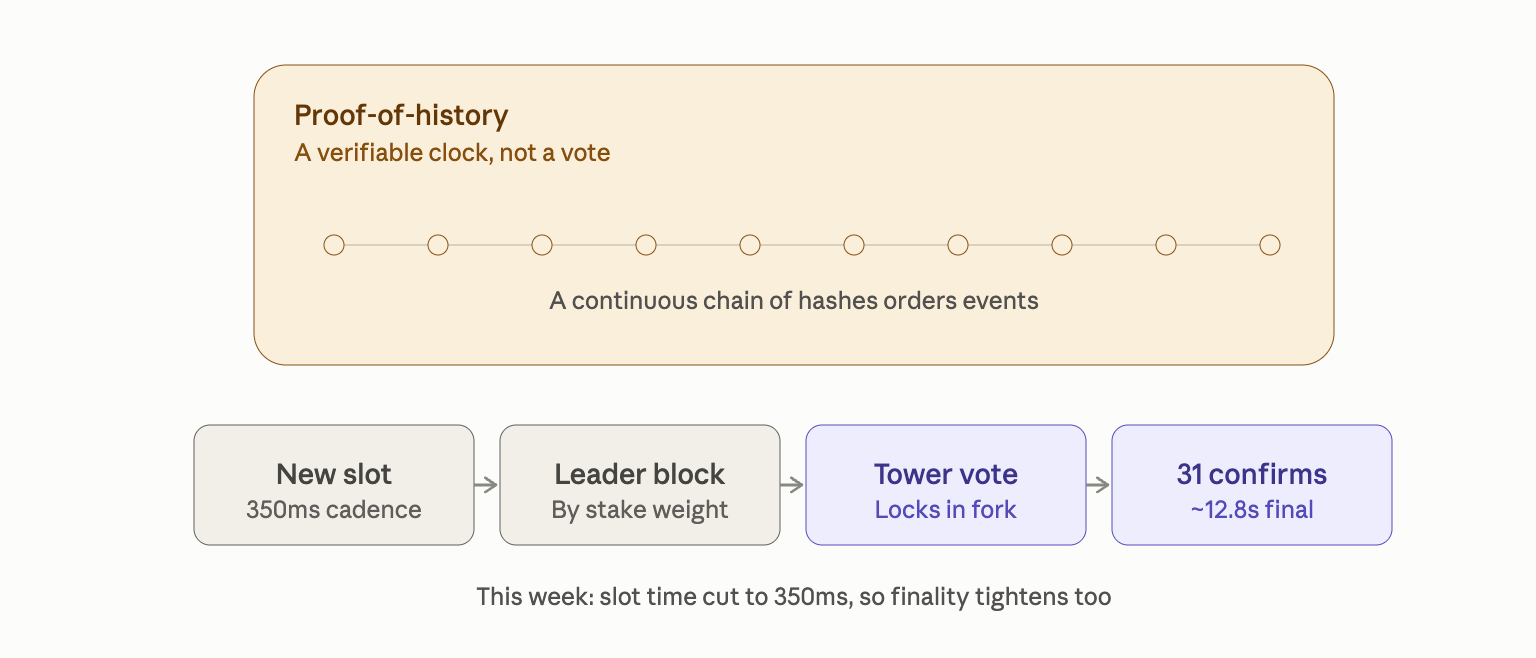
Under the Tower mechanism, a block is finalized after at least 31 confirmed descendants appear, providing finality in about 12.8 seconds at the traditional 400-millisecond slot rate. Last week, the network reduced the slot time to 350 milliseconds.
Tron Introduces a Work Schedule for 27 Elected Producers
The Tron distributed ledger system has both similarities and differences. Tron uses delegated PoS, where TRX holders vote for Super Representatives, and 27 leaders become active block producers. These producers rotate on a schedule every three seconds. Before reaching finality, Tron may resort to a "longest chain" rule to resolve conflicts between competing versions, somewhat reminiscent of Nakamoto-style chain selection.
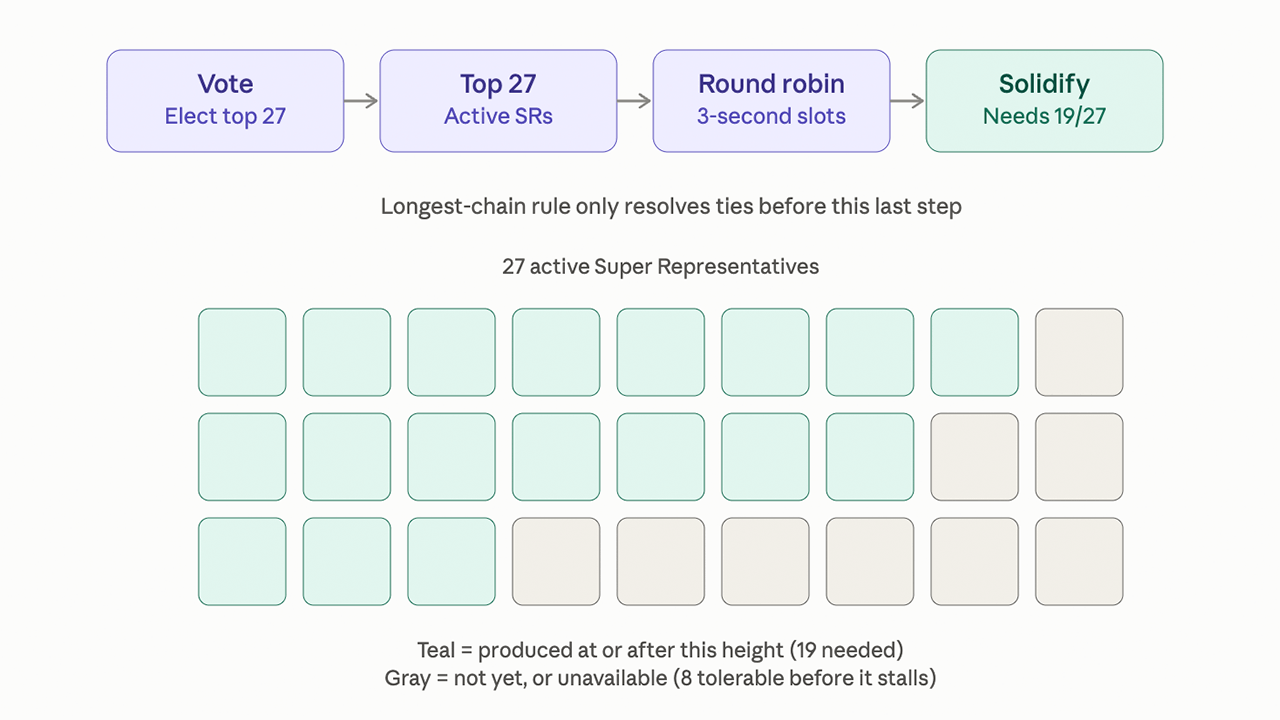
This similarity ends at the finalization stage. A block becomes final after at least 19 of the 27 active representatives have produced a block at that height or higher, typically leading to finalization about a minute after the leading block appears. If nine representatives are unavailable or refuse to cooperate, this threshold cannot be reached.
Dogecoin Preserves Nakamoto Consensus but Changes the Mechanism
Dogecoin fits squarely into the Nakamoto consensus family, although the mechanism "under the hood" differs sharply from Bitcoin's. It uses the Scrypt proof-of-work algorithm instead of SHA-256 and aims for a new block about every minute. DigiShield adjusts difficulty after every block, which is much faster than Bitcoin's 2,016-block adjustment cycle.

Dogecoin also uses Auxiliary Proof-of-Work or merged mining, allowing Scrypt miners, especially Litecoin miners, to reuse compatible work to secure Dogecoin. These changes alter mining economics but not its core logic: miners provide work, cumulative work determines the winning chain, and trust in a transaction grows as more proof-of-work accumulates on the payment.
Zcash Keeps the Nakamoto Model at the Core of Its Privacy Tech
Zcash remains Nakamoto in style, although better known for its privacy than its consensus mechanism. It uses the Equihash proof-of-work algorithm, targets blocks every 75 seconds, and follows the valid blockchain carrying the greatest total work. A Digishield-based difficulty system adjusts after every block, allowing Zcash to respond to mining changes faster than Bitcoin's approximately two-week adjustment period.
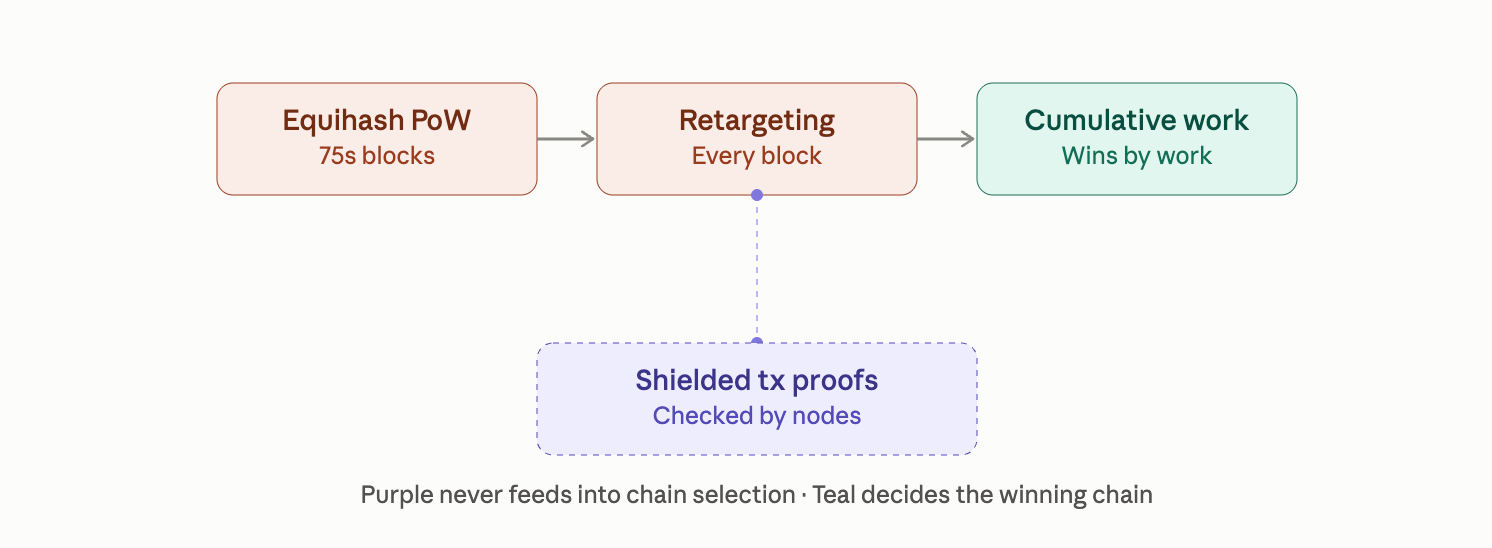
The zero-knowledge proofs underlying shielded transactions do not replace consensus. Nodes apply them as validity checks, while miners and proof-of-work still determine block creation and chain selection. Thus, like Bitcoin and Dogecoin, Zcash settles based on probability without absolute finality at the protocol level.
Consensus is Essentially About Choosing Who to Trust
The differences between these networks run deeper than the familiar "proof-of-work vs. proof-of-stake" debate. Bitcoin, Dogecoin, and Zcash bet that honest miners can perform more computational work than an attacker. Ethereum entrusts responsibility to economic stake. $BNB Smart Chain, Solana, and Tron rely on specific or stake-elected groups of validators, while the $XRP Ledger makes overlapping lists of trusted validators part of its security system itself.
Faster finality can be valuable for payments, applications, and trading, but speed does not guarantee security, and slower "proof-of-work" is not automatically safer. The key question is what an attacker must control to rewrite history and how the protocol reacts if that assumption fails. It is this difference that users feel.
end-content