Crypto Stablecoin Liquidity Shifts As Bear Market Deepens – What The Data Reveal

bitcoinist发布于2026-02-18更新于2026-02-18

文章摘要

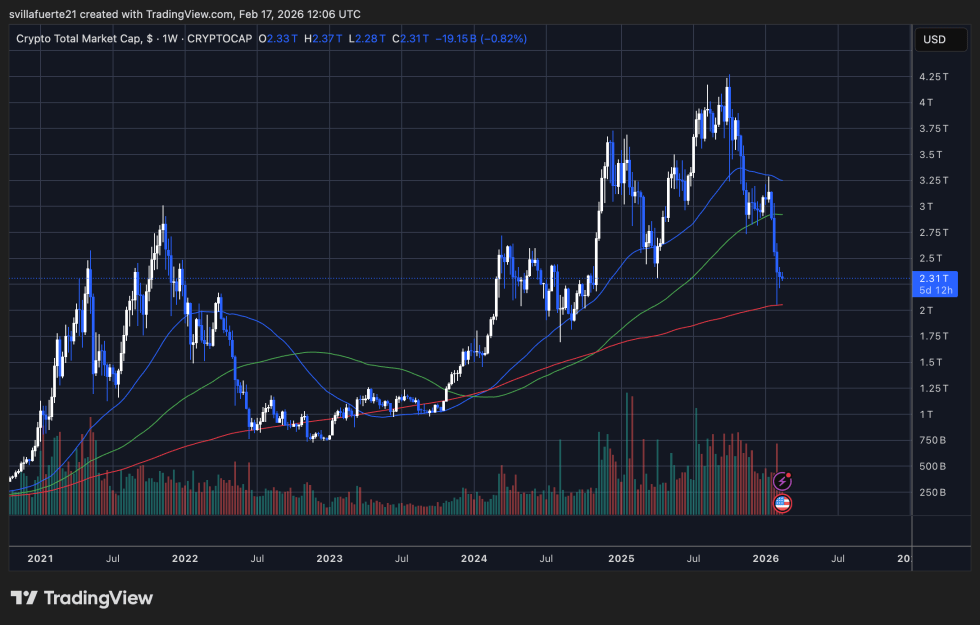
The crypto market faces intense selling pressure as Bitcoin and Ethereum struggle to reclaim key levels, with on-chain data revealing significant shifts in stablecoin liquidity. Stablecoin reserves grew by $11.4 billion in the 30 days before November 5, 2025, but fell $8.4 billion by December 23 as bearish conditions intensified. Outflows have recently slowed to about $2 billion, suggesting potential stabilization, though recovery remains uncertain. Binance dominates stablecoin liquidity, holding $47.5 billion in USDT and USDC—a 31% annual increase—accounting for 65% of all exchange reserves. USDT represents $42.3 billion of Binance’s holdings, while USDC reserves remain flat at $5.2 billion. Other exchanges like OKX ($9.5 billion) and Coinbase ($5.9 billion) lag significantly. The total crypto market cap has retraced from late-2025 peaks near $4 trillion, testing support around $2.3 trillion. Trend indicators show a shift from expansion to consolidation, with subdued buying pressure and elevated selling volume indicating ongoing distribution. The broader uptrend depends on holding long-term support, with a breakdown risking a deeper correction.

Trusted Editorial content, reviewed by leading industry experts and seasoned editors. Ad Disclosure

The crypto market continues to face intense selling pressure as both Bitcoin and Ethereum struggle to reclaim key psychological levels. Repeated rejection near resistance zones has reinforced cautious sentiment across the sector, with investors increasingly defensive after months of declining liquidity and volatile price action. While corrective phases are typical following strong bull market advances, the persistence of downside pressure suggests a more prolonged adjustment period may be unfolding.

On-chain data provides additional context for this shift in market dynamics. According to recent analysis, stablecoin reserve growth peaked shortly before the late-2025 price decline. In the 30 days leading up to November 5, reserves expanded by approximately $11.4 billion, reflecting strong liquidity availability and risk appetite at the time. However, this trend reversed quickly as market conditions deteriorated, with reserves falling roughly $8.4 billion by December 23 as the bear phase began to take shape.

More recently, the pace of outflows has moderated, with reserves declining by about $2 billion over the past month. This slowdown may indicate stabilization in liquidity conditions, though it does not yet confirm a sustained recovery. For now, the market remains sensitive to macro conditions, capital flows, and investor confidence.
Stablecoin Liquidity Concentration Highlights Binance’s Dominant Market Role

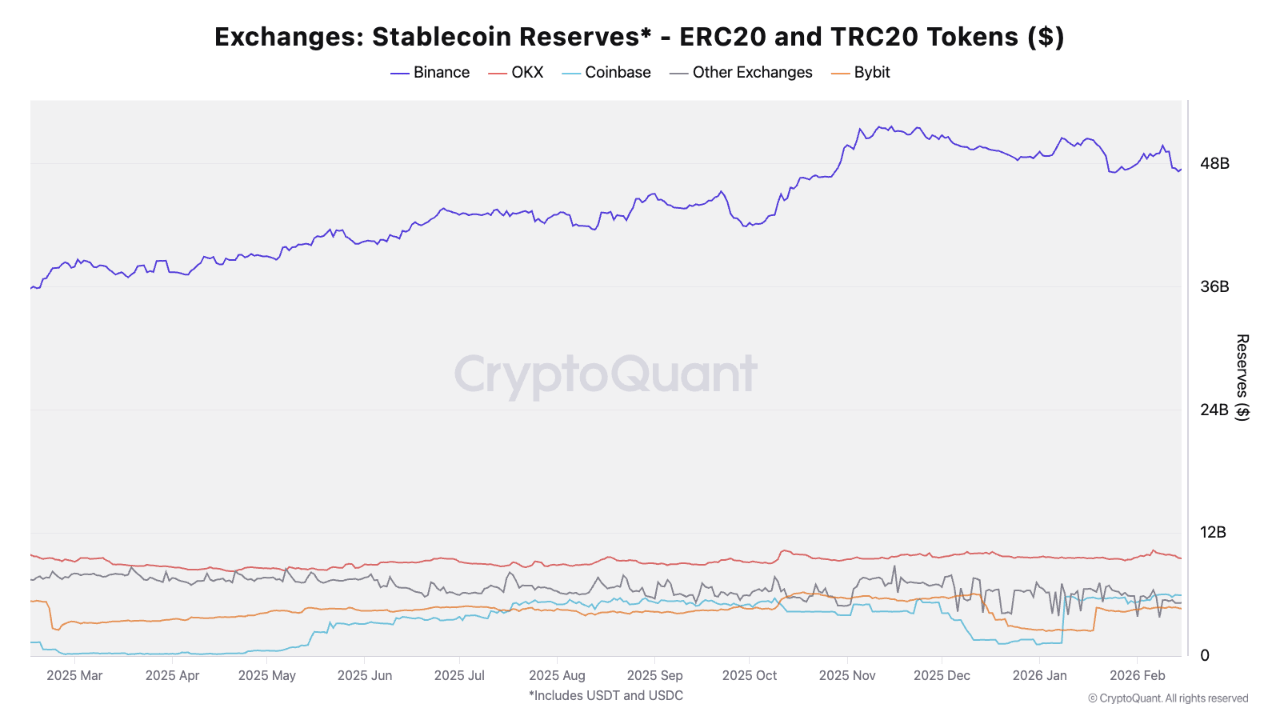
The data further shows that stablecoin liquidity remains heavily concentrated on Binance, reinforcing its role as the primary hub for crypto market liquidity. Current figures indicate the exchange holds roughly $47.5 billion in combined USDT and USDC reserves, marking a 31% year-over-year increase from about $35.9 billion. This concentration is significant, as Binance alone accounts for approximately 65% of all USDT and USDC held across centralized exchanges, highlighting its dominant position in facilitating trading flows and liquidity provisioning.
Crypto Exchanges Stablecoin Reserves | Source: CryptoQuant

Other major exchanges lag considerably behind in stablecoin reserves. OKX holds around $9.5 billion, representing roughly a 13% share, while Coinbase maintains approximately $5.9 billion, or about 8%. Bybit follows with close to $4 billion, equivalent to roughly 6% of exchange stablecoin liquidity. These balances are distributed mainly across Ethereum and TRON networks, which continue to serve as the primary infrastructure layers for stablecoin settlement.

Within Binance itself, liquidity remains overwhelmingly USDT-driven. About $42.3 billion of its reserves are held in USDT, reflecting a 36% year-over-year increase from approximately $31 billion. In contrast, USDC reserves stand near $5.2 billion and have remained broadly flat over the same period, suggesting stable but limited growth compared with USDT dominance.

Editorial Process for bitcoinist is centered on delivering thoroughly researched, accurate, and unbiased content. We uphold strict sourcing standards, and each page undergoes diligent review by our team of top technology experts and seasoned editors. This process ensures the integrity, relevance, and value of our content for our readers.

Sebastian Villafuerte

Follow

Sebastian's journey into the world of crypto began four years ago, driven by a fascination with the potential of blockchain technology to revolutionize financial systems. His initial exploration focused on understanding the intricacies of various crypto projects, particularly those focused on building innovative financial solutions. Through countless hours of research and learning, Sebastian developed a deep understanding of the underlying technologies, market dynamics, and potential applications of cryptocurrencies. As his knowledge grew, Sebastian felt compelled to share his insights with others. He began actively contributing to online discussions on platforms like X and LinkedIn, focusing on fintech and crypto-related content. His goal was to expose valuable trends and insights to a wider audience, fostering a deeper understanding of the rapidly evolving crypto landscape. Sebastian's contributions quickly gained recognition, and he became a trusted voice in the online crypto community. To further enhance his expertise, Sebastian pursued a UC Berkeley Fintech: Frameworks, Applications, and Strategies certification. This rigorous program equipped him with valuable skills and knowledge regarding Financial Technology, bridging the gap between traditional finance (TradFi) and decentralized finance (DeFi). The certification deepened his understanding of the broader financial landscape and its intersection with blockchain technology. Sebastian's passion for finance and writing is evident in his work. He enjoys delving into financial research, analyzing market trends, and exploring the latest developments in the crypto space. In his spare time, Sebastian can often be found immersed in charts, studying 10-K forms, or engaging in thought-provoking discussions about the future of finance. Sebastian's journey as a crypto analyst and investor has been marked by a relentless pursuit of knowledge and a dedication to sharing his insights. His ability to navigate the complex world of crypto, combined with his passion for financial research and communication, makes him a valuable asset to the industry. As the crypto landscape continues to evolve, Sebastian remains at the forefront, providing valuable insights and contributing to the growth of this revolutionary technology.

Full Profile

Related Posts

CFTC Chair Says Crypto Market Structure Bill Nears Final Approval

Why Kraken Is Backing Wyoming ‘Trump Accounts’, A Crypto Policy Gamble?

Polygon supera a Ethereum en tarifas diarias: la señal definitiva del auge de las L2

Zashi Becomes Zodl: Zcash Wallet Rebrands Following Internal Split

Kraken Backs Trump Accounts, Points To Shared Crypto Vision

Crypto And The 2026 Elections: By The Numbers And What Lies Ahead

相关问答

QWhat does the data reveal about the shift in stablecoin reserves leading up to and during the crypto bear market?

AThe data shows that stablecoin reserve growth peaked shortly before the late-2025 price decline, expanding by approximately $11.4 billion in the 30 days leading up to November 5. However, this trend reversed as the bear market took hold, with reserves falling roughly $8.4 billion by December 23. More recently, the pace of outflows has moderated, declining by about $2 billion over the past month, which may indicate a stabilization in liquidity conditions.

QWhich exchange holds the dominant share of stablecoin liquidity, and what are the specific figures?

ABinance holds the dominant share of stablecoin liquidity, with approximately $47.5 billion in combined USDT and USDC reserves. This represents a 31% year-over-year increase and accounts for roughly 65% of all USDT and USDC held across centralized exchanges.

QHow does the distribution of stablecoin reserves on Binance compare between USDT and USDC?

AOn Binance, liquidity is overwhelmingly dominated by USDT. About $42.3 billion of its reserves are held in USDT, reflecting a 36% year-over-year increase. In contrast, USDC reserves stand near $5.2 billion and have remained broadly flat over the same period.

QWhat is the current state of the total crypto market capitalization and its key support level?

AThe total crypto market capitalization has retraced significantly from its late-2025 peak near $4 trillion and has recently stabilized around the $2.3 trillion level. This area is functioning as an interim key support zone, though price action remains fragile with reduced upside momentum.

QWhat do the volume dynamics during the market decline indicate about investor behavior?

AThe volume dynamics indicate that elevated selling volume accompanied the most recent decline, which suggests active distribution by sellers rather than a passive price drift. However, the subsequent moderation in volume hints that panic selling may be easing, even though conviction buying has not yet returned decisively.

你可能也喜欢

硬氪首发 | 海洋具身智能公司「世航智能」拿下创纪录10亿融资,朱啸虎、淡马锡押注

海洋具身智能公司「世航智能」完成超过10亿元的A轮融资,创下全球海洋机器人领域单轮融资纪录。本轮投资方包括上河动量基金、Vertex Growth、大洋电机等,金沙江创投朱啸虎连续第五轮加注,老股东亦超额跟投。 公司创始人兼CEO陈晓博长期深耕水下机器人领域,曾获国防科技进步一等奖。融资将用于技术研发、全球市场拓展及产业链建设。 海洋环境是机器人应用的高难度场景,面临低光照、高压、通信受限等挑战。「世航智能」自主研发了覆盖动力、控制、传感等六大核心系统的技术,其机器人具备0-10000米全海深作业能力,已在船舶清洗、海洋风电、海底巡检等多个场景落地,2026年上半年订单金额已超10亿元。 今年4月,公司发布了海洋具身大模型“沧穹 CEORION”,采用端到端架构,集成感知、理解与自主执行能力。该模型基于百万小时商业作业数据训练,可覆盖12大类水下作业场景,在仿真测试中任务成功率超90%,零样本适应能力超70%,并能通过内置物理推理模块降低碰撞风险。 公司已入选新加坡国家级水下检测与清洗计划,推动海洋机器人从项目验证走向规模化应用。创始人表示,未来将继续聚焦核心技术、智能模型和全球化场景,拓展高风险、高价值的水下作业。

marsbit51分钟前

硬氪首发 | 海洋具身智能公司「世航智能」拿下创纪录10亿融资,朱啸虎、淡马锡押注

marsbit51分钟前

做拼多多的黄峥跟区块链有啥联系

本文探讨了拼多多创始人黄峥与其文章《把资本主义倒过来》中提到的核心理念,以及该理念与区块链技术的潜在联系。 文章首先指出,黄峥认为拼多多本质上是一门关于“不确定性”的保险生意。传统模式下,富人通过承担风险(不确定性)获得收益,而穷人则为求“确定性”支付溢价(如购买保险、接受低息),导致财富向上流动。 黄峥提出的“反向保险”旨在逆转这一过程,即让普通人将“确定性”(例如确定的购买意愿)卖给资本。难点在于单个消费者的承诺缺乏约束力。拼多多的拼团模式通过聚集大量用户的即时订单,为工厂创造了确定性的需求,从而消除其库存风险,并将因此节省的成本以降价形式返还给消费者,实现价值的部分“倒流”。 文章的关键转折点在于,黄峥本人提出疑问:区块链是否天生为这种“反向保险”而生?分析指出,区块链技术,特别是智能合约,恰好能解决“个人承诺不值钱”的核心难题。它可以通过代码和押金机制,将消费者的购买承诺变成具有违约成本、可强制执行的数字契约,从而建立起不依赖中间机构的信任体系,让承诺变得可信、可定价、可交易。 最后,文章延伸思考了制造确定性的两种路径:一是拼多多式,依靠聚合规模来平抑不确定性;二是比特币式,依靠不可篡改的算法规则从源头锁定确定性。两者分别以牺牲部分自由与弹性为代价。 总之,黄峥的商业思想与区块链在“构建可信承诺”这一点上产生了深刻的共鸣,拼多多的实践可被视为在中心化框架下对类似理念的一次大规模预演。

链捕手2小时前

做拼多多的黄峥跟区块链有啥联系

链捕手2小时前

交易

现货
合约
活动图片