Crypto Should Be Judged By Economic Role, Not Tech Design: ASIC Fintech Chief

bitcoinist发布于2026-03-11更新于2026-03-11

文章摘要

According to Rhys Bollen, head of fintech at the Australian Securities and Investments Commission (ASIC), consumer harm in crypto primarily stems from intermediaries—exchanges, custodians, lenders—rather than the tokens themselves. In a paper presented at the Melbourne Money and Finance Conference, Bollen argued that Australia should regulate digital assets based on their economic function, not their technological design. Tokens that act like securities should be treated as such, stablecoins moving money should fall under payments law, and consumer protection rules should cover the rest. This approach contrasts with jurisdictions like the U.S. and EU, which are creating crypto-specific laws. Australia is already implementing this through its Digital Asset Framework bill, which integrates digital assets into existing financial regulations rather than building a separate legal structure.

Most harm done to consumers in the crypto space has come not from the tokens themselves, but from the platforms handling them — the exchanges, custodians, lenders, and yield services.

That finding sits at the center of a new paper delivered this week by Rhys Bollen, the head of fintech at the Australian Securities and Investments Commission, who argues Australia should stop treating digital assets as something categorically new and start applying the financial laws already on the books.

Regulating What It Does, Not What It’s Called

Bollen made the case at the Melbourne Money and Finance Conference, where he argued that crypto tokens should be judged by their economic function. A token that acts like a security should be treated as one. A stablecoin that moves money should fall under payments law.

Consumer protection rules should pick up whatever else remains. His argument strips away the technological wrapping and asks a simpler question: what does this thing actually do?
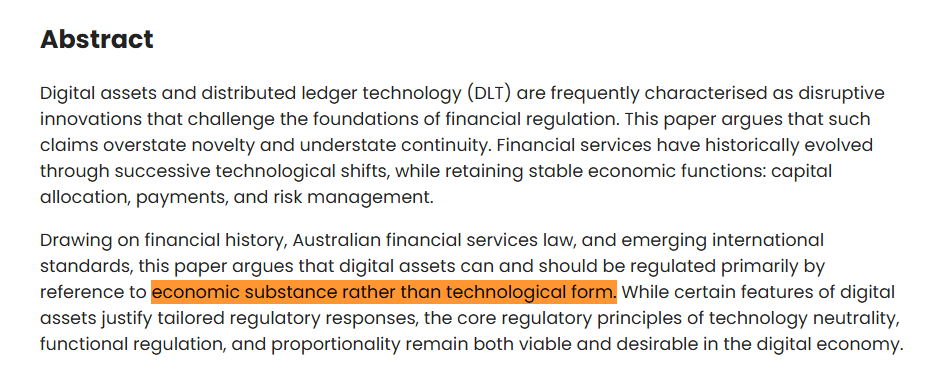
Paper presented at the Melbourne Money & Finance Conference, University of Melbourne by Dr. Rhys Bollen, Senior Executive Leader, FinTech

Crypto-Specific Law

That framing puts Australia at odds with how other countries have gone about it. The US is pushing the CLARITY Act, a purpose-built crypto framework. The European Union has rolled out its Markets in Crypto-Assets rules, known as MiCA. Both create dedicated regulatory structures for digital assets.

Bollen’s position, by contrast, is that building a separate system from scratch misses the point — and leaves gaps that bad actors will find.

“Opportunities for regulatory arbitrage” is how Bollen describes those gaps. Build a crypto-specific law, and someone will structure a product to fall outside it. Attach crypto to existing law based on what the product does, and that exit shrinks.

BTCUSD trading at $69,615 on the 24-hour chart: TradingView

Australia Already Writing It Into Law

Australia isn’t waiting on theory. The country’s Digital Asset Framework bill, currently moving through parliament, doesn’t attempt to replace the Corporations Act.

Reports indicate the bill amends it — slotting digital asset platforms into the existing regulatory structure rather than building a lane beside it.

ASIC’s own guidance document, Information Sheet 225, has already confirmed that existing definitions of financial products and services under the Corporations Act can apply to crypto, depending on how a given asset functions.

Bollen was direct about what that means in practice. Regulators, he said, should be focused on intermediaries — the companies sitting between users and their crypto — rather than on the tokens themselves. That’s where the consumer harm has actually shown up.

Featured image from Cyber Security News, chart from TradingView

相关问答

QAccording to Rhys Bollen, where has most consumer harm in the crypto space originated from?

AMost consumer harm has come not from the tokens themselves, but from the platforms handling them, such as exchanges, custodians, lenders, and yield services.

QWhat is the core argument made by the ASIC FinTech chief regarding how crypto should be regulated?

ACrypto tokens should be judged by their economic function rather than their technological design, meaning a token that acts like a security should be treated as one, and existing financial laws should be applied based on what the product actually does.

QHow does Australia's proposed regulatory approach for digital assets differ from that of the US and EU?

AAustralia is amending its existing Corporations Act to slot digital assets into the current regulatory structure, whereas the US is pushing the purpose-built CLARITY Act and the EU has created a dedicated framework called MiCA.

QWhat does the term 'regulatory arbitrage' refer to in the context of crypto regulation, as mentioned by Bollen?

A'Regulatory arbitrage' refers to the opportunities for bad actors to structure crypto products in a way that falls outside the scope of a purpose-built, crypto-specific regulatory framework, thereby creating gaps in consumer protection.

QWhat is the practical focus for regulators that Bollen suggests to prevent consumer harm in the crypto space?

ARegulators should focus on the intermediaries—the companies that sit between users and their crypto, such as platforms and service providers—rather than on the tokens themselves, as that is where the actual consumer harm has occurred.

你可能也喜欢

黄仁勋戏剧性“拯救”韩国股市

韩国股市在6月5日和8日遭遇大幅下跌,KOSPI指数暴跌并触发熔断。在此市场动荡之际,英伟达CEO黄仁勋访韩,其与SK集团的合作动向对市场产生了显著影响。 黄仁勋与SK集团会长崔泰源、SK海力士CEO郭鲁正举行晚餐会,并确认英伟达新款Vera CPU将采用SK海力士的DRAM内存,双方正为下半年及明年的“超大规模合作”做准备。随后,英伟达与SK海力士官宣了一份多年期技术合作协议,涉及AI超级计算机、机器人、数字孪生和半导体制造。黄仁勋更公开表示AI公司股价目前“非常低”。 合作核心内容包括:英伟达将首款数据中心CPU Vera的内存供应锁定SK海力士,双方将共同开发下一代内存以支持英伟达的AI基础设施路线图。此外,SK海力士将利用英伟达的CUDA-X库和AI技术来加速其半导体设计和制造流程,例如计算光刻和构建晶圆厂数字孪生,以实现更智能的工厂运营。 此次合作有前期铺垫,早在2025年10月,双方就宣布在韩国合作建设大型AI工厂。值得注意的是,在关键的HBM4内存供应上,英伟达采取了多元策略,同时认证了三星、SK海力士和美光三家供应商。黄仁勋判断,由于AI需求旺盛,从晶圆到封装的整个存储芯片短缺状况将持续数年。 黄仁勋此行还会见了现代、LG、三星等韩国企业,显示出英伟达正系统性地加深与韩国科技产业的联系。其访问及释放的积极合作信号,在韩国股市低迷时起到了提振市场信心的作用。

链捕手58分钟前

黄仁勋戏剧性“拯救”韩国股市

链捕手58分钟前

当推理成为稀缺资源,价值由谁捕获

当推理成为稀缺资源,价值由谁捕获?本文探讨了AI算力市场中,推理(inference)正取代训练成为核心瓶颈与价值捕获点的趋势。 2023年提出的“2000亿美元问题”指出GPU超前建设可能带来收入缺口,而2024年该问题已扩大为“6000亿美元问题”。市场近期开始意识到,缺口实际上正通过推理侧的需求来填补。推理是持续性的运营成本,伴随每次模型调用而增长,其市场规模可达训练的10至50倍。 英伟达最新财报将业务重组为“数据中心”与“边缘计算”两大平台,凸显推理已成为战略核心。边缘计算虽当前占比小,但代表了推理向终端设备的延伸。同时,Cerebras的IPO获得超额认购,也因市场看好其专注于推理加速的芯片架构。 Anthropic的案例进一步印证了推理资源的紧张:其因使用量远超产能而接管大型数据中心专用于推理,并对高频的agentic使用改为按量计费,说明推理已成为制约应用扩张的关键因素。 在AI算力栈中,价值沉淀点正在转移。大多数公司只占据从芯片制造到API服务中的某一层,而Hyperbolic作为一家不持有GPU的聚合平台,通过整合多来源的碎片化算力供给,提供统一、低成本的GPU租赁与路由服务,形成了“供给聚合-数据洞察-优化路由-吸引更多用户与供给”的飞轮。与之相比,Venice等应用层公司虽直接面向用户,但其利润受限于向底层购买的推理算力成本,凸显了聚合层在产业链中的潜在优势。 最终,随着agentic AI和物理AI推动推理需求爆发,价值可能不会流向持有最多硬件的公司,而是流向能高效聚合、路由并优化算力资源的那一层。Hyperbolic正试图成为这样的关键聚合层,在推理成为稀缺资源的时代捕获核心价值。

链捕手1小时前

当推理成为稀缺资源,价值由谁捕获

链捕手1小时前

交易

现货
合约
活动图片





