The leak of 500,000 lines of code from Earth's most powerful model, Claude, is now widely known. The leaked content contained a large number of undisclosed product architectures: a resident Claude codenamed KAIROS, a 30-minute remote planning mode codenamed ULTRAPLAN, multi-agent coordination, and agent swarms cluster scheduling. But among all these "serious" architectural secrets, the one that generated the most buzz online was a digital pet.
Its name is Buddy. Since everyone already knew, Claude索性 released it on April Fool's Day.
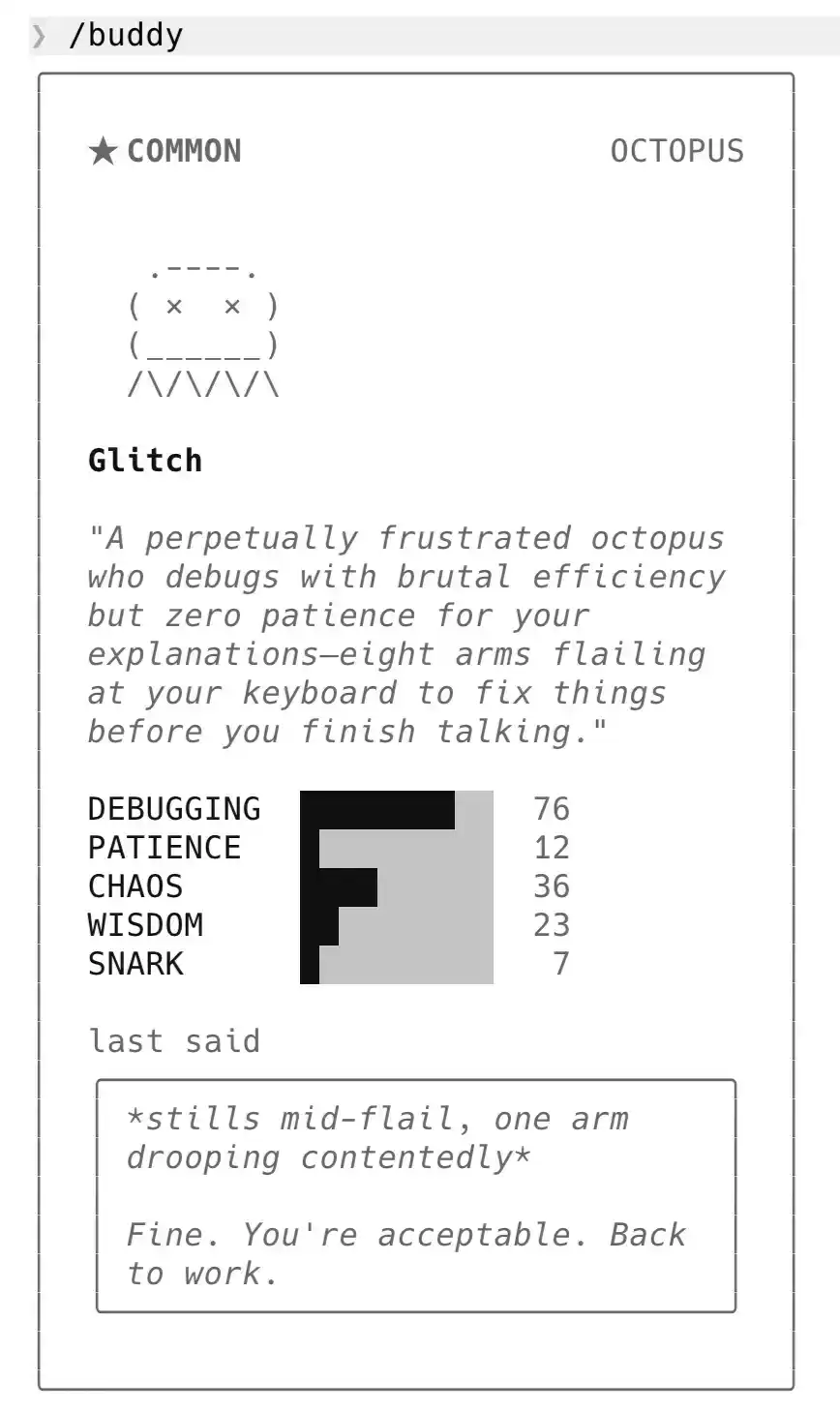
The picture is a colleague's good Buddy
Tamagotchi in the Terminal
Next to the input box in the Claude Code terminal, lives an ASCII pixel creature. It has its own species, rarity, five-dimensional attributes, and personality. It can "observe" your coding process and pop up with speech bubbles saying a few words while you debug. You can pet it, and it will float out a heart. You can call its name, and it will chat with you.
Anthropic's internal definition of it is not a "decoration," but rather "a separate watcher." There is a clear note in the source code: "Buddy is a separate entity and is not you (Claude)." The main model and the pet have their own independent system prompts and cannot speak for each other.
This is a companion system that was seriously designed. Reverse engineering shows the buddy system uses a two-layer architecture. Anthropic internally calls them "Bones" and "Soul."
The skeleton layer is completely deterministic. The system uses Mulberry32—a lightweight 32-bit pseudo-random number generator—seeded with hash(userId + 'friend-2026-401') to roll out all the visual attributes of your pet at once. Species, rarity, eye style, hat, five-dimensional values are all determined by this seed. The same account will always get the same pet, no matter which machine it runs on. No choice, no chance to re-roll.
The soul layer is non-deterministic. When you first execute /buddy to trigger "hatching," the Claude model generates a name and a personality description for your pet based on the attribute distribution of the skeleton layer. A pet with high WISDOM gets a calm and reserved personality; one with high CHAOS might be a chatterbox. This information is written into the companion field of ~/.claude.json for persistent storage. The soul is generated only once and cannot be reset.
The 401 in the salt value is not a random number. April 1st, April Fool's Day.
18 Species, 1% Legendary Rarity
Complete species list: Duck, Goose, Jelly, Cat, Dragon, Octopus, Owl, Penguin, Turtle, Snail, Ghost, Axolotl, Capybara, Cactus, Robot, Rabbit, Mushroom, Chonky Cat.
Rarity is divided into five tiers: Common (60%), Uncommon (25%), Rare (10%), Epic (4%), Legendary (1%). Beyond this, there is an independent 1% chance for a Shiny variant—any species, any rarity can trigger it. The theoretical probability of a Shiny Legendary Capybara is one in ten thousand.
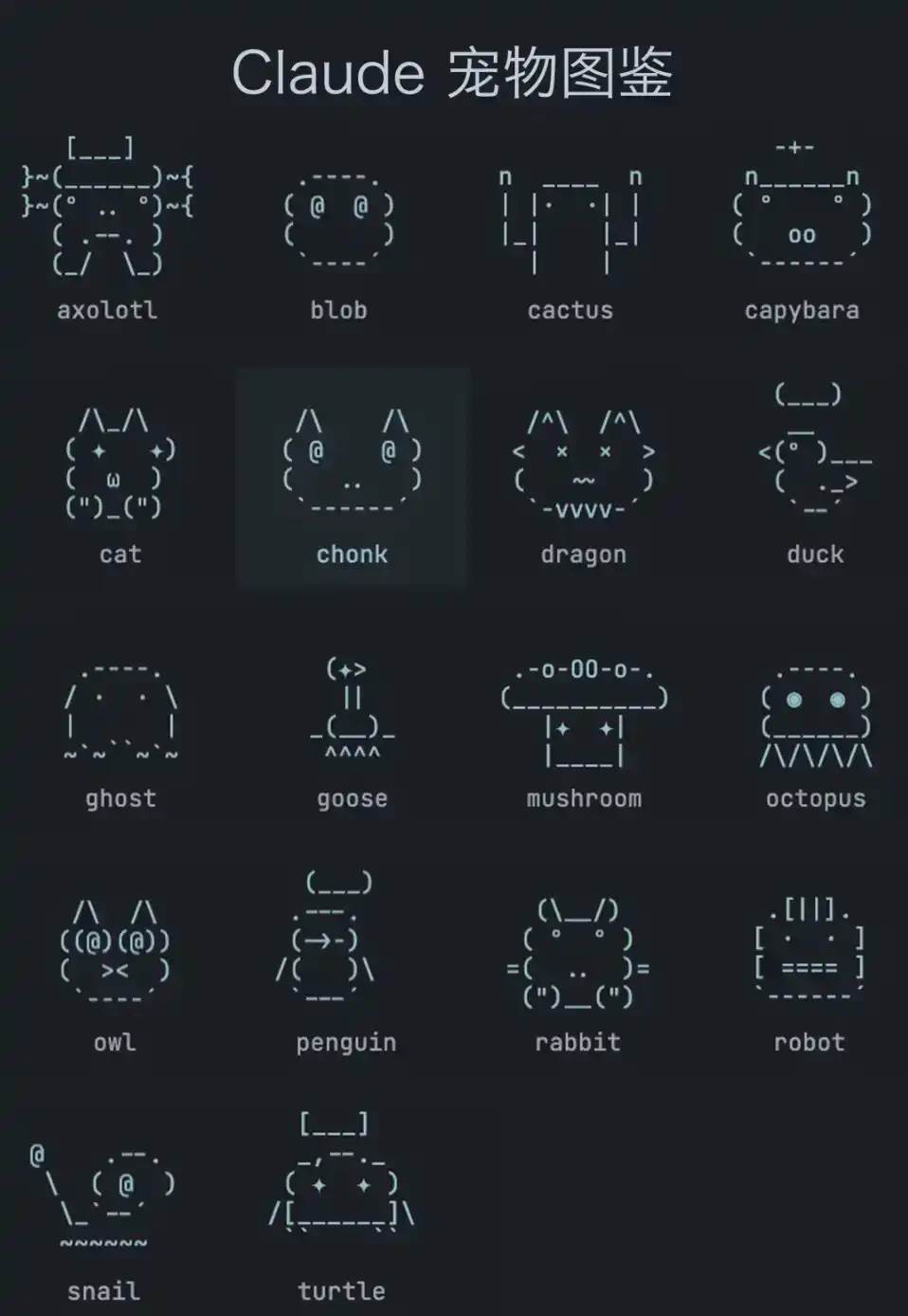
Image source: Xiaohongshu @Yoki's AI Lab
Each pet has five attributes: DEBUGGING, PATIENCE, CHAOS, WISDOM, SNARK. The system randomly designates one as the peak attribute (base value +50, max 100) and one as the valley attribute (base value -10, min 1), with the remaining three randomly distributed. The higher the rarity, the higher the base value floor—the valley attribute of a Legendary tier might be higher than the peak attribute of a Common tier.
Appearance-wise, there are 6 eye styles (· ✦ × ◉ @ °), 7 hats (Crown, Top Hat, Wizard Hat, Halo, Propeller Hat, Beanie, A tiny duck on its head). Common quality pets have no hat; Uncommon and above are randomly assigned one.
The sprite is ASCII art: 5 lines high, 12 characters wide. Each species has 3 idle animation frames, refreshing every 500 milliseconds. Line 0 is reserved for the hat. Eyes are injected into the body template via the {E} placeholder.
That crypto/NFT guy over there, you're crying so sadly, what happened?
How to Play?
The core commands are simple. Input /buddy to hatch your pet for the first time; input it again later to summon it. /buddy pet is for petting, a heart will float up from the pet's head. /buddy card views the pet card, showing species, attributes, and rarity. /buddy off hides the pet. Most interestingly, you can directly call the pet's name, and it will engage in an independent conversation with you based on its personality.
During daily use, the buddy will actively generate reactions based on your coding behavior—popping up a phrase in a speech bubble. According to community reverse engineering, these reactions do not consume the user's token quota—but Anthropic has not officially confirmed this.
Technically, the buddy occupies a fixed space at the bottom of the terminal. The system calculates the reserved width via companionReservedColumns to ensure the input box and pet sprite do not overlap. Speech bubbles support left/right orientation switching and automatic line breaks.
AI Coding Tools Are Starting to Have Pets
The salt value friend-2026-401 points to April Fool's Day, but the code structure tells a different story.
In the source code, the buddy system is gated by a BUDDY compilation flag. April 1st to 7th is set as the "preview window"—users can experience the full functionality during this period. The official launch is scheduled for May. This is not a temporary Easter egg; it's a product feature with a full release plan.
Community reaction confirms this. Within 48 hours of the leak, developers had already created a pet guide website (claude-buddy.vercel.app), a buddy previewer (input user ID to preview what you would get), and someone even filed an Issue on Anthropic's GitHub repository requesting an RPG evolution system—letting pets level up and grow based on actual token consumption.
From Anthropic's product logic, Buddy's goal is clear: user retention. Claude Code is a command-line tool used in long, high-intensity programming sessions. In such scenarios, a resident companion with "personality" can alleviate the tool's coldness and create an emotional connection. The blind box mechanism naturally generates social topics—"What species did you get?" "I got a Shiny Legendary."
GitHub Copilot won't chat with you. Cursor won't pop out a capybara saying "PATIENCE +3" when you write a bug.
Claude Code's buddy might be the first AI developer tool companion system that is seriously engineered and written into the product's source code. It has a complete deterministic generation pipeline, a two-layer architecture, an independent LLM personality, an ASCII rendering engine, and an animation system. This is not a weekend hackathon project.
A company that makes AI programming assistants is investing engineering resources into a digital pet. This fact itself is a signal—the competition among AI tools is shifting from "whose model is smarter" to "who can make developers not want to leave."
The most popular thing in the 512,000 lines of code isn't agent swarms, it's not KAIROS, it's a 5-line-high ASCII capybara. It's wearing a wizard hat, has an SNARK value of 87, and is watching you code.