Original | Odaily (@OdailyChina)
Author | Qin Xiaofeng(@QinXiaofeng 888 )

The much-watched "Crypto-Asset Regulatory Infrastructure and Transparency Act" (CLARITY Act) has, unsurprisingly, faced further delays. Senator Cynthia Lummis previously stated that negotiators expected to finalize a compromise text around July 4th (U.S. Independence Day) and "move forward in July," but progress has clearly lagged.
Now, with the Senate's August 10th recess approaching, the window is shrinking rapidly: the bill must overcome a 60-vote threshold in the Senate (requiring at least 7 Democratic defections), reconcile its text with the Senate Agriculture Committee's version, merge with the House bill, and receive the President's signature. All of this must be accomplished within the next 25 working days, creating an extremely tight timeline.
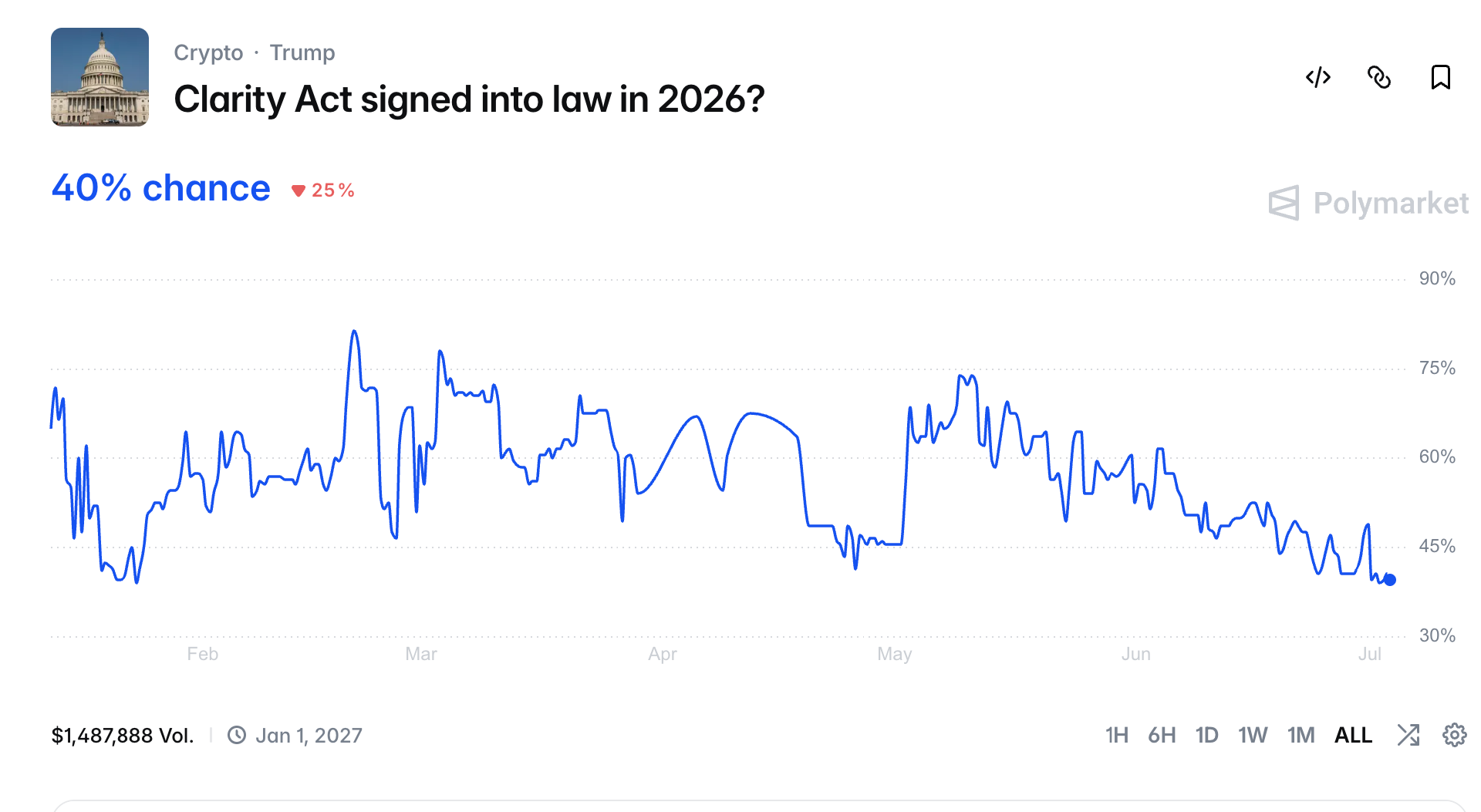
Should the pre-recess window be missed, the probability of the CLARITY Act passing this year drops further. Indeed, data from the prediction market Polymarket shows only a 40% chance of passage this year; Galaxy Digital has also lowered its 2026 passage probability to 50%.
1. A Recap of the CLARITY Act's Latest Progress
The CLARITY Act is landmark crypto market structure legislation being advanced by the U.S. Congress. It aims to clarify the regulatory boundaries between the SEC and CFTC, provide a non-security pathway for decentralized tokens, and require registration and anti-money laundering obligations for digital commodity intermediaries.
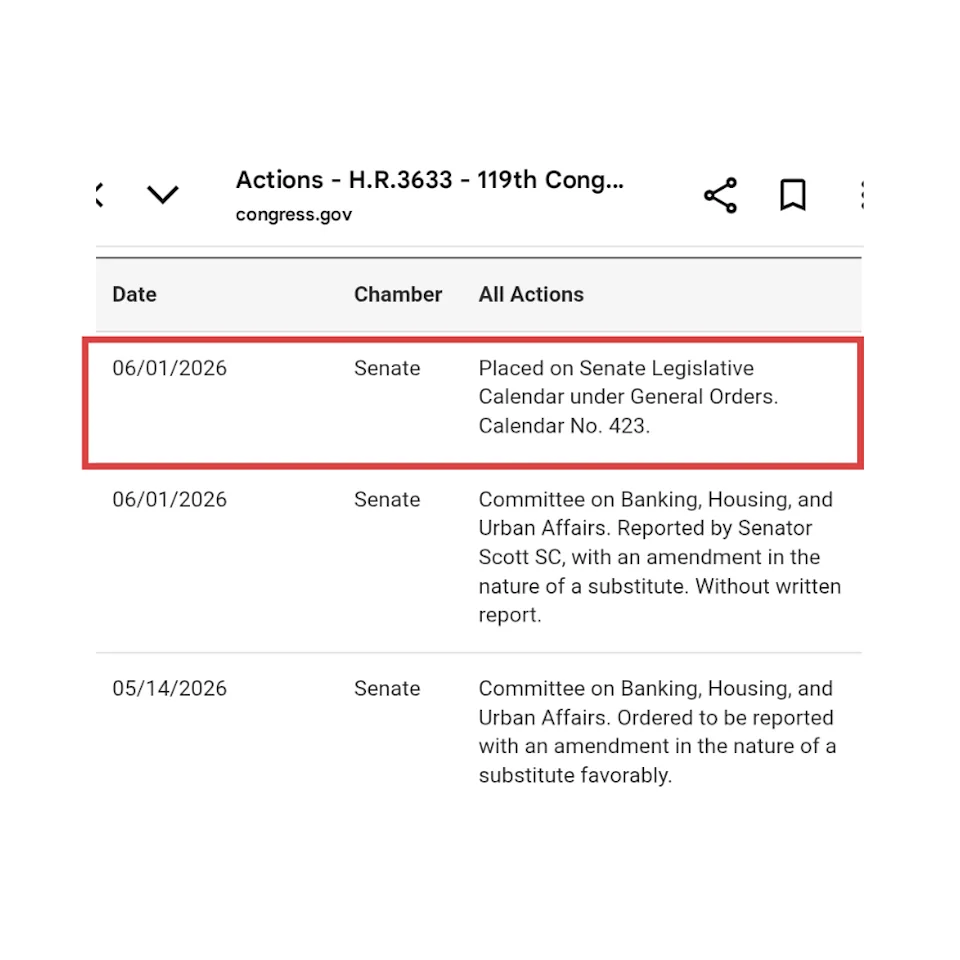
On July 17, 2025, the House passed the HR 3633 bill introduced by French Hill with a vote of 294 in favor and 134 against, receiving over 70 votes from Democrats. On May 14, 2026, the Senate Banking Committee advanced and passed it with a 15-9 vote (supported by 13 Republicans and 2 Democrats). On June 1, 2026, the CLARITY Act was officially placed on the Senate legislative calendar (Calendar No. 423), qualifying it for full consideration.
However, the entire month of June saw little progress for the CLARITY Act. On June 9th, negotiations around ethical provisions concerning presidential crypto holdings broke down, directly leading to softened stances or additional demands from some Democratic senators, slowing the bill's progress to floor debate. On June 10th, the White House met with police and prosecutor groups. Subsequently, an enforcement dispute over Section 604 (the developer protection clause) within the "Blockchain Regulatory Certainty Act" reached a stalemate; if unresolved, law enforcement groups may lobby against it, and Democratic senators might vote 'no' for "insufficient consumer protection/crime fighting."
Simply put, the former is a "political/ethical hurdle," and the latter a "law enforcement/security red line." Together, they constitute the final two major obstacles for the CLARITY Act to "pass" in the Senate before the recess. Failure to resolve them makes it difficult to gather the necessary 60 votes and finalize the text, thus preventing completion of the legislative process before the August 10th recess. These two negotiation points are the key "stumbling blocks" that have directly hindered the final advancement of the CLARITY Act, causing the July 4th target to be missed and the overall progress to stall. Negotiations are still attempting to break the impasse, but time is running extremely short.
Brian Gardner, Stifel's Chief Washington Policy Strategist, stated that for the bill to pass in 2026, "it likely needs to pass the Senate by the end of July, preferably in June," and warned that prospects would worsen significantly if the Senate misses the recess window.
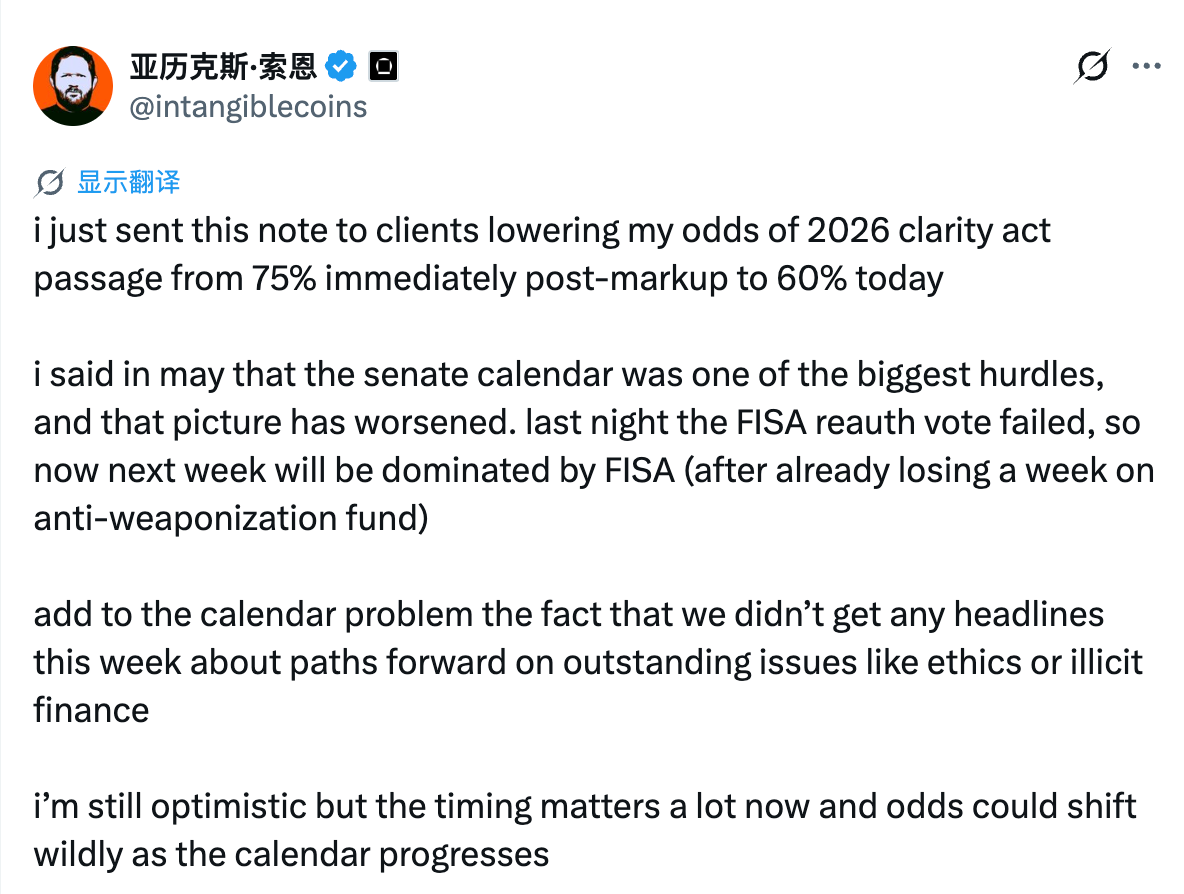
However, the market is not holding much hope for the bill's passage this year. Alex Thorn, Head of Galaxy Research, lowered his 2026 passage prediction from 75% to 60% on June 5th, citing the Senate's increasingly crowded schedule. Data from prediction market Polymarket shows only a 40% chance of passage this year.
2. If the CLARITY Act Doesn't Pass on Schedule, What Will Happen to Crypto?
According to CCN's analysis, if the CLARITY Act fails to pass before the August recess, the market's most likely reaction would not be a crash, but a "slow bleed through premium products." In fact, crypto's poor performance throughout June already indicates the market has begun repricing for legislative uncertainty. (Odaily Note: Here, "premium products" primarily refer to various spot ETFs)
Data shows that throughout June, U.S. spot Bitcoin ETFs saw cumulative net outflows of approximately $4.5 billion, equivalent to about 77,000 BTC redeemed. This marks the largest monthly net outflow since the products launched in January 2024, surpassing the previous record from February 2025 (about $3.56 billion), setting a new worst monthly record.
In fact, XRP might be the asset most directly and significantly impacted by the bill, as it would permanently classify it as a commodity, eliminating the risk of reversible agency interpretation. If delayed long-term or failed, XRP could lose some of its "regulatory upside premium."
Geoffrey Kendrick, Global Head of Digital Assets Research at Standard Chartered, forecasts an XRP price target of $8, contingent on the Senate fully passing the relevant legislation and $4-8 billion in ETF inflows. J.P. Morgan predicts that if the bill passes, XRP ETFs could see inflows of $4.3 billion to $8.4 billion in their first year. Data shows that since the XRP spot ETF launched in November 2025, it has seen cumulative net inflows of about $1.41 billion, with 84% coming from retail; institutional inflows still await clearer regulatory signals.
For Bitcoin, already classified as a commodity via the joint SEC-CFTC interpretation in March 2026, the CLARITY Act's main role is to permanently codify this reversible decision into federal law. Even if the bill fails or is long delayed, Bitcoin's "digital gold" narrative remains relatively robust, facing less direct impact.
The impact on ETH is similar to Bitcoin. Ethereum was also classified as a commodity via the joint interpretation. Bill failure could mean DeFi protocols face prolonged compliance ambiguity longer, suppressing innovation and capital inflows. Standard Chartered's Geoffrey Kendrick forecasted a $7,500 year-end 2026 target for ETH (later revised to $4,000), contingent on the relevant bill passing.
Kristin Smith, President of the Solana Foundation, stated that many asset allocators are actively exploring digital asset investments but are holding back funds due to the lack of clear regulatory guidelines. The same applies to institutional DeFi, where projects are currently on hold awaiting the outcome of Section 604.
3. What Lies Ahead?
There isn't much time left for the CLARITY Act to push through. Several scenarios could unfold:
- 1. Passage before the August recess: The biggest catalyst, potentially leading to a significant price rebound, especially for XRP and related ETFs.
- 2. Postponement to 2027: The market's least desired outcome, extending the "slow bleed" process and keeping institutional capital on the sidelines.
- 3. Failure and push to the next Congress: The CLARITY Act is currently in the 119th Congress. If the Senate floor vote, reconciliation, and final passage are not completed before the August 2026 recess, the entire process cannot conclude within this Congress. When the new Congress (the 120th, 2027-2028) begins, the bill must be reintroduced and go through the entire committee review, floor debate, etc., all over again.
The CLARITY Act is currently at a critical "on the verge but stuck" stage—technically on the Senate calendar, yet political negotiations, the time window, and bipartisan support remain the biggest hurdles.
However, as Vincent Chok, CEO of First Digital, stated: "The CLARITY Act's entry into Senate floor voting itself shows the U.S. is closer than ever to resolving regulatory ambiguity... A successful vote would accelerate this process, but failure wouldn't necessarily stop it. In fact, delays in the U.S. framework could create urgency and extend the time window for setting global standards, potentially allowing the U.S. to become the de facto global digital asset hub."