By | Tingtong Tech (ID:tingtongtech), Author | Chen Ke, Editor | Rao Yan
Just as the market thought the AI video generation battlefield would still be a showdown between ByteDance and Kuaishou, a "dark horse" has joined the game.
Without any预告, without any paper, without any official account, a mysterious video generation model named HappyHorse topped the overseas evaluation platform Artificial Analysis, becoming the new technical throne.
The shockwave this "three-noes" product caused in the AI circle was no less than when AlphaGo defeated Lee Sedol. However, all the "technical fingerprints" and personnel change clues in the market pointed to the same origin: Alibaba. However, Alibaba did not admit it initially when the news broke.
After the market "speculated" for a few days, on April 10th, Alibaba finally claimed HappyHorse, stating it is a model developed by its ATH (Alibaba Token Hub) Innovation Business Unit.
For Alibaba, the "Happy Horse" is not the most eye-catching news this year. In fact, prior to this, whether it was the "triple release" of three flagship models at the end of March, or Qwen3.6Plus breaking the global call volume record, or the restructuring of the technical command, Alibaba's series of actions, like a "hat-trick," showed the market a new way of running.
More interestingly, this wave of密集 releases happened恰好 after researchers like Lin Junyang, Yu Bowen, and Hui Binyuan from the Tongyi Lab left in early March. Previously, the outside world was once deeply concerned about Alibaba's AI progress, and the capital market was also questioning. However, Alibaba quickly made the market look at it differently with the rapid iteration of products and market performance.
The industry jokingly called this the turning point for Alibaba's AI from "scattered" to "systematic"; others said that this time Alibaba is not是为了守住 the old territory of e-commerce, but to expand its territory on the AI map.
The final outcome, the market still cannot give an answer. But undoubtedly, for Alibaba, this is ultimately a gamble.
The stakes are not only huge amounts of money but also the company's "next ten years." Now, Alibaba has placed its heaviest bet in this gamble. Next, it depends on whether Alibaba has more "Happy Horses" breaking out and how far these "Happy Horses" can run.
-01- The Emergence of "Happy Horse"
"Whose model is this anyway?"
That's the answer global AI investors and practitioners wanted to know over the past few days.
In a blind test on the third-party platform Artificial Analysis, HappyHorse-1.0 (Happy Horse) topped the text-to-video track with an Elo score of 1357, leaving other video models far behind.
Insiders even called HappyHorse's emergence a "dimensionality reduction strike" in the video model world.
The reason is simple: HappyHorse not only solved the hard problem of motion logic where previous AI videos "moved like PowerPoint slides," but more importantly, it integrated synchronized audio and video generation. Input a script, and it can not only output high-definition footage but also同步生成 sound effects and even background music that fit the scene.
Public reports stated that "Happy Horse" has extremely bright efficiency metrics, taking only about 38 seconds to generate a 5-second 1080P video on a high-end graphics card. This saves not just time, but also computing power costs. It is rumored that its后续 pricing will be user-friendly, and it will open up some open-source capabilities, potentially reducing post-production costs by more than 50%.
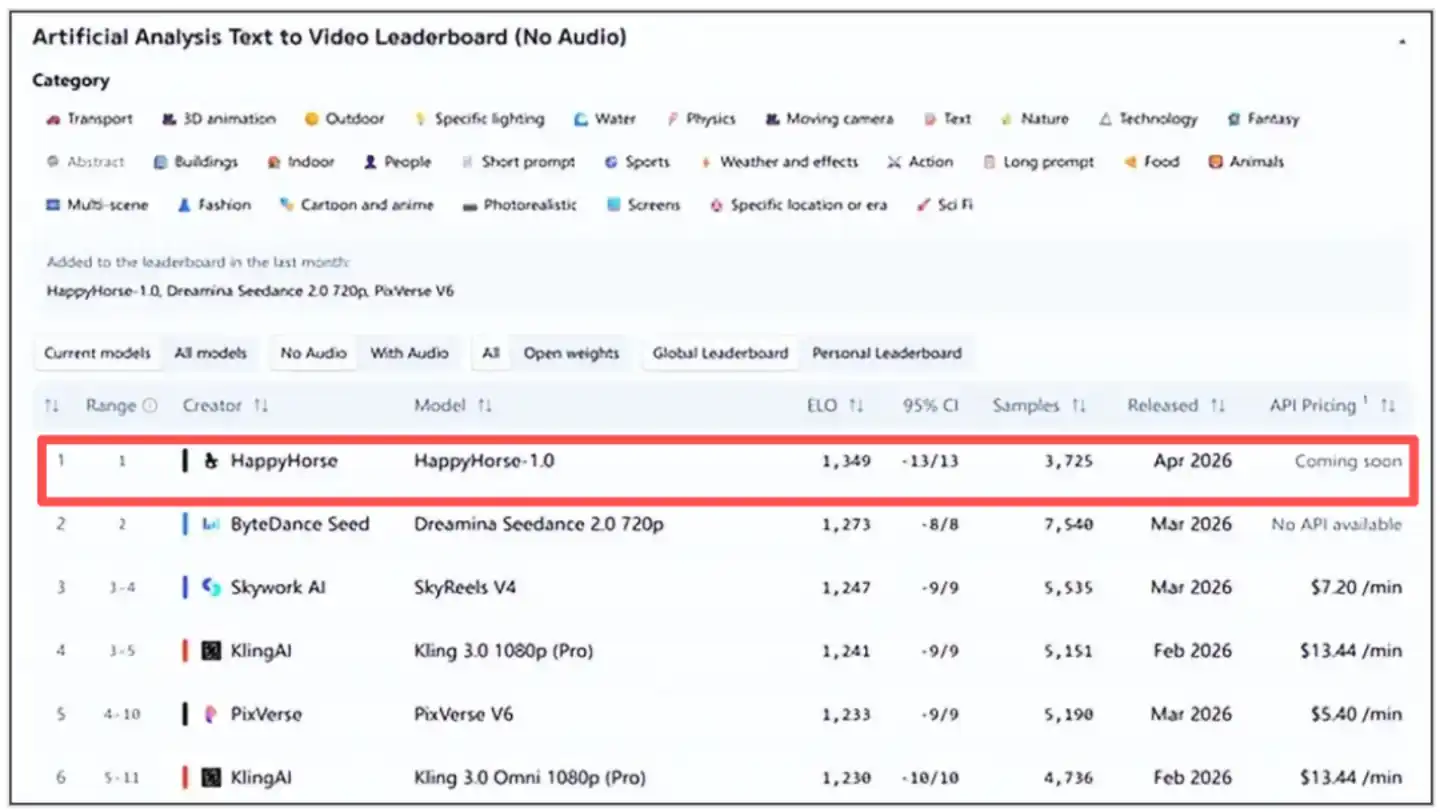
Figure: HappyHorse ranking on Artificial Analysis
Source: Internet
Over the past few days, because the "Happy Horse" was unclaimed, the market was full of curiosity about the origin of this "horse," leading the tech community to collectively play "Sherlock Holmes" to dig into its background.
At that time, many analyses pointed out that "Happy Horse" was an Alibaba product.
The analysis indicated two main evidence chains: first, the technical path displayed by HappyHorse has a very high affinity with the architecture of the Wan 2.6 series just released by Alibaba's Tongyi Lab; second, the return of key figures, Zhang Di, known as the "Father of Kling," who returned to Alibaba at the end of 2025, might have led the team to complete this product in just five months.
After the market "detectived" for a few days, on April 10th, Alibaba finally confirmed that the HappyHorse video model is a model developed by its innovation business unit and is currently in internal testing, with the API interface expected to be launched on April 30th.
It is said that the ATH Innovation Business Unit has launched an exploration plan for a new interactive方式 in the AI era, and HappyHorse is part of this exploration direction. More products will be launched陆续.
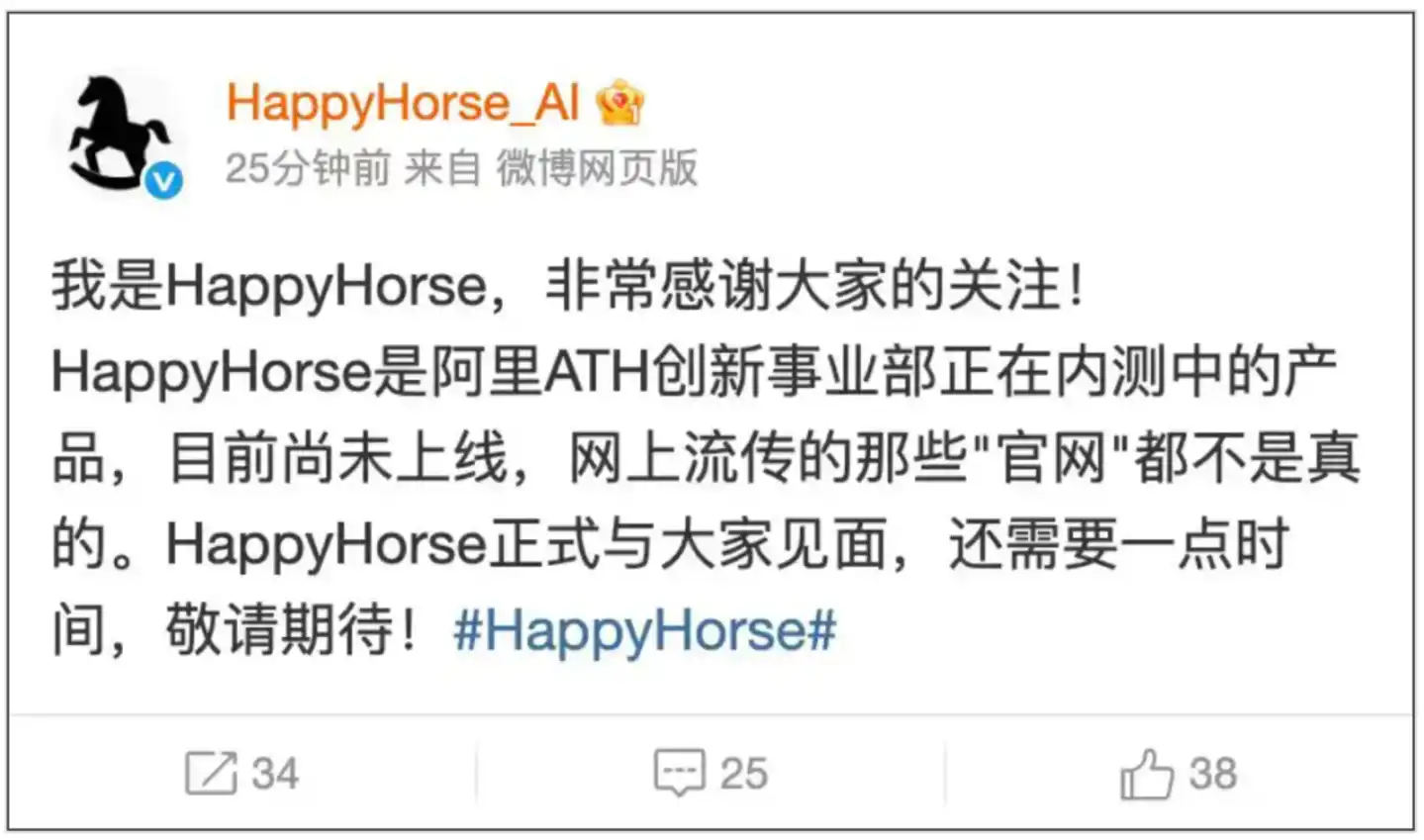
Figure: Alibaba confirms HappyHorse as its product
Source: Weibo 《Tingtong Tech》 Screenshot
At the same time, news indicated that the product was not completed by Zhang Di's team but by Zheng Bo's team from ATH.
Zheng Bo is an Alibaba Group Vice President. Public information shows that Zheng Bo holds a Ph.D. from the Tsinghua University Computer Science Department and joined Alibaba in September 2017. He has served as the head of Taobao Search and Recommendation Algorithms, CTO of Alimama, and head of algorithm technology for Taotian Group. His main research areas include large models, multimodal AI, decision intelligence, deep learning, advertising algorithms, and engine optimization.
This "claiming" news was not surprising to the market. Many analyses pointed out that the emergence of the "Happy Horse" means that Alibaba has completed a leap from "catching up" to "leading" in the multimodal field.
More importantly, this is not just a simple technical muscle show but a strategic "surprise attack" by Alibaba.
In the past, although Qwen was aligned internationally in text models, it rarely had products that captured user mindshare in the AI video track, which has the shortest path to commercialization. The performance of "Happy Horse"验证了 that Alibaba is maintaining a fast offensive pace in full-stack AI.
The market pointed out that the birth of "Happy Horse" accelerates the process of AI video generation moving from the laboratory to commercialization, becoming the "new quality productive forces" for the content industry.
An AI creator, Lin Shao, told 《Tingtong Tech》 that with the rapid iteration of "Happy Horse" and Seedance 2.0, AI video is transforming from a "toy" to a "tool".
Particularly important is that "Happy Horse" has changed the overall industry landscape of AI video large models, marking the entry of the AI video track into a new stage of multi-power melee.
More analyses pointed out that the impact on the former AI video "leader" Kling AI is especially obvious. Lin Shao直言, "Under the influence of Seedance 2.0 and Happy Horse, a 'double strangulation' pattern has formed against Kling AI."
-02- Alibaba's AI Formation
In fact, besides the "Happy Horse," Alibaba has明显 accelerated the推进 speed of its full-stack AI products in the past period.
From late March to early April 2026, Alibaba's Tongyi Lab completed a "triple release" of the full-modal large model Qwen3.5-Omni, the image generation model Wan2.7-Image, and the large language model Qwen3.6-Plus at a "daily update" pace.
This also allowed Alibaba to achieve全方位 matrix coverage of the underlying foundation (Qwen), vertical applications (Coding), and multimodal video (HappyHorse/Wanxiang).
According to a report by China National Radio, Qwen3.6Plus performed on par with or even surpassed competitors with 2 to 3 times larger parameter scales in programming capability evaluations. Just one day after its release, the model rushed to the top of the OpenRouter daily chart, with daily call volume breaking 1.4 trillion Tokens, setting a global record.
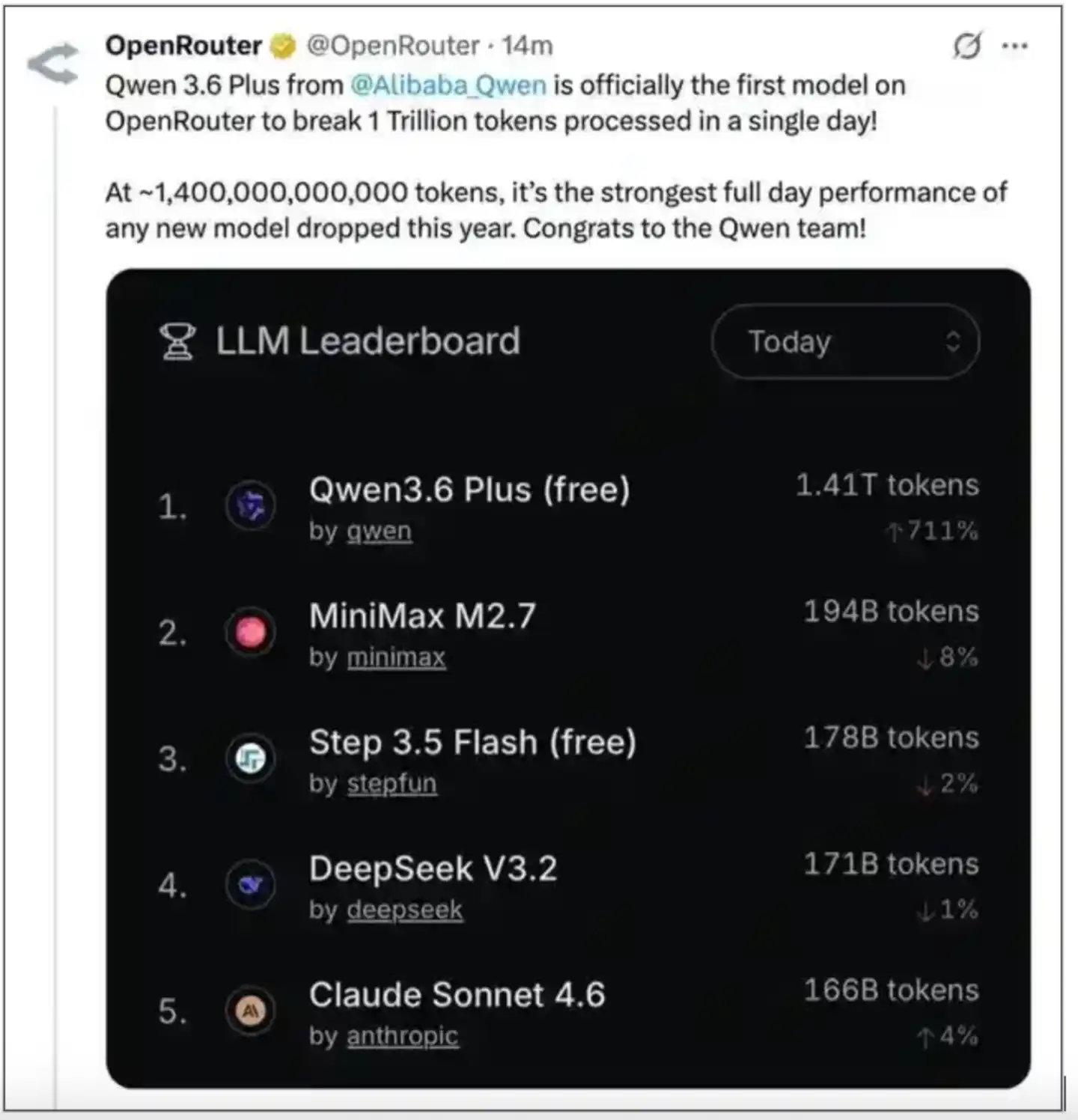
Figure: Qwen3.6Plus tops the OpenRouter daily chart
Source: Internet
Many analyses believe that this density and speed恍惚间让人看到当年阿里在电商领域“碾压一切”的气势 (vaguely reminds people of Alibaba's "crushing everything" momentum in the e-commerce field back in the day).
Actually, Alibaba's offensive is far more than just quickly deploying troops to seize positions.
Public information shows that the Qwen series has already produced multiple data points. As of January 2026, the cumulative downloads of the Tongyi Qianwen series models on the Hugging Face platform had exceeded 700 million, making it the most downloaded open-source AI series on the platform. By February, this number had exceeded 1 billion.
Performance on the C-end is同样亮眼. Public data shows that the monthly active users of the Qwen App have exceeded 300 million. By the end of February, nearly 140 million users had completed their first AI shopping through the Qwen App's智能体 function.
Call volume data also tells a story. According to the latest data from OpenRouter, the global call volume of Chinese AI large models has surpassed that of the US for five consecutive weeks, and two of the top three are models from Alibaba's Qwen 3.6 series.
This strategy is also being validated by the market. Alibaba's latest financial report data shows that Alibaba Cloud revenue increased by 36% year-on-year, and AI-related product revenue has achieved triple-digit year-on-year growth for the tenth consecutive quarter.
Of course, in the view of the market, Alibaba's ambition is far more than just making a few good models.
Judging from Alibaba's various actions in 2026, Alibaba is trying to重塑 its commercial底色, shifting from "selling goods" to "selling Tokens."
At Alibaba's earnings conference in March, Alibaba Group CEO Wu Yongming stated that in the future, relying on the full-stack AI capability of "large model + cloud + chip," and the comprehensive integration with Alibaba's business ecosystem, Alibaba will continue to exert efforts in both AI to B and to C directions.
Wu Yongming used "full-stack AI capability" to summarize Alibaba's core competitiveness, with chips and cloud computing as the AI infrastructure layer, and Token Hub as the main line, composed of large models, MaaS business, and ToB+ToC applications forming the AI model and application layer.
This system also nests chips, computing power, models, and applications layer by layer, forming a complete closed loop from the bottom to the front end.
This means that in the past, Alibaba's e-commerce story was about GMV and user growth; the cloud business story was about infrastructure and customer scale. Now, Alibaba is telling a new story, the full-stack AI story of "large model + cloud + chip".
-03- The Key to the "Sudden" Acceleration
Whether it is the emergence of the "Happy Horse" or the sudden acceleration of the Qwen series, the market has raised a question: Hasn't Alibaba's AI capability always been there? Why does it feel like this is a "sudden"爆发?
One of the key answers is "system."
In the past, Alibaba's AI could be described as "scattered." Damo Academy did research, Alibaba Cloud built platforms, and Taotian Group developed applications. Each had its own turf, inevitably leading to internal friction. Superficially, it looked like multiple points were blooming and advancing separately, but in reality, it wasted resources and was inefficient in coordination.
But all this was broken.
The change began this spring.
On March 16th, Alibaba established the Alibaba Token Hub (ATH) business group, personally led by CEO Wu Yongming. It includes the Tongyi Lab, MaaS business line, Qianwen business unit, Wukong business unit, and AI Innovation business unit, covering the complete chain from basic model R&D to personal and enterprise AI applications.
In the view of the market, the establishment of ATH is precisely about dismantling departmental barriers from the top-level design, eliminating the situation where model R&D, computing power supply, and application落地各自为战. The core logic is also very clear: "create Tokens, deliver Tokens, apply Tokens,"打通 the computing power layer, model layer, and application layer.
But this is not enough.
On April 8th, Alibaba conducted an even deeper organizational restructuring. Wu Yongming announced the establishment of a technology committee at the group level, with himself serving as the leader. Zhou Jingren serves as the Chief AI Architect of the technology committee, Li Feifei is responsible for Alibaba Cloud technology and AI cloud infrastructure construction, and Wu Zeming is responsible for the group's business technology platform and AI inference platform construction.
At the same time, the Tongyi Lab was officially upgraded to the "Tongyi Large Model Business Unit,"全面负责 by Zhou Jingren. This upgrade marks the shift of AI technology from R&D-oriented to full-scale commercial use.
Coupled with Li Feifei taking up the role of Alibaba Cloud CTO and Wu Zeming focusing on his group CTO work, Alibaba's AI governance architecture has formed a clear troika: the group technology committee is responsible for top-level design, the ATH business group is responsible for the business closed loop, and the Tongyi Large Model Business Unit is responsible for core R&D.
A series of system integrations also directly contributed to the recent "hat-trick" of密集 model releases.
Beyond organizational changes, the hardest force driving acceleration is money and resources.
For this AI battle, Alibaba's capital investment has reached the point of不计成本. In the latest quarterly report, Alibaba's free cash flow plummeted by 71% year-on-year. Where did the money go? There are two answers: one is burned on instant retail, and the other is burned on AI.
In the talent war, Alibaba also acted出击 quickly. Although it experienced the departure of people like Lin Junyang, it is understood that the personnel scale and technical梯队 of the Tongyi Lab were not substantially impacted.
Wu Yongming also responded in an internal letter that they will continue to increase AI R&D investment and the efforts to absorb outstanding talent. Additionally, the return of former Kuaishou VP and Kling technical负责人 Zhang Di in November 2025 is also a trophy of Alibaba's talent grab.
Especially in terms of the computing power base, in early 2025, Alibaba announced it would invest over 380 billion yuan in the next three years for云 and AI hardware infrastructure construction. In terms of T-Head's self-developed GPU chips, mass production has been achieved规模化. As of the end of February, cumulative deliveries had reached 470,000 units. This also means that Alibaba is摆脱 external dependence in computing power.
However, with such a big fanfare of burning money, does the capital market really buy it?
At least, judging from the current stock price reaction, the signal given by the market is that under the concept of organizational adjustment and "Happy Horse," Alibaba's stock price rose accordingly.
Of course, there are also different voices in the market.
E-commerce expert Cao Lei said that Alibaba also faces several challenges: how to balance centralization and business flexibility to avoid the technology committee becoming a "rubber stamp"; additionally, two major架构 adjustments in a short period may cause employee adaptation issues, affecting team stability.
Although the outcome is not yet determined, one fact is that Alibaba has shown sufficient sincerity in undertaking full-stack AI entrepreneurship.
This is a豪赌, concerning Alibaba's next ten years. And in the new round of organizational restructuring and ecological synergy, whether more "Happy Horses" will emerge is still worth waiting for the market.
(Header image generated by AI.)
(Disclaimer: This article is for information exchange only and does not constitute any investment reference advice.)





















