Vitalik Buterin is urging the Ethereum ecosystem to get bolder about what it builds on top of the chain—while drawing a hard line around the base layer’s core guarantees—arguing that a first-principles reset on applications, wallets, and even culture could be necessary for Ethereum’s next phase.
In a post on X, the Ethereum co-founder said “it’s healthy for us in the Ethereum world to have a more bold and open mindset,” especially on the application layer and “how we see ourselves in the world.” That openness, he argued, should not drift into ambiguity about what Ethereum’s L1 is supposed to protect.
“We should not compromise on core properties: censorship resistance, open source, privacy, security (CROPS),” Buterin wrote. “We should not have ‘open mindedness’ of the type that leaves people with no confidence of what security properties the L1 will still have one year from now.” He added that Ethereum should not backslide into questioning fundamentals like whether “light clients” should “trustlessly verify correctness of the chain.”
Where the rethink should happen, in his framing, is the interface between Ethereum and users: the application stack, its assumptions, and the social conventions that shape what builders consider “serious” work.
Ethereum AI Wallets, But With Guardrails
Buterin tied part of the shift to AI, floating a scenario where “wallets as browser extensions and mobile extensions are dead within a year?” On Farcaster, he made the point more directly: “Pretty obvious that the next iteration of wallets will heavily involve AI.”
Still, he stressed that higher-value usage can’t simply outsource trust to a model. “I would not trust an LLM with multi-million transactions or funds,” he wrote, describing what he sees as the “optimal workflow” for large transfers: “AI proposes a plan, local light client simulates it, you see the action and the simulated outcome and manually confirm it.”
The pay-off, he suggested, is that moving away from today’s dapp-heavy interaction model could reduce risk. If done “conservatively with lots of emphasis on security,” Buterin argued, removing dapp UIs “from the picture completely” could eliminate “a large number of attack vectors (for both theft and privacy).”
‘Rip Off The Suit And Tie’
Buterin pointed to privacy as a recent example of Ethereum changing its priorities at the application layer. He described last year’s “shift to thinking about privacy as a first-class consideration,” which, he argued, implies “a radically different Ethereum application stack” because “the entire stack so far has not been built around privacy.” This year, he said, that has expanded into “growing work on the networking side of privacy, both inside the EF and outside.”
He also sketched more provocative app-layer thought experiments, including whether “the rest of defi is basically just universal futures markets on top of a good decentralized oracle and letting users self-organize on top of that,” and even whether “the ideal decentralized oracle is just a SNARK over M-of-N small LLMs over zk-TLSes of some major news sites?” In his view, AI pushes “applications” away from discrete products with discrete UIs and toward a continuous space—making “build fewer apps and rely on users to self-organize around them” a pattern that could expand.
On scaling, he said Ethereum is also “rethinking from zero the role of L2s, and what kind of L2s are actually most synergistic and additive to Ethereum,” framing it as another area where past assumptions may no longer hold.
Buterin framed culture as a non-technical constraint that can quietly narrow what gets built. Referencing “the whole milady thing,” he argued the subtext is to “rip off the suit and tie,” describing a deliberately irreverent break from “respectable” postures: “Take the preconception that you are ‘respectable’, write it down on a piece of paper, crumble it up and burn it. The psychological baptism of doing this leads to the intellectual baptism of unlocking greater creativity and expanding overton windows.”
He closed his X post with a challenge to builders: stop iterating one step at a time from today’s usage patterns and instead imagine Ethereum’s application layer as if starting from a blank page. “If YOU had to write the section of the 2014 Ethereum whitepaper that talked about applications... what would you write?” he asked, urging people to “mark all path-dependence concerns down to zero” and see what new designs emerge.
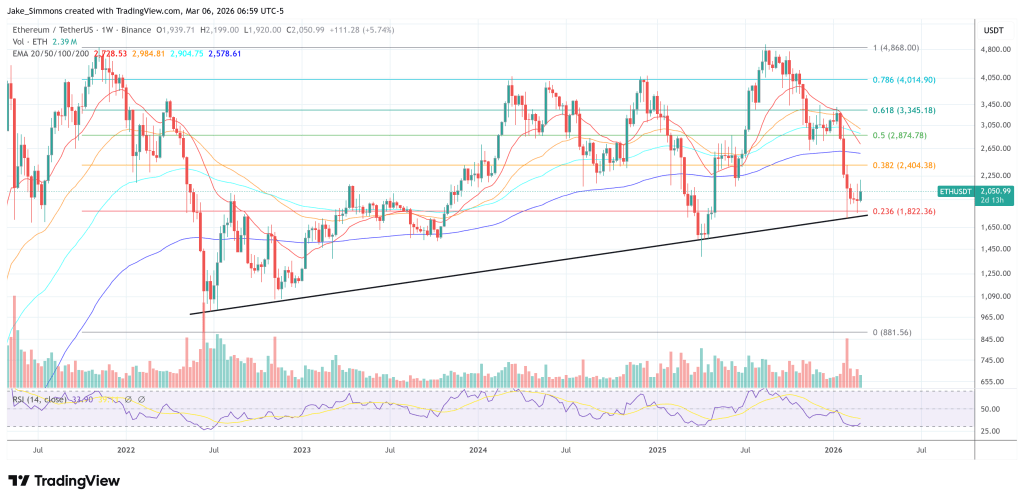
At press time, ETH traded at $2,050.